INDIA’S TRADE DEFICIT
TOPIC: (GS3) ECONOMY: THE HINDU
India’s overall trade deficit dropped by 9.4% in the first quarter of FY 2025, mainly due to an 11% rise in services exports. The total exports are on track to exceed the previous year’s record.
What is Balance of Payments (BoP)?
- The Balance of Payments (BoP) is a record of all economic transactions made between a country and the rest of the world during a specific time period (usually a year or a quarter).
- It shows how much money is coming in and going out of the country.
Main Components of BoP:
Current Account: Includes trade in goods and services, income, and current transfers
- Exports – Imports of goods → Trade Balance
- Export – Import of services
- Remittances and foreign aid
Capital Account: Deals with capital transfers and acquisition/disposal of non-produced, non-financial assets (very small in India’s case)

Trade Performance
- India’s overall exports rose to $210.3 billion in April-June 2025, showing a 6% increase from last year’s $198.5 billion.
- The trade deficit reduced to $20.3 billion, compared to the same quarter last year.
- Growth in services exports was the key reason behind the narrowing trade gap.
Growth in Services Exports
- Services exports went up to $98.1 billion, marking an 11% rise from last year’s $88.5 billion.
- This strong performance helped offset slower growth in merchandise exports.
Merchandise Trade Trends
- Merchandise exports saw only a 2% rise to $112.2 billion.
- The slow growth is largely due to the fall in petroleum prices.
- Non-petroleum exports, however, improved by 6% in the same period.
Imports Overview
- Overall imports grew by 4.4% to $230.6 billion. Goods imports increased by 4.2%. Services imports grew by 4.9%.
Top Performing Export Sectors
- Electronics exports surged by 47.1% to $12.4 billion.
- Marine products rose by 19% to $1.9 billion.
- Tobacco and tea exports grew by 19% and 16% respectively.
Import Surge in Select Commodities
- Highest increase in imports seen in: Sulphur & iron pyrites (284%), Silver (216%), Chemical products (142%), Raw cotton (73%)
Top Trade Partners
- Top export destination: United States ($25.5 billion), with a 22.1% growth.
- Other major export partners: UAE, Netherlands, China, UK.
- Top import source: China ($29.7 billion), with 16% rise.
- Other key importers: UAE, Russia, U.S., Iraq.
WHAT IS TRADE DEFICIT?
A trade deficit occurs when a country imports more goods and services than it exports. It means money is flowing out of the country to pay for foreign products.
- Trade Deficit = Total Imports – Total Exports
- If imports > exports → Trade Deficit
- If exports > imports → Trade Surplus
Example: If India imports ₹100 crore worth of goods and exports only ₹70 crore: Trade Deficit = ₹100 crore – ₹70 crore = ₹30 crore
What is Primary Deficit?
- Primary Deficit is the fiscal deficit minus the interest payments made by the government on past loans.
- It shows how much the government is borrowing for its current expenses, excluding interest payments.
- Primary Deficit = Fiscal Deficit – Interest Payments
Why It Matters: It helps us know if the government’s deficit is because of new spending or just paying old debt.
Conclusion:
India’s trade performance in Q1 of FY25 was supported by strong services exports and electronic goods, helping reduce the trade deficit significantly.
PROTECTING INDIA’S LINGUISTIC SECULARISM
TOPIC: (GS2) INDIAN POLITY: THE HINDU
Recent tensions in Maharashtra over language-based violence have brought attention to the importance of protecting India’s linguistic diversity, which is a key part of its secular and democratic framework.
What is Secularism?
- Secularism means that the government stays neutral in matters of religion and treats all religions equally. It does not favour or discriminate against any religion.
- Secularism is the idea that the State and religion are separate, and everyone has the freedom to follow any religion or no religion at all.
Key Features of Secularism:
- Religious Freedom: Every person has the right to profess, practice, and propagate their religion (Article 25 of the Indian Constitution).
- No State Religion: India does not have an official religion. The government does not promote or support any one religion.
- Equal Treatment: The State gives equal respect and protection to all religions.
Secularism in the Indian Context
- Indian secularism is distinct from Western secularism, which promotes a complete separation of religion from the state.
- In India, secularism is not neutral — the Constitution actively protects religious and linguistic rights.
- The state does not favour or oppose any religion or language but steps in to prevent communal or linguistic dominance.
Constitutional Safeguards for Linguistic Diversity
- Article 343: Hindi in Devanagari script is the official language of the Union.
- However, States are free to choose their own official languages, respecting local cultures.
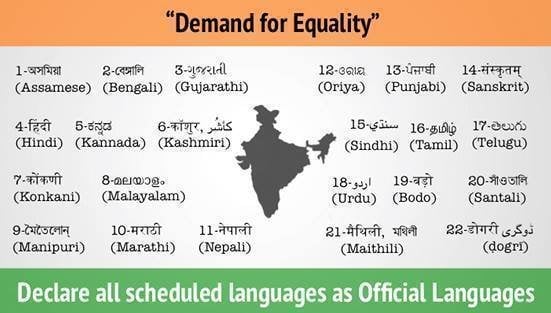
- Eighth Schedule of the Constitution lists 22 scheduled languages.
- Article 29 gives all citizens the right to preserve their language, script, and culture, especially minorities.
- According to the 2011 Census, India has 121 languages and 270 mother tongues. About 96.7% of Indians speak one of the 22 scheduled languages.
Current Language-Related Issues
- Several southern and northeastern States have resisted Hindi imposition due to concerns of cultural dominance.
- The Dravidian movement in Tamil Nadu has strongly upheld the status of Tamil and promoted English as an alternative.
- Maharashtra has recently witnessed language-linked violence against non-Marathi-speaking communities, raising serious concerns.
Need to Preserve Linguistic Harmony
- Language must not become a tool of exclusion or identity-based violence.
- True cultural protection comes from tolerance, liberalism, and mutual respect.
- India’s strength lies in its unity in diversity, including religious, linguistic, and cultural coexistence.
- The Constitution guarantees space for all languages — official or non-official — and demands mutual respect.
Way Forward
- Political parties must play a responsible role in safeguarding India’s diverse languages.
- Government policies must ensure equal treatment and representation of all linguistic groups.
- Promoting inclusive national identity while respecting regional languages is essential for national integrity.
- In a globalising world, linguistic conservatism can damage social unity and weaken India’s secular values.
Conclusion:
Preserving India’s linguistic diversity is crucial for upholding the spirit of secularism and maintaining social harmony. Respecting every language equally reinforces national unity.
CRIMINALISING ADOLESCENT RELATIONSHIPS UNDER POCSO
TOPIC: (GS2) INDIAN POLITY: THE HINDU
The Supreme Court, in Right to Privacy of Adolescents (May 2025), ruled that sentencing the accused would harm the girl involved, highlighting systemic failures in handling consensual adolescent relationships under the POCSO Act.
Background of the Case
- A 14-year-old girl left her home to live with a 25-year-old man.
- The girl and the man later married and had a child.
- He was charged under POCSO for aggravated sexual assault, child marriage, and kidnapping.
- The Special Court sentenced him to 20 years, but the Calcutta High Court overturned this.
- The Supreme Court later restored the conviction but chose not to send him to jail.
Supreme Court’s Stand
- Used Article 142 to deliver complete justice.
- Took into account the girl’s hardships, financial struggles, and emotional toll.
- Chose not to imprison the man as it would hurt the woman further.
Concerns with Current POCSO Application
- The law does not consider consensual relationships among adolescents.
- Many such cases involve youth above 16 years in romantic relationships.
- Research (Enfold study) shows over 24% of POCSO cases are about consensual adolescent bonds.
- Victims in such cases often refuse to testify, showing disagreement with prosecution.
Need for Legal Reform
- Current laws ignore adolescent agency and treat all acts as exploitation.
- State systems often fail — through institutionalisation, stigma, and legal delays.
- Experts suggest revising laws to allow non-exploitative consensual relations among adolescents aged 16+.
- Courts urge for reforms like sex education, counselling, and better child welfare support.
POCSO ACT (PROTECTION OF CHILDREN FROM SEXUAL OFFENCES ACT, 2012)
Important Features of POCSO Act
- Child-Centric Law: Applies to all children under 18 years of age, regardless of gender.
- Defines Multiple Offences: Covers penetrative and non-penetrative sexual assault, sexual harassment, and use of children for pornography.
- Mandatory Reporting: Any person who has knowledge of an offence must report it. Failure to do so is punishable.
- Child-Friendly Procedures: Police and court must use child-sensitive language, and no aggressive questioning is allowed.
- Special Courts: Every district must have a Special POCSO Court to ensure speedy trial.
- Presumption of Guilt: The burden of proof is on the accused, not the child.
- In-Camera Trial: The identity of the child victim must be protected; trials are held privately (in-camera).
Conclusion:
Justice must shift from criminalising all adolescent intimacy to recognising their rights, choices, and context, especially when there’s no exploitation or coercion.
FOREST GOVERNANCE AND COMMUNITY RIGHTS
TOPIC: (GS2) INDIAN POLITY: THE HINDU
The Chhattisgarh Forest Department’s attempt to control the implementation of Community Forest Resource Rights (CFRR) under the Forest Rights Act (FRA), 2006 sparked strong opposition. It was seen as a violation of gram sabhas’ legal authority over forest management and was later withdrawn.
Background on CFR and FRA
- The Forest Rights Act (2006) recognises the rights of gram sabhas to manage and protect forests they have traditionally used.
- Community Forest Resource Rights (CFRR) aim to correct colonial-era policies that removed forest control from local communities.
- The recent move by Chhattisgarh’s forest department to act as the nodal agency for CFRR violates this provision.
Forest RIGHTS ACT (FRA), 2006
- Recognises Forest Dwellers’ Rights: Gives legal rights to Scheduled Tribes (STs) and other traditional forest dwellers to live in and use forest land.
- Types of Rights Given
- Individual rights: to live in forest land, grow crops, collect minor forest produce.
- Community rights: to access, manage and conserve forests.
- Community Forest Resource (CFR) Rights: Gram Sabhas can manage forests through their own plans, ensuring sustainable use and local control.
- Eligibility Conditions: People must have lived in the forest for 75 years or more (for non-STs) and must depend on it for livelihood.
- Gram Sabha is the Authority: Local Gram Sabha decides claims and has the final say in giving forest rights.
- No Eviction Until Claims are Settle: Forest dwellers cannot be removed from land unless all legal claims are processed.
Conflict Between Gram Sabhas and Forest Departments
- The department directed that CFR plans must follow a model from the Ministry of Tribal Affairs (MoTA), which is not legally binding.
- It also barred NGOs and other officials from helping gram sabhas with their plans.
- After protests by tribal groups and local leaders, the order was withdrawn.
Issues with Traditional Forest Working Plans
- Forest departments use working plans focusing on timber production, a model rooted in colonial forestry.
- These plans often ignore biodiversity, local needs, and scientific scrutiny.
- Although updated to include conservation goals, they still exclude local communities from real decision-making.
Gram Sabhas’ Vision for Forests
- FRA empowers gram sabhas to create CFR management plans that address livelihoods, ecology, and climate concerns.
- These plans are meant to replace working plans in CFR areas.
- However, only a small fraction of over 10,000 CFRR-holding gram sabhas have been able to implement their plans due to official resistance.
Challenges and Way Forward
- Forest departments delay, reject or undermine CFR claims to retain control.
- MoTA’s changing stance — including a 2024 circular requiring CFR plans to match the National Working Plan Code (NWPC) — adds confusion.
- NWPC’s timber-focused methods do not match the diverse needs of forest communities.
- Local plans reflect lived knowledge and offer better adaptive strategies for climate and ecological challenges.
Panchayats (Extension to Scheduled Areas) Act – PESA, 1996
- Applies to Scheduled Areas: Extends panchayat powers to tribal areas under Fifth Schedule of the Constitution.
- Empowers Gram Sabhas: Gram Sabhas must be consulted before land acquisition, rehabilitation, or development projects.
- Control Over Natural Resources: Villages have the right to manage minor water bodies, forests, and minor minerals.
- Traditional Rights Protected: Recognises customary laws, social and religious practices of tribal communities.
- Decision-Making Power: Gram Sabhas must approve plans, programmes, and projects before implementation in their area.
- Checks Exploitation: Aims to protect tribals from displacement and exploitation by giving legal control over local resources.
Conclusion
To make forest governance people-centric, MoTA must defend FRA’s spirit, enable flexible planning, and push forest departments to shift from timber-focused to community-driven forest management.
GLOBAL SHIPPING INDUSTRY DECARBONISATION
TOPIC: (GS3) ENVIRONMENT: THE HINDU
As the global shipping industry aims to decarbonise by 2040-2050, India sees a strategic chance to promote green fuel production and boost shipbuilding, with initiatives for green ammonia and methanol gaining traction.
Why Decarbonisation is Needed
- Shipping mainly uses VLSFO, diesel, and LNG — all carbon-intensive.
- The industry is transitioning to cleaner fuels to meet net-zero goals by 2050.
- Green fuels such as green ammonia, e-methanol, and biofuels are being considered.
Types of Green Fuels and Production
- Green hydrogen is made through water electrolysis using renewable energy.
- Green ammonia is made by combining green hydrogen with nitrogen — more stable and suited for shipping.
- Green methanol is created by mixing green hydrogen with captured CO₂ from industries.
- Methanol is easier to handle than ammonia and needs fewer engine modifications.
Challenges in Using Green Fuels
- High cost: E-methanol costs ~$1,950/ton vs $560/ton for VLSFO (Feb 2024, Singapore).
- Limited supply: Estimated demand of 14 million tonnes by 2028, but supply may only reach 11 million tonnes.
- Slow adoption: Shipping is traditionally conservative in adopting new tech.
India’s Decarbonisation Plans for Shipping
- India plans to use green fuels in domestic shipping and set up fuel bunkering hubs at Tuticorin and Kandla.
- Focus on exporting green fuels to Singapore, a global fuelling hub.
- Backed by India’s solar power capacity and manufacturing expertise.
Steps for Building a Green Fuel Hub
- Electrolysers and solar panels are currently imported — increasing local production is key.
- PLI schemes for electrolysers can support local manufacturing.
- Sovereign guarantees can lower capital costs and attract foreign investment.
- Carbon capture incentives needed for green methanol based on industrial CO₂.
- Target of 1.5 GW electrolyser capacity and use of multilateral funding at low interest rates (4%).
Reviving Indian Shipbuilding with Green Focus
- India pledged $10 billion to buy over 110 ships.
- Plans to build 10-20% of these with green fuel capability in Indian shipyards.
- Partnerships with South Korea and Japan for technology and retrofitting are underway.
- Promotes Indian-flagged, eco-friendly vessels to revive domestic shipowning.
WHAT IS DECARBONATION?
Decarbonation (also called decarbonization) refers to the process of reducing carbon dioxide (CO₂) emissions, especially those produced by burning fossil fuels such as coal, oil, and gas.
- Decarbonation means reducing the amount of carbon released into the atmosphere to fight climate change.
Conclusion:
India can become a global green fuel hub by aligning its clean energy push with shipping decarbonisation. Strategic policies, local manufacturing, and global partnerships will be key to success.
CONFINED FIELD TRIALS OF GM MAIZE IN PUNJAB
TOPIC: (GS3) ENVIRONMENT: THE HINDU
Punjab Agricultural University has received approval to conduct field trials of genetically modified (GM) maize varieties during the Kharif 2025 season, following clearance by the Genetic Engineering Appraisal Committee (GEAC) and the Punjab government.
Details of the Trials
- The trials are to test herbicide-tolerant and insect-resistant GM maize developed by Bayer Crop Science Ltd.
- Objectives: Test weed control using glyphosate-K salt. Check resistance of maize against lepidopteran pests.
Purpose and Concerns
- Punjab Agricultural University (PAU) clarified the trials are for research only, not commercial recommendation.
- GM-Free India Coalition opposed the trials, citing: Health and environmental risks of glyphosate. A Punjab government ban on glyphosate use already exists.
- Legal and safety concerns over field-testing glyphosate-resistant crops.
Concerns about GM Crops:
- Possible health and environmental risks.
- Loss of biodiversity and seed sovereignty.
- Opposition from farmers’ groups and NGOs.
- Dependence on multinational seed companies.
What are GM Crops?
- GM crops (Genetically Modified crops) are plants whose genetic material is altered using biotechnology.
- They are developed to improve resistance to pests, tolerance to herbicides, or enhance nutritional content.
Features of GM Crops:
- Insect Resistance: Genes from bacteria like Bt (Bacillus thuringiensis) are inserted to kill specific pests.
- Herbicide Tolerance: Crops can survive spraying of weed-killing chemicals (like glyphosate).
- Drought and Disease Tolerance: Future GM crops are being developed to survive water shortage or viral attacks.
Status of GM Crops in India:
- Approved GM Crop: Bt Cotton (approved in 2002) is the only GM crop legally grown in India. It helped reduce pesticide use and increase yield.
- Other GM Crops (Not approved for commercial use):
- Bt Brinjal – Approved by regulators but banned in 2010 due to safety concerns.
- GM Mustard (DMH-11) – Awaiting final approval for commercial cultivation.
- GM Maize (corn) – Trials approved for research purposes.
Regulation in India:
- Regulated by the Genetic Engineering Appraisal Committee (GEAC) under the Ministry of Environment, Forest and Climate Change.
- Field trials require State government approval.
Conclusion
The issue reflects a broader debate over the safety and regulation of GM crops and herbicides in India.
CYBERCRIME RISK IN DELHI: A GROWING CONCERN
TOPIC: (GS3) SCIENCE AND TECHNOLOGY: THE HINDU
In 2024, Delhi citizens lost over ₹700 crore due to cybercrimes, revealing a serious rise in digital fraud and highlighting gaps in awareness, reporting systems, and institutional support.
Rising Cyber Threats in Delhi
- Delhi is among the top cities in India facing cybercrime incidents.
- Increased use of internet banking, online payments, and digital platforms has made people vulnerable to online scams.
- Despite the Information Technology Act, 2000, many cyber police stations lack trained officers.
Public Awareness and Preventive Actions
- Over 90% of people are aware of traditional scams like fake OTP calls and banking frauds.
- New scams like ‘digital arrest’ are less known (only 61% aware).
- Awareness of reporting mechanisms is low: Only 42% know about helpline 1930. Only 25% are aware of cyber police stations.
- Preventive habits: 87% avoid unknown links, 85% use trusted apps., Only 50% use antivirus or change passwords regularly.
Digital Divide and Risk
- High-income groups use more safety measures like antivirus (73%) and two-factor authentication (75%).
- Low-income users are less protected and have less trust in digital security.
Reporting and Redressal Challenges
- Only 21% of victims report cybercrime.
- Traditional platforms (police, banks) are preferred over digital ones.
- 70% of victims did not recover lost money.
- 48% are dissatisfied with institutional help.
Way Forward
- 40% citizens demand more awareness campaigns over technical changes.
- Improving digital literacy and trust in systems is essential.
- Government and public must share responsibility for digital safety and data protection.
WHAT IS CYBERCRIME?
Cybercrime refers to illegal activities using computers, mobile devices, or the internet. These crimes target data, networks, individuals, or financial systems.
Types of Cybercrime
- Financial Fraud: Includes online banking frauds, fake UPI payments, phishing, OTP fraud. Example: Getting tricked into sharing bank details via fake calls or links.
- Phishing & Email Scams: Fake emails or websites designed to steal personal information like passwords or credit card numbers.
- Identity Theft: Criminals steal personal details (Aadhaar, PAN, etc.) to open fake bank accounts or commit fraud.
- Hacking: Unauthorized access to computers or networks to steal, alter, or destroy data.
- Ransomware Attacks: Malware locks your files and demands money to release them.
- Cyberstalking: Repeated online harassment using emails, messages, or social media.
Government Measures to Prevent Cyber Crimes
- Cyber Crime Helpline – 1930: 24×7 helpline number to report financial cyber frauds quickly.
- Indian Cyber Crime Coordination Centre (I4C): Helps coordinate investigations and training between different law enforcement agencies.
- CERT-In (Indian Computer Emergency Response Team): Monitors cyber threats and issues advisories to prevent attacks.
- IT Act, 2000: Legal framework to deal with cybercrime offences like hacking, identity theft, and data breaches.
- Data Protection Bill (Draft Stage): Aims to safeguard users’ personal data from misuse online.
Conclusion:
Delhi’s citizens are digitally aware but remain vulnerable due to weak support systems and unequal access to protection tools. A more inclusive, responsive, and trusted cyber safety framework is urgently needed.
INDIA AT SCO
TOPIC: (GS2) INTERNATIONAL RELATIONS: INDIAN EXPRESS
External Affairs Minister S. Jaishankar raised concerns over terrorism at the Shanghai Cooperation Organisation (SCO) Foreign Ministers’ meeting in China, referring to the Pahalgam attack in Jammu & Kashmir.
India’s Key Message at SCO
- Mr. Jaishankar urged SCO members to take a firm stance against terrorism, separatism, and extremism — the core principles on which SCO was founded.
- He condemned the April 22 Pahalgam terror attack that targeted tourists, saying it aimed to disrupt Kashmir’s tourism and create religious division.
- Emphasised the importance of justice for the victims and highlighted the UN Security Council’s resolution on the attack.
Criticism of Pakistan and Focus on Trade
- He indirectly criticised Pakistan for blocking India-Afghanistan trade transit.
- Highlighted the need for better connectivity through the International North South Transport Corridor (INSTC) via Iran.
India’s Role:
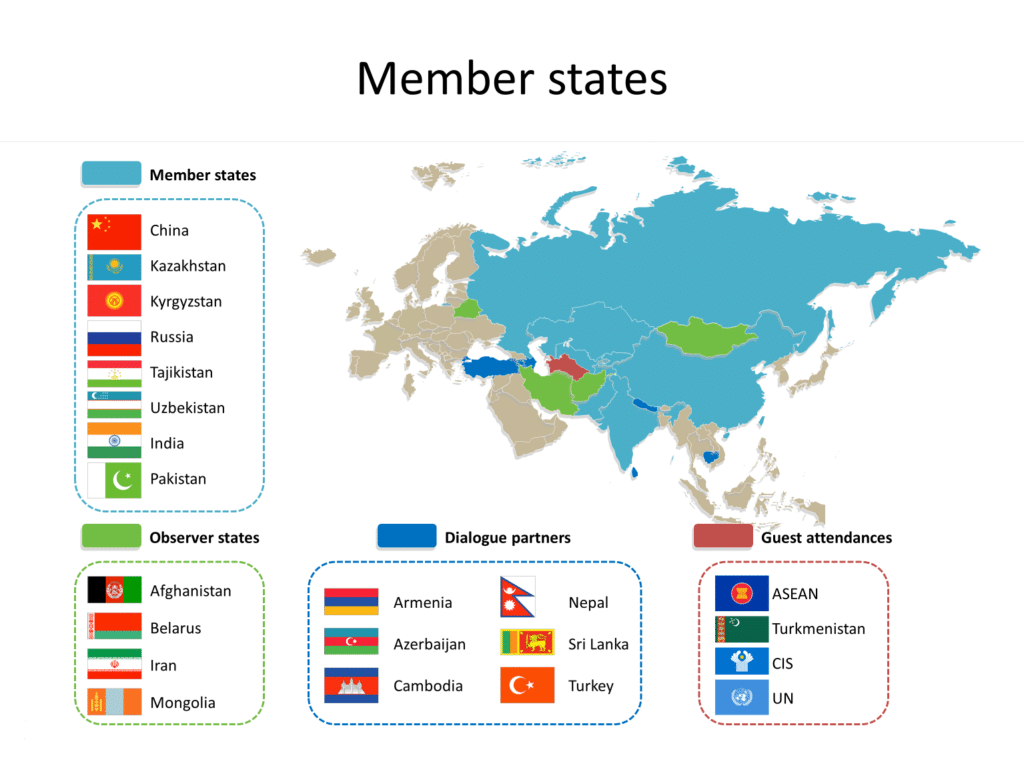
- India became a full member in 2017.
- India uses SCO to discuss issues like Afghanistan, terrorism, trade, and connectivity.
- SCO gives India a platform to engage with Central Asia and counter China’s influence.

WHAT IS SCO?
- SCO stands for Shanghai Cooperation Organisation.
- It is a regional group of countries formed to promote peace, security, economic cooperation, and counter-terrorism in Eurasia.
- Initially started as the Shanghai Five in 1996, it became the SCO in 2001.
Headquarters:
- SCO’s headquarters is in Beijing, China.
- The members of SCO are: China, Russia, India, Pakistan, Kazakhstan, Kyrgyzstan, Uzbekistan, Tajikistan, and Iran.
Conclusion
India reaffirmed its zero tolerance towards terrorism and sought greater unity within SCO to maintain regional peace and cooperation.