

Daily Current affairs 16 March 2026

Daily Current Affairs 16-March-2026

Share this Post

OIL PRICES AND GEOPOLITICAL RISKS

TOPIC: (GS3) ECONOMY: THE HINDU

Crude oil prices surged to $118 per barrel last week due to the ongoing West Asia conflict, highlighting how geopolitical tensions beyond supplydemand factors.

Background

  • Brent crude rose from $57.56 in December 2025 to over $118 in March 2026, a 100% increase.
  • Around 20% of global oil supply passes through the Strait of Hormuz, while 10% of seaborne crude flows through Bab elMandeb and Suez.
  • Conflicts in West Asia and strategic rivalries have disrupted supply chains, raising freight costs and insurance premiums.

What is Brent Crude Oil?

  • Definition: Brent crude refers to a blend of light, sweet crude oils originally from the North Sea (Brent, Forties, Oseberg, Ekofisk, Troll fields).
  • Benchmark Role: It is the reference price for ~66% of internationally traded crude oil.
  • Origin: First extracted from the Brent oilfield in 1976; now includes multiple North Sea grades and other blends.
  • Comparison: Alongside WTI (West Texas Intermediate) and Dubai/Oman crude, Brent is one of the three main global benchmarks.

How Brent Prices Are Decided

  • Global Supply and Demand: Production levels by OPEC+, US shale, and other producers. Consumption trends in Asia (India, China) and OECD countries.
  • Geopolitical Risks: Conflicts in West Asia, RussiaUkraine war, Chokepoints like the Strait of Hormuz and Suez Canal or sanctions can disrupt supply routes.
  • Financial Markets:Prices reflect not only physical supply but also investor sentiment, speculation, and hedging.
  • Currency Movements: Oil is priced in US dollars; fluctuations in USD value affect Brent prices globally.
  • Strategic Petroleum Reserves (SPRs): Announcements of releases (e.g., G7 releasing 400 million barrels) can calm markets and lower prices.

Key Challenges

  • Supply Disruptions: Closure of chokepoints like Hormuz and Suez raises risks for global trade. Freight rates for supertankers have more than doubled.
  • Price Volatility: Oil prices fluctuate 5–10% within days of military or diplomatic developments. Prices now reflect geopolitical sentiment as much as physical supply.
  • Financial Market Influence: Oil traded as a financial asset (futures, derivatives) amplifies volatility. Speculative positions expand even when inventories are stable.
  • Strategic Petroleum Reserves (SPRs): Used not only for physical shortages but also to calm market psychology. Example: G7 announced release of 400 million barrels to ease volatility.
  • India’s Vulnerability: India imports over 85% of its crude needs. Rising costs affect fiscal balance, inflation, and current account deficit.

Way Forward

  • Diversify Import Sources: Strengthen ties with Africa, Latin America, and US suppliers.
  • Expand SPR Capacity: Build larger reserves to cushion against shocks.
  • Boost Renewable Energy: Accelerate solar, wind, and green hydrogen adoption.
  • Enhance Maritime Security: Collaborate with global partners to secure trade routes.
  • Financial Hedging: Develop expertise in managing oil futures and derivatives to reduce exposure.

Conclusion

For India, resilience lies in diversification, strategic reserves, renewable energy, and diplomatic engagement. Energy security today means managing not only supply but also financial and geopolitical risks.

SUPREME COURT PUSHES FOR AGRICULTURAL DIVERSIFICATION

TOPIC: (GS3) ECONOMY: THE HINDU

The Supreme Court of India has directed the Union government to revisit its crop policy and encourage farmers to shift from waterintensive crops like wheat and paddy towards pulses.

What is Agricultural Diversification?

  • It means moving away from dependence on a few staple crops (mainly rice and wheat) to a wider mix including pulses, oilseeds, fruits, vegetables, livestock, and fisheries.
  • Aim: reduce risks, improve farmer incomes, conserve resources, and ensure nutritional security.

Why India Needs Diversification

  • Water Scarcity: Paddy requires ~3,000–5,000 litres of water per kg; pulses need far less, making them ecofriendly.
  • Nutritional Security: Pulses are the main protein source for millions; India still imports ~2–3 million tonnes annually.
  • Income Stability: Diversified farming reduces dependence on volatile cereal markets.
  • Climate Resilience: Crop variety lowers vulnerability to droughts and floods.
  • Employment Generation: Allied sectors like dairy, fisheries, and horticulture create rural jobs.
  • Economic Role: Agriculture contributes ~18–20% of GDP and employs ~45% of India’s workforce (Economic Survey 2025–26).

Challenges

  • Policy Bias: MSP and procurement heavily favour rice & wheat; pulses lack strong support.
  • Small Landholdings: Difficult for marginal farmers to experiment with new crops.
  • Infrastructure Gaps: Poor storage, transport, and marketing facilities.
  • Price Volatility: Imports of yellow peas and other pulses depress domestic prices.
  • Awareness Issues: Farmers often lack knowledge of diversification benefits.
  • Regional Imbalance: North India remains heavily dependent on paddy cultivation.

Current scenario

  • Pulses production: ~27 million tonnes in 2024–25, demand ~32 million tonnes → imports fill the gap.
  • Horticulture output: Surpassed foodgrain production, showing diversification in allied sectors.
  • Livestock sector: Accounts for ~30% of agricultural GDP, growing faster than crops.
  • Groundwater depletion: Punjab & Haryana face critical stress due to paddy monoculture.

Way Forward

  • Policy Reform: Expand MSP coverage to pulses and oilseeds; ensure timely procurement.
  • Stakeholder Committees: Involve groundlevel experts and farmer representatives (as directed by SC).
  • Infrastructure Development: Invest in storage, cold chains, and rural markets.
  • Awareness Campaigns: Educate farmers on benefits of crop diversification.
  • Promote Allied Sectors: Encourage dairy, fisheries, and horticulture for income diversification.

Conclusion

Agricultural diversification is essential for food security, farmer welfare, and climate resilience. India must move beyond its ricewheat cycle to pulses, oilseeds, aligning with national goals of reducing imports, and improving rural livelihoods.

MANDATORY MENSTRUAL LEAVE

TOPIC: (GS2) POLITY: THE HINDU

On March 13, 2026, the Supreme Court refused to entertain a petition seeking a law for mandatory menstrual leave for women workers and students.

Background

  • Some States have introduced menstrual leave policies:
    • Odisha: One extra day of leave per month for women government employees.
    • Kerala: Leave for female trainees in ITIs and universities.
    • Karnataka: One day of leave per month for women in public and private sectors (challenged in High Court).
  • Concerns exist that such policies may discourage private employers from hiring women.

Court’s Reasoning

  • Mandatory leave could reinforce biological determinism, limiting women’s opportunities for promotions and responsibilities.
  • Women already face systemic barriers such as unequal pay and workplace discrimination.
  • Suggested that menstrual leave policy should be framed after consultation with stakeholders.

Why It Is Necessary

  • Health & WellBeing: Menstruation can cause severe pain, fatigue, and discomfort; leave helps women manage their health without stress.
  • Workplace Equality: Recognizes biological differences and ensures fair treatment for women employees.
  • Productivity Boost: Rest during difficult days can improve overall efficiency and reduce absenteeism.
  • Social Awareness: Helps break stigma around menstruation and normalizes conversations about women’s health.

What It Is Not

  • Not a Privilege: It is a healthbased necessity, not an extra benefit.
  • Not Gender Discrimination: It does not reduce women’s capability; instead, it supports equal participation.
  • Not Unlimited Leave: It is structured and limited to specific days, not a blanket holiday.
  • Not a Replacement for Other Rights: It complements, but does not substitute, maternity leave or general sick leave.

Challenges

  • Workplace Disadvantage: Employers may avoid hiring women due to perceived productivity loss.
  • Poor Enforcement: In countries like Spain (2023 law), few women opted for menstrual leave.
  • Misuse Concerns: Reports from Zambia show misuse of such provisions.
  • Informal Sector Issues: Majority of Indian women work in informal jobs where leave policies are unenforceable.
  • Economic Reality: Many women cannot afford to lose wages by taking leave.

Way Forward

  • Provide free sanitary products and medicines at workplaces. Allow flexibility under existing leave provisions instead of separate mandatory leave.
  • Encourage voluntary policies by States and employers. Focus on gender parity in recruitment, pay, and promotions to address systemic disadvantages.

Conclusion

A balanced approach combining voluntary leave, workplace support, and systemic equality measures  is essential to ensure that wellintentioned policies do not backfire against women’s participation in the workforce.

RIGHT TO DIE WITH DIGNITY

TOPIC: (GS2) POLITY: THE HINDU

The Supreme Court recently allowed withdrawal of life support for Harish Rana, who had been in a Persistent Vegetative State (PVS) for 13 years, applying the Common Cause guidelines (2018, modified 2023).

What is Passive Euthanasia?

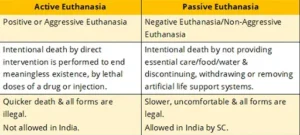
  • It means withdrawing or withholding medical treatment that prolongs the life of a terminally ill patient.
  • Example: stopping ventilator support or discontinuing lifeprolonging medicines.
  • Unlike active euthanasia (directly causing death), passive euthanasia allows natural death by not artificially extending life.

Background in India

  • Aruna Shanbaug Case (2011): Supreme Court allowed passive euthanasia under strict guidelines, making India one of the few countries to legally recognize it.
  • Living Will (2018 Judgment): SC upheld the right to die with dignity as part of Article 21 (Right to Life). It permitted individuals to draft an Advance Directive (Living Will) stating their wish to refuse life support in case of terminal illness.
  • Procedure: Requires approval from a medical board, judicial oversight, and consent of family members to prevent misuse.
  • Legislative Gap: India still lacks a comprehensive statutory law; current framework is based on Supreme Court judgments.

Constitutional Basis

  • Article 21: Protection of life and personal liberty – interpreted to include dignity, autonomy, and privacy.
  • Article 39(e) & (f): Directive Principles – protect health and dignity of citizens.
  • Article 47: Duty of the State to improve public health.
Right to Die with Dignity                          

Judicial Evolution

  • Gian Kaur vs State of Punjab (1996): Held: Right to life includes dignity but not right to die.
  • Aruna Shanbaug vs Union of India (2011): Recognised passive euthanasia under strict safeguards. Guidelines framed until legislation is enacted.
  • Common Cause vs Union of India (2018): Constitution Bench recognised right to refuse medical treatment as part of dignity under Article 21. Introduced Advance Directives (Living Will) and medical board procedures.
  • Harish Rana Case (2026): Court held Clinically Assisted Nutrition and Hydration (CANH) qualifies as medical treatment.

Present India’s Stance

  • Passive euthanasia allowed under SC guidelines.
  • Active euthanasia (deliberate act to end life) remains prohibited.
  • No comprehensive legislation yet; SC has urged Parliament to enact a law.
  • Current framework rests on judicial guidelines + medical board oversight.

Challenges

  • Legislative Gap: Absence of statutory law governing euthanasia.
  • Safeguards vs Accessibility: Balancing prevention of misuse with ease of implementation.
  • Ethical Dilemmas: Reconciling sanctity of life with individual autonomy.
  • Medical Preparedness: Need for trained medical boards and standardized protocols.

Way Forward

  • Comprehensive Legislation: Enact a clear law on euthanasia and end-of-life care.
  • Enhanced Care Services: Strengthen palliative care and hospice facilities.
  • Transparent Procedures: Establish accountable medical board processes.
  • Advance Directives: Promote awareness and acceptance of Living Wills.
  • Ethical Balance: Safeguard individual autonomy while respecting societal values.

Conclusion

The jurisprudence on euthanasia reflects India’s gradual recognition of the right to die with dignity as part of Article 21. While courts have provided safeguards, the absence of legislation remains a gap. A humane, balanced law is essential to uphold dignity while preventing misuse.

HOUSE DECORUM AND RESTORING THE MAJESTY OF PARLIAMENT

TOPIC: (GS2) POLITY: THE HINDU

On March 11, 2026, the Lok Sabha rejected by voice vote a resolution under Article 94(c) of the Constitution seeking removal of Speaker Om Birla.

Background

  • Parliament is the foundation of representative democracy, meant to hold the executive accountable.
  • Increasing partisanship and singleparty dominance have eroded the deliberative role of legislatures.
  • Similar tensions were seen earlier in 2024 when an Opposition resolution was moved against Rajya Sabha Chairman Jagdeep Dhankhar.

Issues Raised

  • Alleged denial of opportunities to raise substantive issues.
  • Microphones of Opposition MPs often switched off during debates.
  • Leader of Opposition Rahul Gandhi interrupted multiple times during speeches.
  • Disallowance of references to sensitive matters (e.g., former Army Chief’s memoir, Adani issue, EUUS trade deal).

Government on Speaker’s Functioning

  • Allocation of Time: The government argued that the Opposition was given 56% of Zero Hour time, ensuring adequate opportunity to raise issues.
  • Parliamentary Questions: Opposition MPs asked 364 supplementary questions, which was more than the 321 questions raised by NDA MPs, despite the ruling party’s majority.
  • Productivity of the House: The Speaker’s tenure was marked by high productivity, with debates conducted in 14 regional languages, reflecting inclusivity and efficiency.

Constitutional Provisions

  • Article 93: Lok Sabha elects Speaker and Deputy Speaker.
  • Article 94(c): Speaker can be removed by a resolution passed by majority of all members.
  • Article 118: Parliament makes rules for its procedure and conduct of business.
  • Article 105: Parliamentary privileges and freedom of speech in the House.

Challenges

  • Erosion of Parliamentary Norms: Chairs dragged into political conflict.
  • Declining Deliberation: Important issues sidelined due to disruptions.
  • Partisanship: Government and Opposition locked in confrontation rather than cooperation.
  • Public Trust: Perception of Parliament as a partisan battleground weakens democratic legitimacy.

Way Forward

  • Strengthen Neutrality of Presiding Officers: Uphold impartiality of Speaker/Chairman.
  • Ensure Equal Opportunity: Balanced time allocation for government and Opposition.
  • Promote Consensus Building: Encourage dialogue across party lines.
  • Institutional Reforms: Use technology for transparency, strengthen committee system.
  • Restore Decorum: MPs must adhere to rules of debate and respect parliamentary traditions.

Parliamentary Question Tools

Starred Questions

  • Require an oral answer in the House.
  • Supplementary questions can be asked on the spot.
  • Marked with an asterisk (*).
  • Encourage direct accountability and debate.

Unstarred Questions

  • Require a written reply only.
  • No supplementary questions allowed.
  • Useful for detailed factual information.

Short Notice Questions

  • Asked with shorter notice period (10 days instead of 15).
  • Admitted when the matter is urgent and of public importance.
  • Answered orally, allowing supplementary questions.

Questions to Private Members

  • Directed to MPs who are not Ministers.
  • Relate to private member bills, resolutions, or other parliamentary business.
  • Ensures accountability beyond the government.

Purpose of Question Hour

  • Held in the first hour of a sitting of Lok Sabha and Rajya Sabha.
  • Provides MPs an opportunity to seek information and hold the government accountable.
  • Strengthens transparency and responsiveness in governance.

Conclusion

Parliament must remain a forum of accountability and constructive debate, not a stage for partisan conflict. Both ruling and Opposition parties must rise above politics to restore dignity, neutrality, and effectiveness of the House.

TRUMP’S COERCIVE DIPLOMACY AND GLOBAL FALLOUT

TOPIC: (GS2) INTERNATIONAL RELATIONS: THE HINDU

Recent reports highlight that U.S. military interventions under President Donald Trump’s second tenure (2025) have reached the highest level in over a decade.

Background

  • President Trump began his second term in January 2025, promising to act as a “peacemaker and unifier.”
  • Despite these claims, U.S. external military actions have sharply increased, contradicting his stated goal of ending foreign wars.
Trumps Coercive Diplomacy & Global Falloutwebp

Surge in Military Interventions

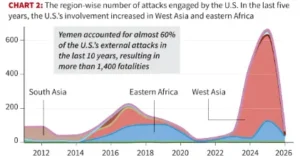
  • Data from ACLED shows 663 external military events in 2025, including airstrikes and armed disruptions.
  • This marks a 50% rise compared to 2024, making it the highest in 15 years.
  • Casualties in 2025 exceeded 1,000 deaths, surpassing figures from previous years.

Regional Focus

  • Yemen: Nearly 60% of U.S. attacks in the past decade occurred here, causing over 1,400 fatalities.
  • Somalia: Accounted for about 30% of U.S. interventions, with more than 4,000 deaths since 2015.
  • Iran & Israel Conflict: Joint U.S.-Israel operations intensified hostilities, adding to civilian losses.
  • Latin America: Intervention in Venezuela in 2025 was the most dramatic since Panama (1989).

Contradictions in Policy

  • Trump’s inaugural speech emphasized ending wars, yet his administration expanded military presence in West Asia and Africa.
  • Statements about “saving lives” contrast with the rising death toll from U.S.-led operations.

Domestic Reactions

  • Polls show 40% of Americans disapproved of Trump’s attack on Iran.
  • Public opinion reflects discomfort with aggressive foreign policy despite promises of peace.

Strategic Analysis

  • Experts note U.S. presence in West Asia is at its highest since the Iraq invasion (2003).
  • However, the scale is insufficient for regime change, indicating reliance on coercive diplomacy rather than full-scale war.

Conclusion

While he projected himself as a peacemaker, the U.S. has witnessed its bloodiest year of external interventions in recent history, raising concerns about the future of American foreign policy and its global impact.

BUILDING INDIA’S CLIMATE RESILIENCE WITH WATER AT THE CORE

TOPIC: (GS3) ENVIRONMENT: THE HINDU

At COP30 (Belém, Brazil, 2025), water, sanitation, and hygiene (WASH) were formally integrated into global climate adaptation indicators.

Climate Change Felt Through Water

  • Floods, droughts, glacial melt, saline intrusion, and erratic monsoons directly affect water systems.
  • Agriculture contributes ~40% of methane emissions, with rice cultivation and livestock as major sources.
  • Water efficiency, wastewater reuse, aquifer recharge, and resilient sanitation are now climate strategies.

Belém Adaptation Indicators

  • Cluster 1: Water & Sanitation Resilience
    • Reduce climateinduced water scarcity.
    • Build resilience to floods and droughts.
    • Ensure universal access to safe drinking water.
    • Upgrade sanitation to withstand extreme events.
  • Cluster 2: Risk Governance
    • Universal multihazard early warning systems by 2027.
    • Strengthened hydrometeorological services.
    • Updated national vulnerability assessments by 2030.

India’s Progress

  • Institutional Reform: Ministry of Jal Shakti (2019) consolidated water governance.
  • Water Vision 2047: Focus on sustainability, equity, resilience.
  • Groundwater Management: NAQUIM 2.0 shifted from mapping to aquiferlevel management plans.
  • River Rejuvenation: NMCG integrates biodiversity, digital monitoring, and international collaboration.

Challenges

  • Water Scarcity: Uneven distribution, most disasters are waterrelated.
  • Adaptation Finance: Global target of $1.3 trillion annually by 2035, but funding pathways unclear.
  • Digital Fragmentation: Hydrological data exists but lacks AIdriven realtime integration into planning.

Way Forward

  • Embed climate stress indicators into mission dashboards. Classify water projects explicitly as climate investments.
  • Use digital public infrastructure to integrate hydrological data, crop advisories, insurance, and finance.
  • Strengthen communityled initiatives for local resilience. Ensure redundancy in water supply systems to withstand floods and droughts.

Conference of the Parties (COP)

COP = Conference of the Parties, the supreme decisionmaking body of the UN Framework Convention on Climate Change (UNFCCC).

  • Members: 198 countries (Parties) to the UNFCCC.
  • Purpose:
    • Review progress on climate commitments.
    • Negotiate agreements like the Kyoto Protocol (1997) and Paris Agreement (2015).
    • Assess emission reduction efforts and strengthen climate action.
  • Frequency: Held annually since 1995 (Berlin, COP1).
  • Recent: COP30 took place in Belém, Brazil, in November 2025.

Belém Declaration (2025)

  • Context: Announced during COP30 in Belém, Brazil.
  • Key Themes:
    • Recognition of the Rights of Nature as a guiding principle.
    • Strong support for Indigenous peoples and local communities as guardians of biodiversity.
    • Opposition to unchecked fossil fuel expansion and destructive mining projects.
    • Call for a just transition to renewable energy that respects ecosystems.
  • Significance:
    • Represents a global civil society and Indigenous pledge to protect the Amazon and biodiversity.
    • Highlights concerns about agribusiness expansion, deforestation, and offshore oil drilling near the Amazon.
    • Reinforces Brazil’s role in global climate leadership under President Lula.

Conclusion

India already has strong foundations in water governance, but must quickly align missions, metrics, and finance with global adaptation indicators. By doing so, India can lead the Global South in operationalising climate resilience at scale.

SUJAL GAON ID

TOPIC: (GS2) GOVERNANCE: THE HINDU

The Union Minister of Jal Shakti has recently launched the Sujal Gaon ID, a digital initiative to strengthen rural water supply management under the Jal Jeevan Mission.

Sujal Gaon ID

  • A unique digital identifier created for every village to map rural piped water supply assets.
  • Enables complete digital mapping of water infrastructure from source to household tap.
  • Linked with the Sujalam Bharat national digital architecture, ensuring transparency in service delivery.
  • Across 31 States/UTs, over 67,000 Sujalam Bharat IDs have been generated, integrating scheme infrastructure and service area IDs.
  • Objective: Provide a comprehensive digital footprint of rural water supply systems.

Jal Jeevan Mission (JJM)

  • Launched on 15 August 2019.
  • Vision: Provide Functional Household Tap Connections (FHTCs) to all rural households by 2024.
  • Based on a communitydriven approach with strong focus on Information, Education, and Communication (IEC).
  • Nodal Ministry: Ministry of Jal Shakti.

Funding Pattern

  • 50:50 between Centre and States.
  • 90:10 for Himalayan and NorthEastern States.
  • 100% Central funding for Union Territories.

Significance of Sujal Gaon ID

  • Ensures realtime monitoring of water supply infrastructure.
  • Helps in sourcetotap mapping, improving accountability.
  • Facilitates better planning and maintenance of rural water systems.
  • Strengthens transparency and efficiency in JJM implementation.
  • Supports India’s goal of safe drinking water for all rural households.

Conclusion

By integrating infrastructure and service delivery data, it will enhance transparency, improve efficiency, and ensure that the Jal Jeevan Mission achieves its vision of universal access to clean drinking water in rural India.

Write a Review

Your email address will not be published. Required fields are marked *