Table of Contents
ToggleBALANCING REGIONAL TIES AMID WEST ASIA CONFLICT
TOPIC: (GS2) INTERNATIONAL RELATIONS: THE HINDU
The ongoing war in West Asia has created serious disruptions for South Asia, affecting trade, energy supplies, and the safety of millions of South Asians living and working in the region.
Impact on South Asia
- Large Diaspora: About 25 million South Asians, including 10 million Indians, live in West Asia; their safety is at risk.
- Maritime Security: Indian and South Asian seafarers face danger near the Strait of Hormuz, where Iran has weaponised access.
- Economic Disruptions: Shortages of food, fuel, fertilizers, and trade routes affect daily life in South Asia.
- Energy Dependence: Countries like Bangladesh, Sri Lanka, and Maldives have sought fuel supplies from India.
India’s Diplomatic Position
- Initial Response: India’s delayed condolences on Iran’s Supreme Leader’s death contrasted with quicker reactions from neighbours like Bangladesh, Pakistan, and Sri Lanka.
- Balancing Act: India condemned Iran’s retaliatory strikes but avoided criticism of U.S. and Israel, raising questions about neutrality.
- Traditional Policy: Historically, India has maintained ties with all West Asian nations without taking sides, ensuring goodwill and trust.
- Recent Actions: Indian Navy assisted Sri Lanka in rescue operations after IRIS Dena’s sinking, but lack of condolences for Iranian sailors was noted.
Challenges
- Neighbourhood Sensitivities: India must reassure neighbours of support during energy shortages and crises.
- Youth Discontent: Rising unemployment and protests in South Asia affect political stability and India’s regional diplomacy.
- Security Provider Role: India’s image as a “net security provider” is challenged by unilateral U.S. actions in the Indian Ocean.
- Global Balancing: India must manage ties within Quad, BRICS, and regional forums while avoiding alignment with one side in West Asia.
Way Forward
- Balanced Diplomacy: Restore neutrality in West Asia by engaging both Iran and Israel constructively.
- Regional Cooperation: Strengthen platforms like IORA, Colombo Security Conclave, and IFCIOR for maritime security.
- Energy Sharing: Build mechanisms for fuel and resource distribution across South Asia during crises.
- Youth Engagement: Address employment concerns to stabilize neighbourhood politics and strengthen trust.
- Global Leadership: Use upcoming Quad and BRICS summits to highlight South Asia’s economic and security concerns.
Conclusion
Restoring balance, ensuring energy security, and reinforcing regional cooperation are essential for India to safeguard its interests and maintain leadership in South Asia.
CHILD MALNUTRITION IN GUJARAT
TOPIC: (GS2) SOCIAL JUSTICE AND HEALTH: THE HINDU
During a debate in the Gujarat Legislative Assembly (March 2026), concerns were raised that 40 out of 100 children in Gujarat are malnourished, especially among tribal communities.
Malnutrition Data
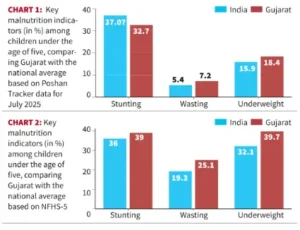
- NFHS5 (2019–21): Nationally representative survey; shows ~39% stunted, 25% wasted, and ~40% underweight children in Gujarat.
- Poshan Tracker (2025–26): Realtime monitoring at anganwadi centres; reported 11.4% malnourished children (January 2026).
- Difference in Methods: NFHS covers entire population, while Poshan Tracker covers only enrolled children; data quality issues exist due to pressure on anganwadi workers and app connectivity problems.
Key Findings
- NFHS5 Gujarat Data:
- Stunting: 39% (low height for age).
- Wasting: 25.1% (low weight for height).
- Underweight: 39.7% (low weight for age).
- National Averages: Stunting 36%, Wasting 19.3%, Underweight 32.1%.
- Gujarat performs worse than national average in all three indicators.
- Poshan Tracker (July 2025):
- Stunting: 32.7%.
- Wasting: 7.2%.
- Underweight: 18.4%.
- Gujarat ranked 21st in stunting and 31st in wasting and underweight among 36 States/UTs.
Tribal Districts
- Worst affected districts are tribal:
- Stunting: Dahod (55.3%), Chhota Udaipur (48.6%), Narmada (47.2%), Panchmahal (47.1%).
- Wasting: The Dangs (40.9%), Tapi (36.6%), Panchmahal (35.7%), Sabarkantha (33.1%).
- Underweight: The Dangs (53.1%), Dahod (53%), Narmada (52.8%), Panchmahal (51.9%), Tapi (51.8%).
- Confirms higher malnutrition among tribal children.
Challenges
- Data Reliability: NFHS vs Poshan Tracker differences create confusion.
- Structural Issues: Poverty, poor healthcare, lack of dietary diversity in tribal areas.
- Policy Gaps: Inadequate focus on nutrition beyond anganwadi coverage.
Way Forward
- Strengthen Nutrition Schemes: Ensure effective implementation of ICDS, Poshan Abhiyaan, and MidDay Meal.
- Target Tribal Areas: Special interventions for worstaffected districts.
- Improve Data Quality: Harmonize NFHS and Poshan Tracker for reliable monitoring.
- Community Awareness: Promote dietary diversity and maternal health education.
Malnutrition
- Meaning: When the body does not get enough nutrients (proteins, vitamins, minerals, calories) for proper growth and health.
- Types:
- Undernutrition: Not enough food or nutrients.
- Overnutrition: Too much unhealthy food leading to obesity.
- Impact: Weak immunity, poor growth, learning difficulties, and higher risk of diseases.
Stunting
- Definition: Low height for age.
- Cause: Longterm poor nutrition, repeated infections, and lack of care in early childhood.
- Effect: Children look shorter than their age group, and it affects brain development and learning ability.
Wasting
- Definition: Low weight for height.
- Cause: Sudden shortage of food, illness, or infections.
- Effect: Children look very thin, weak, and are at high risk of death if not treated quickly.
Difference
- Malnutrition = lack of proper nutrition.
- Stunting = child too short for age (chronic issue).
- Wasting = child too thin for height (acute issue).
Conclusion
The claim that 40% of children in Gujarat are malnourished is supported by NFHS5 data, especially in tribal districts. While Poshan Tracker shows lower figures, methodological differences highlight the need for better data integration and targeted nutrition policies.
IMPORTANCE OF SEX EDUCATION IN ACADEMIA
TOPIC: (GS2) POLITY: THE HINDU
The Supreme Court of India (2024–25) emphasized the need for comprehensive sex education in schools and universities to address rising student mental health concerns in higher education.
Importance of Sex Education in Academia
- Breaking Stigma: Sexuality and intimacy are often treated with silence and shame; education helps normalize discussions.
- Mental Health Link: Lack of awareness and bodily autonomy can worsen anxiety, depression, and even lead to suicides.
- WHO’s View: Safe, consensual, and satisfying sexual relationships are essential for wellbeing.
- Inclusive Learning: Recognizes diversity in sexual orientations and identities, fostering equality in classrooms.
Current Gaps in India
- Heteronormative Curriculum: Focuses only on heterosexual dysfunctions, ignoring consent, pleasure, and sexual politics.
- Marginalization of Queer Students: Structural violence and discrimination against LGBTQ+ individuals remain unaddressed.
- Biomedical Bias: Treats sexuality as a medical issue, neglecting sociocultural dimensions.
- Counselling Deficiencies: University psychologists often lack training to support sexual minorities effectively.
Challenges
- Taboos & Silence: Fear and anxiety prevent open dialogue in classrooms.
- Lack of Vocabulary: Students and teachers struggle to articulate issues around intimacy and sexuality.
- Resistance to Change: Conservative norms and family pressures hinder reforms.
- Unequal Spaces: Absence of safe, accountable environments for sensitive discussions.
Way Forward
- Inclusive Curriculum: Integrate sexuality education that covers consent, diversity, and gender equality.
- Safe Classrooms: Use icebreakers, group discussions, and trustbuilding exercises to encourage openness.
- Structural Reforms: Address institutional discrimination and create supportive policies for LGBTQ+ students.
- Holistic Approach: Move beyond shortterm fixes like hiring counsellors; build sustained support systems.
- Critical Thinking: Encourage students to question norms and develop empathy, allyship, and care communities.
Conclusion
Sex education in academia is vital for mental health, equality, and social justice. By creating inclusive and compassionate learning environments, India can empower its youth to navigate challenges, reduce stigma, and build a more equitable society.
COAL PLANT INFLEXIBILITY AND INDIA’S CLEAN ENERGY PUSH
TOPIC: (GS3) ENVIRONMENT: THE HINDU
India’s renewable energy capacity has reached 262 GW (over 51% of total power), but the inflexibility of coalbased power plants is creating challenges for grid integration, leading to curtailment of solar power and financial losses.
Coal Plant Inflexibility
- Coal plants lack flexibility to reduce output during peak solar hours and ramp up after sunset.
- Many plants cannot operate below 55% Minimum Technical Load (MTL), limiting their ability to adjust generation.
- Running plants at lower loads risks equipment damage, higher maintenance costs, and reduced lifespan.
Impact on Renewable Energy
- Curtailment of Solar Power: Between May–Dec 2025, India lost 2.3 TWh of solar energy, enough to power 14 lakh households for a year.
- Financial Burden: Compensation of ₹5.75–6.9 billion paid to renewable generators under grid management rules.
- Missed Climate Goals: Curtailment prevents full use of clean energy, slowing progress toward 500 GW nonfossil capacity by 2030.
Grid Safety Concerns
- India’s grid must maintain frequency between 49.900–50.050 Hz.
- In May 2025, frequency exceeded limits for 20% of the time due to surplus solar power.
- Even after reducing coal generation to 58% and curtailing 10 GW solar, frequency rose to 50.48 Hz, showing risks to grid stability.
Industry Concerns
- NTPC and other producers warn that operating below 55% load causes stress on turbines and boilers.
- Poor coal quality and repeated ramping up/down accelerate wear and reduce reliability.
- Reluctance to adopt twoshift operations or reduce load to 40% due to technical risks.
Way Forward
- CEA Proposal: Incentives for coal plants to operate flexibly.
- Grid Modernization: Invest in storage solutions (batteries, pumped hydro) to absorb surplus renewable energy.
- Transmission Upgrades: Strengthen intrastate and interstate networks for better balancing.
- Policy Push: Encourage phasing down old coal units and integrate flexible gasbased generation.
- Consumer Impact: Curtailment costs are passed on in tariffs; reforms needed to protect consumers.
Conclusion
Coal plant inflexibility is a major obstacle to India’s clean energy transition. Without flexible thermal operations, storage expansion, and stronger grid management, renewable energy will continue to be curtailed, undermining both economic efficiency and climate goals.
SAHITYA AKADEMI AWARDS 2025
TOPIC: (GS1) INDIAN ART AND CULTURE: THE HINDU
The Sahitya Akademi announced its literary awards for 2025 in 24 languages after a delay caused by directives from the Union Culture Ministry.
Sahitya Akademi Awards
- India’s national literary award given annually for outstanding works in 24 recognized languages.
- Established: 1954 by the Sahitya Akademi, India’s National Academy of Letters.
- Purpose: To promote Indian literature and recognize excellence across diverse linguistic traditions.
- Award Components: Engraved copper plaque, a shawl, and ₹1 lakh cash prize.
Historical Background
- The Sahitya Akademi was founded in 1954 as an autonomous organization under the Ministry of Culture.
- It is the second highest literary honor in India after the Jnanpith Award.
- Awards are given for poetry, novels, short stories, plays, literary criticism, and essays.
- Over the decades, it has become a symbol of India’s linguistic and cultural diversity.
Latest Recipients (2025)
- Navtej Sarna – English category, Crimson Spring (novel).
- Mamta Kalia – Hindi category, Jeete Jee Allahabad (memoir).
- Sa Tamilselvan – Tamil category, Thamizh Sirukathaiyin Thadangal (literary criticism).
- Awards announced across 24 languages recognized by the Akademi.
Importance
- Cultural Recognition: Encourages writers and preserves India’s multilingual literary heritage.
- Promotion of Diversity: Highlights contributions from different regions and languages.
- Intellectual Value: Inspires critical thinking and creative expression in society.
- Global Standing: Strengthens India’s image as a country rich in literature and arts.
Conclusion
The 2025 awards underline the importance of nurturing diverse voices and reaffirm literature’s role in shaping cultural identity and national discourse.
UNITED NATIONS ENVIRONMENT PROGRAMME (UNEP)
TOPIC: (GS3) ENVIRONMENT: THE HINDU
The United Nations Environment Programme (UNEP) recently released a report warning that improper disposal of unused medicines poses serious risks to both public health and the environment.
UNEP
- Founded: 1972, after a UN General Assembly resolution.
- Mandate: Monitor global environmental conditions and coordinate responses to major challenges.
- Headquarters: Nairobi, Kenya.
- Role: Leading global authority on environmental issues.
Structure of UNEP
- United Nations Environment Assembly (UNEA): Highest decisionmaking body on environment; all UN member states participate.
- Committee of Permanent Representatives (CPR): Advisory body that prepares UNEA’s agenda.
- Secretariat: Led by the Executive Director; implements UNEA decisions.
- Regional & Thematic Offices: Operates across AsiaPacific, Africa, Europe, Latin America, West Asia, and North America.
Functions of UNEP
- Develops and supports global environmental treaties (CBD, CITES, Minamata Convention).
- Hosts secretariats of major conventions and assists in negotiating new agreements.
- Publishes key reports like Global Environment Outlook and Emissions Gap Report.
- Provides technical assistance and funding to developing countries for environmental capacity building.
Conclusion
UNEP plays a crucial role in shaping global environmental governance. Its latest warning on medicine disposal highlights the intersection of health and environment, reminding nations to adopt safe practices and measures.
APPOINTMENT OF STATE DGP
TOPIC: (GS2) POLITY: THE HINDU
The Union Public Service Commission (UPSC) has revised the procedure for appointing State DirectorsGeneral of Police (DGP). States must now seek Supreme Court approval if they delay sending names of eligible officers for empanelment.
Provisions of the New Rule
- Supreme Court Approval for Delays: States cannot delay proposals without Court permission.
- Advance Submission: Names of eligible IPS officers must be sent to UPSC three months before the retirement of the current DGP.
- No Acting DGPs: Appointment of temporary or “acting” DGPs is prohibited.
- Exceptional Cases: Delays allowed only if the incumbent dies, resigns, or is relieved prematurely.
DGP Appointment Process
- UPSC prepares a panel of three senior IPS officers eligible for DGP.
- The State government selects one officer from this panel as Head of Police Force (HoPF).
- Judicial basis: Prakash Singh vs Union of India (2006) – landmark judgment mandating police reforms, fixed tenure for DGPs, and transparent selection.
Reason for Change
- Many States delayed sending proposals or appointed acting DGPs, bypassing the process.
- Attorney General R. Venkataramani clarified that UPSC cannot condone delays without Supreme Court’s nod.
Significance
- Ensures uniformity and transparency in police leadership appointments.
- Strengthens compliance with Supreme Courtmandated police reforms.
- Prevents political interference in top police postings.
- Promotes professional and independent policing across States.
Conclusion
By mandating Supreme Court oversight for delays and banning acting appointments, it seeks to ensure stable, impartial, and accountable police leadership in States.
GREAT INDIAN BUSTARD (GIB)
TOPIC: (GS3) ENVIRONMENT: THE HINDU
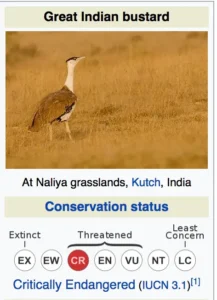
The Union Environment Minister recently informed Parliament that Project Great Indian Bustard has entered its fourth year of captive breeding, aiming to save this critically endangered bird from extinction.
Great Indian Bustard
- Large terrestrial bird endemic to the Indian subcontinent.
- Habitat: Dry grasslands and scrublands, now shrinking due to agriculture and development.
- Distribution: Core population in the Thar Desert, mainly Jaisalmer and Barmer (Rajasthan).
Characteristics
- Among the heaviest flying birds in the world (up to 15 kg).
- Horizontal body posture, long bare legs, resembles an ostrich.
- Lifespan: 12–15 years.
- Diet: Opportunistic feeders – grass seeds, insects (grasshoppers, beetles), small rodents, and reptiles.
Conservation Status
- IUCN Red List: Critically Endangered.
- CITES: Appendix I.
- Wildlife (Protection) Act, 1972: Schedule I (highest protection).
Threats
- Habitat loss due to farming, mining, and infrastructure projects.
- Collision with power lines in desert regions.
- Low breeding rate and small population size.
- Poaching in some areas.
Conservation Efforts
- Project GIB: Captive breeding programme started in 2021, now in its fourth year.
- Supreme Court directive: Power lines in critical habitats to be undergrounded.
- Protected areas: Desert National Park (Rajasthan) is a key habitat.
- Community involvement: Awareness campaigns among local villagers and farmers.
Conclusion
The Great Indian Bustard is a symbol of India’s grassland ecosystem but faces imminent extinction. Effective captive breeding, habitat protection, and strict enforcement of conservation measures are vital to ensure its survival.