
ENSURE SAFEGUARDS FOR INDIA’S CARBON MARKET
TOPIC: (GS3) ENVIRONMENT: THE HINDU
India is setting up a national Carbon Credit Trading Scheme (CCTS) to promote low-carbon growth, but experts warn that without proper safeguards, the system could exploit farmers, tribal groups, and rural communities—repeating global mistakes like those seen in Kenya’s carbon projects.
India’s Low-Carbon Growth Path
- As a developing nation, India faces the dual challenge of reducing poverty while ensuring environmental sustainability.
- Rather than adopting “degrowth,” India aims to decouple economic growth from carbon emissions using clean technologies, renewable energy, and sustainable farming.
- The Carbon Credit Trading Scheme (CCTS) is part of this effort to encourage emission reductions and promote carbon-neutral development.
What are Carbon Credits?
- A carbon credit represents one tonne of carbon dioxide (CO₂) reduced or removed through verified projects.
- Credits can be earned via:
- Renewable energy projects (solar, wind, biogas)
- Nature-based projects (reforestation, agroforestry, biochar)
- Companies buy these credits to offset their own emissions while moving toward greener operations.
- Globally, around 175–180 million carbon credits are traded each year.
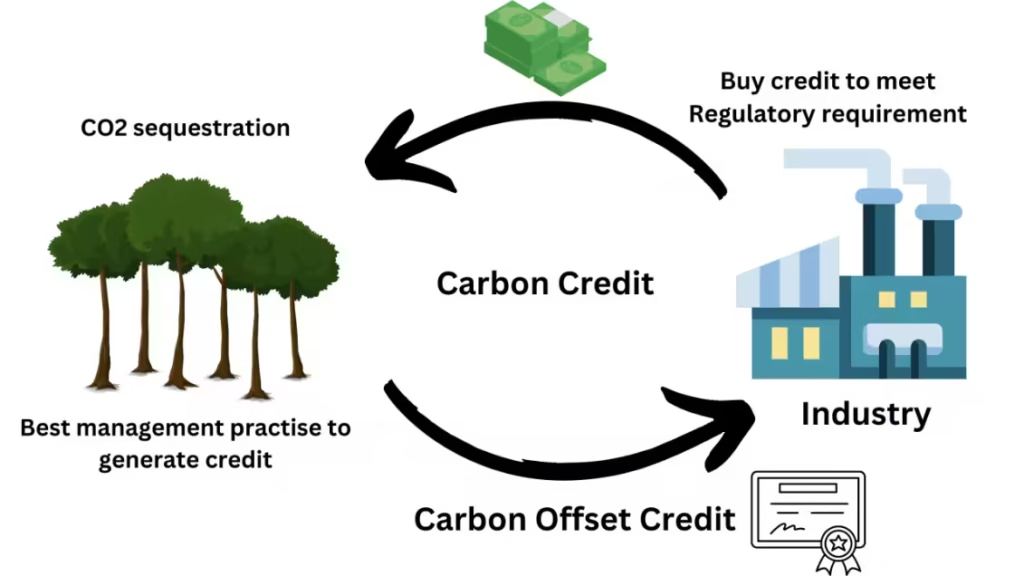
India’s Carbon Credit Market
- The CCTS will create:
- Emission benchmarks for industries.
- A national registry and trading platform for carbon transactions.
- Methods for projects such as biomass energy, biogas, and low-emission rice farming.
- However, agriculture-based projects remain underdeveloped. Of 64 Indian projects listed with Verra, only four are registered and none have issued credits, mainly due to weak farmer participation and lack of training.
Lessons from Kenya
- The Northern Kenya Rangelands Carbon Project once hailed as community led was suspended due to:
- Missing community consent and flawed carbon measurement.
- Violation of indigenous land rights and top-down control.
- Another case, Lake Turkana Wind Project, restricted pastoralists’ access to land and water.
- These examples show that poorly designed carbon schemes can harm local livelihoods and reinforce colonial-style land control.
Risks for India
- Many Indian carbon projects—especially afforestation or reforestation—target common or tribal lands, risking displacement or loss of traditional access.
- Lack of Free, Prior, and Informed Consent (FPIC) and opaque benefit-sharing could marginalize small and caste-oppressed farmers.
- Current CCTS rules emphasize compliance and reporting but ignore social safeguards like land rights and equitable profit-sharing.
The Way Forward
- Avoid overregulation that deters genuine investors but ensure fair, transparent, and inclusive governance.
- Essential reforms include:
- Formalising community consent and land rights.
- Transparent benefit-sharing frameworks.
- Community monitoring of carbon projects.
- Adaptive regulation built on local consultation and trust.
Conclusion:
For India’s carbon market to succeed, it must uphold both climate integrity and social justice. True sustainability means empowering local communities—not displacing them—in the fight against climate change.
IS LANDLOCKEDNESS THE REASON FOR BIHAR’S UNDERDEVELOPMENT?
TOPIC: (GS3) ECONOMY: THE HINDU
As elections approach in Bihar, the debate over its underdevelopment has resurfaced. Experts are questioning whether the State’s landlocked geography is the main cause of its economic stagnation, or if deeper structural, political, and governance issues are responsible.
Bihar’s Development Paradox
- Bihar is among India’s poorest and least industrialised States, despite fertile land and abundant water resources.
- The debate focuses on whether being landlocked limits its economic opportunities, or if policy failures and institutional weaknesses play a bigger role.
Landlockedness the Main Barrier?
- Not necessarily. States like Punjab and Telangana, though also landlocked, have achieved high growth through better infrastructure and education.
- Bihar’s agrarian exports — such as makhana, litchi, and corn — face logistical problems due to high transport costs and long travel times to ports.
- However, experts agree that geography alone cannot explain Bihar’s backwardness; lack of infrastructure, poor connectivity, and weak governance are larger issues.
Agriculture vs. Industrialisation
- Bihar’s economy remains largely agrarian, with nearly 80% of the workforce dependent on farming.
- Despite fertile soil and irrigation, agricultural productivity is below the national average.
- Experts argue Bihar must modernise agriculture and develop agro-based industries before fully transitioning to manufacturing.
- Overdependence on farming without diversification risks low income and rural distress.
Historical and Policy Factors
- Freight Equalisation Policy (1952): Made transport costs uniform across India, discouraging industries from setting up near Bihar’s mineral and raw material sources. Resulted in loss of local industrial base and revenue.
- Lack of Capital Formation: Bihar’s economy remains stuck between feudal and capitalist structures, limiting entrepreneurship and private investment.
- Low State Capacity: Even when funds are allocated by the Finance Commission, they often remain unused due to poor administrative capability and lack of matching contributions.
- Migration: Millions of Biharis migrate to other States for work. Experts note that better local job creation could reduce this outflow.
Role of Governance and Politics
- Governance often focuses on resource redistribution (caste-based politics) rather than productive investments in infrastructure and industry.
- A social and political shift toward accountability, entrepreneurship, and reinvestment is needed.
Special Status Debate
- Granting special status may provide more central aid, but experts warn it won’t help unless funds are effectively used.
- The lack of fiscal capacity and bureaucratic efficiency remains a key obstacle to development.
Conclusion:
Bihar’s underdevelopment cannot be blamed solely on being landlocked. The real challenge lies in weak infrastructure, poor governance, and policy missteps. Sustainable progress will depend on building state capacity, promoting industry, and ensuring inclusive, transparent investment.
RESTORING FISCAL SPACE FOR THE STATES
TOPIC: (GS3) ECONOMY: THE HINDU
The recent restructuring of GST tax slabs and the abolition of the GST compensation cess have reignited debate on the fiscal autonomy of States.
Shifting Fiscal Balance
- India’s fiscal framework divides taxation and spending powers between the Centre and the States.
- The introduction of GST (2017) replaced many State taxes with a common national tax, centralising revenue decisions under the GST Council, where the Centre holds more influence.
- As a result, States’ fiscal autonomy and resource flexibility have reduced, even as their expenditure responsibilities have grown.
Impact of GST on States’ Finances
Loss of Taxing Powers:
- Earlier, States had authority over taxes such as VAT, entry tax, and purchase tax.
- Under GST, these powers were shifted to the GST Council, limiting States’ control over revenue policy.
End of GST Compensation:
- The GST compensation cess, which reimbursed States for revenue loss for five years, has now been abolished.
- States fear higher revenue shortfalls and reduced fiscal capacity post-compensation.
Rising Dependence on the Centre:
- States now depend on Central transfers for up to 44% of their revenue, ranging from 72% in Bihar to 20% in Haryana.
- This has weakened fiscal federalism, especially for Opposition-ruled States.
Finance Commission and Tax Devolution
- Articles 268–293 of the Constitution define Centre-State financial relations.
- The Finance Commission recommends the sharing of Central taxes with States.
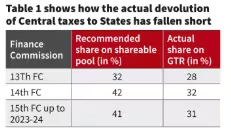
- Over time, the States’ share in Central taxes rose from 29.5% (11th FC) to 42% (14th FC), but the effective share remains lower due to increasing cesses and surcharges.
- cesses and surcharges are not part of the divisible pool, allowing the Centre to retain additional funds.
Fiscal Imbalance and Governance Challenges
- States handle key responsibilities like health, education, agriculture, and local governance, but their revenue capacity hasn’t kept pace with rising demands.
- Centralisation of resources and conditional grants limit flexibility and often create political friction.
- The fiscal imbalance has become more pronounced as expenditure is decentralised while taxation power remains centralised.
Reforms Suggested for Restoring Fiscal Space
- Share Personal Income Tax Base: Allow States to receive a portion of personal income tax revenue, similar to GST revenue sharing.
- Permit States to Top-Up Income Tax: States could levy a small surcharge or additional rate over the existing personal income tax collected within their jurisdiction.
- Merge Cesses and Surcharges into the Divisible Pool: This would ensure fairer and more transparent revenue distribution.
- Enhance Fiscal Autonomy: Enable States to design region-specific policies and improve liquidity without over-reliance on Central transfers.
Conclusion:
India’s fiscal system must evolve to strengthen cooperative federalism. Restoring fiscal space for States through tax-sharing reforms and transparent devolution is essential to balance responsibilities, encourage local accountability, and ensure inclusive national growth.
NORTHEAST MONSOON
TOPIC: (GS1) GEOGRAPHY: THE HINDU
The northeast monsoon has arrived earlier than usual on October 16, bringing relief to southern India, especially Tamil Nadu and coastal Andhra Pradesh, and raising hopes for good rainfall and better agricultural outcomes.
About the northeast monsoon
- Normally arrives around October 20 (± seven days).
- Covers Tamil Nadu, coastal and Rayalaseema regions of Andhra Pradesh, Kerala, and parts of Karnataka.
- The India Meteorological Department (IMD) has predicted above-normal rainfall, exceeding 112% of the long-period average for this season.
Importance of the monsoon
- Provides nearly 48% of Tamil Nadu’s annual rainfall and over 30% for Andhra Pradesh.
- Critical for rabi crop cultivation, groundwater recharge, and drinking water reserves.
- Also influences the formation of cyclones in the Bay of Bengal, which can both help and harm depending on their intensity.
Associated challenges
- The season typically witnesses three or more cyclonic systems in the Bay of Bengal.
- Increased frequency of cloudbursts and urban flooding, especially in Chennai, has been observed in recent years.
- Poor condition of stormwater drains, encroached watercourses, and dumping of waste in waterbodies worsen flood impacts.
- Shortage of fertilizers, particularly urea, remains a concern for farmers. The Union Agriculture Ministry has increased allocations to meet higher demand.
Government measures
- Tamil Nadu is setting up a real-time flood forecasting system for Chennai to manage water discharge from reservoirs.
- States are preparing disaster response teams and strengthening coordination among departments to reduce loss of life and property.
Way Forward
- The early and strong monsoon brings hope for agriculture, but also calls for greater vigilance and urban preparedness.
- Integrated flood management, improved drainage systems, and community participation are essential.
- Coordinated action between the Centre, States, and local bodies can ensure that the benefits of the monsoon outweigh its risks.
Indian Monsoon
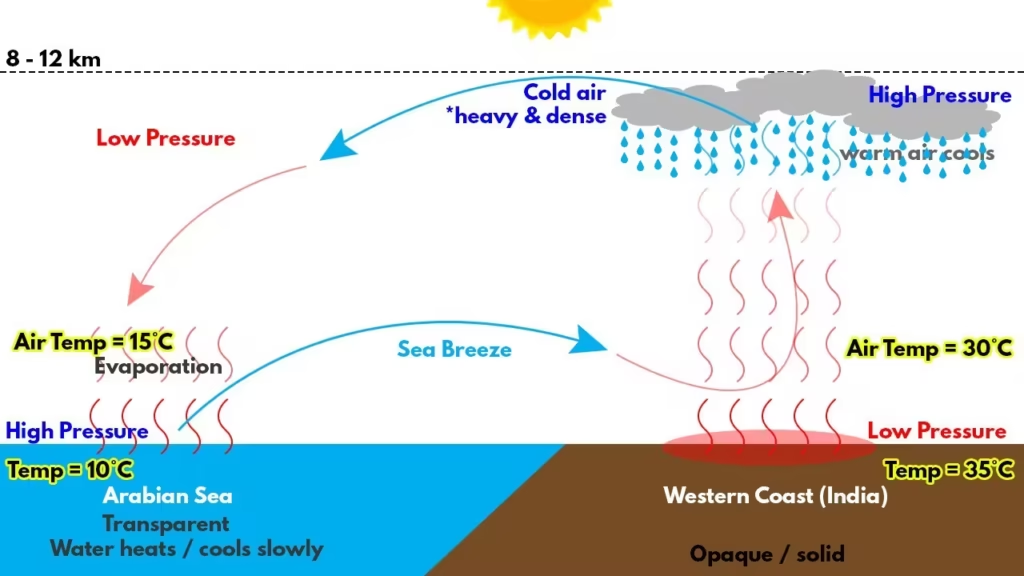
- Differential Heating:
In summer, the land heats up faster than the surrounding ocean, creating a low-pressure area over northwestern India and a high-pressure area over the Indian Ocean. This pressure difference pulls in moist air from the ocean toward the land. - Shift of ITCZ (Inter-Tropical Convergence Zone):
The ITCZ, a low-pressure belt near the equator, shifts northwards over India during summer, drawing in southwest trade winds that carry moisture. - Coriolis Effect:
Due to Earth’s rotation, these winds are deflected to the right, turning them into southwest monsoon winds that bring heavy rainfall to most of India. - Reversal in Winter:
In winter, the land cools faster than the sea, creating a high-pressure area over land and low pressure over the sea, reversing the wind direction — this causes the northeast monsoon.
Two Divisions of the Indian Monsoon:
- Southwest Monsoon (June–September):
- Brings nearly 75% of India’s annual rainfall.
- Affects the entire country except Tamil Nadu and parts of the southeast coast.
- Northeast Monsoon (October–December):
- Mainly affects Tamil Nadu, coastal Andhra Pradesh, Kerala, and south interior Karnataka.
- Brings rainfall when the winds reverse direction and blow from land to sea.

SACHET
TOPIC: (GS3) DISASTER MANAGEMENT: THE HINDU
At the recent G20 Ministerial Meeting on Disaster Risk Reduction in Durban, India highlighted its Integrated Alert System (SACHET) — a unified disaster warning platform that connects various national agencies to deliver real-time alerts to citizens.
About the integrated alert system (SACHET)
- Launched by: National Disaster Management Authority (NDMA)
- Developed by: Centre for Development of Telematics (C-DOT) under the Department of Telecommunications
- Objective: To provide real-time, geo-targeted early warnings to people during natural disasters and emergencies.
Key features
- Based on the Common Alerting Protocol (CAP), a global standard set by the International Telecommunication Union (ITU) for uniform emergency communication.
- Brings together multiple national agencies dealing with weather, hydrology, seismology, and oceanography under one system.
- Uses multi-channel communication for maximum coverage — including:
- SMS and Cell Broadcast
- Mobile App alerts
- TV, Radio, and Social Media
- Satellite communication, Browser notifications, and RSS feeds
Functioning and coverage
- Operational across all States and Union Territories of India.
- Sends alerts directly to citizens’ mobile phones in specific geo-marked regions affected by disasters.
- Users can subscribe to receive warnings for their current location or any selected state/district.
- The SACHET mobile app also provides:
- Verified alerts from authorized government sources
- Weather forecasts and daily updates from the India Meteorological Department (IMD)
Significance
- Strengthens India’s disaster preparedness and early warning capabilities.
- Ensures last-mile communication to reduce loss of life and property.
- Acts as a model for technology-driven disaster management aligned with global standards.
BLUE FLAG CERTIFICATION
TOPIC: (GS3) ENVIRONMENT: THE HINDU
Recently, five beaches in Maharashtra have been awarded the international Blue Flag certification, marking recognition for their environmental cleanliness and sustainable coastal management.
About Blue Flag Certification
Overview
- The Blue Flag Certification is a globally recognised eco-label awarded to beaches, marinas, and sustainable tourism boats that maintain high standards of environmental management and safety.
- It is administered by the Foundation for Environmental Education (FEE), headquartered in Denmark.
Origin and Expansion
- The programme began in France in 1985 and was later expanded globally in 2001.
- It aims to encourage sustainable tourism practices in both marine and freshwater environments.
Criteria for Certification
To earn the Blue Flag, a beach must meet 33 strict criteria across four key areas:
- Water Quality – ensuring clean and safe bathing waters.
- Environmental Management – effective waste handling and ecosystem protection.
- Environmental Education – awareness and information programs for visitors.
- Safety and Services – availability of lifeguards, first aid, and accessibility measures.
Blue Flag Mission
- Its main mission is to promote environmental education, protection, and sustainable tourism practices worldwide.
Blue Flag Beaches in India
- India has several Blue Flag-certified beaches including Shivrajpur (Gujarat), Ghoghla (Diu), Kasarkod and Padubidri (Karnataka), Kappad (Kerala), Rushikonda (Andhra Pradesh), Golden Beach (Odisha), Radhanagar (Andaman & Nicobar Islands), Kovalam (Tamil Nadu), Eden Beach (Puducherry), and Minicoy Thundi and Kadmat (Lakshadweep).
Conclusion:
The Blue Flag certification signifies global recognition of a beach’s eco-friendly practices, water quality, and safety standards, reinforcing India’s commitment to sustainable coastal management and eco-tourism.
WILD ELEPHANT NUMBERS DECLINE
TOPIC: (GS3) ENVIRONMENT: THE HINDU
India’s first-ever DNA-based elephant census estimates 22,446 wild elephants, showing an 18% decline since 2017, highlighting growing conservation challenges.
About Wild Elephants in India
Ecological and Cultural Importance
- Elephants are keystone species, maintaining forest ecosystems.
- They hold cultural, spiritual, and mythological significance in India.
- India houses over 60% of the global Asian elephant population.
Habitat and Distribution
- Major elephant landscapes:
- Western Ghats
- North Eastern Hills & Brahmaputra Floodplains
- Shivalik Hills & Gangetic Plains
- Central India & Eastern Ghats
- Leading elephant states: Karnataka, Assam, Tamil Nadu, Kerala, Uttarakhand, Odisha.
Threats to Elephant Populations
- Habitat fragmentation due to agriculture, mining, and infrastructure.
- Human-elephant conflict causing casualties and property loss.
- Poaching for ivory and retaliatory killings.
- Disruption of migration corridors by roads, railways, and power lines.
- Invasive plants and land-use changes affecting habitat quality.
Conservation Status and Legal Protection
- Listed as Endangered (IUCN Red List) and under Schedule I of Wildlife Protection Act, 1972.
- Included in CITES Appendix I, prohibiting international trade of elephant parts.
DNA-Based Census (SAIEE 2021–25)
Methodology
- Combined ground surveys, satellite mapping, and DNA analysis of 21,000 dung samples.
- Identified 4,065 unique elephants using genetic markers.
- Used mark-recapture statistical model to estimate total population.
Key Findings
- Total population: 22,446 (range 18,255–26,645).
- Regional distribution: Western Ghats – 11,934, North East – 6,559, Shivalik/Gangetic Plains – 2,062, Central India/Eastern Ghats – 1,891.
- State-wise: Karnataka – 6,013; Assam – 4,159; Tamil Nadu – 3,136; Kerala – 2,785; Uttarakhand – 1,792; Odisha – 912.
Significance and Conservation Concerns
- Highlights habitat fragmentation and disruption of corridors.
- Calls for stronger enforcement of habitat protection, restoration of corridors, and community-based conflict mitigation.
- Establishes a scientific, replicable baseline for future monitoring under Project Elephant 2.0.
Conclusion:
The DNA-based census provides a more accurate and non-invasive method to monitor elephants, showing a worrying population decline and underlining the need for enhanced conservation measures and habitat connectivity.
VIRTUAL MUSEUM OF STOLEN CULTURAL OBJECTS
TOPIC: (GS1) INDIAN ART AND CULTURE: THE HINDU
UNESCO recently launched the world’s first Virtual Museum of Stolen Cultural Objects at the MONDIACULT 2025 conference to raise awareness about illicit trafficking of cultural heritage.
Objective of the Museum
- To create a global digital platform showcasing stolen or missing cultural artifacts.
- Aims to reconnect communities with their lost heritage through immersive virtual experiences.
- Seeks to educate the public on the impact of illegal trade in cultural property and support recovery efforts.
Key Features
- Launched at the World Conference on Cultural Policies and Sustainable Development (MONDIACULT 2025).
- Developed in partnership with INTERPOL and funded by the Kingdom of Saudi Arabia.
- Currently displays around 240 stolen artifacts from 46 countries.
India’s Contribution
- Features two 9th-century sandstone sculptures from the Mahadev Temple in Pali, Chhattisgarh:
- A Nataraja sculpture depicting Lord Shiva in a cosmic dance pose.
- A Brahma statue seated in lalitasana, with three visible faces and four arms holding symbols like the Vedas and a rosary.
Significance
- Highlights the global scale of cultural theft and the need for international cooperation.
- Promotes transparency and public engagement in tracking and recovering stolen heritage.
- Supports India’s ongoing efforts to reclaim its lost cultural artifacts from abroad.
Conclusion
The virtual museum is a landmark initiative in cultural diplomacy, combining technology, heritage preservation, and global collaboration to combat the illicit trade of cultural treasures.