
Daily Current Affairs 18-December-2025

Share this Post

SABKA BIMA SABKI RAKSHA BILL, 2025

TOPIC: (GS3) ECONOMY: THE HINDU

Union Government introduced the Sabka Bima Sabki Raksha (Amendment of Insurance Laws) Bill, 2025 in Parliament.

Background

  • Insurance penetration in India has increased, yet remains below global averages.
  • Persistent concerns include mis-selling of policies, non-transparent commissions, and delays in grievance redressal.
  • The insurance ecosystem has expanded to include agents, brokers, banks, NBFCs, fintech platforms, web aggregators, and TPAs.
  • However, regulatory oversight has lagged behind market expansion, creating supervisory gaps.
  • These challenges necessitated stronger legal backing for the regulator.

Key Features of the Bill

  • The Bill amends existing insurance laws to provide enhanced supervisory and enforcement powers to the Insurance Regulatory and Development Authority of India (IRDAI).
  • It signals a shift from a rule-compliance model to a proactive, enforcement-oriented regulatory framework.
  • The provisions apply to insurance companies as well as intermediaries, ensuring comprehensive oversight.

Expanded Search and Inspection Powers

  • The IRDAI Chairperson can order search, inspection, and seizure operations.
  • These powers may be used when entities are suspected of:
    • Hiding information,
    • Refusing to submit records, or
    • Destroying or tampering with documents.
  • Authorized officers may enter premises, seize records, and access locked spaces if required.
  • This brings IRDAI’s authority closer to regulators like SEBI, ensuring regulatory parity.

Stronger Enforcement and Penalties

  • IRDAI can now order disgorgement of illegal gains earned through:
    • Excessive commissions,
    • Rebates, or
    • Unethical sales practices.
  • The regulator may issue binding directions to insurers in the public interest to:
    • Protect policyholders,
    • Prevent mismanagement, and
    • Improve corporate governance.
  • Though insurers will have the right to be heard, compliance will be mandatory.

Regulation of Commissions and Intermediaries

  • IRDAI will have authority to: Fix commission ceilings, Enforce disclosure norms, and Regulate payment structures.
  • This aims to reduce commission-driven mis-selling, especially in digital and fintech-based insurance platforms.

Significance and Current Affairs Linkages

  • Enhances consumer trust and policyholder protection.
  • Supports national goals like Insurance for All by 2047 and Digital Financial Inclusion.
  • Aligns with global regulatory trends and complements reforms in banking and capital markets governance.
  • Reinforces India’s shift towards strong financial sector regulation amid rising digital finance risks.

Challenges and Way Forward

  • Concerns may arise over excessive concentration of powers.
  • Safeguards such as due process, transparency, and judicial review are essential.
  • Reforms must be supported by consumer awareness, financial literacy, and faster dispute resolution mechanisms.

Conclusion

The Sabka Bima Sabki Raksha Bill, 2025 represents a decisive step towards robust insurance governance, balancing market growth with consumer protection, and strengthening India’s financial regulatory architecture.

COFFEE PLANTATION IN INDIA

TOPIC: (GS3) AGRICULTURE: THE HINDU

India’s coffee plantation sector has gained renewed attention due to a sharp rise in exports to USD 1.8 billion in 2024–25, India becoming the 5th largest coffee exporter, and increased global recognition through GI tags and G20 showcasing of Araku Coffee.

Historical Background

  • Baba Budan’s Journey (17th Century): Coffee cultivation began when Baba Budan brought seven coffee seeds from Yemen and planted them in the Baba Budan Giri hills of Karnataka.
  • Ethiopian Origin: Coffee originally came from the Kaffa region of Ethiopia and later spread to Arabia and India.
  • Arab Influence: Arabs were the first to cultivate and trade coffee commercially.
  • British Era Expansion: During the 18th century, the British established large plantations in South India, building roads, curing units, and export networks.
  • Global Identity: Over time, Indian coffee gained recognition for its shade-grown and mild-flavoured characteristics.
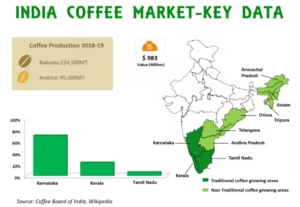
India Coffee Market-Key Data 

AgroClimatic Requirements

  • Soil: Deep, fertile, welldrained soils rich in organic matter; slightly acidic pH.
  • Rainfall: 1000–2500 mm annually for flowering and berry formation.
  • Temperature:
    • Arabica: 15–25°C
    • Robusta: 20–30°C
  • Altitude:
    • Arabica: 1000–1500 m
    • Robusta: 500–1000 m
  • Shade: Requires dense natural shade, which enhances bean quality.
  • Humidity: Optimal relative humidity is 70–90%.

Major CoffeeGrowing Regions

Traditional Regions (Western Ghats)

  • Karnataka: Produces 70% of India’s coffee; major areas include Kodagu and Chikkamagaluru.
  • Kerala: Wayanad and Idukki dominate Robusta production.
  • Tamil Nadu: Nilgiris, Dindigul, and Theni grow highaltitude Arabica.

NonTraditional Regions (Eastern Ghats)

  • Andhra Pradesh: Araku Valley known for tribal organic coffee.
  • Odisha: Koraput and Rayagada emerging as organic coffee hubs.

NorthEastern States

  • Assam, Meghalaya, Manipur, Mizoram, Nagaland, Tripura—small but expanding plantations.

Role of the Coffee Board of India

  • Statutory Body: Formed under the Coffee Act, 1942; HQ in Bengaluru.
  • Key Functions:
    • Promotes replanting, productivity, and sustainable farming.
    • Identifies new growing zones using scientific tools.
    • Supports tribal farmers with training and market access.
    • Enhances branding, quality certification, and export promotion.

Significance

  • India produces 3.6 lakh tonnes annually; 70% is exported to over 120 countries.
  • Specialty coffees like Monsooned Malabar, Mysore Nuggets, Kaapi Royale fetch premium prices.
  • Domestic consumption is steadily rising.
  • Coffee supports tribal livelihoods, biodiversity, and rural employment.

Recent Developments

  • 5th World Coffee Conference (2023) held in Bengaluru focusing on sustainability and circular economy.
  • Araku Coffee showcased at the G20 Summit, boosting global visibility.
  • GI Tags awarded to 7 Indian coffees including Coorg Arabica and Araku Valley Arabica.
  • Exports surged to USD 1.8 billion in 2024–25, making India the 5th largest exporter.
  • GST cut to 5% on processed coffee products.
  • Trade agreements like IndiaUK FTA and IndiaEFTA TEPA provide dutyfree access to premium markets.
  • Koraput Coffee (Odisha) emerging as a successful tribal-led model with fair pricing and doorstep procurement.
  • 2024–25: Government promoting climateresilient coffee varieties under the Coffee Board’s R&D initiatives.

Conclusion

Coffee plantation in India represents a successful blend of sustainable agriculture, tribal livelihood support, and export-led growth. With policy support, climate-resilient practices, and market access through global trade agreements, Indian coffee is well positioned to strengthen its economic and ecological footprint.

INDIA’S GDP ESTIMATION FRAMEWORK

TOPIC: (GS3) ECONOMY: THE HINDU

Ministry of Statistics and Programme Implementation (MoSPI) has proposed a major reform in India’s GDP estimation framework by phasing out the ‘discrepancies’ component.

‘Discrepancies’ in GDP Estimation

  • GDP in India is estimated using two main methods:
    • Production (Value-Added/Income) Approach
    • Expenditure Approach
  • Due to different data sources, coverage gaps, valuation methods, and timing issues, the two estimates often do not match.
  • The gap between them is recorded as ‘discrepancies’, mainly under the expenditure-side GDP, which is considered less robust in early estimates.
  • Positive discrepancy: Production-side GDP is higher
  • Negative discrepancy: Expenditure-side GDP is higher

Why Discrepancies Are a Concern

  • Large discrepancies reduce clarity about the real drivers of economic growth.
  • They complicate macroeconomic analysis and weaken confidence in headline GDP numbers.
  • In recent quarters, discrepancies have reached 3–4% of GDP, leading to sharp future revisions in growth estimates.
  • Post-pandemic volatility has further increased fluctuations, raising concerns among economists, investors, and rating agencies.

Proposed Reform

  • MoSPI plans to integrate Supply and Use Tables (SUTs) more closely with annual national accounts.
  • SUTs ensure that total supply equals total use for every product and service in the economy.
  • Under the new approach:
    • Discrepancies will be minimised in early GDP estimates, and
    • Fully eliminated in final estimates once comprehensive data is available.
  • This approach follows the UN System of National Accounts (SNA) framework.

Role of Supply and Use Tables (SUTs)

  • SUTs match domestic production and imports with: Intermediate consumption, Final consumption, Capital formation,Exports.
  • They impose accounting consistency, improving reliability and internal coherence of GDP data.

Expert Views and Concerns

  • Economists largely welcome the move as it improves transparency, interpretability, and credibility of GDP figures.
  • However, concerns remain regarding: Outdated surveys, especially in services and informal sectors
  • Heavy reliance on judgement-based adjustments, which may reduce transparency if not clearly disclosed

Challenges and Way Forward

  • Structural complexity of India’s large informal economy requires stronger statistical capacity.
  • Regular updating of surveys and base-year datasets is essential.
  • Improve administrative data systems and real-time data collection (GST, digital payments, enterprise data).
  • Ensure methodological transparency to maintain public trust.

WHAT IS GDP?

Gross Domestic Product (GDP) is the total value of all final goods and services produced within a country in a given year.

How is GDP of a Nation Calculated?

GDP is calculated using three main methods. Ideally, all three should give the same value.

Production (Value Added) Method

  • Measures value added at each stage of production.
  • Formula:
    GDP = Value of Output – Value of Intermediate Goods
  • Example:
    • Farmer grows wheat → mill makes flour → bakery makes bread
    • Only final value is counted to avoid double counting.
  • Most reliable method in developing countries like India.

Income Method

  • Measures income earned by all factors of production.
  • Includes:
    • Wages (labour)
    • Rent (land)
    • Interest (capital)
    • Profit (entrepreneurs)
  • Formula:
    GDP = Wages + Rent + Interest + Profit + Taxes – Subsidies

Expenditure Method

  • Measures total spending in the economy.
  • Formula:
    GDP = C + I + G + (X – M)
    • C = Consumption
    • I = Investment
    • G = Government spending
    • X – M = Exports – Imports

Conclusion

Removing ‘discrepancies’ from GDP estimates is a significant methodological reform aimed at enhancing statistical credibility and policy relevance. Its success will depend on robust data quality, transparency, and institutional capacity, enabling a clearer understanding of India’s growth trajectory.

EXAMINING THE FARM LABOUR SHORTAGE

TOPIC: (GS3) ECONOMY: THE HINDU

the proposed Viksit Bharat – Guarantee for Rozgar and Ajeevika Mission Gramin (VB-G RAM G) Bill suggested a temporary pause on rural employment works during peak agricultural seasons, citing concerns over farm labour shortages.

MGNREGS and Rural Wages

  • MGNREGS is often credited with strengthening workers’ bargaining power and tightening rural labour markets.
  • However, Labour Bureau data across multiple states and occupations shows that:
    • Nominal rural wage growth remained modest, averaging 3–6% annually over the last decade.
    • In several years, wage growth was lower than inflation, resulting in declining real wages.
    • Real wage growth exceeded 1% only once in the past decade.
  • Agricultural wages performed slightly better than non-farm rural wages in most years, but still largely just matched inflation.

Why Has Rural Wage Growth Remained Weak?

  • A major factor is the sharp rise in rural female labour force participation.
  • According to PLFS data, rural female LFPR nearly doubled between 2017–18 and 2023–24.
  • This significantly expanded labour supply, placing downward pressure on wages despite MGNREGS.
  • Economically, this represents a rightward shift in labour supply, moderating wage increases.

Role of Government Welfare Schemes

  • The Economic Survey 2023–24 links rising female participation to welfare schemes such as:
    • Ujjwala (clean cooking fuel),
    • Har Ghar Jal (tap water),
    • Saubhagya (electricity), and
    • Swachh Bharat Mission (sanitation).
  • By reducing unpaid domestic work, these schemes freed women’s time for paid employment, increasing labour availability.

Re-examining the Farm Labour Shortage Argument

  • Available data does not strongly support the claim that MGNREGS has caused a widespread labour shortage.
  • Increased participation of women, especially in nearby farm activities, may have compensated for workers opting for MGNREGS.
  • Seasonal shortages exist, but blanket restrictions on MGNREGS during peak seasons lack robust empirical backing.

Other Reasons Behind Farm Labour Shortages

  • Low farm wages compared to MGNREGS and non-farm jobs.
  • Poor working conditions in agriculture, including health risks and hard physical labour.
  • Rural-to-urban migration, a long-standing trend predating MGNREGS.
  • Improved bargaining power of workers due to employment security, often perceived by farmers as a shortage.

Way Forward

  • Better alignment of MGNREGS work schedules with agricultural cycles.
  • Allowing select MGNREGS activities on farms during peak seasons.
  • Focus on raising farm wages, mechanisation, and improving work conditions.
  • Use data-driven evidence rather than assumptions for labour market reforms.

Conclusion

The debate on MGNREGS and farm labour shortages reflects deeper structural issues in rural labour markets. Balanced reforms must protect rural livelihoods while supporting agricultural productivity.

NATIONWIDE EGG SAFETY DRIVE

TOPIC: (GS2) GOVERNANCE: THE HINDU

Recently, the Food Safety and Standards Authority of India (FSSAI) initiated a nationwide egg safety drive following concerns over the presence of nitrofuran antibiotic residues in eggs. The issue gained attention after allegations circulated on social media, raising questions on food safety, public health, and regulatory vigilance.

Role of FSSAI

  • FSSAI, a statutory body under the Food Safety and Standards Act, 2006, is responsible for regulating food quality and safety in India.
  • It oversees the manufacture, storage, distribution, sale, and import of food items, including animal-origin products like eggs.

Reason for the Safety Drive

  • A viral video alleged the presence of banned antibiotic residues in branded eggs.
  • This triggered concerns related to consumer health, antibiotic misuse, and trust in food systems.

Steps Taken by FSSAI

  • Issued directions to Food Safety Officers across states.
  • Random sampling of both branded and non-branded eggs.
  • Samples sent for analysis to multiple FSSAI-notified laboratories to ensure credibility.

About Nitrofurans

  • Nitrofurans are synthetic antibiotics prohibited in food-producing animals.
  • Residues may remain due to illegal veterinary practices.
  • Long-term exposure is linked to carcinogenic effects, making strict monitoring essential.

Global and National Context

  • The European Union has completely banned nitrofurans in livestock.
  • The drive aligns with India’s National Action Plan on Antimicrobial Resistance (NAP-AMR) and the One Health approach, which integrates human, animal, and environmental health.

Public Health Significance

  • Enhances food safety surveillance.
  • Reduces risks of antibiotic residues and AMR.
  • Builds consumer confidence and promotes responsible livestock practices.

Conclusion

The egg safety drive reflects India’s commitment to safe food, preventive health governance, and global best practices, reinforcing the need for science-based regulation and transparency.

EKAM AI AND SAMBHAV

TOPIC: (GS3) SCIENCE AND TECHNOLOGY: THE HINDU

During the recent Vijay Diwas celebrations, the Indian Army showcased key indigenous defence technologies, notably Ekam AI and SAMBHAV, reflecting India’s progress under Atmanirbhar Bharat in defence innovation.

Ekam AI: Indigenous Artificial Intelligence Platform

  • Ekam AI is a fully homegrown and secure AI platform developed for use in sensitive defence environments.
  • It operates without reliance on foreign software, external servers, or overseas cloud infrastructure, ensuring data sovereignty.
  • The platform supports:
    • Information analysis,
    • Document management, and
    • Decision-support systems for military operations.
  • Designed with a user-friendly interface, it allows personnel at different ranks to use AI tools without advanced technical training.

Significance of Ekam AI

  • Strengthens cybersecurity and data protection in defence operations.
  • Reduces risks of foreign surveillance or data leakage.
  • Aligns with India’s push for trusted digital ecosystems in strategic sectors.

SAMBHAV: Satellite-Based Mobile Communication System

  • SAMBHAV is a portable communication solution that provides mobile connectivity through satellite support.
  • It can be rapidly deployed in:
    • Remote border areas,
    • Disaster-hit regions, and
    • Areas with damaged or absent communication networks.
  • The system enhances real-time communication for both armed forces and civilian authorities.

Significance of SAMBHAV

  • Improves operational coordination during military missions and humanitarian assistance.
  • Demonstrates dual-use potential of defence technologies for civil disaster management.
  • Supports national goals of resilient and inclusive communication infrastructure.

Vijay Diwas: Historical Context

  • Vijay Diwas, observed on 16 December, commemorates India’s victory in the 1971 war, leading to the creation of Bangladesh.
  • The day symbolizes military excellence, strategic vision, and national unity.

Conclusion

Technologies like Ekam AI and SAMBHAV highlight India’s evolving defence capabilities, combining security, innovation, and self-reliance, while also contributing to national resilience and civilian welfare.

DHRUV64

TOPIC: (GS3) SCIENCE AND TECHNOLOGY: THE HINDU

India recently unveiled DHRUV64, the country’s first fully indigenously designed microprocessor, marking an important milestone in India’s semiconductor and computing ecosystem.
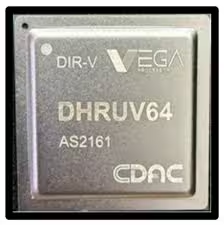
Dhruv64

DHRUV64 Microprocessor

  • DHRUV64 is a homegrown 64-bit microprocessor, fully designed and developed within India.
  • It has been developed by the Centre for Development of Advanced Computing (C-DAC) under the Microprocessor Development Programme (MDP).
  • The processor reflects India’s long-term efforts to build sovereign computing capabilities.

Technical Features

  • Processor Architecture: A 64-bit dual-core processor operating at a clock speed of 1.0 GHz, enabling efficient multitasking.
  • Execution Capability: Uses superscalar execution, allowing multiple instructions to be processed simultaneously.
  • Instruction Management: Supports out-of-order execution, improving performance by completing ready instructions first.
  • Design and Packaging: Integrated communication and control features within an advanced FCBGA package, making it compact and versatile for system integration.

Potential Applications

  • Suitable for both strategic and civilian uses, reducing dependence on foreign chips.
  • Can be deployed in:
    • 5G and telecom infrastructure,
    • Automotive electronics,
    • Industrial automation systems,
    • Consumer electronics, and
    • Internet of Things (IoT) platforms.
  • Supports low-cost prototyping for new system architectures, enabling innovation by startups, academic institutions, and domestic industries.

Significance for India

  • Strengthens Atmanirbhar Bharat in critical semiconductor technology.
  • Enhances national security by ensuring trusted hardware for sensitive applications.
  • Encourages indigenous R&D and manufacturing ecosystems in advanced computing.

Conclusion

The launch of DHRUV64 represents a strategic leap in India’s journey towards self-reliant digital infrastructure, offering a strong foundation for innovation, security, and growth in high-technology sectors.


NATYASHASTRA

TOPIC: (GS1) ART AND CULTURE: THE HINDU

Indira Gandhi National Centre for the Arts (IGNCA) recently organised an academic programme titled “Natyashastra – Synthesis of Theory and Praxis” during the 20th session of UNESCO’s Intergovernmental Committee for the Safeguarding of Intangible Cultural Heritage, held at the Red Fort, Delhi.

About Natyashastra

  • The Natyashastra is an ancient Sanskrit treatise dealing with drama, dance, and music.
  • The term combines ‘Natya’ (dramatic performance) and ‘Shastra’ (systematic knowledge or science).
  • It is traditionally attributed to sage Bharata Muni.
  • Scholars date its composition between 2nd century BCE and 2nd century CE.
  • It is regarded as the earliest comprehensive text on performing arts in South Asia.

Themes and Concepts

  • The text contains nearly 36,000 verses, covering:
    • Natya (drama)
    • Abhinaya (expression and performance)
    • Sangita (music)
    • Bhava (emotions)
    • Rasa (aesthetic experience)
  • Its central contribution is the theory of Rasa, explaining how art creates emotional fulfilment.
  • Bharata identified eight Rasas:
    Shringara, Hasya, Karuna, Raudra, Veera, Bhayanaka, Bibhatsa, and Adbhuta.
  • Through effective bhava, a performer evokes rasa in the audience, making drama a tool of moral and spiritual enlightenment.

Global Recognition

  • UNESCO has included the Natyashastra in its Memory of the World Register, recognising its universal cultural value.
  • This reflects India’s growing role in shaping global cultural discourse.

Role of IGNCA

  • IGNCA is an autonomous institution under the Ministry of Culture.
  • Its mandate includes documentation, preservation, research, and dissemination of Indian heritage.
  • It operates through specialised divisions such as Kalanidhi, Kalakosa, Janapada Sampada, Kaladarsana, and Cultural Informatics Lab.

Conclusion

The Natyashastra remains a living foundation of Indian performing arts. Contemporary engagement by institutions like IGNCA and recognition by UNESCO underline India’s commitment to preserving and globally projecting its intangible cultural heritage.

Write a Review

Your email address will not be published. Required fields are marked *