
HOW CHINA REDUCED AIR POLLUTION
TOPIC: (GS3) ENVIRONMENT: THE HINDU
India facing severe smog and struggling with enforcement, experts are exploring whether China’s strategies can be adapted to Indian conditions.
China’s Pollution Crisis
- China underwent rapid industrial growth after 1978, leading to high emissions, toxic air, and rising health hazards.
- Pollution reached alarming levels during the 2008 Beijing Olympics, forcing strong government intervention.
- Major contributors were heavy industries, coal-based power plants, diesel vehicles, and crop residue burning.
- Severe PM2.5 levels caused serious health problems, putting pressure on the government to act.
Policy Measures in China
- Strong Centralized Governance: Environmental goals were included in government officials’ performance evaluations under the 11th Five-Year Plan.
- Industrial Regulation: China shut down thousands of outdated factories and coal plants. scrubbers, filters were mandated in existing industries.
- Electric Mobility Revolution: China invested heavily in Electric Vehicles (EVs) and offered subsidies for EV manufacturing.
- Cleaner Energy Transition: Coal-based residential boilers were replaced with cleaner energy options like natural gas and electricity.
Limitations of the Chinese Model
- In some regions, industries falsified data or restarted operations secretly.
- China’s air quality standards are still less strict than global norms.
- New coal plant approvals threaten the long-term sustainability of improvements.
India vs China: Why Different Results?
- India has similar laws and air-quality programmes, but enforcement is weaker.
- India reacts only when pollution reaches emergency levels (GRAP in NCR), while China follows continuous, long-term policy enforcement.
- Fragmented governance and overlapping authorities in India reduce accountability.
Lessons India Can Learn
- Implement stricter emission standards for industries and vehicles to reduce harmful pollutants released into the air.
- Strengthen public transport systems and promote electric vehicles (EVs) to minimize dependence on private, fuel-based transport and cut urban pollution.
- Ensure wider availability of affordable clean household fuels so that people shift away from biomass burning and reduce indoor as well as outdoor air pollution.
- Improve scientific monitoring systems and research capacity to track air quality accurately and support evidence-based policymaking.
Conclusion:
China’s experience shows that science-based policymaking, political will, and strict enforcement can bring lasting improvements in air quality.
This article has been updated and published in detail on our new platform. Please visit the link below for the latest version:
REGULATING CRYPTOCURRENCY IN INDIA
TOPIC: (GS3) ECONOMY: THE HINDU
Cryptocurrency in India is expanding rapidly but the absence of clear legal provisions, concerns about financial stability, and rising cyber frauds have made it an important governance and economic policy issue.
What are Cryptocurrencies?
- Blockchain-based digital assets enabling decentralized, encrypted transactions.
- No legal tender status in India and not backed by any government or central authority.
- Value dependent on market demand, speculation, and global investor sentiment.
- Popular examples: Bitcoin, Ethereum, largely traded on offshore platforms.

Crypto Exchanges
- Digital platforms enabling buying, selling, and storing of crypto assets.
- Operate without formal regulatory status in India.
- Wide accessibility via mobile apps attracts young investors, especially aged 18–35 years.
Reasons for Rising Crypto Scams in India
- Pump-and-dump schemes promoted by influencers.
- Social media traps through WhatsApp/Telegram promising high returns.
- Unregistered exchanges shutting down, leaving users with no legal remedy.
- Limited investor awareness and lack of financial literacy.
RBI’s Major Concerns
- Threat to monetary sovereignty, as crypto bypasses official currency channels.
- Capital flight risk, enabling unrecorded cross-border money transfers.
- Extreme volatility, endangering financial stability and investor security.
- IMF also warns that digital currency growth may weaken monetary control and policy transmission.
Challenges in Crypto Regulation and Enforcement
- Data Issues: No mandatory disclosures or registration for crypto platforms. Jurisdictional issues with global exchanges.
- Digital Wallet Complexities: Self-custody wallets cannot be easily frozen or traced. Anonymous transactions and privacy coins hide user identity.
- Legal Limitations: India lacks a comprehensive cryptocurrency law. Current laws like PMLA and IT Act are insufficient for decentralized digital assets.
- Technical Barriers: Blockchain mixers, private coins, and encrypted wallets complicate investigations. Law agencies lack skilled manpower and adequate technical tools.
- Investor Risks: Highly volatile markets, no intrinsic value backing. Cyber hacks, phishing attacks, and permanent loss of private keys.
Way Forward
- Establish a dedicated cryptocurrency law and clear regulatory framework.
- Mandate registration and KYC compliance for all exchanges.
- Build cyber forensic capabilities and promote international cooperation.
- Encourage public awareness and financial literacy.
Conclusion
Cryptocurrency represents innovation but also poses serious risks without proper safeguards. India must strike a fine balance between promoting digital progress and ensuring financial security and legal accountability.
This article has been updated and published in detail on our new platform. Please visit the link below for the latest version:
GLOBAL CLIMATE ACTION VS. TRADE BARRIERS
TOPIC: (GS3) ENVIRONMENT: THE HINDU
At COP30, developing countries, including India, raised concerns about how climate action affects international trade, especially through measures like carbon taxes and border adjustments.
What is COP?
- COP stands for Conference of the Parties, the supreme decision-making body of the UN Framework Convention on Climate Change (UNFCCC).
- It meets annually to review global climate actions, set goals, and negotiate agreements such as the Paris Agreement.
- COP acts as a platform for climate diplomacy, finance, technology sharing, and sustainable development cooperation.
Issues Raised at COP30
Impact of Climate Measures on Trade
- Developing nations objected to unilateral trade measures like the EU’s Carbon Border Adjustment Mechanism (CBAM).
- These measures may hurt exports from developing economies by imposing carbon taxes on energy-intensive goods.
Call for Dialogue
- Countries demanded an annual international dialogue on the relationship between trade and climate policies.
- They aim to reduce trade barriers and ensure fairness while promoting low-carbon development.
Finance and Technology Gaps
- Developing countries highlighted the lack of financial support for climate mitigation and adaptation.
- They stressed the need for climate finance, technology transfer, and capacity building.
India’s Concerns at COP30
- India argued that climate trade policies should not disadvantage developing countries.
- Highlighted that historical polluters (developed countries) have greater responsibility.
- Opposed CBAM as it could reduce India’s exports and burden industries unfairly.
- Supported solutions based on equity, common but differentiated responsibilities, and sustainable growth.
INDIA’S CONTRIBUTIONS TO CLIMATE ACTION
- Nationally Determined Contributions (NDCs): Committed to reducing emission intensity by 45% by 2030 and achieving Net Zero by 2070.
- International Solar Alliance (ISA): Founded by India to promote clean solar energy globally.
- Mission LiFE (Lifestyle for Environment): Promotes sustainable lifestyle and climate-conscious behavior.
- One Sun, One World, One Grid: Advocates global renewable energy sharing.
- Significant progress in renewable energy, ranking among the top solar and wind energy producers.
Way Forward
- Need for balance between climate ambition and trade justice.
- Promote green technology cooperation between developed and developing countries.
- Encourage inclusive, fair, and sustainable global trade policies.
Conclusion
COP meetings reflect the global commitment to climate action. For meaningful progress, climate solutions must also support trade justice and the development needs of countries like India.
This article has been updated and published in detail on our new platform. Please visit the link below for the latest version:
TREATING HUMAN-WILDLIFE CONFLICT AS A NATURAL DISASTER
TOPIC: (GS3) ENVIRONMENT: THE HINDU
The Supreme Court has recently emphasized treating such conflicts as natural disasters, highlighting the need for coordinated action and stronger policies.
Supreme Court Judgment
- The Supreme Court directed States to consider declaring human-wildlife conflict as a natural disaster, enabling quick relief measures.
- States were instructed to provide compensation up to ₹10 lakh for death due to wildlife attacks.
- It emphasized smooth coordination under the Integrated Development of Wildlife Habitats Scheme (CSS-IDWH).
- The Court stressed the need for better planning, cooperation, and accountability among departments like forest, disaster management, and local administration.
- Orders to notify buffer zones and core areas of tiger reserves within six months for better wildlife protection.
Significance of Declaring Conflict as Natural Disaster
- Faster Relief and Compensation – Victims can get timely financial support from disaster management funds.
- Stronger Legal Framework – Helps bring uniform guidelines across all States.
- Improved Coordination – Encourages better planning between forest, disaster management, agriculture, and local bodies.
Causes of Human-Wildlife Conflict
- Habitat Loss due to deforestation, urbanization, and agricultural expansion.
- Encroachment into forest areas and illegal land use.
- Fragmentation of wildlife corridors forcing animals into human settlements.
- Climate change and scarcity of resources pushing animals toward villages and farms.
Impacts of Human-Wildlife Conflict
- Human casualties and injuries
- Crop loss, livestock killing, and economic damage
- Negative attitude towards conservation
- Loss of wildlife due to retaliatory killings
Government Initiatives
- Integrated Development of Wildlife Habitats (IDWH) – Promotes habitat conservation and relocation of villages from core forest areas.
- Project Tiger and Project Elephant – Focuses on protection, habitat improvement, and corridor development.
- Wildlife Protection Act, 1972 – Provides a legal framework for protection and conservation of wildlife.
Challenges in Addressing Human-Wildlife Conflict
- Lack of coordination among departments such as forest, agriculture, disaster management, and local administration, leading to fragmented responses.
- Delay in compensation disbursement, creating dissatisfaction among affected families and reducing trust in government mechanisms.
- Limited awareness and sensitization among local communities, resulting in unsafe practices and negative attitudes toward wildlife conservation.
- Weak implementation of rehabilitation and resettlement policies, leading to continued human encroachment and wildlife intrusion.
Way Forward
- Strengthen Habitat Connectivity – Design wildlife corridors, reduce fragmentation, and prevent encroachment.
- Community-Based Conservation – Involve local villagers in monitoring and protecting wildlife, provide training and jobs under eco-tourism.
- Technology-based Solutions – Use drones, early warning systems, GPS tracking, and solar fencing to alert villages of animal movement.
Reasons for Human-Wildlife Conflict
- Shrinking forests and increasing human settlements.
- Scarcity of food and water in forests.
- Unplanned development blocking animal movement paths.
Government Initiatives
- Project Tiger and Project Elephant for corridor and habitat protection.
- Compensation schemes under Disaster Management and Forest Departments.
- Integrated Development of Wildlife Habitats (IDWH) for mitigation and relocation.
Conclusion
Human-wildlife conflict demands urgent policy action and public cooperation. Sustainable development and ecological balance must go hand-in-hand for long-term harmony between humans and wildlife.
This article has been updated and published in detail on our new platform. Please visit the link below for the latest version:
NEW GARRISONS NEAR THE SILIGURI CORRIDOR
TOPIC: (GS3) SECURITY: THE HINDU
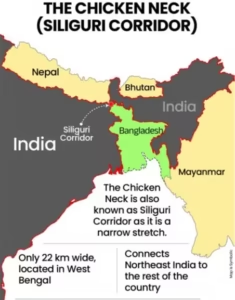
India has established three new Army garrisons at Dhubri, Kishanganj, and Chopra to enhance security around the Siliguri Corridor—a strategically vulnerable link between mainland India and the Northeast—due to geopolitical changes in Bangladesh and increasing Chinese activity near the tri-junction.
Siliguri Corridor
- A narrow stretch of land known as the ‘Chicken Neck’ connecting mainland India to the northeastern states.
- Around 60 km long and only 17–22 km wide, making it extremely vulnerable in terms of defence and logistics.
- Location: Situated in northern West Bengal, bordered by Nepal (west), Bangladesh (south), Bhutan (north), and near China’s Chumbi Valley.
- Strategic Value: Acts as the only uninterrupted land route for movement of goods, food, fuel, and military supplies to the Northeast.
- Military Importance: Critical for mobilizing troops and logistics toward Sikkim and Arunachal Pradesh, especially during LAC tensions with China.
- Security Concerns: Multiple international borders make the region prone to smuggling, infiltration, illegal migration, and potential military threats.
- Economic Role: Supports trade with Nepal and Bhutan and serves as a corridor for tourism to Darjeeling, Sikkim, and Bhutan.
New Eastern Garrison Deployments
- Lachit Borphukan Military Station, Dhubri (Assam)
- Forward base, Kishanganj (Bihar)
- Forward base, Chopra (West Bengal)
Purpose & Role:
- Provides continuous surveillance and faster troop mobilization.
- Enhances border security and defence preparedness along the India–Bangladesh and India–China frontier.
- Strengthens monitoring of cross-border movement, illegal migration, and security risks.
Regional Significance:
- Assam supported quick establishment of the Dhubri station named after Ahom warrior Lachit Borphukan, symbolizing regional pride and military readiness.
Key Drivers for Reinforcement
- Political changes in Bangladesh leading to potential shifts in border dynamics.
- Demographic shifts in border districts due to illegal immigration.
- China’s growing influence, including LAC build-up, trilateral cooperation with Pakistan and Bangladesh, and maritime ties.
This article has been updated and published in detail on our new platform. Please visit the link below for the latest version:
ARTICLE 32 OF THE INDIAN CONSTITUTION
TOPIC: (GS2) POLITY: THE HINDU
On the 75th anniversary of the Constitution, Chief Justice of India highlighted B. R. Ambedkar’s view of Article 32 as the most vital provision that allows people to approach the Supreme Court directly to protect their Fundamental Rights.
What is Article 32?
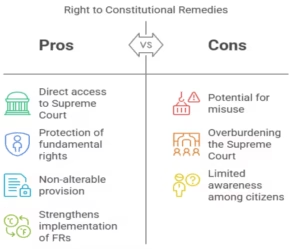
- It provides the Right to Constitutional Remedies, allowing citizens to move directly to the Supreme Court when their Fundamental Rights (Part III) are violated.
- It is considered a Fundamental Right in itself, ensuring legal protection and enforcement of rights.
- The Supreme Court has original jurisdiction under Article 32, while High Courts have similar powers under Article 226.
- The right under Article 32 can only be suspended during a National Emergency as per Article 359.
Writs under Article 32
- Habeas Corpus – Protection from unlawful detention.
- Mandamus – Orders public officials to perform their legal duties.
- Certiorari – To cancel unlawful decisions of lower courts or tribunals.
- Prohibition – Prevents lower courts from overstepping their jurisdiction.
- Quo Warranto – Checks illegal occupation of public office.
Ambedkar’s View on Article 32
- Ambedkar believed that rights are meaningless without proper remedies.
- He called Article 32 the “Heart and Soul of the Constitution” because it makes Fundamental Rights enforceable.
- He emphasized that the Supreme Court acts as the protector of individual liberty.
- Article 32 ensures a balance between constitutional adaptability and protection of core freedoms, working together with Article 368.
Conclusion
Article 32 empowers citizens to defend their Fundamental Rights and ensures that the Supreme Court remains the guardian of justice and liberty in India.
This article has been updated and published in detail on our new platform. Please visit the link below for the latest version:
SENKAKU–DIAOYU ISLANDS
TOPIC: (GS2) INTERNATIONAL RELATIONS: THE HINDU
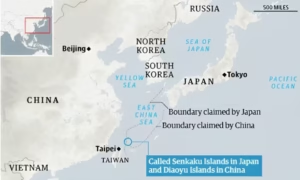
China recently sent its Coast Guard to patrol waters near the disputed Senkaku Islands, heightening tensions with Japan, especially following Tokyo’s latest remarks supporting Taiwan.
About the Senkaku–Diaoyu Islands:
- Location & Status: A cluster of uninhabited islands in the East China Sea, claimed by Japan, China, and Taiwan.
- Different Names: Senkaku (Japan), Diaoyu (China), Diaoyutai (Taiwan).
- Administration: Controlled by Japan since 1972 after the Okinawa Reversion Treaty with the U.S.
- Geography: Five islands and three rocks, covering around 7 sq km, largest being Uotsuri.
- Strategic Importance: Near major global shipping routes, making it vital for maritime trade and military presence.
- Natural Resources: Believed to have potential oil and gas reserves, highlighted by a 1969 UN study.
- Fishing Zone: Surrounding waters are rich in marine and fisheries resources.
- Geopolitics: The islands lie at the crossroads of China, Japan, Taiwan, and involve the U.S. security alliance, making it a key Indo-Pacific hotspot.
Nature of the Dispute:
- Japan’s Argument: Claims lawful incorporation in 1895, stating the islands were terra nullius with no prior Chinese control.
- China and Taiwan’s Argument: Cite historical maps, imperial records, and Qing-era administration showing long-term Chinese usage.
- Post-WWII Status: Came under U.S. control via the San Francisco Treaty (1951); returned to Japan in 1971, triggering Chinese protests.
- Resource Trigger: China’s active claim grew after the 1969 UN report on hydrocarbons.
- Major Flashpoints:
- 2012: Japan’s purchase of private islands led to violent protests in China.
- Now: China’s Coast Guard regularly patrols waters to assert claims.
Conclusion:
This dispute reflects nationalism, historical rivalry, and growing power competition between China, Japan, and the U.S., impacting Indo-Pacific security and India’s strategic interests.
This article has been updated and published in detail on our new platform. Please visit the link below for the latest version:
AMMONIUM NITRATE
TOPIC: (GS3) SECURITY: THE HINDU
Ammonium nitrate, which recently caused an explosion in Delhi, has also been used in several major bomb blasts in Mumbai in the past when mixed with other chemicals.
About Ammonium Nitrate
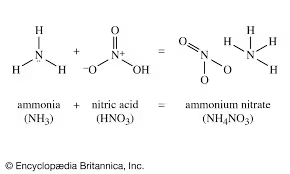
- Ammonium nitrate (NH₄NO₃) is a white crystalline solid produced on a large industrial scale.
- It is a chemical compound formed from ammonia and nitric acid.
- Widely used in agriculture as a nitrogen-rich fertilizer, it is also an oxidizing agent in industrial explosives.
- It melts at 170°C and dissolves easily in water. When heated in solution, it releases nitrous oxide (laughing gas).
- It is a key ingredient in commercial explosives, especially those used in mining operations.
Why Can Ammonium Nitrate Explode?
- In its pure form, ammonium nitrate is not explosive.
- It becomes explosive only when combined with fuels or other chemicals.
- To trigger an explosion, detonators or other initiators are required.
Legal Regulation in India
- As per the 2012 rules (updated in 2021), any mixture with over 45% ammonium nitrate is treated as an explosive.
- A District Magistrate can allow possession of up to 30 metric tonnes, but larger quantities need approval from PESO (Petroleum and Explosives Safety Organisation).
- PESO provides licenses for storage, transport, manufacturing, and use of ammonium nitrate.

This article has been updated and published in detail on our new platform. Please visit the link below for the latest version: