
Daily Current affairs 19 March 2026

Daily Current Affairs 19-March-2026

Share this Post

TRANSGENDER RIGHTS AMENDMENT BILL, 2026

TOPIC: (GS2) POLITY: THE HINDU

The Transgender Persons (Protection of Rights) Amendment Bill, 2026 was recently introduced in Parliament. It proposes major changes to the 2019 law.

Background

  • NALSA v. Union of India (2014): Supreme Court recognised transgender persons as “third gender” and upheld self-identification without medical proof.
  • 2019 Act: Legalised self-identification, issued identity cards, and created welfare boards.
  • 2026 Bill: Seeks to replace this rights-based approach with a medicalised framework.

Provisions of the 2026 Bill

  • Shift in Approach: Moves focus from identity-based recognition to biology-based recognition. Prioritises physical traits (chromosomes, hormones, genitalia) over lived identity.
  • Narrower Definition of Transgender: Recognises only Traditional socio-cultural groups (hijra, kinner, aravani, jogta). Excludes gender-fluid, non-binary, and self-perceived identities.
  • Removal of Self-Identification: Deletes the right to declare one’s gender without medical proof. Introduces Medical Board certification headed by senior doctors. District Magistrate to approve identity based on medical evaluation.
  • New Category Introduced: Recognises persons “forced” into transgender identity through coercion or surgery.
  • Institutional Changes: Welfare boards to include only senior officials (Director rank or above).

Stricter Penal Provisions

  • Forcing transgender identity (adult): 10 years–life imprisonment + ₹2 lakh fine.
  • Forcing transgender identity (child): Life imprisonment + ₹5 lakh fine.
  • Forced begging/servitude (adult): 5–10 years + ₹1 lakh fine.
  • Forced begging/servitude (child): 10–14 years + ₹3 lakh fine.

Criticism & Concerns

  • Violation of Self-Determination: Removes fundamental right to self-identify gender. Seen as a rollback of progressive jurisprudence.
  • Burden of Proof: Individuals must prove identity through medical certification. Activists argue identity is personal, not subject to external validation.
  • Social Stigma in Healthcare: Medical gatekeeping may expose trans persons to discrimination in hospitals.
  • Exclusionary Definition: Limits recognition to traditional communities. Ignores diversity of modern transgender identities.

Conclusion

The 2026 Bill marks a shift from rights-based recognition to medicalised control. While it strengthens punishments against exploitation, critics argue it undermines dignity, equality, and the constitutional principle of self-determination upheld in the NALSA judgment.

PARLIAMENTARY PANEL’S ON NITI AAYOG’S FINANCIAL PLANNING

TOPIC: (GS2) GOVERNANCE: THE HINDU

A Parliamentary Standing Committee on Finance has flagged poor financial planning by NITI Aayog and the Ministry of Planning, citing persistent underutilisation of budget allocations despite rising demands for funds.

Role of NITI Aayog

  • Established in 2015, replacing the Planning Commission.
  • Functions as the government’s policy think tank.
  • Promotes cooperative federalism and evidence-based policymaking.
  • Key roles:
    • Designing long-term policy frameworks.
    • Monitoring and evaluating schemes.
    • Advising Centre and States.
    • Supporting innovation and development.
  • Unlike the Planning Commission, it does not directly allocate funds but influences priorities and utilisation.

Committee’s Observations

  • Underutilisation of Funds: 2023–24: Expenditure ₹290.81 crore vs Budget Estimate (BE) ₹824.39 crore (~35%). 2024–25: Expenditure ₹282.61 crore vs BE ₹837.26 crore (~34%). Indicates structural issues in planning and execution.
  • Rising Allocations Despite Low Spending: Ministry sought ₹1,203.38 crore for 2026–27, a 22% increase. Committee criticised demand for higher allocations without proper utilisation.
  • Weak Implementation: Planned activities poorly executed. Quarterly Expenditure Plan (QEP) shows consistent gaps between planned and actual spending.
  • End-of-Year Spending Rush: Large amounts spent in the final quarter. Creates pressure to exhaust funds, risking poor quality expenditure.

Issues Highlighted

  • Poor fiscal discipline – inflated demands with low utilisation.
  • Administrative delays – slow approvals and weak monitoring.
  • Inefficient resource use – idle funds block development projects.
  • Violation of expenditure norms – excessive last-quarter spending.

Recommendations by Committee

  • Realistic Budgeting: Estimate expenditure accurately. Avoid inflated demands. Align allocations with actual needs.
  • Strengthened Monitoring: Conduct regular internal reviews. Ensure timely approvals. Match planning with expenditure targets.
  • Better Utilisation of Funds: Prevent idle funds. Implement schemes on time. Improve coordination between planning and execution.

Broader Implications

  • Impact on Development: Delays in projects reduce effectiveness of government programmes and affect service delivery.
  • Fiscal Responsibility: Persistent underutilisation undermines accountability and weakens fiscal discipline.
  • Governance Challenge: Reflects deeper issues in India’s public financial management system.

Conclusion

The Committee’s findings highlight a serious mismatch between planning and execution in NITI Aayog’s financial management. Without realistic budgeting, timely implementation, and monitoring, will not translate into effective development outcomes.

INDIA’S FUTURE DEMOGRAPHIC CHALLENGES

TOPIC: (GS3) ECONOMY: THE HINDU

A new report by the International Institute of Migration and Development (IIMD) and the Population Foundation of India highlights India’s demographic projections (2021–2051), to slower population growth, declining fertility, and rising ageing population.

What is Demographic Dividend?

  • Economic growth potential arising from a larger share of working-age population compared to dependents.
  • Opportunity: More workers → higher productivity → faster GDP growth.
  • Time-bound: India’s window lasts till 2041.

Demographic Trends

Population Growth

  • India’s population projected to rise from 1,355.8 million (2021) to 1,590.1 million (2051).
  • Average annual growth: 0.5%, much lower than earlier estimates.
  • Suggests India will not face a “population explosion.”

Declining Child Population

  • 0–4 years age group to fall from 113.5 million (2021) to 8.6 million (2051).
  • Reduced demand for new schools, risk of “uneconomic schools” with low enrolment.
  • Already visible: number of government schools dropped from 11.07 lakh (2014–15) to 10.18 lakh (2023–24).
  • Private schools increased from 2.88 lakh to 3.31 lakh in the same period.

Working-Age Population

  • Workforce (15–59 years): 833.8 million (65.2%) in 2021 → peak at 1,009 million (65.5%) in 2041 → decline to 998.1 million (62.8%) in 2051.
  • Demographic dividend window expected to close after 2041.

Ageing Population

  • Elderly (60+): 130.5 million (9.6%) in 2021325.3 million (20.5%) in 2051.
  • Median age: 28 years (2021)40 years (2051).
  • Rising demand for healthcare, pensions, and social security.

How to Utilise Demographic Dividend

  • Education & Skill Development: Upgrade schools, vocational training, and higher education.
  • Employment Generation: Create quality jobs in manufacturing, services, and technology. Encourage entrepreneurship and startups.
  • Gender Dividend: Increase women’s participation in the workforce. Provide safe workplaces, childcare support, and equal pay.
  • Healthcare & Family Planning: Continue investments in reproductive health Prevent unintended pregnancies and ensure women’s rights.
  • Silver Economy: Develop industries catering to elderly needs (healthcare, insurance, housing). Unlock a second demographic dividend through ageing population.

Future Prospects

  • India will move towards a stable, ageing, urban society by mid-century.
  • The challenge is to convert demographic potential into economic strength before the dividend window closes.
  • With proper planning, India can balance youth opportunities and elderly care, ensuring sustainable growth.

Way Forward

  • Skill Development & Education: Focus on quality education and vocational skills. Align skills with industry demand (AI, manufacturing, services).
  • Job Creation: Promote labour-intensive sectors like manufacturing. Boost MSMEs, startups, and digital economy.
  • Increase Female Workforce Participation: Provide Safe workplaces, Maternity benefits & childcare support. Ensure equal pay and opportunities.
  • Strengthen Healthcare System: Expand primary healthcare & geriatric care. Promote preventive healthcare and insurance coverage.

Conclusion

India’s demographic future presents both opportunities and challenges. While the youth bulge offers a chance for accelerated growth, the ageing population will demand robust healthcare and social security systems.

CHILDREN IN CONFLICT ZONES

TOPIC: (GS1) SOCIAL ISSUES: THE HINDU

Recent missile strikes on a school in Minab, Iran, and ongoing Israeli airstrikes in Lebanon have led to large-scale child fatalities, drawing global criticism and UN investigations into violations of international humanitarian law.
Children in Conflict Zones

Minab School Strike (Feb 28, 2026)

  • A missile hit Shajareh Tayyebeh school in Minab, Iran.
  • Around 168 children (aged 7–12) were killed.
  • Likely caused by a U.S. Tomahawk missile using outdated targeting data.
  • UN and Amnesty International condemned the attack as a failure to protect civilians.

Lebanon Airstrikes

  • Since March 2, 2026, Israeli strikes have killed over 100 children.
  • Entire families wiped out; death toll rising faster than in previous wars.
  • Reflects escalation in Israel’s military campaign.

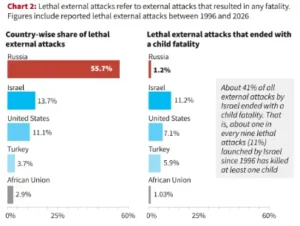
Data Analysis (1996–2026)

  • 2,500 external attacks recorded with child fatalities.
  • Israel: 41% of all such attacks; about 1 in 9 lethal strikes killed at least one child.
  • U.S.: 21% of child-fatality attacks; ~7% of its lethal strikes involved children.
  • Russia: 55% of lethal external attacks overall, but <2% involved child deaths.
  • Gaza (2023–25): ~20,000 children killed; infants formed 10% of casualties.

Grave Violations Against Children

  • The UN Security Council identifies six grave violations in war; killing and maiming of children is one of them. Other risks include:
  • Recruitment into armed groups.
  • Sexual violence and abduction.
  • Denial of humanitarian aid.

Conclusion

The data reveals a disturbing pattern of child casualties in external military operations by Israel and the U.S. Protecting children in conflict zones is not just a legal obligation but a moral imperative for the global community.

LADAKH MAGMATIC ARC

TOPIC: (GS1) GEOGRAPHY: THE HINDU

Scientists have recently studied the evolution of the Ladakh Magmatic Arc (LMA) in the northwestern Himalaya, shedding light on its geological history and tectonic significance.

Ladakh Magmatic Arc

  • A belt of igneous rocks in the Trans-Himalaya.
  • Formed between Jurassic (201.3 million years ago) and Eocene (33.9 million years ago).
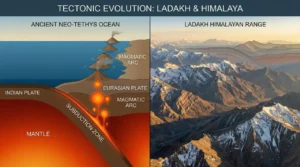
  • Represents a long-extinct volcanic system shaped by three major phases of magmatism.
Ladakh Magmatic ARC

Phases of Evolution

Island Arc Formation (160–110 million years ago)

  • Early stage: chain of volcanic islands in the Neo-Tethys Ocean.
  • Represented by the Dras–Nidar Island Arc Complex (DNIAC).
  • Magma mainly from mantle; little input from sediments.

Crustal Enrichment & Batholith Formation (103–45 million years ago)

  • Convergence of tectonic plates intensified magmatism.
  • Formation of large granite bodies called Ladakh Batholith (LB).
  • Magma mixing and crustal processes enriched composition.
  • Linked to the approaching India–Eurasia collision.

Post-Collision Magmatism (after 45 million years ago)

  • Continued tectonic activity after closure of Neo-Tethys Ocean.
  • Formation of mafic dykes (vertical sheets of volcanic rock).
  • Magma derived from enriched mantle sources.

Process of Formation

  • Originated due to subduction of oceanic crust beneath the Neo-Tethys Ocean.
  • Subduction triggered volcanic activity, leading to arc formation.
  • Over millions of years, evolved into batholiths and dykes after continental collision.

Significance

  • Provides insights into plate tectonics and Himalayan evolution.
  • Helps understand magma generation, crustal processes, and mountain building.
  • Important for geological research and mapping India’s tectonic past.

Conclusion

The Ladakh Magmatic Arc is a geological archive of the Himalaya’s tectonic journey from oceanic subduction to continental collision. Its study highlights the dynamic processes that shaped the Indian subcontinent.

EXERCISE SEA DRAGON 2026

TOPIC: (GS3) SEQURITY: THE HINDU

The Indian Navy is participating in Exercise Sea Dragon 2026, a multinational anti-submarine warfare drill led by the United States Navy.

Exercise Sea Dragon

  • It is an annual multinational anti-submarine warfare (ASW) exercise.
  • Conducted under the leadership of the United States Navy.
  • Aims to improve coordination among friendly navies in the Indo-Pacific region.
  • Focuses on detecting, tracking, and neutralizing submarines.

Location & History

  • Held every year since 2019.
  • Conducted at Andersen Air Force Base, Guam in the western Pacific.
  • Serves as a key platform for strengthening military partnerships.
  • Participating Countries (2026): United States, India, Australia, Japan, New Zealand

Key Features of the Exercise

  • Use of long-range surveillance aircraft like the P-8 Poseidon.
  • Gradual training progression: Simulated submarine tracking, Real-time detection of live submarines
  • Emphasis on: Speed and accuracy, Mission coordination, Real-world operational readiness

Importance of the Exercise

  • Enhances interoperability between partner nations.
  • Standardizes: Communication systems, Data-sharing mechanisms, Tactical procedures
  • Improves joint response capability in case of maritime threats.
  • Strengthens security cooperation in the Indo-Pacific region.

Assessment & Award

  • Each participating country is evaluated during different phases.
  • Performance is judged on mission success and coordination.
  • The top-performing nation is awarded the prestigious “Dragon Belt.”

Conclusion

Exercise Sea Dragon 2026 is a significant platform for improving anti-submarine warfare skills and boosting strategic cooperation among Indo-Pacific partners, ensuring maritime stability and collective security.

FLOATING LIDAR BUOY SYSTEM

TOPIC: (GS3) SCIENCE AND TECHNOLOGY: THE HINDU

The National Institute of Ocean Technology has successfully tested an indigenous Floating LiDAR Buoy near the coast of Muttom.

What is Floating LiDAR Buoy System?

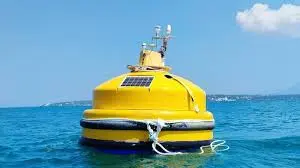
  • It is an advanced ocean-based monitoring device used to measure wind and atmospheric conditions over seas.
  • Combines: A floating structure (buoy), LiDAR (Light Detection and Ranging) technology
  • Designed for collecting accurate, real-time marine data.
Floating Lidar Buoy System

What is LiDAR Technology?

  • LiDAR stands for Light Detection and Ranging.
  • It works by: Emitting laser pulses into the atmosphere, Measuring the time taken for signals to return after hitting particles
  • Helps in calculating: Wind speed and direction and Air density and movement
  • Provides high precision data, even at higher altitudes.

Working Mechanism

  • The buoy floats on the ocean surface.
  • It continuously sends laser beams upward.
  • Reflected signals are analysed to: Track wind patterns, Study changes at different heights
  • Can measure wind profiles up to 300 metres above sea level, which is difficult for traditional tools.

Key Features

  • Operates in harsh marine environments.
  • Provides continuous and real-time data.
  • More flexible and cost-effective than fixed offshore towers.
  • Useful in remote ocean regions where installation of instruments is difficult.

Significance

  • Improves weather forecasting accuracy.
  • Helps in better cyclone and storm tracking.
  • Supports development of offshore wind energy projects.
  • Enhances understanding of climate change and ocean-atmosphere interaction.
  • Strengthens India’s scientific and technological capabilities in ocean studies.

Conclusion

The Floating LiDAR Buoy System is a major step towards advanced marine monitoring, enabling better disaster management, renewable energy planning, and climate research in India.


Write a Review

Your email address will not be published. Required fields are marked *