Table of Contents
ToggleILLEGAL IMMIGRATION AND CENTRIST POLITICS
TOPIC: (GS2) POLITY: THE HINDU
The Special Intensive Revision (SIR) of electoral rolls, which removed voters across nine States and three Union Territories, has triggered disputes linked with illegal immigration and national security.
Who are illegal immigrants?
- Foreigners without valid documents – Anyone who enters India without a valid passport, visa, or other legal travel documents.
- Overstayers – Foreign nationals who entered legally but stayed beyond the permitted period of their visa.
- Unauthorized entrants – Persons who cross the border secretly or through unauthorised routes, bypassing immigration checks.
Voter List Revision
- SIR aimed to clean rolls by removing dead, duplicate, and shifted voters.
- Opposition alleged it was part of a “vote theft” strategy.
- Public perception: Revision is necessary, but concerns about illegal immigrants dominate discourse.
Evidence of Illegal Immigration
- November 2025: Hundreds of Bangladeshi nationals intercepted at Hakimpur, West Bengal.
- December 2025: 19 Bangladeshis among 511 arrested in Uttarakhand under Operation Kalnemi.
- Such incidents reinforce public fears and strengthen calls for stricter border control.
Policy Developments
- Immigration and Foreigners Bill, 2025: Passed to regulate entry and stay of foreigners using tech-driven, time-bound processes.
- Opposition staged a walkout instead of engaging in nuanced debate.
- Needed a balanced discussion on legal authorisations, economic contributions, and refugee intake negotiations.
Why India Faces Heavy Immigration
- Geography and Borders: India shares 15,000+ km of land borders with countries like Bangladesh, Nepal, Myanmar, and Pakistan.
- Economic Pull Factors: India offers better job opportunities, higher wages, and access to markets compared to neighboring countries.
- Historical and Cultural Linkages: Shared ethnic, linguistic, and religious ties across borders encourage migration. Example: Bengali-speaking populations across India–Bangladesh border.
- Political Instability in Neighbourhood: Conflicts, persecution, and instability in Afghanistan, Myanmar (Rohingya crisis), and Sri Lanka (Tamil refugees) have pushed people into India.
- Legal Loopholes and Open Borders: Nepal and Bhutan citizens can enter India without visas under bilateral treaties. This facilitates both legal and undocumented migration.
Challenges
- Opposition denial of illegal immigration concerns alienates voters.
- Risk of conspiracy theories gaining traction if mainstream parties avoid the issue.
- Balancing human rights concerns with national security imperatives remains complex.
Way Forward
- Build a nuanced conversation on immigration, recognising both challenges and benefits.
- Focus on legal work permits, economic contributions, and refugee negotiations.
- Centrist politics must reconnect with public sentiment, addressing emotive issues without polarisation.
- India should learn from global experiences where ignoring immigration concerns weakened liberal parties.
Conclusion
A centrist approach requires acknowledging public concerns, framing them positively, and balancing national security with humanitarian values. This recalibration is vital for strengthening democracy and inclusive politics.
INDIA’S DILEMMA IN GLOBAL GOVERNANCE
TOPIC: (GS2) INTERNATIONAL RELATIONS: THE HINDU
U.S. President Donald Trump has invited India to join the proposed Board of Peace for Gaza, a new conflict-management mechanism.
Board of Peace for Gaza
- Mandate: Supervise Gaza’s transitional governance, stabilisation, and reconstruction. Oversee a temporary, technocratic Palestinian administration.
- The initiative, backed by some Islamic countries, has sparked debate on the future of the UN system and the authority of the UN Security Council (UNSC).
- Leadership: Chaired by Donald Trump; includes select invited nations and leaders (e.g., Tony Blair).
- UN Linkage: UNSC Resolution 2803 authorised the Board until 2027. Russia and China abstained; Global South countries supported.
- Future Vision: Trump aims to expand it into a global conflict-resolution model beyond Gaza.

India’s Position
- Invitation received: India has not yet responded; Pakistan also invited.
- Principles:
- Consistent support for a Two-State Solution (Israel and Palestine coexisting).
- Welcomed humanitarian aid and hostage release under Trump’s plan.
- Military Role: India ruled out sending troops to the International Stabilisation Force (ISF) since it is not a UN peacekeeping mission.
Global Governance Debate
- Criticism: Seen as undermining UN Charter principles and sovereign equality. Concentrates authority in a U.S.-led executive body, bypassing UNSC.
- Trump’s Approach: Long-standing skepticism of multilateralism (withdrawal from UNESCO, WHO, etc.). Linked to Project 2025, which advocates reducing U.S. commitments to global institutions.
- Risk: Could divert legitimacy, funds, and attention away from the UN. May become a precedent for ad hoc coalitions replacing multilateral forums.
Challenges and Way Ahead
- For Global Order: Weakening of UN centrality. Rise of exclusive, power-driven governance clubs. Threat to rules-based international order.
- For India: Balancing commitment to multilateralism with pragmatic U.S. engagement. Risk of undermining India’s push for UNSC reform.
- Options for India:
- Calibrated engagement: Participate diplomatically but avoid military involvement.
- Defend UN-centric multilateralism: Reaffirm support for UNSC-authorised mechanisms.
- Strategic autonomy: Balance ties with U.S. while safeguarding principles.
- Push for UN reform: Use the debate to highlight urgency of UNSC restructuring.
Conclusion
The initiative offers flexibility in conflict resolution, it challenges the UN-led multilateral system India has long supported. Navigating this moment will test New Delhi’s ability to balance principle with pragmatism in an evolving global order.
INDIA’S DIPLOMATIC OPPORTUNITIES IN 2026
TOPIC: (GS2) INTERNATIONAL RELATIONS: THE HINDU
On Republic Day 2026, the European Union’s leadership will be chief guests, marking a shift from inviting individual nations to engaging blocs. This reflects India’s growing focus on coalition diplomacy in a fragmented global order.
Changing Global Context
- Bilateral ties remain demanding, especially with Washington and Beijing.
- Neighbourhood challenges continue to require constant attention.
- Global forums like the UN and G-20 struggle to deliver outcomes due to power rivalries.
- India’s opportunity lies in “white spaces” – areas where no single power leads, but coalitions can act.
Working with Europe
- EU presence signals intent to push the India–EU Free Trade Agreement (FTA).
- Engagement is not just about tariffs but also market access, data standards, and sustainability rules.
- Benefits for India:
- Stronger access to European markets.
- Positioning in restructured global value chains.
- Insurance against U.S. trade pressures.
- Challenge: Higher compliance costs for Indian firms.
- EU seeks to reduce dependence on China and hedge against U.S. unpredictability, opening a window for India.
BRICS – Political Test
- BRICS expansion has widened reach but diluted focus.
- Members demand stronger Global South representation and alternatives in finance.
- As chair in 2026, India can: Use New Development Bank guarantees effectively. Push practical toolkits for implementation.
- Risks: U.S. tariff threats and anti-West rhetoric.
- India must balance reform with pragmatism, avoiding extreme positions like de-dollarisation.
Quad – Delivering Public Goods
- Possible Quad summit in India with U.S. President Trump attending.
- Focus areas: maritime domain awareness and resilient ports for Indian Ocean states.
- India can make Quad useful by offering services and rapid-response capabilities.
- Example: Operation Sagar Bandhu in Sri Lanka after Cyclone Ditwah showed India’s ability to act quickly.
Limits of Larger Forums
- UN remains important for legitimacy but weak in delivery.
- G-20 faces agenda fights; U.S. boycott of Johannesburg summit (2025) showed fragility.
- Smaller coalitions increasingly drive outcomes.
Conclusion
India’s strength in 2026 lies in shaping smaller coalitions – Europe for standards, BRICS for functionality, and Quad for public goods. By choosing priorities wisely and acting decisively, India can turn diplomatic gaps into opportunities for global leadership.
TAMIL NADU ASSURED PENSION SCHEME (TAPS)
TOPIC: (GS3) ECONOMY: THE HINDU
On January 3, 2026, the Tamil Nadu government launched the Tamil Nadu Assured Pension Scheme (TAPS).
What is TAPS?
- TAPS (Tamil Nadu Assured Pension Scheme) is a new pension system that guarantees a fixed monthly pension to government employees after retirement.
- It is a hybrid model—combining features of the Old Pension Scheme (OPS) and Contributory Pension Scheme (CPS).
- Both the employee and the government contribute to it.
Why is TAPS Needed?
- OPS was financially unsustainable for the government due to rising pension costs.
- CPS did not provide enough security as it did not assure a fixed monthly pension.
- TAPS was introduced to balance employee welfare with government’s financial stability.
Features of TAPS
- Effective from January 1, 2026.
- Contribution: 10% of basic pay + DA by employee, with matching government contribution.
- Pension Calculation: 50% of last month’s basic pay (not average of last 12 months as in UPS).
- Eligibility: Pension assured regardless of length of service.
- DA Benefits: Pensioners and family pensioners get DA hikes equal to serving employees.
- Family Pension: 60% of last drawn pension to surviving family.
- Gratuity: Death-cum-retirement gratuity up to ₹25 lakh.
- Compassionate Pension: For CPS retirees before TAPS implementation.
- Financial Impact: One-time cost of ₹13,000 crore; annual contribution ~₹11,000 crore.
Challenges
- Short-term fiscal stress due to dual burden of OPS retirees and new TAPS contributions.
- Long-term sustainability depends on revenue growth.
- Employee dissatisfaction persists as some demand full OPS restoration.
Old Pension Scheme (OPS)
- The government fully pays for the pension; employees do not contribute.
- Pension amount is revised after every Pay Commission.
- Dearness Allowance (DA) is the same as that of serving employees.
- Nearly 2 lakh employees are covered under this scheme.
Contributory Pension Scheme (CPS)
- Introduced after 2003, similar to the National Pension System (NPS).
- Employees contribute 10% of basic pay + DA, and the government contributes the same amount.
- It does not guarantee a fixed monthly pension; only a lump-sum amount is paid at retirement.
- Pension amount does not automatically increase with inflation.
- Returns are lower than NPS because funds are invested mainly in LIC and Treasury Bills.
Conclusion
TAPS represents Tamil Nadu’s attempt to balance fiscal responsibility with employee welfare, by blending OPS’s assured benefits with CPS’s contributory model. Its success will depend on financial management and acceptance among government staff.
TIGER GLOBAL TAX RULING
TOPIC: (GS2) POLITY: THE HINDU
The Supreme Court has ruled that Tiger Global’s Flipkart stake sale to Walmart is taxable in India, rejecting treaty benefits under the India–Mauritius DTAA. The verdict is a landmark for foreign investors and India’s startup ecosystem.
Background
- Tiger Global exited Flipkart in 2018 via Mauritius-based entities.
- Claimed exemption under India–Mauritius DTAA using the “grandfathering clause.”
- Tax authorities rejected, citing lack of independent control in Mauritius.
- AAR (2020): Held structure was tax-avoidance oriented.
- Delhi HC (2024): Favoured Tiger Global.
- Supreme Court (2026): Reversed HC, ruled gains taxable in India.
Key Observations
- DTAA benefits not automatic; Tax Residency Certificate (TRC) alone insufficient.
- Substance over form principle reinforced – genuine operations and decision-making required.
- Flipkart transaction fell outside treaty scope.
Implications
- Weakens reliance on DTAA for capital gains exemption.
- Raises uncertainty for venture capital/private equity exits.
- Offshore structures via Mauritius/Singapore face closer scrutiny.
- Compliance costs and risk management (insurance, indemnities) likely to rise.
- Startup funding slowdown already visible – $10.5 billion raised in 2025 (↓17% from 2024).
Challenges
- Investor Confidence: Foreign investors may hesitate due to tax unpredictability.
- Litigation Risk: More disputes likely, increasing transaction costs.
- Exit Planning: Complexities in structuring deals and valuations.
- Startup Ecosystem: Funding slowdown worsened by tax uncertainty.
- Global Perception: India may be seen as a difficult jurisdiction for cross-border exits.
Way Forward
- Clear Guidelines: Government should issue transparent rules on DTAA applicability and grandfathering.
- Advance Rulings Reform: Strengthen AAR to provide faster, binding clarity to investors.
- Tax Certainty: Build mechanisms for pre-deal tax agreements to reduce disputes.
- Balanced Approach: Ensure tax enforcement without discouraging foreign capital inflows.
- Global Coordination: Align with international best practices to reassure investors.
- Startup Support: Provide incentives or simplified compliance for genuine startup investments to sustain growth momentum.
Conclusion
The Tiger Global ruling underscores India’s shift toward substance-based taxation in cross-border deals. The challenge for policymakers is to balance investor confidence with fair taxation, ensuring India remains attractive for global capital while protecting revenue interests.
INDIAN BISON (GAUR)
TOPIC: (GS3) ENVIRONMENT: THE HINDU
The population of Indian bison (gaur) in Odisha’s Debrigarh Wildlife Sanctuary has shown a remarkable rise, increasing by 189 individuals in a year, taking the total count to 848.
Indian Bison
- Largest species among wild cattle (family Bovidae).
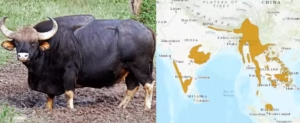
- Distribution: Native to South and Southeast Asia.
- Habitat: Evergreen, semi-evergreen, and moist deciduous forests with open grasslands.
- Prefer hilly terrain below 1,500–1,800 m with undisturbed forest tracts and abundant water.
Conservation Status
- IUCN Red List: Vulnerable.
- CITES: Appendix I.
- Wildlife Protection Act, 1972: Schedule I (highest protection).
Ecological Importance
- Maintains forest ecological balance.
- Serves as prey for apex predators like tigers.
- Influences vegetation dynamics and aids seed dispersal.
Threats
- Habitat loss and fragmentation.
- Vulnerable to diseases from domestic cattle (e.g., rinderpest, hoof-and-mouth disease).
Debrigarh Wildlife Sanctuary
- Location: Bargarh district, Odisha, near Hirakud Dam on the Mahanadi River.
- Vegetation: Mixed and dry deciduous forests.
- Flora: Sal, Asana, Bija, Aanla, Dhaura.
- Fauna: Indian leopard, sloth bear, chousingha, sambar deer, and gaur (Indian bison).
Conclusion
The rise in gaur numbers at Debrigarh Sanctuary reflects effective habitat protection and management. Sustained efforts against habitat loss and disease transmission are vital to secure the long-term survival of this vulnerable species.
GLOBAL RISKS REPORT 2026
TOPIC: (GS2) INTERNATIONAL RELATIONS: THE HINDU
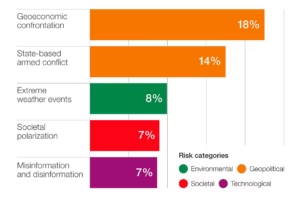
The World Economic Forum (WEF) has released the Global Risks Report 2026, identifying geoeconomic confrontation as the most severe near-term global risk. The report is based on inputs from over 1,300 global experts and was published ahead of the Davos meeting.
About the Report
- 21st edition of the Global Risks Report.
- Examines risks across three horizons:
- Immediate (2026)
- Short to medium term (up to 2028)
- Long term (up to 2036)
- Respondents include experts from academia, business, government, civil society, and international organisations.
Top Risks in 2026
- Geoeconomic confrontation ranked first – use of tariffs, sanctions, restrictions, and control of critical minerals.
- Economic Risks: Economic downturn moved to rank 11. Inflation rose to rank 21. Driven by debt stress, fragile financial systems, and geopolitical rivalry.
- Technological Risks: Misinformation/disinformation ranked 2nd in short term. Cyber insecurity at rank 6. AI risks job loss, social harm, military misuse.
- Societal Risks: Rising political and social polarisation. Weak trust in institutions.
- Environmental Risks: Short term: extreme weather (rank 4), pollution (rank 9). Long term: environmental risks dominate half of top 10. Extreme weather is top long-term risk.
- Global Order Transition: Shift toward multipolar and fragmented world. 68% respondents expect contested multipolarity in next decade. Bretton Woods institutions under strain.
Conclusion:
The report warns of rising economic weaponisation, technological disruptions, and environmental crises, alongside a fragmented global order. For India, understanding these risks is crucial for shaping foreign policy and economic resilience.
COCONUT ROOT WILT DISEASE
TOPIC: (GS3) SCIENCE AND TECHNOLOGY: THE HINDU
Coconut Root Wilt Disease is spreading rapidly across Kerala, Tamil Nadu, and Karnataka, damaging lakhs of coconut palms and causing heavy yield losses. The outbreak has raised alarm among farmers and policymakers.
About the Disease
- A chronic but non-fatal disease affecting coconut palms.
- Caused by a phytoplasma, a pathogen restricted to the phloem tissue.
- Leads to gradual decline in palm health and productivity.
- Infected palms survive but act as continuous sources of infection.

Origin and Spread
- First reported over 150 years ago from Erattupetta, Kerala.
- Endemic in southern India, persisting across major coconut belts.
- Transmission: Mainly through insect vectors.
- Spread worsens due to:
- Dense coconut plantations.
- Wind-assisted movement of vectors.
- Stress factors like extreme temperatures and new sucking pests.
Vectors
- Disease spreads via sap-sucking insects.
- Key vectors: Stephanitis typica, Proutista moesta
Impact
- Causes long-term productivity decline in coconut palms.
- Threatens livelihoods in major coconut-growing states.
- Persistent infection makes eradication difficult.
Conclusion
Coconut Root Wilt Disease is a serious agricultural challenge in southern India. Tackling it requires integrated pest management, improved surveillance, and farmer awareness to protect productivity and ensure sustainable coconut cultivation.