Table of Contents
ToggleLinguistic Regionalism in Post-Independence India: A Deep Dive into Identity, Politics, and Integration
1. Defining Linguistic Regionalism
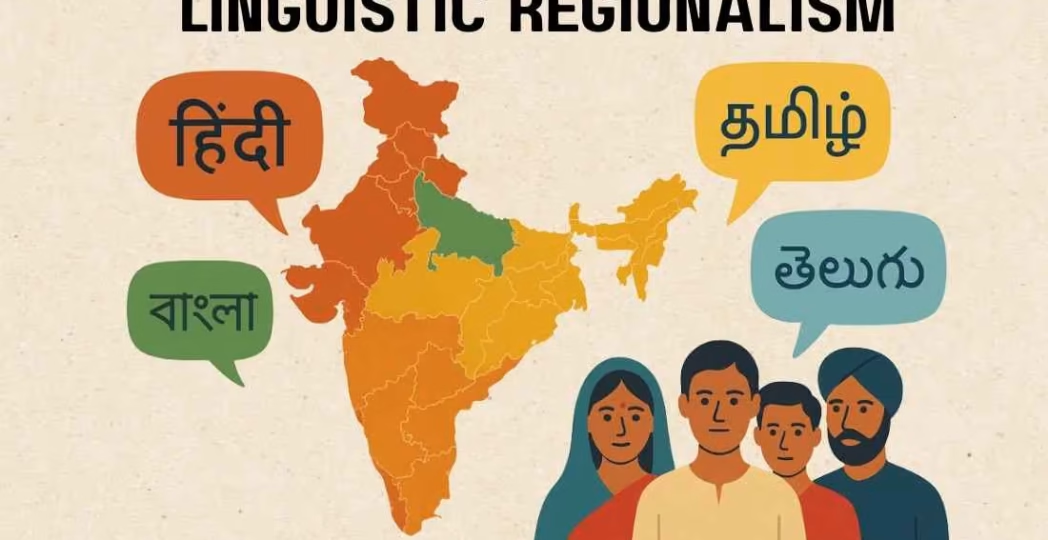
Linguistic regionalism refers to the intense emotional and political attachment of a group of people to their native language, often manifesting as a demand for political recognition, administrative autonomy, or the creation of separate provincial boundaries based on linguistic homogeneity.
In the Indian context, it is not merely about communication; language is seen as a carrier of culture, history, and “sub-national” identity. While often viewed as a centrifugal force (tending to pull away from the center), linguistic regionalism in India has paradoxically served as a tool for democratic deepening.
2. The Colonial Legacy and the Seeds of Language Politics
During British rule, administrative boundaries were drawn based on military conquest and administrative convenience. This resulted in multilingual provinces like the Madras Presidency (Tamil, Telugu, Kannada, Malayalam) and the Bombay Presidency (Marathi, Gujarati, Kannada).
- INC Strategy: In 1920, at the Nagpur Session, the Indian National Congress (INC) reorganized its internal provincial committees on a linguistic basis. This gave the masses a sense that independence would bring a reorganization of India’s internal map to reflect their mother tongues.
- The Nehru Report (1928): Explicitly stated that “the redistribution of provinces should take place on a linguistic basis.”
3. Post-1947 Dilemma: Unity vs. Identity
Upon achieving independence, the national leadership—primarily Jawaharlal Nehru, Sardar Patel, and Rajendra Prasad—shifted their stance. The trauma of Partition along religious lines made them fear that any further division based on “primordial identities” like language might lead to the balkanization of India.
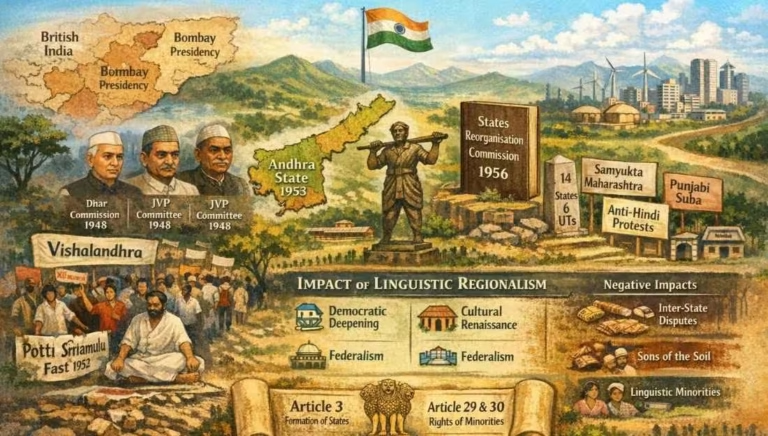
The Dhar Commission (1948)
The government appointed the Linguistic Provinces Commission under S.K. Dhar to examine the feasibility of linguistic states.
- Verdict: It rejected the linguistic basis, favoring “administrative convenience” and “national security.”
- Reaction: Massive protests in the South, particularly among Telugu speakers.
The JVP Committee (1948)
Comprising Jawaharlal Nehru, Vallabhbhai Patel, and Pattabhi Sitaramayya.
- Verdict: While acknowledging popular sentiment, it advised caution and recommended postponing linguistic reorganization to focus on national consolidation.
4. The Catalyst: The Creation of Andhra State (1953)
The movement for ‘Vishalandhra’ (Greater Andhra) reached a breaking point when Gandhian leader Potti Sriramulu began a fast-unto-death in 1952. After 56 days, his death triggered massive violence.
- Outcome: Nehru was forced to announce the creation of Andhra State, the first linguistic state in independent India, carved out of the Madras Presidency in 1953.
5. The States Reorganisation Commission (SRC) 1953-55
The creation of Andhra opened the floodgates. To systematically address these demands, the SRC (Fazl Ali Commission) was formed.
Key Criteria for Reorganisation:
- Preservation of Unity: Any reorganization must strengthen national security.
- Linguistic and Cultural Homogeneity: Recognized as a valid but not the sole factor.
- Financial Viability: States must be economically sustainable.
- Administrative Convenience: Ensuring the smooth functioning of the state machinery.
The States Reorganisation Act (1956)
This landmark act abolished the Part A, B, C, and D classifications and created 14 States and 6 Union Territories.
6. Major Linguistic Movements After 1956
A. The Bilingual Bombay Crisis (1956–1960)
The 1956 Act kept Bombay as a bilingual state for Marathi and Gujarati speakers. This led to the Samyukta Maharashtra Samiti and the Mahagujarat Andolan.
- Result: In 1960, the state was bifurcated into Maharashtra and Gujarat.
B. The Punjab Suba Movement (1966)
The Akali Dal demanded a “Punjabi Suba” for Punjabi speakers.
- Result: The Shah Commission recommended the division of the state into Punjab (Punjabi speakers), Haryana (Hindi speakers), and the Union Territory of Chandigarh.
C. The Anti-Hindi Agitations (1960s)
A critical facet of linguistic regionalism was the resistance to Hindi as the sole official language.
- The 1965 Crisis: As the 15-year transition period for English ended, riots broke out in Tamil Nadu.
- The Three-Language Formula: Introduced as a compromise to ensure students learned their mother tongue, English, and a third language (Hindi in non-Hindi states, and a modern Indian language in Hindi-speaking states).
7. The Shift: From Language to Development (2000s)
By the turn of the millennium, the nature of regionalism shifted. The creation of Uttarakhand, Jharkhand, and Chhattisgarh in 2000 was driven by:
- Regional economic backwardness.
- Administrative neglect of hilly or tribal belts.
- Political aspirations of local leaders.
The formation of Telangana (2014) was a unique case where two regions spoke the same language (Telugu) but felt culturally and economically distinct due to historical reasons.
8. Impact of Linguistic Regionalism: A Critical Analysis
Positive Impacts:
- Democratic Deepening: Governance became accessible in local languages, increasing political participation.
- Cultural Renaissance: Regional literatures, arts, and cinema flourished under state patronage.
- Federalism: It forced the Center to negotiate with regional powers, strengthening the federal structure.
Negative Impacts:
- Inter-State Disputes: Boundary disputes (e.g., Belagavi) and water disputes (e.g., Cauvery) often take a linguistic/ethnic color.
- Sons of the Soil Doctrine: Discrimination against “outsiders” or migrants in employment (e.g., Shiv Sena’s early politics).
- Linguistic Minorities: Small linguistic groups within large linguistic states often face marginalization.
9. Conclusion for UPSC Aspirants
Linguistic regionalism in India has not been a precursor to secession (unlike in many other countries). Instead, it acted as a mechanism for accommodating diversity. For the exam, remember that the “Indian Model” of secularism and federalism thrives on recognizing these identities rather than suppressing them.
Key Constitutional Provisions to Remember:
- Article 3: Parliament’s power to form new states.
- Article 29 & 30: Protection of linguistic interests of minorities.
- Article 347: Special provisions relating to language spoken by a section of the population.
- 8th Schedule: List of 22 scheduled languages.
UPSC Prelims: PYQs & Practice Questions
Previous Year Questions (PYQs)
Question 1 (UPSC 2005)
Q: Consider the following statements:
1. The Dhar Commission (1948) recommended the reorganization of states on the basis of linguistic factors.
2. The JVP Committee (1949) also supported the linguistic basis for the reorganization of states.
Which of the statements given above is/are correct?
Options:
(a) 1 only | (b) 2 only | (c) Both 1 and 2 | (d) Neither 1 nor 2
Answer: (d)
Explanation: Both the Dhar Commission and the JVP Committee (Jawaharlal Nehru, Vallabhbhai Patel, and Pattabhi Sitaramayya) did not support language as the primary basis at that stage, due to concerns about national unity and security.
Question 2 (UPSC 2001)
Q: Which Article of the Constitution of India provides that it shall be the endeavour of every state to provide adequate facilities for instruction in the mother tongue at the primary stage of education?
Options:
(a) Article 349 | (b) Article 350 | (c) Article 350A | (d) Article 351
Answer: (c)
Explanation: Article 350A directs every state to provide facilities for mother-tongue instruction at the primary stage, especially to safeguard the linguistic interests of minorities.
Practice Question 3
Q: With reference to the "Three-Language Formula", consider the following statements:
1. It was proposed by the Kothari Commission (1964–66).
2. It mandates the study of Hindi in all South Indian states.
3. It was designed as a strategy to accommodate linguistic regionalism and promote national integration.
Which of the statements given above are correct?
Options:
(a) 1 and 2 only | (b) 1 and 3 only | (c) 2 and 3 only | (d) 1, 2, and 3
Answer: (b)
Explanation: The formula is associated with the Kothari Commission and aimed at national integration. It does not mandate Hindi in all South Indian states; it broadly suggests learning a modern Indian language along with the regional language and English (often including Hindi in non-Hindi states, but not as a compulsory rule everywhere).
Practice Question 4
Q: The "Official Languages Act", which allowed for the continued use of English for official purposes indefinitely, was passed in which year?
Options:
(a) 1950 | (b) 1956 | (c) 1963 | (d) 1967
Answer: (c)
Explanation: The Official Languages Act, 1963 enabled the continued use of English for official purposes beyond the initial constitutional transition period, addressing fears of Hindi-only imposition in non-Hindi speaking states.
UPSC Mains: Previous Year Questions (PYQs)
Linguistic Reorganisation: Democracy & National Unity
Question: "Linguistic reorganisation of states has not only helped in deepening Indian democracy but also in strengthening the national unity." Comment. (UPSC 2023)
Linguistic States: Indian Unity
Question: Has the formation of linguistic states strengthened the cause of Indian Unity? (UPSC 2016)
Anti-Hindi Agitations: Causes & Resolution
Question: Discuss the factors that led to the anti-Hindi agitations in India. How did the government resolve this crisis? (UPSC 1998/Modified)
Linguistic Reorganisation: Necessary Evil?
Question: "The reorganisation of states on a linguistic basis was a necessary evil." Critically examine this statement in the context of post-independence India. (UPSC 2009)
Linguistic Regionalism & Federal Structure
Question: Discuss the impact of linguistic regionalism on the federal structure of India. (UPSC 2011/Modified)
Mains Practice Questions
Sons of the Soil: Linguistic Regionalism & Migration
Question: The 'Sons of the Soil' doctrine is a negative manifestation of linguistic regionalism. Examine its socio-economic impacts on inter-state migration in India. (250 Words)
Linguistic Regionalism as a Safety Valve in South India
Question: Analyze how linguistic regionalism acted as a safety valve for regional aspirations, preventing the growth of secessionist tendencies in Southern India. (250 Words)
8th Schedule: Managing Competing Linguistic Claims
Question: Evaluate the role of the 8th Schedule of the Indian Constitution in managing the competing claims of different linguistic groups in India. (250 Words)
Frequently Asked Questions (FAQs)
Is linguistic regionalism the same as communalism?
- No. While both are forms of identity politics, linguistic regionalism is based on shared language and culture, whereas communalism is based on religious identity. In India, linguistic identity has often cut across religious lines to unite people (e.g., the Punjabi Suba movement or the Bengali identity in 1971).
What is the "Sons of the Soil" doctrine?
- It is a radical form of regionalism where local linguistic groups claim exclusive rights over their state’s resources, land, and jobs, often discriminating against migrants who speak different languages.
Why did Potti Sriramulu fast to death?
- He demanded a separate state for Telugu-speaking people (Andhra) to be carved out of the multi-lingual Madras Presidency, fearing that Telugu interests were being neglected by the Tamil-dominated administration.
Does the Indian Constitution recognize a "National Language"?
No. India does not have a “National Language.” Article 343 specifies Hindi in Devanagari script as the “Official Language” of the Union, with English as an associate official language.
How many languages are currently in the 8th Schedule?
- There are 22 languages. Originally, there were 14. Subsequent additions included Sindhi (1967), Konkani, Manipuri, Nepali (1992), and Bodo, Dogri, Maithili, and Santhali (2003).
What is the difference between a State and a Union Territory in the context of reorganisation?
- States are administrative units with their own elected governments and a share of federal power. Union Territories (UTs) are governed directly by the Central Government. Many regions (like Himachal Pradesh, Manipur, and Tripura) began as UTs to ensure stability before being granted full statehood.