
A recent car explosion near Delhi’s Red Fort has exposed a new trend of terrorists using advanced digital technologies for planning, funding, and execution highlights the growing shift toward encrypted and covert digital platforms.
Shift to Digital Tradecraft
- Terrorists are using secure and encrypted platforms like Threema, VPNs, cloud servers, and closed online communities.
- These platforms do not require phone numbers or identity proof, protecting terrorists from surveillance.
- They are also using dark web tools, virtual private servers, and bypassing traditional monitoring methods.
Features of Digital Terrorism
- Encrypted Communication: Messaging apps with end-to-end encryption reduce traceability. Some don’t need SIM cards or identity proof, making monitoring difficult.
- Digital Secrecy and Anonymity: Use of VPNs, proxies, and encrypted cloud servers hides location and identity. Terrorists create private networks for planning, coordination, and data sharing.
- Operational Discipline: Completely avoids traceable methods like mobile phones and public internet. Use of isolated offline networks, code names, and hidden digital storage.
- Emerging Technologies: Use of AI, deepfake tools, cryptocurrency, and memory-wiping technologies. Digital financial transfers leave minimal physical evidence.

Implications for National Security
- Traditional surveillance methods like tapping phones, tracking SIMs, and email monitoring are becoming ineffective.
- Digital anonymity reduces the ability of law enforcement to track suspects.
- Terror attacks may involve fewer people physically, but more digital actors operating remotely.
- Radicalisation, recruitment, and training can occur entirely in the digital space.
Challenges for Law Enforcement
- Lack of trained digital forensic teams.
- Limited cooperation between agencies and low investment in cyber surveillance.
- Poor coordination between national security bodies and private tech companies.
- Legal and policy frameworks have not adapted to encrypted digital ecosystems.
Way Forward
- Strengthen Digital Forensics Teams to track online activities, decode encrypted platforms, and monitor remote operations.
- Create Strong Cyber Laws to regulate encrypted communication platforms and enhance accountability of service providers.
- Enhance Inter-agency Coordination between intelligence, police, cybercrime units, and international agencies.
- Public Awareness and Digital Literacy to prevent exploitation of vulnerable individuals online.
- Promote Tech Collaboration with AI, data analytics, and predictive policing tools.
Conclusion
Digital terrorism represents a silent yet powerful threat, operating beyond physical borders. To counter this, India must shift from traditional intelligence to a technology-driven approach, combining cyber skills, strong laws, and coordinated action.
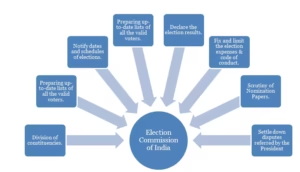
During the SIR exercise, the Opposition raised concerns over the impartiality and independence of the Election Commission of India, especially in light of the new appointment mechanism introduced through the 2023 Act.
Constitutional Provisions Ensuring Independence and Authority of ECI
- Article 324: Provides the ECI with the power to supervise, direct, and control elections to Parliament, State Legislatures, and offices of President and Vice President.
- Article 325: Ensures no discrimination based on religion, race, caste, or sex for inclusion in electoral rolls, promoting equality in voting rights.
- Article 326: Establishes universal adult suffrage, meaning all citizens above 18 years have the right to vote, strengthening democratic participation.
- Article 327: Empowers Parliament to make laws related to elections, such as the Representation of the People Acts.
- Article 328: Empowers State Legislatures to make election laws for their states, as long as they don’t conflict with Parliament’s laws.
Changes Introduced by the 2023 Act
- New Appointment Panel: Prime Minister (Chairperson), Leader of Opposition, Lok Sabha, Union Cabinet Minister nominated by PM
- Impact: Replacing the Chief Justice of India with a Cabinet Minister increases executive influence, raising concerns about neutrality in appointments.
- Service Conditions: CEC and ECs will have salaries and perks equivalent to Cabinet Secretary.
Impact: Critics argue this may symbolically lower their constitutional authority by equating them with executive officials. - Fixed Tenure: Tenure of six years or until age 65, whichever is earlier.
Impact: Promotes continuity, but age limit may shorten the effective tenure. - Removal Provisions Unchanged: CEC remains protected; ECs removable only on CEC’s recommendation, maintaining a core constitutional safeguard.
Challenges to Independence
- Executive-dominated appointment panel weakens neutrality.
- Exclusion of CJI reduces the balance of constitutional institutions.
- Status dilution may weaken institutional stature.
- Administrative dependence on government limits functional autonomy.
- Post-retirement prospects may influence decision-making.
Conclusion
The Election Commission remains a crucial constitutional institution safeguarding democratic integrity. Strengthening its autonomy and ensuring institutional neutrality are essential for preserving public trust in the electoral process.
The Supreme Court recently struck down several provisions of the Tribunal Reforms Act, 2021, stating that they violated constitutional principles. The Court held that the government’s attempt to control tribunal appointments, service conditions, and tenure undermined judicial autonomy.
About Tribunals
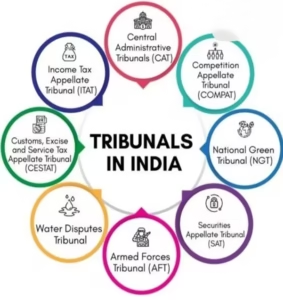
- Tribunals are quasi-judicial bodies created to resolve specific types of disputes like taxation, environment, administrative, and corporate matters.
- They provide speedy, specialized, and cost-effective justice, reducing the burden on regular courts.
- 42nd Constitutional Amendment (1976) introduced Articles 323A and 323B, empowering Parliament to set up tribunals.
- Tribunal decisions are subject to judicial review under Articles 32 and 226, protecting fundamental rights.
Why the SC Struck Down Provisions
The Supreme Court observed that the 2021 Act:
- Allowed excessive government control over appointments, tenure, and salaries of tribunal members.
- Reduced tenure from five years to four, affecting independence and performance.
- Enabled the government to override recommendations of the selection committee, weakening autonomy.
- Was merely a repackaged version of the previous Tribunal Ordinance, which was already quashed by the Court in 2021.
SC’s Key Observations
- The Act violated the basic structure of the Constitution, particularly judicial independence and separation of powers.
- The Centre cannot ignore judgments of the Supreme Court, as judicial decisions are binding under Article 141.
- Judicial review (Article 13 & 32) is a basic feature, and any law undermining it is unconstitutional.
- A tribunal must have the same independence and credibility as a court.
Directions by the Supreme Court
- Ordered the Centre to establish a National Tribunals Commission to regulate appointments, service conditions, and ensure transparency.
- Directed that appointments be free from executive dominance, ensuring separation of powers.
- Urged reforms to make tribunals more uniform, accountable, and efficient.
Way Forward
- Establish an independent Tribunal Commission for standardized recruitment and administration.
- Ensure adequate tenure, salary protection, and autonomy to tribunal members.
- Promote technology, e-courts, and better case management for faster disposal.
Conclusion
Tribunal independence is vital for their credibility and for upholding justice. Any reform must strengthen, not weaken, judicial autonomy and constitutional supremacy.
A recent IUCN report presented at the Conservation Congress in Abu Dhabi warns that dugongs in India are facing a serious risk of extinction.
Dugongs: India’s Sea Cows
- Dugongs (Dugong dugon) are large, calm marine mammals often associated with mermaid folklore.
- Measuring up to 10 feet and weighing nearly 420 kg, they are closely related to manatees.
- Being exclusively herbivorous, they consume 30–40 kg of seagrass daily, inhabiting shallow and sheltered coastal waters like lagoons, estuaries, and bays.

Ecological Significance
- Dugongs are crucial for maintaining vibrant seagrass ecosystems—one of the world’s most effective carbon sinks.
- Their grazing prevents overgrowth, recycles nutrients, and enhances carbon storage. Healthy seagrass beds boost marine biodiversity and support commercially valuable fish, shellfish, and invertebrates.
- Areas with dugong presence generate up to ₹2 crore more fish annually, highlighting their role as ecosystem engineers.
Conservation Status
- IUCN Red List: Vulnerable
- Wildlife Protection Act, 1972: Schedule I (highest protection)
Current Population Estimates
- Gulf of Mannar–Palk Bay: 150–200
- Andaman & Nicobar Islands: Fewer than 50
- Gulf of Kutch: Below 20
Total numbers likely range between 250–450, showing severe fragmentation and vulnerability.
Major Threats
- Fishing-net entanglement is the leading cause of mortality.
- Pollution, industrial discharge, and agricultural runoff degrade seagrass meadows.
- Boat collisions and coastal development disturb habitats.
- Toxic metals like mercury, arsenic, and lead have been found in stranded dugongs, signifying contaminated ecosystems.
- Slow reproduction, with births occurring only every few years, further increases extinction risk.
Government Initiatives
- India has launched a Dugong Recovery Programme and created the 448 sq km Dugong Conservation Reserve in Palk Bay (2022) to protect seagrass habitats.
- A national task force also coordinates conservation efforts across key states.
- Experts suggest focusing more on community participation, long-term monitoring, and reducing fisheries-related threats.
Conclusion
Dugongs are vital for the health of coastal ecosystems, yet their survival hangs by a thread. Sustained, collaborative, and community-driven conservation is essential to prevent their silent extinction from Indian waters.
Centre has proposed a revamped UDAN (Ude Desh Ka Aam Nagrik) scheme with a substantial outlay of ₹30,000 crore, focusing on broader inclusion, infrastructure expansion, and operational viability.
New UDAN Framework
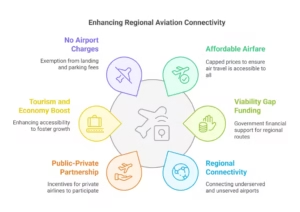
- The upgraded UDAN initiative is designed to develop regional aviation infrastructure, ensure affordable air travel, and support operations in difficult terrains.
- Out of the proposed ₹30,000 crore: ₹18,000 crore for airport infrastructure—development of new airports, upgrades of existing airstrips, and construction of heliports in hilly regions.
- ₹12,000 crore for Viability Gap Funding (VGF) to incentivize airlines to fly on low-demand routes.
- Priority areas include: North-Eastern states, Aspirational districts, Hilly and remote regions, Towns with limited air connectivity
Evolution of the UDAN Scheme
- Inclusive Air Travel Initiative: Launched in 2016 under the National Civil Aviation Policy, UDAN aims to make air travel accessible and affordable for ordinary citizens.
- First Operational Flight: The inaugural UDAN flight was launched in April 2017, connecting Shimla and Delhi, marking the beginning of regional air connectivity under the scheme.
- Significant Expansion Achieved: With an initial funding of ₹8,000 crore, the scheme has successfully operationalised 649 out of 915 approved routes, connecting 92 unserved or underserved airports, along with 15 heliports and 2 water aerodromes, benefitting over 1.56 crore passengers.
Objectives of Modified UDAN
- Connect 120 new destinations over the next decade.
- Enable 4 crore additional passengers through regional flights.
- Expand coverage to include airstrips, helipads, and water aerodromes.
- Increase private sector participation by easing leasing rules, permits, and bidding norms.
Addressing Implementation Challenges
- Land acquisition delays and inadequate state coordination
- Lack of airport infrastructure and navigational systems
- Shortage of suitable regional aircraft
- Low passenger demand in remote locations
- High maintenance and leasing costs
- Enhanced coordination among Centre, states, airport operators, and airlines, coupled with flexible funding, seeks to resolve these challenges.
Incentives and Expected Outcomes
- Improved regional connectivity, tourism, and economic integration
- Large-scale employment generation in aviation, logistics, and hospitality
- Faster emergency, relief, and medical services
- Focused development in North-East, Himalayan, and aspirational districts
Conclusion
The modified UDAN scheme is a strategic step toward inclusive and balanced regional development. By bridging connectivity gaps, it aims to make aviation a catalyst for economic growth, social integration, and national cohesion.