
Daily Current affairs 21 March 2026

Daily Current Affairs 21-March-2026

Share this Post

PETITIONS AGAINST CEC SELECTION LAW

TOPIC: (GS2) POLITY: THE HINDU

Recently, Chief Justice of India (CJI) Surya Kant transferred petitions challenging the CEC and ECs (Appointment, Conditions of Service, and Term of Office) Act, 2023 to another Bench, citing possible conflict of interest since the law concerns the office of the CJI.

Background of the Issue

  • The 2023 law replaced the CJI with a Union Cabinet Minister in the selection committee for appointing the Chief Election Commissioner (CEC) and Election Commissioners (ECs).
  • Petitioners argue this dilutes the March 2023 Supreme Court ruling (Anoop Baranwal vs Union of India), which had mandated the CJI’s presence in the panel.
  • Current selection committee: Prime Minister + Leader of Opposition in Lok Sabha + Union Cabinet Minister (nominated by PM).
  • The validity of Section 7(1) of the Act is under challenge.

Key Concerns

  • Possible executive dominance in appointments.
  • Reduced judicial oversight in the selection process.
  • Impact on the independence of the Election Commission.

Removal of Chief Justice of India (CJI)

  • Grounds: Misbehaviour or incapacity (Article 124(4)).
  • Initiation: Motion signed by at least 100 Lok Sabha MPs or 50 Rajya Sabha MPs.
  • Admission: Motion admitted by the Speaker (Lok Sabha) or Chairman (Rajya Sabha).
  • Inquiry: A three-member committee (judge of SC, Chief Justice of High Court, and a distinguished jurist) investigates charges.
  • Report: If committee finds charges valid → motion taken up in House.
  • Voting: Each House must pass the motion with special majority (two-thirds present and voting + majority of total membership).
  • President’s Order: If passed in both Houses, President issues removal order.

Constitutional Articles

  • Article 124(4): Procedure for removal of SC judges (including CJI).
  • Article 124(5): Parliament may regulate removal process by law.
  • Article 217: Appointment and removal of High Court judges.
  • Article 324: Powers of Election Commission (relevant to current petitions).

Conclusion

The petitions highlight concerns about executive dominance in CEC appointments and the need to safeguard the Election Commission’s independence. The CJI’s recusal shows judicial prudence, while the final verdict will shape the balance between the executive and judiciary in electoral governance.

INDIA’S IRAN STANCE AND FOREIGN POLICY

TOPIC: (GS2) INTERNATIONAL RELATIONS: THE HINDU

Recently, India’s response to U.S.–Israel war against Iran has sparked debate, whether New Delhi’s position compromises its ties with Iran in favour of strategic interests with the U.S. and Gulf states.

Background

  • War Outbreak:
    • The U.S.–Israel military campaign against Iran began on February 28, 2026.
    • This conflict has entered its third week, reshaping West Asian geopolitics.
  • India’s Diplomatic Response:
    • India chose not to issue condolences for the assassination of Iran’s Supreme Leader, Ayatollah Ali Khamenei.
    • This decision attracted criticism for being diplomatically insensitive and potentially undermining historic ties with Iran.
  • Foreign Policy Debate:
    • Central question: Is India exercising strategic autonomy or leaning excessively towards the U.S. and Gulf states?
    • Supporters argue India must prioritise national interest—trade with the U.S., defence technology access, and energy security from Gulf nations.
    • Critics highlight risks of alienating Iran, a civilisational partner and key energy supplier.

Supporters of Government’s Stand

  • India must prioritise strong ties with the United States, its largest trading partner and key source of advanced defence technology.
  • The Gulf states host nearly 10 million Indian workers, whose remittances are vital for India’s economy.
  • Gulf countries are also crucial suppliers of energy resources, making their stability essential for India’s national interest.

Foreign Policy Principles

  • National Interest First: As per Nehru, foreign policy is essentially “selfish,” guided by national interest.
  • Strategic Autonomy vs Independence: Debate over labels; autonomy implies limited freedom, independence is absolute.
  • Pragmatism: Governments may adopt unpopular positions if they serve long-term national interests.

India’s Calculations

  • U.S. Factor: Trade, defence technology, nuclear cooperation.
  • Gulf Factor: Energy security, diaspora welfare, remittances.
  • Iran Factor: Oil supplies, historical ties, regional balance.
  • Diplomatic Choices: India pressed Iran for safety of its citizens but avoided strong gestures of solidarity.

Concerns

  • India’s position appears unfriendly towards Iran, a long-standing civilisational partner.
  • The decision not to condole Ayatollah Khamenei’s assassination is seen as diplomatically insensitive.
  • Critics argue this reflects a weakening of India’s strategic autonomy, showing excessive dependence on U.S. and Gulf priorities.

Significance

  • Reflects tension between realpolitik and values in foreign policy.
  • Raises questions on India’s ability to balance multiple strategic partners.
  • Highlights importance of public communication of foreign policy rationale in a democracy.

Conclusion

India’s Iran stance underscores the complexity of foreign policy in a globalised world. maintaining strategic autonomy and diplomatic sensitivity is vital to preserve credibility and balance in West Asia.

GREAT NICOBAR LAND ACQUISITION AND ENVIRONMENTAL LAW

TOPIC: (GS3) ENVIRONMENT: THE HINDU

Recently, settler families in Campbell Bay Tehsil, Great Nicobar raised objections to the low compensation rates fixed for land acquisition under the mega-infrastructure project.

Background

  • About 300 ex-servicemen families were settled in Great Nicobar between 1969–75, with land de-notified from tribal reserves.
  • Current project involves acquisition of land at ₹113–₹180 per sq. m, far lower than rates in Andaman tourism projects (₹11,370–₹20,500 per sq. m).
  • Nearly 84 sq. km of tribal reserve is proposed to be de-notified for project use.
  • Tribal groups affected: Shompen (PVTG) and Nicobarese.
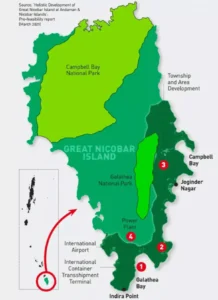
Campbell Bay Tehsil, Great Nicobar

Environmental Law Perspective

  • Forest Rights Act (FRA), 2006: Mandates recognition of customary rights of tribal communities. Requires Gram Sabha consent before diversion of forest land.
  • RFCTLARR Act, 2013: Ensures fair compensation and rehabilitation. Procedural lapses in social impact assessment and inadequate compensation breach statutory safeguards.
  • Environmental Impact Assessment (EIA) Notification, 2006: Large projects require comprehensive EIA and public hearings. Reports suggest lack of tribal participation.
  • Biological Diversity Act, 2002: Great Nicobar hosts unique biodiversity and pristine forests. Project threatens irreversible ecological loss, undermining India’s global commitments.

Challenges

  • Shompen (PVTG): Nomadic hunter-gatherers with no use for monetary compensation, risk losing habitat.
  • Nicobarese: Wish to return to pre-tsunami lands but face displacement again.
  • Settler vs Tribal Rights: Settlers demand fair compensation, but tribal rights are sidelined.
  • Ecological Concerns: Loss of forests, marine ecosystems, and biodiversity.

Way Forward

  • Strict Enforcement of Environmental & Tribal Rights Laws: Ensure compliance with the Forest Rights Act (2006), RFCTLARR Act (2013), and Biodiversity Act (2002).
  • Balanced Development with Ecological Safeguards: Adopt a sustainable infrastructure model that minimises deforestation and biodiversity loss.
  • Inclusive Decision-Making & Rehabilitation: Provide rehabilitation options for Nicobarese and protect the Shompen (PVTG) from forced displacement.

The Great Nicobar Project

The Great Nicobar Project is a strategic infrastructure initiative aimed at boosting India’s maritime presence, but it faces criticism over environmental damage and tribal displacement.

Strategic Maritime Importance

  • The project is designed to enhance India’s presence in the Indian Ocean Region, especially near the Strait of Malacca, a critical global shipping route.
  • It aims to reduce dependence on foreign ports like Singapore and Colombo by building an International Container Transshipment Terminal (ICTT) with a capacity of 14.2 million TEUs.

Multi-Component Infrastructure Plan

  • The project includes:
    • A dual-use airport (civil and military)
    • A power plant
    • A greenfield township
  • It is expected to be developed over 30 years in phases, under the Export Promotion Mission and national security frameworks

Conclusion

The Great Nicobar project highlights a clear conflict where development goals are pursued at the cost of environmental safeguards and tribal rights, raising serious concerns of law violations and ecological justice.

TRANSFER OF OFFICIALS DURING ELECTIONS

TOPIC: (GS2) POLITY: THE HINDU

The Election Commission of India (ECI) recently transferred senior IAS and IPS officers in West Bengal during Assembly elections.

What is MCC?

  • The Model Code of Conduct (MCC) is a set of guidelines issued by the Election Commission of India (ECI) to regulate the conduct of political parties and candidates during elections.
  • It is not a law but has binding force, ensuring a level playing field and preventing misuse of power.
  • MCC covers aspects like campaigning, speeches, use of government facilities, and conduct of officials during the election period.
  • Activation: Comes into effect immediately after the election schedule is announced.
  • Impartiality: Ensures that the government machinery functions neutrally during elections.
  • Restrictions: Prevents the misuse of official resources for electoral advantage.

Role of the Election Commission

  • Constitutional Authority: Established under Article 324, responsible for free and fair elections.
  • Wide Powers: Supervises, directs, and controls elections to Parliament, State Legislatures, and offices of President and Vice-President.
  • Neutrality Measures: Deployment of central forces, Enforcement of Model Code of Conduct (MCC), Transfer/replacement of officials to prevent bias

Legal Basis for Transfers

  • Section 13CC, Representation of the People Act, 1950: Officials on election duty are deemed on deputation to the ECI. They fall under the Commission’s control and discipline.
  • Supreme Court Clarification (1990s): ECI has authority to transfer/replace officials in case of bias or misconduct.

Practice of Transfers

  • Common during both Lok Sabha and Assembly elections.
  • Aim: Remove officers perceived close to political parties.
  • Example: Similar transfers during 2024 General Elections across states.

Current West Bengal Transfers

  • At least 21 senior IAS and IPS officers transferred, including DGP, Chief Secretary, and Kolkata Police Commissioner.
  • ECI Justification: Ensure free and fair elections, prevent misuse of authority, and create a fear-free environment.
  • State Government Concerns:
    • Transfers termed “sweeping” and “unilateral.”
    • Lack of consultation with State.
    • No specific misconduct cited against officers.

Legal Position on Consultation

  • Consultation with State governments is customary but not mandatory.
  • Law gives ECI overriding authority during elections.
  • Officers on election duty are directly accountable to the Commission.

Significance

  • Ensuring Neutrality: Transfers safeguard impartiality in election administration.
  • Federal Tensions: Highlights friction between central authority (ECI) and states.
  • Democratic Functioning: Neutral bureaucracy is vital, though frequent transfers may affect stability.

Conclusion

The transfer of officials during elections reflects the ECI’s constitutional mandate to ensure fairness, but also raises questions of federal balance and administrative stability, making it a recurring issue in India’s electoral politics.

RAS LAFFAN ATTACK AND THREAT TO INDIA’S ENERGY SECURITY

TOPIC: (GS3) ECONOMY: THE HINDU

Iranian missiles hit Ras Laffan Industrial City, Qatar, the world’s largest LNG hub. Attack followed Israeli strikes on South Pars gas field; raises concerns for global LNG supply and India’s energy security.

The Attack & Escalation

  • Conflict Trigger: Israel struck the South Pars gas field (shared by Iran and Qatar), prompting Iran to retaliate against energy facilities in Saudi Arabia, Kuwait, and Qatar’s Ras Laffan.
  • Global Energy Shock: Ras Laffan, which supplies ~20% of global LNG, suffered major damage; Brent crude prices spiked to $119/barrel before settling near $112, reflecting severe market volatility.
  • Infrastructure Damage: Qatar had already suspended LNG production earlier; the latest strikes caused fires and extensive physical damage, making recovery of gas output highly uncertain.
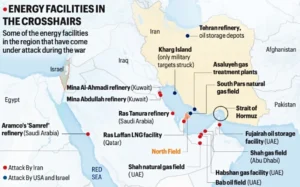
Ras Laffan Industrial City, Qatar

Strategic Importance of Ras Laffan

  • Core LNG Hub: Ras Laffan hosts the production, liquefaction, and export facilities for Qatar’s LNG industry.
  • Global Impact: Any disruption here has a direct effect on worldwide LNG flows.
  • Recovery Challenges: Restoration of supply is uncertain due to extensive physical damage to infrastructure.

Why Ras Laffan Matters for India

  • High Import Dependence: India relies on imports for ~88% of crude oil and ~50% of natural gas needs.
  • Qatar’s Role: Qatar supplies one-third of India’s LPG and nearly half of its LNG requirements.
  • Escalating Risks: Earlier concerns were limited to shipping delays in the Strait of Hormuz; now, damage to processing facilities poses a deeper threat to energy security.

Broader Economic Implications

  • Fuel Price Surge: Rising global fuel costs are likely to push inflation higher and add fiscal pressure on the government.
  • Financial Stress on Oil Companies: Public sector oil firms may have to absorb price shocks, leading to financial strain.
  • Domestic Supply Concerns: Early signs of LPG shortages and delays are already visible, affecting households.
  • Trade Risks with Qatar: India’s bilateral trade with Qatar (worth ~$14 billion in 2024–25) faces disruption, impacting both energy imports and export balance.

India’s Diversification Strategy

  • Traditionally, ~60% LPG imports from Gulf.
  • Now sourcing from U.S., Norway, Canada, Algeria, Russia.
  • Diversification reduces risk but raises shipping costs.

Conclusion

Ras Laffan attack shows India’s high vulnerability to Gulf energy disruptions. India must diversify energy sources, boost domestic gas output, and expand renewables to secure long-term energy needs.

MAHAD SATYAGRAHA (1927)

TOPIC: (GS1) INDIAN MODERN HISTORY: THE HINDU

Recently, the 99th anniversary of the Mahad Satyagraha was commemorated at Chavdar Tale in Raigad, Maharashtra marking the beginning of its centenary year.

Historical Background

  • Held on March 20, 1927 at Chavdar Tale (tank), Mahad, Raigad district, Maharashtra.
  • Led by Dr. B.R. Ambedkar with thousands of Dalits.
  • Objective: Assert the right of “untouchables” to access public water sources.
  • Occurred three years before the Salt Satyagraha (1930), making it one of the earliest mass civil rights movements.
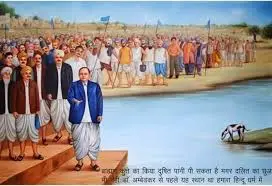
Mahad Satyagraha

Significance in Freedom Struggle

  • Social Justice Movement: Asserted equality and dignity for Dalits, challenging caste-based discrimination.
  • Civil Rights Assertion: First organised attempt to claim equal access to public resources.
  • Precursor to Larger Movements: Inspired later struggles like the Salt Satyagraha and strengthened mass mobilisation.
  • Symbol of Equality: Chavdar Tale water became a metaphor for social and democratic rights.
  • Constitutional Legacy: Reflected Ambedkar’s lifelong fight against caste oppression, later enshrined in the Indian Constitution.
  • National Impact: Highlighted that freedom was not just political independence but also social emancipation.

Conclusion

The Mahad Satyagraha was a landmark in India’s freedom struggle, combining the fight against colonial rule with the battle against social inequality. It reminds that true independence must include justice, equality, and dignity for all citizens.

ADIPOSE TISSUE

TOPIC: (GS3) SCIENCE AND TECHNOLOGY: THE HINDU

Scientists recently highlighted that adipose tissue is not just passive fat storage but functions as a metabolic and endocrine organ, influencing hormones and energy balance.

Adipose Tissue

  • A type of connective tissue spread throughout the body.
  • Found under the skin (subcutaneous fat), around internal organs (visceral fat), and even inside bones (bone marrow fat).
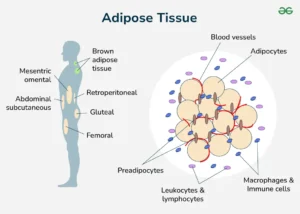
Adipose tissue

Types of Adipose Tissue

White Adipose Tissue (WAT)

  • Most common in adults; stores energy as triglycerides.
  • Functions: Releases hormones like leptin (controls appetite) and adiponectin (regulates insulin and blood sugar). Provides cushioning, insulation, and acts as a metabolic buffer.
  • Excess WAT linked to insulin resistance, fatty liver, and cardiovascular risk.

Brown Adipose Tissue (BAT)

  • Specialised to burn energy.
  • Rich in mitochondria and contains UCP1 protein, converting chemical energy into heat.
  • Important for thermoregulation.

Beige Fat Cells

  • Develop within white fat under cold exposure or hormonal signals.
  • Acquire some heat-producing properties of brown fat.

Significance

  • Adipose tissue plays a dual role: energy storage and hormone regulation.
  • Its dysfunction contributes to metabolic disorders like diabetes, obesity, and heart disease.
  • Understanding its role helps in designing therapies for lifestyle diseases.

Conclusion

Adipose tissue is a dynamic organ system, not just “body fat.” Its role in metabolism, hormone regulation, and disease makes it central to public health and medical research.

RELIEF SCHEME

TOPIC: (GS3) ECONOMY: THE HINDU

The Government of India has launched the RELIEF (Resilience & Logistics Intervention for Export Facilitation) Scheme to protect exporters from maritime disruptions in West Asia.

About the Scheme

  • A time-bound intervention under the Export Promotion Mission (EPM).
  • Designed to help exporters facing extraordinary freight escalation, insurance premiums, and war-related risks.
  • Implemented by ECGC Ltd with real-time monitoring.
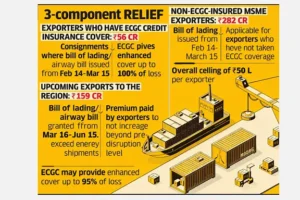
RELIEF Scheme

Key Features

  • Enhanced Risk Coverage: Past shipments (14 Feb – 15 Mar 2026): Up to 100% risk coverage for conflict-linked losses.
  • Future shipments (16 Mar – 15 Jun 2026): Up to 95% coverage to maintain exporter confidence.
  • MSME Support: Non-insured MSMEs can claim 50% reimbursement (capped at ₹50 lakh) for freight and insurance surcharges during the disruption month.
  • Regional Scope: Applies to consignments bound for or transshipped through UAE, Saudi Arabia, Kuwait, Israel, Qatar, Oman, Bahrain, Iraq, Iran, and Yemen.
  • Operational Reliefs: Waivers on storage and dwell time charges at ports. Procedural relaxations for stranded cargo, coordinated by the Inter-Ministerial Group (IMG).
  • Monitoring & Oversight: ECGC to maintain a dashboard system for claims and fund utilization. Periodic reviews by the EPM Steering Committee.

Significance

  • Provides confidence to exporters amid geopolitical tensions.
  • Protects MSMEs from financial shocks.
  • Ensures India’s trade flows remain resilient despite West Asia disruptions.

Conclusion

The RELIEF scheme is a targeted safety net for exporters, ensuring India’s trade remains stable during Gulf maritime crises while safeguarding MSMEs and long-term export competitiveness.


Write a Review

Your email address will not be published. Required fields are marked *