SC: JUDICIARY CANNOT IMPOSE TIMEFRAME ON PRESIDENT OR GOVERNOR
TOPIC: (GS2) POLITY: THE HINDU
The Supreme Court recently delivered an advisory opinion stating that courts cannot impose fixed timelines on the President or Governors for approving state bills, as it violates constitutional boundaries and separation of powers.
Constitutional Debate on Executive Assent and Judicial Limits
- The matter originated from a Presidential Reference seeking clarity on whether the judiciary can compel the President or Governors to make a decision on State Bills within a fixed period.
- Several State governments raised concerns over the persistent delays in granting assent, arguing that such prolonged inaction undermines legislative authority and called it a case of “evasive inaction”.
- The Supreme Court used this opportunity to interpret constitutional provisions and clarify the distinct powers and responsibilities of the executive and judiciary, particularly regarding assent to bills and federal balance.
Supreme Court Observations
- Separation of Powers: Imposing timelines on executive actions would violate constitutional design and disrupt checks and balances.
- No ‘Deemed Assent’: Courts cannot automatically deem bills as approved if the Governor/President delays action.
- Judicial Limits: Courts cannot create new legal concepts like ‘deemed assent’ using Article 142.
Constitutional Provisions
- Article 200 (Governor’s Options): Give assent. Withhold assent (but must send reasons to state legislature). Reserve the bill for President’s consideration (under Article 201).
- Article 201 (President’s Authority): Can approve. Withhold assent. Cannot be forced to seek Supreme Court’s opinion under Article 143 every time.
On Accountability of President and Governors
- Although no fixed timeline applies, they cannot indefinitely hold bills without action.
- Excessive delay is constitutionally improper, and courts may direct them to act within a reasonable period without dictating the decision.
Judicial Concerns
- The court emphasized that prolonged delays can affect governance and democratic functioning.
- However, the judiciary must respect the constitutional role and discretion of the executive.
Implications for Federalism and Governance
- The decision balances executive discretion and judicial restraint.
- Reinforces the principle that governors and the President are not mere rubber stamps, but must act responsibly within constitutional boundaries.
SEPARATION OF POWERS IN INDIA
Separation of powers means dividing government functions among three organs: Legislature, Executive, and Judiciary, to prevent concentration of power.
Three Branches and Their Roles
- Legislature (Parliament & State Legislatures): Makes laws.
- Executive (President, Governors, PM, Ministers, Civil Services): Implements and enforces laws.
- Judiciary (Supreme Court, High Courts, Lower Courts): Interprets laws and ensures justice.
Why It Exists?
- To avoid misuse of power.
- To protect citizens’ rights.
- To maintain checks and balances between different organs of government.
Not Strict but Functional Separation
- India does not follow complete separation (like the USA).
- Instead, it adopts a balanced model, where powers are divided but some functions overlap.
Examples of Overlap
- Executive is part of Legislature (Ministers are MPs).
- Judiciary can strike down laws (Judicial Review).
- Legislature can amend the Constitution.
Constitutional Provisions
- Article 50: Separation of judiciary from executive in public services.
- Articles 121 and 211: No discussion in Parliament/Assembly on judges’ conduct.
- Articles 53 and 154: Executive powers of the Union and States.
Conclusion
The Supreme Court protected constitutional roles of the executive while discouraging unreasonable delays in decision-making. It upheld the separation of powers, ensuring accountability without judicial overreach.
INDIGENOUS GENE EDITING TO MAKE GE CROPS CHEAPER IN INDIA
TOPIC: (GS2) SCIENCE AND TECHNOLOGHY: THE HINDU
Indian scientists have developed a fully homegrown gene-editing tool using TnpB proteins, providing an affordable and patent-free alternative to the globally controlled CRISPR systems.
Gene Editing vs Genetic Modification (GM vs GE)
- Genetic Modification (GM): Introduces genes from another species to create a GMO. Works like adding a new chapter from a different author to a book.
- Gene Editing (GE): Alters existing DNA at specific points without adding foreign genes. Similar to correcting or removing words within the original text.
CRISPR Technology
- Design the guide RNA (gRNA): A short RNA sequence is designed to match the target DNA region (the gene you want to edit).
- Deliver Cas9 + gRNA into the cell: The Cas9 enzyme (molecular scissors) and gRNA are introduced into the cell using a vector (like plasmid, virus, or other delivery methods).
- Targeting and Cutting the DNA: The gRNA guides Cas9 to the exact matching DNA sequence. Cas9 makes a double-strand break (cut) at that specific spot.
- DNA Repair = Gene Edit: The cell repairs the break using its natural repair systems:

India’s First CRISPR-Based Edited Crops
- Samba Mahsuri (IIRR): Edited using CRISPR-Cas12a to boost yield by targeting cytokinin oxidase 2.
- MTU-1010 (IARI): Edited using CRISPR-Cas9 to improve tolerance against drought and salinity.
However, commercialization is restricted due to foreign patent control.
Indigenous TnpB Gene Editing Tool
- Developed by ICAR and recently patented as India’s own molecular editing system.
- Uses TnpB proteins as molecular scissors to edit plant DNA precisely.
- Originates from Deinococcus radiodurans, a highly resilient and harmless bacterium.
Advantages of TnpB Over CRISPR
- Much smaller proteins (400–500 amino acids) than Cas9 (1,000+) or Cas12a (1,300).
- Compact size enables easier delivery via viral vectors, bypassing tissue culture.
- Completely indigenous — no foreign IP, licensing fees, or dependency.
- Helps reduce development costs and speeds up GE crop commercialization.
Strategic Importance for India
- Reduces reliance on Broad Institute and Corteva Agriscience, which hold global CRISPR patents.
- Allows India to bypass costly licensing fees and negotiate better terms.
- Supports wider adoption of GE crops for small and marginal farmers.
Wider Benefits and Societal Impact
- Addresses concerns about foreign corporate monopoly in Indian agriculture.
- Opens opportunities for editing multiple crops for climate resilience, yield, and disease resistance.
- Promotes self-reliance in agricultural biotechnology (Atmanirbhar Bharat).
Conclusion
The indigenous TnpB-based genome editing tool marks a major step toward making GE crop technology affordable, scalable, and free from global IP restrictions. It strengthens India’s scientific autonomy while empowering farmers with locally developed innovations.
IS FEDERALISM IN RETREAT UNDER SINGLE-PARTY DOMINANCE
TOPIC: (GS2) POLITY: THE HINDU
Debates have emerged on whether India’s federal structure is weakening due to rising centralization under a dominant single-party government, especially visible in financial relations, GST, and Centre-State interactions.
Federalism in India
- Federalism refers to the distribution of power between a central authority and constituent units (States).
- It promotes shared governance, protects regional interests, and strengthens democratic participation.
- The Constitution of India does not explicitly use the word “federalism”, but its structure, articles, and functioning reflect a federal character.
- The Supreme Court in S.R. Bommai vs. Union of India (1994) recognized federalism as part of the basic structure of the Constitution.
Signs of Centralization
- Rise of Single-Party Dominance: After 2014, stronger central control has reduced negotiation space for States.
- Weakening Regional Parties: Regional political influence declined, reducing the voice of states in policymaking.
- GST Regime: States lost significant taxation powers; delays in compensation increased mistrust.
- Shift in Resource Allocation: More funds tied to centrally sponsored schemes rather than State plans.
Financial Imbalances
- Wealthier States contribute more to national revenue but face redistribution for poorer regions.
- States argue this creates vertical and horizontal fiscal imbalance.
- Growing expenditure responsibilities without adequate revenue powers weaken States’ autonomy.
Erosion of Institutional Mechanisms
- Planning Commission replaced by NITI Aayog, reducing the forum for intergovernmental negotiations.
- Reduced use of Inter-State Council and Finance Commission recommendations.
- Political centralization affecting administrative systems.
Political Impact
- Regional parties historically promoted federal interests; now weaker due to centralized political culture.
- Electoral strategies focus on national narratives rather than regional concerns.
- Rise of uniform schemes and policies reduces space for state-led innovation.
Developmental and Governance Challenges
- Local employment creation remains weak as States have limited fiscal capacity.
- States face increasing burden of welfare delivery without sufficient financial backing from the Centre.
- Centralized policy-making ignores local diversity and needs.
Way Forward
- Promote collaborative federalism through empowered Inter-State Councils and Finance Commission.
- Provide States with greater taxation authority and flexible funding mechanisms.
- Encourage decentralization, regional innovation, and State-specific development planning.
- Strengthen political dialogue between Centre and States for balanced growth.
CENTRALISATION VS DECENTRALISATION
Centralisation:
- Decision-making power is concentrated at the top level (Union or central authority).
- Leads to uniform policies but may ignore local needs and reduce state or local autonomy.
Decentralisation:
- Authority and decision-making are shared or transferred to state, district, or local bodies.
- Encourages local participation, better governance, and solutions suited to regional needs.
Conclusion
Federalism is facing challenges due to increasing centralization and political dominance. Reviving cooperative and consultative federalism is crucial for India’s democratic strength and inclusive development.
INDIA’S FISHERIES AND AQUACULTURE
TOPIC: (GS3) ECONOMY: THE HINDU
The FAO recently highlighted India’s fisheries and aquaculture growth under its “Blue Transformation” initiative, bringing attention to India’s role in global fish production.

Fisheries and Aquaculture in India
- Contributes to food security, employment, exports, and nutritional needs.
- India is the second-largest aquaculture producer and a major exporter of seafood globally.
- Provides livelihood to around 28 million people, especially small-scale fishers.
- Significant role in women’s participation and coastal economy.
Growth Trends
- According to FAO (2024), global capture fisheries reached 92.3 million tonnes; aquaculture reached 130.9 million tonnes.
- India contributed 10.23 million tonnes from aquaculture, expanding from 2.44 million tonnes in the 1980s to 17.54 million tonnes in 2022–23.
- Shift towards modern farming techniques, digital tools, institutional support, and sustainable practices.
FAO’s Support to India
- Works with India in policy reforms, technology sharing, and better governance.
- Collaborated on Bay of Bengal Programme (BOBP) to improve coastal fisheries, livelihood security, and safety.
- Support for value chain strengthening, including processing, packaging, certification, and market connectivity.
Challenges
- Overfishing, habitat loss, pollution, climate change, and declining fish stocks.
- Small-scale fishers face poor access to credit, technology, cold storage, transport, and fair pricing.
- Weak infrastructure, lack of traceability, high post-harvest losses, and limited digitalization.
Sustainability and Climate Concerns
- Need for climate-smart aquaculture, waste reduction, and carbon-neutral practices.
- Promoting eco-friendly fishing technology, digital monitoring (MCS), and traceability systems.
- Focus on conservation of marine biodiversity, wetlands, mangroves, and coastal regulation.
Government Initiatives
- Blue Revolution, PM Matsya Sampada Yojana: Promote aquaculture, inland fisheries, and innovation.
- Kisan Credit Card for Fishers: Financial support, credit access, and inclusion.
- Matsya Seva Kendras: Centralized support for training, advisory, and market linkage.
- Climate-Resilient Coastal Fishermen Villages and Draft National Fisheries Policy (2020): Sustainability and resilience.
Way Forward
- Enhance research and innovation with ICAR, FAO, and private sector partnerships.
- Build modern processing facilities, cold-chain infrastructure, and digital market access.
- Empower small fishers through cooperatives, skill training, and financial literacy.
- Promote eco-certifications, sustainable fishing, and global competitiveness.
FOOD AND AGRICULTURE ORGANIZATION (FAO)
FAO is a specialized agency of the United Nations. Established on 16 October 1945 in Quebec, Canada. To defeat hunger, improve nutrition, and ensure food security for all and to support sustainable agriculture, fisheries, forestry, and rural development.
- Headquarters: Rome, Italy.
- Members: 194 countries (including European Union).
Key Functions
- Collects global data on food, crops, fisheries, livestock, and climate impacts.
- Assists countries with policy guidance, capacity building, and technical support.
- Helps in setting international standards, like Codex Alimentarius (food safety).
FAO & India
- Supports India in fisheries, food security, agriculture modernization, climate resilience, and digital farming.
- Collaborates on National Food Security Mission, millet promotion, and soil health programs.
Reports Published by FAO
- State of Food Security and Nutrition in the World (SOFI)
- State of World’s Fisheries and Aquaculture (SOFIA)
- State of Food and Agriculture (SOFA)
- State of the World’s Forests (SOFO)
Conclusion
India’s fisheries sector holds huge potential for sustainable growth, livelihoods, and export expansion. With strong policy support, innovation, and sustainability-focused strategies, India can lead the global Blue Economy future.
GOVERNMENT REVISES ROYALTY RATES OF CRITICAL MINERAL PRODUCTION
TOPIC: (GS3) ECONOMY: THE HINDU
The Union Government has updated royalty rates for four essential minerals—graphite, caesium, rubidium, and zirconium—to make mining more viable, attract investments, and reduce reliance on imports crucial for clean energy technologies.
Why Ad Valorem Approach Was Adopted
- Royalty now tied to Average Sale Price (ASP), reflecting real market conditions.
- ASP is calculated by IBM using domestic pricing, or international data (like USGS) where local pricing is unavailable.
- Promotes revenue fairness, improves investor confidence, and aligns royalty with actual mineral value.
- Responds to global supply chain disruptions, particularly due to China’s dominant role in mineral processing.
India’s Growing Mineral Demand and Import Dependence
- Clean energy, battery storage, EVs, and semiconductor industries demand minerals like lithium, cobalt, nickel, REEs, and silicon.
- India currently imports almost 100% of these minerals.
- Revised royalty norms aim to unlock associated minerals and attract exploration investment.
- Since 2023, only 34 of 81 mineral blocks have been successfully auctioned.
Critical Mineral Policy Landscape
- India recognizes 30 critical minerals, though caesium and rubidium—covered in the new rates—are not on the national critical list.
- Other global powers like the US, Canada, and South Korea classify them as critical.
- This reform follows earlier updates in 2022–24 for minerals such as cobalt, titanium, indium, tungsten, and rare earths.
Limitations of the Previous Royalty System
- Fixed per-tonne royalty made low-grade or low-price graphite mining unprofitable.
- Caesium, rubidium, and zirconium were taxed at a flat 12% despite no domestic pricing benchmarks.
- High royalty rates discouraged bidders and stunted domestic exploration.
Expected Benefits of the New Rates
- Offers transparency and predictability for investors.
- Improves auction participation and exploration interest.
- Reduces import reliance, strengthens supply chain security, and supports green-tech goals.
The Bigger Challenge:
- Main bottlenecks: weak processingcapability, low technical expertise, limited financing, and modest private sector participation.
- Domestic demand, production scale, and access to raw materials remain insufficient.
- Even with copper smelting capacity, India contributes only 3% of global refined output.
- Rare earth processing remained restricted due to atomic mineral classification.
The Road Ahead
- Policy focus must expand beyond mining to building end-to-end value chains.
- Developing capabilities in mineral processing, refining, and high-purity material production is essential for true self-reliance.
- Strategic autonomy in areas like EVs, electronics, renewable energy and defense depends on both mining and domestic processing strength.
Conclusion
Royalty reforms are a strong step toward unlocking mineral resources, but they must be paired with processing infrastructure and technology development. Only a full-value-chain approach—from extraction to refining—can reduce import dependence and secure India’s green-tech future.
BVS10 SINDHU
TOPIC: (GS3) SECURITY: THE HINDU
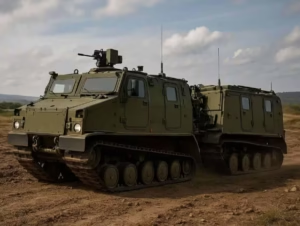
Larsen & Toubro (L&T), in collaboration with BAE Systems, has received a contract from the Indian Army to deliver the BvS10 Sindhu — a specialized all-terrain armored vehicle customized for India’s operational needs.
Global Use of BvS10
- The BvS10 is an articulated, all-terrain armored vehicle widely used by military forces in Sweden, the UK, France, the Netherlands, Austria, and Ukraine.
- It is also selected by Germany and the US Army under the Cold Weather All-Terrain Vehicle (CATV) program.
Unique Design Advantage
- The vehicle features two linked modules, improving mobility over snow, mud, mountains, deserts, and swampy terrain.
- This articulated structure enables it to traverse places where conventional wheeled or tracked vehicles fail.
India-Specific Sindhu Variant
- BvS10 Sindhu is a customized version designed specifically to operate in Indian conditions.
- It is tailored for high-altitude regions, deserts, flood zones, marshlands, and extreme climatic conditions.
Manufacturing Collaboration
- L&T will build the vehicle at its Armoured Systems Complex in Hazira, Gujarat.
- Technical expertise will come from BAE Systems Hägglunds, the original creator of the BvS10 platform.
Multiple Role Configurations
The BvS10 Sindhu can be configured for various operational roles, such as:
- Troop transport
- Medical evacuation (ambulance)
- Command & control vehicle
- Logistics and recovery support
- Armed combat role
Amphibious Capability
- The vehicle is fully amphibious, enabling it to operate in waterlogged areas, flooded zones, and rivers — enhancing operational reach during natural disasters or military missions.
NASAMS (NATIONAL ADVANCED SURFACE-TO-AIR MISSILE SYSTEM)
TOPIC: (GS2) INTERNATIONAL RELATIONS: THE HINDU
The United States has approved the sale of NASAMS air defense systems to Taiwan, valued at nearly $700 million, enhancing Taiwan’s missile defense capabilities.
What is NASAMS?
- NASAMS is a medium-range, ground-based air defense system.
- It is capable of intercepting aircraft, helicopters, drones, and cruise missiles.
- Jointly developed by Raytheon (USA) and Kongsberg Defence & Aerospace (Norway).
- Achieved operational readiness in 1994 and was first used by the Royal Norwegian Air Force.

Global Operators
- Currently deployed by 13 countries, including:
- Integrated into the U.S. National Capital Region’s air defense since 2005.
Features of NASAMS
Modular & Networked Architecture
- Built with distributed, modular, open-hardware and software design.
- World’s first network-enabled short and medium-range air defense system.
- Can integrate with other radars, command systems, and sensors.
Radar & Detection Capability
- Equipped with 360° X-Band phased array radar.
- Detects and tracks targets up to 75 km away.
Missile & Combat Capacity
- Uses the AIM-120 AMRAAM missile with a range of about 30 km.
- Each unit has three launchers, each carrying six missiles (18 total).
- Capable of engaging up to 72 targets simultaneously in active and passive modes.
Survivability & Electronic Protection
- Network-centric design enhances protection against electronic warfare.
- Can operate using external target data from other sensors.
- Advanced emission control reduces detection risk by enemy forces.
CLIMATE CHANGE PERFORMANCE INDEX (CCPI)
TOPIC: (GS3) ENVIRONMENT: THE HINDU
India has dropped 13 positions and now ranks 23rd in the Climate Change Performance Index 2026, moving from the ‘high’ to ‘medium’ performing category.
What is CCPI?
- CCPI is an annual global index that evaluates and compares countries’ climate protection efforts.
- It is jointly published by Germanwatch, New Climate Institute, and Climate Action Network International.
- Introduced in 2005, it assesses how well countries are reducing emissions and transitioning to clean energy.
Assessment Criteria
- Countries are ranked based on performance in four key areas: Greenhouse Gas (GHG) Emissions, Renewable Energy Adoption, Energy Use, Climate Policy and Action.

CCPI 2026 Global
- Top Performers: Denmark, the United Kingdom, and Morocco lead the ranking.
- Poor Performers (G20): China – 54th, Russia – 64th, United States – 65th, Saudi Arabia – 67th
- These countries received very low overall scores due to high emissions and weak climate policies.
India’s Performance
- India ranked 23rd with a score of 61.31, significantly lower than last year’s 10th position.
- India dropped from a high performer to medium performer due to rising fossil fuel use.
- Performance category-wise:
- Medium: GHG Emissions, Energy Use, and Climate Policy
- Low: Renewable Energy
- India was also identified among the largest producers of oil, coal, and gas, affecting its ranking negatively.