COP30 AND INDIA’S CLIMATE STRATEGY
TOPIC: (GS3) ENVIRONMENT: THE HINDU
The upcoming COP30 Climate Summit in Belem, Brazil, comes at a time when global climate action is losing momentum.
Background
- The World Meteorological Organization (WMO) reported that CO₂ concentrations rose sharply in 2024, touching an all-time high.
- Global carbon emissions have grown from 39.6 billion tonnes (2015) to 41.6 billion tonnes (2024), showing limited impact of the Paris commitments.
- The US has again withdrawn from the Paris Agreement under Donald Trump, while developing nations are losing faith in the process.
Expectations from COP30
- COP30 is not expected to deliver major breakthroughs but aims to keep nations engaged in the global climate dialogue.
- India is likely to unveil two key documents:
- New Nationally Determined Contributions (NDCs) for 2035 – setting fresh emission and energy targets.
- First National Adaptation Plan (NAP) – outlining steps to manage and adapt to climate change impacts.
India’s Position
- India’s 2035 goals may remain moderate, as other major emitters like China have set limited targets.
- However, India has its own reasons to act strongly on climate change:
- Clean energy expansion can drive economic growth and boost industrial competitiveness.
- Reducing climate risks is essential for sustainable development by 2047.
- Active climate leadership enhances India’s global standing, especially in the Global South.
Way Forward
- India should accelerate renewable energy and green technology innovation.
- Strengthen global initiatives like the International Solar Alliance (ISA) and Coalition for Disaster-Resilient Infrastructure (CDRI) to showcase leadership.
- Domestic action must match ambition, ensuring both economic progress and climate resilience.
WHAT IS COP
- COP (Conference of the Parties) is the annual meeting of countries that are part of the United Nations Framework Convention on Climate Change (UNFCCC).
- It serves as a platform where nations review global climate progress and negotiate actions to limit global warming.
- Each COP meeting aims to strengthen international cooperation on climate mitigation, adaptation, and finance.
PARIS AGREEMENT
- Temperature Goal: To limit global warming to well below 2°C, and preferably 1.5°C above pre-industrial levels.
- Nationally Determined Contributions (NDCs): Each country must submit and update its emission reduction targets every few years.
- Climate Finance: Developed countries agreed to mobilize $100 billion annually to support developing nations in climate mitigation and adaptation.
Conclusion
COP30 represents a critical moment for renewing global climate commitments. For India, it is both a challenge and an opportunity to lead by example through sustainable growth and decisive climate action.
This article has been updated and published in detail on our new platform. Please visit the link below for the latest version:
GORKHALAND STATEHOOD ISSUE
TOPIC: (GS2) INDIAN POLITY: THE HINDU
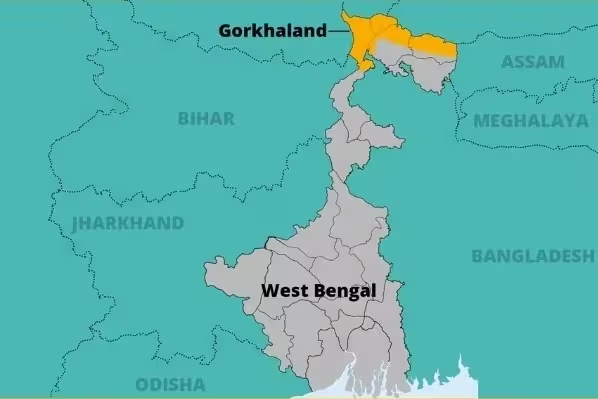
The Central Government has appointed former Deputy National Security Adviser (Dy NSA) Pankaj Kumar Singh as an interlocutor to hold talks with Gorkha leaders on the long-standing Gorkhaland statehood demand, aimed at finding a permanent political solution to the issue in the Darjeeling and Kalimpong hills of West Bengal.
Background
- India’s Constitution under Article 3 allows the creation of new states to meet cultural, linguistic, or administrative aspirations.
- However, the Gorkhaland issue reflects deeper questions of identity, autonomy, and representation within the Indian federal system.
Significance of the Move
- Renewed Engagement: Revives structured dialogue after years of silence since the Gorkhaland Territorial Administration (GTA) was set up.
- Political Signal: Appointment of a senior official shows the Centre’s seriousness in handling the issue peacefully.
- Identity Assertion: Recognizes the Gorkha community’s demand for cultural and political recognition.
- Pre-Election Impact: Seen as an outreach effort to politically mobilize the hill electorate before the West Bengal Assembly elections.
Historical Background
- Early Phase (1907): The Hillmen’s Association first sought a separate administrative unit for Nepali-speaking people under British rule.
- Post-Independence: With linguistic reorganization in the 1950s, the Gorkhas felt underrepresented in West Bengal.
- 1980s Movement: Led by Subhash Ghising’s GNLF, the agitation turned violent; it resulted in the Darjeeling Gorkha Hill Council (DGHC) in 1988.
- Second Wave (2007): Bimal Gurung’s Gorkha Janmukti Morcha (GJM) renewed the demand; the Gorkhaland Territorial Administration (GTA) was created in 2011.
- Current Phase: The Centre’s talks aim to achieve a “permanent political settlement” and recognition of 11 Gorkha sub-tribes as Scheduled Tribes.
Key Demands
- Formation of a separate Gorkhaland state from Darjeeling and parts of Kalimpong.
- ST status for 11 Gorkha sub-tribes for constitutional protection.
- Greater autonomy and recognition of the Gorkha identity within the Indian Union.
Statehood Demands in India
- Over 30 statehood movements have emerged since Independence — e.g., Telangana, Bodoland, Vidarbha, Bundelkhand.
- Reasons:
- Cultural and linguistic assertion.
- Perceived economic neglect.
- Need for better administration.
- Political underrepresentation.
Challenges & Lessons
- Risks: Political fragmentation, resource disputes, and ethnic competition.
- Benefits: Better governance, inclusive development, and local representation.
- Lesson: Peaceful, institutional dialogue—through interlocutors or commissions—is vital for resolving autonomy movements democratically.
CONSTITUTIONAL PROVISION
- Article 3 empowers Parliament to create new states or alter boundaries.
- The concerned state’s opinion is advisory, not binding — ensuring national flexibility.
- Example: Telangana was created in 2014 despite opposition from the Andhra Pradesh Assembly.
Conclusion
The Gorkhaland issue reflects India’s ongoing effort to balance unity with diversity and integration with identity. The Centre’s interlocutor initiative offers a constitutional and consultative path, setting a democratic example for addressing regional aspirations across India.
This article has been updated and published in detail on our new platform. Please visit the link below for the latest version:
STRENGTHENING RURAL GROWTH WITH ENHANCED AGRICULTURAL CREDIT
TOPIC: (GS3) ECONOMY: THE HINDU
The Union Finance Minister recently reviewed the performance of Karnataka Grameena Bank (KaGB) in Ballari and urged rural banks to increase agricultural lending.
About Agricultural Credit in India
- Key Credit Providers: Public Sector Banks, Regional Rural Banks (RRBs), Cooperative Banks, and NABARD are the main sources of formal farm credit.
- Types of Credit:
- Short-Term Loans: For inputs like seeds, fertilizers, pesticides, and other seasonal expenses.
- Medium & Long-Term Loans: For purchasing machinery, irrigation equipment, and developing farmland.
Why Agricultural Credit Needs a Boost
- Rising Input Costs: Increasing prices of fertilizers, seeds, and machinery have made affordable loans essential for farmers.
- Rural Diversification: Growth in allied sectors like dairy, fisheries, food processing, and agri-tech startups needs better financial access.
- Credit Gap for Small Farmers: About 85% of farmers are small or marginal and rely on informal lenders charging high interest rates.
- Support for FPOs & MSMEs: These organisations need working capital to improve value chains and rural employment.
- Adapting to Climate Change: Financing is required for climate-resilient crops, irrigation, and mechanisation.
Government Initiatives to Strengthen Agricultural Credit
- Kisan Credit Card (KCC): Provides easy and flexible credit access to farmers.
- Priority Sector Lending (PSL): Mandates banks to allocate 18% of Adjusted Net Bank Credit to agriculture.
- Interest Subvention Scheme (ISS): Offers loans at concessional rates, especially during crop failures or natural calamities.
- NABARD Refinance: Supplies low-cost funds to rural banks for farm development projects.
- Promotion of FPOs: Government plans to form 10,000 Farmer Producer Organisations to enhance collective bargaining and credit reach.
- Digital Innovations: Tools like Digital KCC, Agristack, and JAM Trinity streamline credit delivery and prevent leakages.
Major Challenges
- Regional Imbalance: Eastern and Northeastern states receive far less institutional credit than Southern or Western states.
- Short-Term Focus: Most loans are short-term, limiting investment in farm infrastructure.
- Land Ownership Issues: Tenant and landless farmers often lack access due to missing land titles.
- Rising NPAs: Defaults and poor recoveries affect RRBs’ financial strength.
- Slow Delivery: Paperwork delays and weak risk assessment hinder effective lending.
The Way Forward
- Strengthen Rural Banks: Infuse capital and upgrade digital systems for faster credit flow.
- Promote Allied Sector Lending: Encourage loans for fisheries, dairy, and renewable energy to diversify income.
- Inclusion of Marginal Farmers: Use Self-Help Groups (SHGs) and Joint Liability Groups (JLGs) to include women and tenants.
- Use Technology: Adopt AI-based credit scoring and satellite data to assess risk and prevent fraud.
- Better Coordination: Align policies of Finance Ministry, NABARD, and state governments to ensure balanced and inclusive rural credit growth.
Conclusion
Enhancing agricultural credit is vital to strengthen rural incomes, reduce dependency on informal lenders, and promote sustainable and inclusive growth in India’s rural economy.
This article has been updated and published in detail on our new platform. Please visit the link below for the latest version:
RBI’S GOLD RESERVES CROSS $100 BILLION
TOPIC: (GS3) ECONOMY: THE HINDU
The Reserve Bank of India (RBI) announced that the value of India’s gold reserves crossed USD 100 billion for the first time, reaching USD 102.36 billion in the week ending October 10, 2025.
India’s Gold Reserve Overview (2025)
- Total Gold Holdings: Around 879.6 metric tonnes as of March 2025.
- Historic Valuation: Gold reserves valued at USD 102.36 billion, marking an all-time high.
- Share in Forex Reserves: Gold now forms 14.7% of India’s total foreign exchange reserves, the highest since 1996–97.
- Annual Increase: Gold’s share rose from 12.5% (early 2025) due to valuation gains and market volatility.
- Repatriation: The RBI brought back over 100 tonnes of gold from overseas vaults to India during FY 2024–25.
Storage and Distribution
- Domestic Holdings: Around 200 tonnes stored in India.
- Foreign Holdings: Nearly 367 tonnes remain abroad for trade convenience.
- Institutions: Gold stored with the Bank of England, Bank for International Settlements (BIS), and the Federal Reserve Bank of New York.
Why Does RBI Store Gold Overseas?
- Ease of Transactions: Facilitates quick trading and gold swaps.
- Risk Diversification: Reduces geopolitical and operational risks by spreading storage globally.
- Historical Context: During the 1991 balance of payments crisis, India pledged gold to the Bank of England; later repaid, but some reserves continued to be held abroad for convenience.
- Security Concerns: Recent global asset freezes (e.g., Russia) prompted the RBI to shift part of its gold back home.
Importance of Gold Reserves
- Economic Stability: Acts as a hedge against currency devaluation and inflation.
- Financial Security Buffer: Provides protection during global financial shocks.
- Supports Monetary Policy: Helps maintain confidence in the rupee and manage domestic gold prices.
- Strategic Asset: Ensures diversification away from volatile foreign currencies.
Conclusion
Crossing the $100 billion mark reflects India’s growing financial strength and prudent reserve management. The RBI’s strategy of diversifying into gold enhances the country’s economic resilience and global credibility.
This article has been updated and published in detail on our new platform. Please visit the link below for the latest version:
DNA-BASED ELEPHANT CENSUS
TOPIC: (GS3) ENVIRONMENT: THE HINDU
The Synchronous All India Elephant Estimation (SAIEE) 2021–25 report was recently released by the Ministry of Environment, Forest and Climate Change (MoEFCC).
Background
- The latest estimate places India’s wild Asian elephant population at 22,446, down from 27,312 in 2017 — a 17.8% decline.
- The Ministry clarified this is a “new scientific baseline”, not a direct comparison, due to changes in methodology.
- The Western Ghats and Northeast remain key habitats, especially in Karnataka, Kerala, and Assam.
- However, regions like Jharkhand (–68%) and Odisha (–54%) have seen sharp population declines.
Key Concerns
- Decline indicates ongoing threats to elephant corridors and habitats caused by deforestation, mining, and human encroachment.
- Fragmented landscapes continue to disrupt elephant migration routes, increasing human–elephant conflict.
New Methodology: DNA-Based Census
- The SAIEE 2021–25 marks a major scientific advancement in wildlife monitoring.
- It uses genetic mark–recapture techniques, similar to the tiger census model.
- Instead of traditional direct counts or dung-decay studies, it relies on:
- Spatially designed sampling grids, and
- DNA analysis of dung samples to identify individual elephants.
- This provides greater accuracy, minimizes duplication, and helps in long-term population tracking.
Significance
- Creates a more reliable and scientific baseline for future monitoring.
- Enables better conservation planning and policy correction based on real data.
- Helps in mapping habitat use and migration patterns, crucial for sustainable coexistence strategies.
Way Forward
- Strengthen habitat connectivity through protected corridors.
- Increase community participation in conflict management.
- Use scientific data for adaptive conservation policies ensuring long-term elephant survival.
This article has been updated and published in detail on our new platform. Please visit the link below for the latest version:
WE RISE INITIATIVE
TOPIC: (GS2) GOVERNANCE: THE HINDU
The Government of India launched the ‘We Rise’ (Women Entrepreneurs Reimagining Inclusive and Sustainable Enterprises) initiative to support women entrepreneurs in expanding their businesses globally.
About the ‘We Rise’ Initiative
- Purpose: To help women-led enterprises grow beyond borders through trade facilitation, mentorship, and global partnerships.
- Implementing Agencies: A joint effort between NITI Aayog’s WEP and DP World, aligning with India’s goal of women-led economic growth.
- Focus Areas:
- Enabling international trade access for women entrepreneurs.
- Providing mentorship and skill-building for scaling businesses.
- Creating networks and partnerships with global markets.
Women Entrepreneurship Platform (WEP)
- Establishment: Started by NITI Aayog in 2018, WEP acts as a one-stop platform for promoting and supporting women-led businesses.
- Transition: Became a public-private partnership (PPP) model in 2022 to enhance collaboration.
- Functions as an Aggregator:
- Connects women entrepreneurs with over 47 partners from both public and private sectors.
- Focuses on six key areas:
- Access to finance
- Market linkages
- Training and skill development
- Mentoring and networking
- Compliance and legal support
- Business development services
Award to Reward (ATR) Initiative
- Launched: In 2023 to create a structured collaboration model within WEP.
- Objective: To build partnerships among stakeholders addressing specific challenges faced by women entrepreneurs.
- Features:
- Recognises and celebrates successful women-led ventures.
- Works as a plug-and-play framework promoting scalable impact and measurable outcomes.
Conclusion
The ‘We Rise’ initiative reinforces India’s vision of women-led development, empowering women entrepreneurs to become global business leaders and key contributors to the nation’s sustainable growth.
This article has been updated and published in detail on our new platform. Please visit the link below for the latest version:
INTERNATIONAL MARITIME ORGANIZATION (IMO)
TOPIC: (GS2) INTERNATIONAL RELATIONS: THE HINDU
The United States President Donald Trump expressed strong opposition to the IMO’s proposal to impose a carbon emissions price on global shipping, calling it a “Global Green New Scam Tax.”
Overview of IMO
- Full Form: International Maritime Organization.
- Type: UN specialized agency for shipping safety, security, and marine pollution prevention.
- Headquarters: London, United Kingdom.
- Members: 176 member states and 3 associate members.
- Role: Sets global standards for the safety, security, and environmental performance of international shipping.
- Regulatory Nature: IMO develops regulations; enforcement is the responsibility of member states, which incorporate them into domestic law.
- Contribution to SDGs: Supports UN SDG 14, promoting sustainable use and conservation of oceans and marine resources.
Functions of IMO
- Safety Regulations: Develops rules for ship design, construction, and operation to ensure maritime safety.
- Security Measures: Formulates policies to prevent threats to ships and ports.
- Environmental Protection: Controls marine pollution from ships, including emissions, oil spills, and ballast water.
- Legal Framework: Handles issues like liability, compensation, and maritime traffic facilitation.
- Standard Setting: Creates a universally accepted framework for global shipping operations.
Organisational Structure
- Assembly: Supreme decision-making body; meets every two years to approve the budget, work programme, and elect council members.
- Council: Executive body overseeing IMO operations between Assembly sessions.
- Committees: Five main committees, including the Marine Environment Protection Committee (MEPC), formulate policies and draft regulations.
- Funding: Comes from mandatory member contributions, voluntary donations, and commercial revenue.
Conclusion
The IMO plays a crucial role in ensuring safe, secure, and environmentally responsible shipping worldwide. Its initiatives, including carbon pricing and emission controls, are central to global climate action and sustainable maritime development.
This article has been updated and published in detail on our new platform. Please visit the link below for the latest version:
ZOMBIE DEER DISEASE
TOPIC: (GS3) ENVIRONMENT: THE HINDU
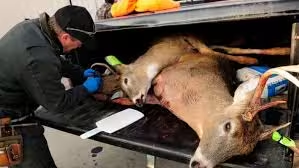
Health officials in Florida (USA) have recently confirmed new cases of Chronic Wasting Disease (CWD), popularly called Zombie Deer Disease, raising concerns about its potential spread and ecological impact.
About Chronic Wasting Disease
Chronic Wasting Disease (CWD) is a progressive, fatal neurological disorder that primarily infects deer, elk, moose, and reindeer. It is part of a group of diseases known as transmissible spongiform encephalopathies (TSEs), similar to mad cow disease (BSE) in cattle.
Cause and Transmission
- Causative Agent: CWD is caused by prions, which are abnormally folded proteins that lack DNA or RNA.
- These prions induce other normal brain proteins to misfold, resulting in brain tissue degeneration.
- Mode of Transmission: The disease spreads through body fluids (saliva, blood, urine, feces) and can also contaminate soil, plants, and water, remaining infectious for years.
- Persistence: Once introduced, prions are extremely resistant to heat and disinfectants, making environmental control difficult.
Symptoms
- Long incubation period of 18–24 months.
- Weight loss, loss of coordination, drooling, lethargy, and lack of fear of humans are typical signs.
- The disease ultimately leads to severe brain damage and death.
Treatment and Human Risk
- There is no cure or vaccine for CWD.
- So far, no confirmed human cases exist, but health authorities advise avoiding consumption of infected animal meat due to potential risks.

This article has been updated and published in detail on our new platform. Please visit the link below for the latest version: