VICE-PRESIDENT JAGDEEP DHANKHAR RESIGNS
TOPIC: (GS2) INDIAN POLITY: THE HINDU
Jagdeep Dhankhar resigned as the Vice-President of India, citing health concerns. His decision came unexpectedly on the first day of the 2025 Monsoon Session of Parliament.
Details of the Resignation
- Jagdeep Dhankhar, aged 74, stepped down with two years remaining in his term.
- He submitted his resignation to President Droupadi Murmu.
- Cited medical advice and the need to focus on his health as the reason.
- The resignation was submitted under Article 67(a) of the Constitution.
Recent Activities Before Resignation
- Presided over Rajya Sabha proceedings on the morning of the Monsoon Session’s first day.
- Held a meeting of the Business Advisory Committee and active in discussions related to impeachment motions of judges.
- PIB later announced he was traveling to Jaipur for a day visit.
Tenure Highlights
- Elected as the 14th Vice-President in August 2022.
- Served as the Chairman of Rajya Sabha (ex-officio).
- Had earlier served as the Governor of West Bengal, where he had notable clashes with the state government.
- Known for his vocal speeches and assertive stance as a presiding officer.
VICE-PRESIDENT OF INDIA
Election & Tenure
- Elected by an electoral college (members of both Houses of Parliament).
- Serves a 5-year term, but can resign or be removed earlier.
Qualifications
- Must be a citizen of India, 35 years of age, and eligible for Rajya Sabha membership.
- Should not hold any office of profit under the Government.
Functions
- Acts as ex-officio Chairman of the Rajya Sabha.
- Acts as President in the absence or vacancy of the President.
- Has no role in day-to-day executive powers unless acting as President.
Removal
- Can resign by writing to the President.
- Can be removed by a resolution passed by a majority of Rajya Sabha and agreed to by Lok Sabha (as per Article 67(b)).
Conclusion
Jagdeep Dhankhar’s unexpected resignation has left a vacancy in one of India’s top constitutional posts. His active role as Vice-President and Rajya Sabha Chairman will be remembered for its assertiveness and engagement with legislative matters.
EXCLUSION FROM ELECTORAL ROLLS AND CITIZENSHIP STATUS
TOPIC: (GS2) INDIAN POLITY: THE HINDU
The Election Commission (EC) told the Supreme Court that being left out of the voter list during the Special Intensive Revision (SIR) in Bihar will not affect a person’s citizenship. This came after concerns were raised that the revision process was like a citizenship verification drive and could lead to mass voter exclusion.
Background of the Issue
- The Special Intensive Revision (SIR) is currently being conducted in poll-bound Bihar.
- Petitioners had claimed this exercise could be used to question people’s citizenship and disenfranchise many citizens.
- The matter was heard by the Supreme Court, and the EC responded with a detailed affidavit.
Election Commission’s Affidavit
- Citizenship is not affected by exclusion from electoral rolls during SIR under Article 326 (adult suffrage).
- The EC can ask for proof of citizenship documents as per the law to ensure the purity of voter lists.
- The existing voters in Bihar will be included in the draft roll to be published on August 1, if they submit enumeration forms.
Electoral Roll Process in Bihar
- The previous electoral rolls were published on January 7, 2025.
- People who miss submitting documents before the draft roll can still apply during a 31-day claims period.
- During this period, Electoral Registration Officers (EROs) will check the forms.
- If the ERO has any doubt about someone’s eligibility, a suo motu inquiry can be started, and a notice will be issued.
Conclusion
The Election Commission clarified that voter list updates are not linked to citizenship status. Citizens can still apply to be included in the final list even if they miss the initial deadline, ensuring the voting rights of genuine citizens remain protected.
INDIA-U.K. FTA AND THE ROLE OF GLOBAL CAPABILITY CENTRES (GCCS)
TOPIC: (GS3) ECONOMY: THE HINDU
As India and the U.K. move closer to signing a Free Trade Agreement (FTA), the focus is shifting to services, digital trade, and innovation, especially through Global Capability Centres (GCCs).
What are GCCs?
- Global Capability Centres (GCCs) are offshore units that deliver IT, business, and digital services for multinational companies.
- India has over 1,500 GCCs, employing nearly 1.9 million professionals.
- These centres support global operations in research, cybersecurity, AI, analytics, taxation, and more.
How FTA Can Boost GCCs
- The India-U.K. FTA can remove regulatory hurdles and support free movement of skilled professionals.
- It may promote data-sharing rules, intellectual property protections, and solutions to issues like double taxation and data localisation.
- British companies can partner with Indian GCCs to reach global markets.
Policy Support in India
- The MeitY-led panel is working on a national framework for GCCs, announced in Budget 2025.
- States like Uttar Pradesh are launching dedicated GCC policies and hosting investor summits in cities like Lucknow and Kanpur.
- Both Centre and States are aiming to improve infrastructure, legal ease, and talent development.
Diplomatic and Economic Importance
- The FTA will help the U.K. access India’s digital economy, while India can benefit from U.K. investment and tech expertise.
- The UKIBC and business leaders urge focus on services, mobility, and innovation in the final FTA draft.
FREE TRADE AGREEMENTS (FTAS)?
A Free Trade Agreement (FTA) is a pact between two or more countries to reduce or eliminate trade barriers like tariffs, import quotas, and export restrictions to encourage smoother trade and investment flows between the nations.
Features of FTAs:
- Reduction or elimination of tariffs on goods traded between member countries.
- Access to markets for goods, services, and sometimes investments.
- Rules of origin to determine the national source of a product.
- Provisions for intellectual property, e-commerce, government procurement, etc.
- Dispute resolution mechanisms in case of trade conflicts.
Objectives of FTAs:
- Boost bilateral trade and investment.
- Enhance competitiveness of domestic industries.
- Create jobs and economic growth.
- Strengthen strategic and economic partnerships.
Examples of India’s Free Trade Agreements:
FTAs Partner Countries / Regions Key Highlights
India-ASEAN FTA 10 ASEAN nations (like Indonesia, Vietnam, Thailand) Trade in goods & services liberalized.
India-South Korea CEPA South Korea Broader than an FTA; includes investment & services.
India-Japan CEPA Japan Covers trade in goods, services, investment, and people movement.
India-UAE CEPA (2022) United Arab Emirates Aims to increase bilateral trade to $100 billion in 5 years.
India-Australia ECTA (2022) Australia Eliminated duties on many Indian exports like textiles, gems, etc.
Conclusion
GCCs are central to the India-U.K. trade partnership, offering a pathway to strengthen innovation, skill development, and global services through a well-designed Free Trade Agreement.
GENDER GAP IN PRIVATE SCHOOL ENROLMENT IN INDIA
TOPIC: (GS1) SOCIAL ISSUES: THE HINDU
A new report reveals that while enrolment in private schools has grown in India over the past decade, boys continue to outnumber girls, especially in northern and western States. The gender imbalance reflects persistent social biases and economic choices in education.
Trends in School Types (2012–2024)
- The share of government schools dropped from 74.2% (2012–13) to 69.1% (2023–24).
- Private schools increased their share from 17.2% to 22.5% during the same period.
- This shift indicates growing preference for private education due to perceived better quality.
Enrolment Patterns
- In 2012–13, 57.3% of students were in government schools; by 2023–24, it reduced to 51.4%.
- In contrast, private school enrolment rose from 28.2% to 36.3% over the decade.
- These trends show increased demand for private schooling, especially in urban and semi-urban areas.
Gender Disparity in Enrolment
- In 2023–24: 54% of girls were in government schools, while only 33% were in private schools. 49% of boys studied in government schools, but 39% were in private schools.
- This data indicates a clear gender gap, with boys having higher representation in private institutions.
Regional Differences
- States in northern and western India show lower girl enrolment than the national average of 48.1%.
- Cultural and economic factors may influence families to invest more in boys’ education.
Reasons for the Disparity
- Economic constraints lead families to prioritize sons for costly private education.
- Social biases and traditional gender roles discourage investing in daughters’ higher-quality schooling.
- Access issues and safety concerns may also limit girls’ attendance in distant or urban private schools.
Government Initiatives Addressing Gender Inequality
- Pradhan Mantri Matru Vandana Yojana (PMMVY): Provides conditional cash transfers to pregnant and lactating women for their first live birth, improving maternal and child health.
- Stand-Up India Scheme: Supports women (and SC/ST) entrepreneurs with bank loans from ₹10 lakhs to ₹1 crore.
- Mahila EHaat: Emarket platform for women entrepreneurs to sell products directly, boosting inclusion and incomes
- Nari Shakti Vandan Adhiniyam (2023): Reserved onethird of seats in Lok Sabha and State Legislatures for women, enhancing political representation by 2029 elections
Conclusion
Despite overall progress in school enrolment, a significant gender gap remains in private schools, especially in some regions. Bridging this divide will require focused policy measures, awareness campaigns, and financial support for girls’ education.
LEGAL STATUS OF THE RIGHT TO VOTE IN INDIA
TOPIC: (GS2) INDIAN POLITY: THE HINDU
The Supreme Court is hearing petitions on the Special Intensive Revision (SIR) of electoral rolls in Bihar. A key issue raised is whether the right to vote is a fundamental, constitutional, or statutory right.
Types of Rights in India
- Natural Rights: Inherent to all human beings (e.g., right to life). Not directly enforced by courts unless included in fundamental rights.
- Fundamental Rights: Listed in Part III of the Constitution. Directly enforceable in the Supreme Court under Article 32.
- Constitutional Rights: Found elsewhere in the Constitution (not Part III), e.g., right to property, free trade. Enforceable under Article 226.
- Statutory Rights: Given by laws made by Parliament, e.g., right to work under MGNREGA or food under NFSA.
What the Constitution and Laws Say
- Article 326: Grants universal adult suffrage to every citizen aged 18+, unless disqualified by law.
- Representation of the People Act, 1950 & 1951:
- Section 16 (1950): Disqualifies non-citizens.
- Section 19 (1950): Requires age 18+ and ordinary residency.
- Section 62 (1951): Allows only those on the electoral roll to vote; disqualifies those in jail or under specific legal conditions.
Judicial Viewpoints
- N.P. Ponnuswami (1952) & Jyoti Basu (1982): Right to vote is a statutory right.
- PUCL (2003): Justice Reddy called it a constitutional right, not fundamental.
- Kuldip Nayar (2006) & Anoop Baranwal (2023): Reaffirmed it as statutory.
- Justice Ajay Rastogi’s dissent: Saw voting as linked to freedom of expression (Article 19) and essential to democracy.
Conclusion
Currently, the right to vote is a statutory right, not a fundamental one. However, there is growing legal opinion that it deserves to be treated as a constitutional right because of its role in protecting democracy and the basic structure of the Constitution.
AI AND COPYRIGHT: LEGAL STATUS AND GLOBAL TRENDS
TOPIC: (GS3) SCIENCE AND TECHNOLOGY: THE HINDU
Recent U.S. court rulings (2025) in cases like Thomson Reuters vs Ross, Bartz vs Anthropic, and Kadrey vs Meta have clarified AI’s use of copyrighted data for training. These cases address whether AI training qualifies as ‘fair use’ and how it affects creators’ rights globally, including in India.
Key Legal Question
- Can AI systems legally train on datasets containing both copyrighted and public domain content without violating intellectual property (IP) laws?
Understanding the Issue
- Generative AI models are trained using vast datasets scraped from the internet, which often include copyrighted content.
- The major concern: Does copying this material for training count as copyright infringement or does it fall under ‘fair use’ or similar exceptions?
Court Decisions in the U.S.
- Anthropic Case: Court ruled training on copyrighted works could be transformative, like a writer learning from books. However, using pirated content remains a legal issue and must face trial.
- Meta Case: Judge ruled Meta’s training didn’t harm the market of original works; thus, it could be allowed under ‘fair use’. Still, the court noted that creators deserve compensation as AI companies profit from their work.
Legal Uncertainty
- There’s no global consensus on how copyright applies to AI training.
- Questions remain about:
- Whether AI outputs can have IP rights.
- Who owns the rights to AI-generated content.
- How to regulate AI’s use of private or pirated data.
Indian Context
- Copyright Act, 1957 gives creators exclusive rights like reproduction, adaptation, etc.
- Section 52 allows fair dealing, which may cover some AI training uses.
- India hasn’t created new AI-specific IP laws, but courts may use existing rules to decide.
- Case like ANI vs OpenAI may guide future legal clarity.
Conclusion
Courts in the U.S. have provided some protection under fair use, but the legal framework is still evolving. In India, current laws may handle basic issues, but AI-specific legal reforms may be needed to ensure fairness for creators and clarity for AI developers.
IMPEACHMENT PROCESS AGAINST JUSTICE YASHWANT VARMA
TOPIC: (GS2) INDIAN POLITY: THE HINDU
Parliament has begun the process to remove Justice Yashwant Varma, a judge of the Allahabad High Court, following allegations involving burnt currency found at his residence. Notices for his removal were submitted in both Lok Sabha and Rajya Sabha with required MP signatures.
Background
- Justice Varma was earlier transferred from Delhi High Court to Allahabad High Court.
- Action was initiated after burnt currency notes were discovered at his official home.
- Parliament has now triggered formal removal proceedings.
Current Action in Parliament
- 152 Lok Sabha MPs, including Opposition and BJP members, signed the notice.
- 63 Rajya Sabha MPs from various Opposition parties signed a separate notice.
- Notices met the legal requirement: Minimum 100 Lok Sabha members or 50 Rajya Sabha members must sign.
Legal Procedure for Judge’s Removal
Relevant Provisions:
- Article 124(4) (Supreme Court) and Article 217 read with 124(4) (High Court) of the Constitution govern judge removal.
- The only ground: proved misbehaviour or incapacity.
Steps in the Impeachment Process:
- Notice of Motion: Signed by required number of MPs and submitted to Speaker/Chairman.
- Admission of Motion: Speaker/Chairman may admit or reject it.
- Constitution of Committee (under Judges Inquiry Act, 1968):
- One Supreme Court judge,
- One Chief Justice of High Court,
- One distinguished jurist.
- Investigation & Report: Committee examines charges and submits report within 3 months.
- Parliamentary Voting: If committee finds judge guilty, motion is debated.
- Must be passed in both Houses by:
- Majority of total membership and
- 2/3rd of present and voting members.
- Must be passed in both Houses by:
- President’s Role: If passed, the President removes the judge by order.
Note
- Similar motion was earlier filed for Justice Shekhar Yadav (Allahabad HC).
- Such motions are rare and follow strict constitutional safeguards to protect judicial independence.
Conclusion
The process showcases checks and balances within the Indian judiciary and Parliament. It reflects constitutional mechanisms to ensure accountability of judges, while maintaining judicial independence.
NISAR – NASA-ISRO JOINT SATELLITE LAUNCH
TOPIC: (GS3) SCIENCE AND TECHNOLOGY: THE HINDU
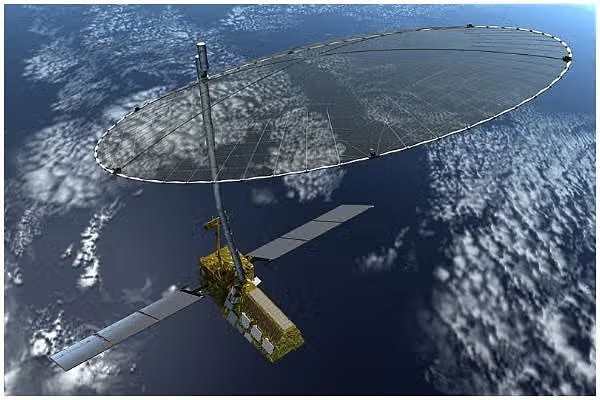
NISAR, the first Earth observation satellite developed jointly by NASA and ISRO, is scheduled for launch on July 30, 2025, from Sriharikota. This mission aims to monitor changes in Earth’s surface using advanced dual-frequency radar technology.
Features of NISAR
- Weight & Orbit: Weighs 2,392 kg; will be placed in a 743-km sun-synchronous orbit with a 98.4° inclination.
- Radar Technology: Equipped with dual-frequency Synthetic Aperture Radar (SAR) — NASA’s L-band and ISRO’s S-band.
- Antenna System: Features NASA’s 12-meter wide mesh reflector antenna mounted on ISRO’s modified I3K satellite platform.
- Swath & Resolution: Covers a 242-km swath with high spatial detail using SweepSAR technology.
Purpose and Applications
- Global Monitoring: Will scan the entire Earth every 12 days, offering continuous, weather-independent observation both day and night.
- Earth Surface Changes: Can detect minor movements like ground deformation, glacier flow, and vegetation shifts.
- Water and Soil Analysis: Useful for studying soil moisture, surface water bodies, and mapping shorelines.
- Disaster Management: Aids in tracking earthquakes, landslides, storms, and floods for timely response.
- Marine Uses: Helps in sea ice classification, ship tracking, and coastal surveillance.
Significance
- Enhances Earth observation capabilities and climate monitoring.
- Symbolizes strong Indo-US space cooperation.
- Supports sustainable development through precise environmental data.
Conclusion:
NISAR marks a milestone in international space partnerships and will serve as a critical tool for environmental monitoring and disaster management.