
Daily Current Affairs 22-November-2025

Share this Post

INDIA’S FOREIGN POLICY SHIFTING TOWARDS ASIA

TOPIC: (GS2) INTERNATIONAL RELATIONS: THE HINDU

India’s foreign policy is entering a critical phase as global influence moves toward Asia. In this changing geopolitical setting, India’s long-term interests may be better protected by strengthening ties within Asia rather than relying on any single major power.

Why Asia is Important for India

  • Asia is rapidly becoming the geopolitical and economic center of the world.
  • Two-thirds of the world’s population and a large share of global GDP are concentrated in Asia.
  • Asia has emerging strategic groupings like SCO and BRICS, which emphasize mutual security, economics, and cooperation outside Western-dominated structures.
  • India’s geographical location and civilizational links offer strong foundations for regional leadership.

Need for a New Foreign Policy Approach

  • India can no longer follow a binary choice between major powers like the U.S. and China.
  • The current era requires India to assert strategic autonomy, making decisions based on national interests, not external pressure.
  • The decline of Western dominance and the rise of Asian economies calls for stronger South-South cooperation.

Strategic Autonomy: Redefined

  • Strategic autonomy should reflect India’s unique position, not just non-alignment.
  • India’s interests include:
    • Sustainable development,
    • Protection of supply chains,
    • Promoting inclusive growth and technology cooperation.
  • India must avoid entering alliances that limit its freedom to take independent decisions.

Pillars of India’s Asia-Centric Strategy

Economic and Technological Strength

  • India is one of the world’s fastest-growing major economies.
  • Large digital talent, technological capacity, growing defense manufacturing, and innovation make India an attractive partner.
  • India can be a key technological counterweight to other global powers.

Regional Security Cooperation

  • Asia’s future security structure will rely on cooperation, not military dominance.
  • India must expand regional partnerships focusing on: Cybersecurity,, Maritime security,, Counter-terrorism, Disaster management.

Reforming Global Governance

  • India represents the interests of the Global South, demanding reforms in international institutions like the UN, WTO, IMF.
  • India’s stance on climate justice, equitable trade, and sustainable development aligns closely with developing Asian nations.

Hard Choices for India

  • India must protect its economic data, digital innovation, and technological sovereignty.
  • Defense spending needs reallocation — shift from equipment imports to home-grown capability (AI, drones, missiles, space tech).
  • Partnerships should be based on transparent, value-based supply chains—not blind alignment with any single power.

Future Outlook

  • India must leverage its demographic advantage, technological potential, and growing global influence to shape Asia’s future.
  • Collaboration with Asian nations can create a more balanced, multipolar world.
  • India’s ultimate aim should be to lead through cooperation, innovation, and inclusive development.

Conclusion

India’s future lies in strengthening its role as a responsible Asian power, promoting multipolarity, regional cooperation, and strategic autonomy. By positioning itself at the heart of Asian growth and stability, India can contribute to shaping a fair and balanced global order.

This article has been updated and published in detail on our new platform. Please visit the link below for the latest version:

👉 Read the full article on ekamiasacademy.in

INDIA’S PROPOSED CAFE 3 NORMS AND AUTO INDUSTRY DIVIDE

TOPIC: (GS3) ENVIRONMENT: THE HINDU

The upcoming CAFE 3 Corporate Average Fuel Efficiency (CAFE) norms (FY28–FY32) introduce stricter fuel-efficiency rules based on the weight of vehicles.

What are CAFE 3 Norms?

  • Corporate Average Fuel Efficiency (CAFE) norms are part of India’s climate and mobility policy aimed at reducing fuel consumption and lowering CO₂ emissions from vehicles.
  • CAFE norms control average CO₂ emissions and fuel consumption across all models manufactured by a company.
  • CAFE 3 uses a weight-based formula: 0.002 × (W − 1170) + c (which becomes stricter every year).
  • Lighter vehicles will be required to improve fuel efficiency more than heavier vehicles.
  • Norms also shift testing standards from MIDC to WLTP, which gives more realistic emission results.

Corporate Average Fuel Efficiency (CAFE) norms (FY28–FY32)

Why the Auto Industry is Divided

Impact on Small Cars

  • Small cars face stricter efficiency targets despite being less polluting in absolute terms.
  • Limited scope for advanced technologies like hybrid systems and electrification due to cost constraints.
  • Entry-level cars may become more expensive, affecting first-time buyers and lower-income groups.

Impact on Bigger Vehicles (SUVs)

  • Heavy vehicles get relatively easier targets despite higher emissions.
  • Manufacturers like Tata and Mahindra support the norms and believe small cars should not get more exemptions.

Challenges:

  • “Brick in the Boot” problem: Manufacturers may artificially increase vehicle weight to qualify for lenient norms.
  • Market distortion risk: Could push the sector towards heavier, more polluting SUVs.
  • Safety vs affordability: Relaxation for lighter cars may compromise safety features.
  • Regressive social impact: Higher prices may reduce car ownership for lower-income segments.
  • Risk of inflated efficiency on paper without real CO₂ reduction.

Comparison with Global Practices

  • In countries like the US, China, Japan, and the EU, stricter rules apply to heavier vehicles, while smaller cars get relief.
  • India’s reverse approach creates imbalance and discourages production of affordable, low-emission small cars.

Way Forward

  • Revisit the weight-based structure to better support lighter and cleaner vehicles.
  • Introduce technology-neutral incentives for EVs, hybrids, and cleaner internal combustion engines.
  • Provide financial incentives or tax support for budget cars.
  • Gradually phase in new testing systems like WLTP to ensure smooth transition.
  • Focus on absolute emission cuts, not just average fleet targets.

Conclusion

CAFE 3 norms represent an important step toward cleaner mobility. However, their current structure puts an unfair burden on small cars, risking affordability, fairness, and environmental goals. A balanced approach that protects both climate and consumer interests is essential for India’s sustainable mobility transition.

This article has been updated and published in detail on our new platform. Please visit the link below for the latest version:

👉 Read the full article on ekamiasacademy.in

RETHINKING ENVIRONMENTAL RESPONSIBILITY IN INDUSTRIAL PLANNING

TOPIC: (GS3) ENVIRONMENT: THE HINDU

Industrial expansion is increasingly linked to reduced green cover norms and reliance on small on-site green belts, raising concerns that such symbolic measures may not reflect true environmental responsibility or ecological sustainability.

Limits of Plot-Level Green Cover

  • Green belts within industrial plots reduce dust, noise, and improve local air quality.
  • These provide local benefits, like microclimate regulation and visual greening.
  • But they do not restore biodiversity, hydrological cycles, or ecological resilience.
  • They are mitigative, not restorative—they do not compensate for large-scale land conversion damage.
  • Industrial green belts are often too narrow, fragmented, and isolated to support long-term ecological functions.

Misconception: Green Belts = Sustainability

  • Policymakers often view green cover guidelines as environmental compliance.
  • But applying uniform green cover targets across different regions is ecologically unscientific.
  • Areas with dense population and heavy industry need wider ecological buffers for pollution control.
  • Instead of fixed percentage-based green norms, a landscape-specific strategy is needed.
  • Borrowing norms from different countries without considering local population, biodiversity, or climate leads to ineffective planning.

Need for a Landscape-Level Approach

A balanced ecological planning strategy should include:

  • State or regional green reserves near industrial clusters.
  • Restoration of natural ecosystems, wetlands, riverbanks, mangroves, and degraded forests.
  • Creation of green corridors and ecological connectivity for wildlife and climate regulation.
  • Linking industrial projects with carbon offset programmes and green credits.
  • Mandatory ecological health assessment before industrial clearance.

This approach would ensure environmental sustainability at landscape scale, not just within plot boundaries.

Industries as Ecological Stewards

  • Industrial growth should not be seen as an enemy of environmental protection.
  • Industries can support large-scale ecosystem restoration by:
    • Funding reforestation and watershed protection.
    • Supporting biodiversity conservation initiatives.
    • Restoring degraded lands, wetlands, and buffer zones.
  • Instead of being mere polluters to be penalised, industries can become partners in ecological restoration.

Policy Recommendations

  • Replace rigid plot-level green norms with science-based, region-specific policies.
  • Promote public-private partnerships for ecosystem restoration.
  • Encourage carbon credits, ecological compensation, and biodiversity offsets.
  • Align green strategies with climate action, sustainable development, and regional planning.

Way Forward

  • The future of sustainable development lies not in small isolated green patches, but in large, interconnected natural ecosystems.
  • Industrial compliance should evolve from symbolic green efforts to systemic ecological restoration.
  • Environmental responsibility must move from plot-based protection to landscape-level resilience.

Conclusion:
Environmental sustainability cannot be achieved by simply planting trees around factory walls. True ecological responsibility requires industries to become active partners in restoring natural ecosystems at a landscape scale, ensuring long-term environmental health and resilience.

This article has been updated and published in detail on our new platform. Please visit the link below for the latest version:

👉 Read the full article on ekamiasacademy.in

HIGH PENDENCY AND STAFFING GAPS IN JUVENILE JUSTICE BOARDS

TOPIC: (GS2) POLITY: THE HINDU

A recent study by the India Justice Report (IJR) shows that Juvenile Justice Boards (JJBs) across India are suffering from high case pendency, staff shortages, weak data systems, and poor inter-agency coordination.

Who are Juveniles?

  • A juvenile is a child or minor who is below 18 years of age according to the law.
  • Juveniles are not treated as adults in legal matters and are dealt with under the Juvenile Justice system, focusing on care and reform, not punishment.
  • If a child below 18 commits an offence, they are called a “child in conflict with law”, and their case is handled by the Juvenile Justice Board (JJB).

Major Findings

High Pendency and Heavy Workload

  • Over 55% of cases before JJBs remain pending.
  • Odisha has the highest pendency (83%), while Karnataka has the lowest (35%).
  • Each JJB handles around 154 pending cases per year, causing delays and affecting child rights.

Staffing and Infrastructure Gaps

  • 24% of JJBs are not fully constituted, lacking trained professionals, especially social workers.
  • Many districts lack child-friendly infrastructure and legal service clinics, which are essential for rehabilitation.
  • Training and capacity building of staff receive inadequate funding.

Poor Data and Transparency

  • Unlike regular courts, there is no centralized database for juvenile justice cases.
  • RTI analysis showed low transparency, with many responses incomplete or rejected.
  • Absence of real-time data affects planning, monitoring, and accountability.

Structural Weaknesses in Juvenile Justice System

  • Agencies like Police, Women & Child Development Department, SCPS, and SLSA work in isolation, leading to poor coordination.
  • 30% of JJBs lack legal aid clinics, forcing many children to face the system without proper legal help.
  • Even Child Care Institutions (CCIs), responsible for rehabilitation, face large staffing vacancies.

Rising Juvenile Cases

  • 40,036 juveniles were apprehended in more than 31,000 cases, mainly aged 16–18 years, showing an increasing share of older adolescents.

Way Forward

Administrative Reforms

  • Create a National Juvenile Justice Data Grid for transparency and tracking of cases.
  • Fill vacancies in JJBs and CCIs, and improve training for judges, social workers, and support staff.

Legal and Social Measures

  • Ensure legal aid clinics in all districts.
  • Enhance child-friendly infrastructure such as counseling rooms and rehabilitation cells.

Policy Measures

  • Improve inter-agency coordination and establish a monitoring framework.
  • Increase fund allocation for child protection and justice institutions.

Conclusion

For a fair and compassionate juvenile justice system, India must focus on strengthening institutions, improving human resources, and ensuring timely justice. Only then can the principles of child protection and rehabilitation under the JJ Act be fully realized.

This article has been updated and published in detail on our new platform. Please visit the link below for the latest version:

👉 Read the full article on ekamiasacademy.in

IMMIGRANTS EXPULSION ACT 1950

TOPIC: (GS2) POLITY: THE HINDU

Assam has, for the first time, used the Immigrants (Expulsion from Assam) Act, 1950 to issue deportation orders against five individuals declared “foreigners” by a tribunal. This is the Act’s first recorded use since its approval by the state cabinet.

Historical Background

  • Enacted on 1 March 1950, this law was framed to control the increasing migration into Assam from East Pakistan after Partition.
  • Assam was facing political, demographic, and ethnic tensions due to mass cross-border movement.
  • Since citizenship is a Union subject, the Central government drafted the Act and delegated powers to Assam.

Purpose and Key Features of the Act

  • The Act allows the Central Government to expel individuals from Assam who are:
    • Normally residents outside India,
    • Entered Assam before/after 1950,
    • Considered harmful to public interest or to Scheduled Tribes in Assam.
  • The law gives authorities power to order such individuals to remove themselves from Assam or India within a time limit, through a defined route.
  • Officers of both the Union and Assam governments can enforce expulsion.

Refugee Exemption

  • Understanding post-Partition humanitarian issues, the Act exempted refugees who migrated due to civil unrest or communal riots in Pakistan (later Bangladesh).
  • This showed a balance between security concerns and humanitarian duty.

Challenges in Implementation

Difficulty in Identification

    • During communal tensions in Lower Assam (1950), 40,000 to 1 lakh Muslims migrated to East Pakistan.
    • Many original residents were mistakenly labeled immigrants, especially Assam’s Bengali Muslims.

Political Sensitivity

    • A controversial case involved an Assamese Muslim being asked to leave, which drew strong objection from PM Jawaharlal Nehru.
    • He believed that such harsh action during unstable times would harm communal harmony.

Nehru–Liaquat Pact (April 1950)

    • A bilateral pact between India and Pakistan to protect minorities on both sides.
    • Pakistan’s PM Liaquat Ali Khan raised concerns over Assam’s expulsion orders.
    • Soon after, Nehru suspended the Act’s implementation.

End of Active Use

  • On 10 April 1950, Nehru ordered the Assam CM to suspend all expulsions.
  • The emphasis shifted to minority protection, peace, and stability.
  • Historically, only a few hundred individuals were impacted before the Act was quietly sidelined.


1950 – Enactment of the Immigrants (Expulsion from Assam) Act

  • This law was made to control illegal migration into Assam from East Pakistan (now Bangladesh) after Partition.
  • It gave the Central Government power to remove foreigners whose presence was harmful to peace, public interest, or tribal areas.
  • Refugees fleeing violence were not to be expelled under this Act.

1979–1985 – The Assam Movement

  • A mass student-led protest in Assam.
  • Main demand: identify, delete names, and deport illegal immigrants from Assam.
  • People feared loss of jobs, land, culture, and identity due to migration.
  • Led by All Assam Students’ Union (AASU).

1985 – Assam Accord Signed

  • Peace agreement between Government of India and Assam Movement leaders.
  • Key points:
    • Foreigners who entered after 24 March 1971 to be detected and deported.
    • Protect Assamese people’s culture, identity, and language.
    • Promised development and safety for local communities.

2015 – Supreme Court Ruling on the Act

  • The Supreme Court said the 1966 and 1971 cut-off rules (from Assam Accord) must be followed strictly.
  • It ordered the government to speed up detection and deportation of illegal immigrants.
  • Stressed the need to protect Assam’s demographics and national security.

Conclusion

The Immigrants (Expulsion from Assam) Act, 1950 reflected early attempts at regulating migration in Assam. However, due to political sensitivity, humanitarian concerns, and challenges in identifying genuine citizens, the law remained largely unused. Its recent revival shows Assam’s continuing struggle with migration, citizenship, and identity.

This article has been updated and published in detail on our new platform. Please visit the link below for the latest version:

👉 Read the full article on ekamiasacademy.in

GLOBAL METHANE STATUS REPORT 2025

TOPIC: (GS3) ENVIRONMENT: THE HINDU

The Global Methane Status Report 2025 highlights the urgent need for methane reduction, especially in large emitting countries like India.

About the Report

  • Published by the UN Environment Programme (UNEP) and the Climate and Clean Air Coalition (CCAC).
  • Monitors progress toward the Global Methane Pledge, which aims to reduce methane emissions by 30% by 2030.
  • Tracks emission trends, health, agriculture, and climate impacts.
Global Methane Status Report 2025

Key Findings

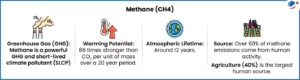
  • Methane concentration has more than doubled since the pre-industrial era.
  • Increasing methane emissions may lead to 24,000 additional premature deaths and 2.5 million tonnes of crop loss annually by 2030.
  • India is the third-largest methane emitter globally.
  • India’s agriculture alone contributes 12% of global agricultural methane emissions, mainly from paddy cultivation, livestock, and crop-residue burning.
  • G20+ nations contribute 65% of global human-induced methane emissions but hold 72% of reduction potential.
  • If countries fully implement NDCs and Methane Action Plans, emissions could drop by 8% by 2030.

Conclusion

The Immigrants (Expulsion from Assam) Act, 1950 reflected early attempts at regulating migration in Assam. However, due to political sensitivity, humanitarian concerns, and challenges in identifying genuine citizens, the law remained largely unused. Its recent revival shows Assam’s continuing struggle with migration, citizenship, and identity.

WHAT IS METHANE?

Methane is a gas with the chemical formula CH₄. It is the main ingredient of natural gas used for cooking and energy.

  • It is colorless, odorless, and flammable.
  • It does not dissolve in water.
  • It is also called marsh gas or methyl hydride.

Environmental Importance

  • Methane is a powerful greenhouse gas.
  • It is 28–34 times stronger than carbon dioxide (CO₂) in trapping heat.
  • It is responsible for about one-third of current global warming.
  • It stays in the atmosphere for around 12 years, but its impact is very strong.

Where Does Methane Come From?

  • Natural Sources: Wetlands, termites, melting ice (permafrost), and ocean floors.
  • Human Sources: Rice fields, cow dung and livestock digestion, landfills, coal mining, oil and gas drilling, and burning crop residue.

Why is Methane a Concern?

  • It heats the Earth faster than CO₂.
  • It contributes to air pollution and ground-level ozone formation.
  • Reducing methane gives quick results in slowing climate change.

Conclusion

Effective methane reduction offers a quick and impactful climate solution, especially for countries like India. Addressing agricultural and waste-related emissions is essential for sustainable development and climate resilience.

This article has been updated and published in detail on our new platform. Please visit the link below for the latest version:

👉 Read the full article on ekamiasacademy.in

COLOMBO SECURITY CONCLAVE (CSC)

TOPIC: (GS3) SECURITY: THE HINDU

The 7th NSA-level meeting was recently held in New Delhi. The Colombo Security Conclave (CSC) is a regional security initiative that promotes cooperation among Indian Ocean coastal countries.

About CSC

  • Members: India, Sri Lanka, Maldives, Mauritius, Bangladesh, and Seychelles.
  • Objective: To ensure regional stability, maritime security, and cooperation against transnational threats.
  • Format: Brings together National Security Advisors (NSAs) and Deputy NSAs.

Origin and Evolution

  • Started in 2011 as a Trilateral Maritime Security Cooperation framework between India, Sri Lanka, and Maldives.
  • Became inactive after 2014 due to diplomatic issues.
  • Revived and renamed as Colombo Security Conclave in 2020.
  • Mauritius joined in 2022, Bangladesh in 2024, and Seychelles became the sixth member later.
  • Permanent Secretariat: Colombo, Sri Lanka.

Areas of Cooperation (Five Pillars)

  • Maritime Safety and Security – joint naval exercises, anti-piracy operations.
  • Counter Terrorism and Radicalisation – intelligence sharing, capacity building.
  • Combating Trafficking and Organised Crime – cooperation against drugs, human trafficking, and illegal arms trade.
  • Cybersecurity and Critical Infrastructure Protection – securing digital networks and financial channels.
  • Humanitarian Assistance and Disaster Relief – coordinated response to natural disasters in the Indian Ocean region.

Significance for India

  • Strengthens maritime security architecture in the Indian Ocean.
  • Supports India’s SAGAR policy (Security and Growth for All in the Region).
  • Enhances regional stability, counterterrorism cooperation, and strategic influence.

This article has been updated and published in detail on our new platform. Please visit the link below for the latest version:

👉 Read the full article on ekamiasacademy.in

TEJAS FIGHTER JET CRASH AT DUBAI AIR SHOW

TOPIC: (GS3) DEFENCE: THE HINDU

During international defence promotion of India’s indigenous fighter jet, an Indian Tejas Light Combat Aircraft (LCA) crashed during an aerobatic demo at the Dubai Air Show.

Details of the Incident

  • The pilot ejected safely, and no ground damage or casualties were reported.
  • The accident occurred during international defence promotion of India’s indigenous fighter jet.
  • The crash happened during a high-speed maneuver at the air show.
  • Technical malfunction is suspected; official investigation is underway.
  • The aircraft was showcasing India’s Make in India defence capabilities.

Tejas Fighter Aircraft

  • Developed by HAL, DRDO, and Aeronautical Development Agency (ADA).
  • First indigenous supersonic fighter jet of India.
  • Part of India’s efforts under Atmanirbhar Bharat (self-reliance in defence).

Tejas Light Combat Aircraft (LCA) Crashed

Technical Features

  • Type: Light Combat Aircraft (LCA).
  • Role: Air-to-air combat, ground attack, and precision strike.
  • Speed: Supersonic (Mach 1.6).
  • Materials: 45% lightweight composite materials.
  • Systems: Fly-by-wire, glass cockpit, multi-mode radar.
  • Weapons: Missiles, bombs, laser-guided ammunition.

Export and Strategic Significance

  • Tejas is being offered to countries like Egypt, Philippines, Argentina, Malaysia.
  • Represents India’s defence manufacturing strength and global ambitions.
  • Used by Indian Air Force, with orders for Tejas Mk1A and upgraded Mk2 versions.

Impact of the Crash

  • May temporarily impact export image and trust.
  • However, since pilot safety systems worked, it also reflects high safety standards.
  • Final impact depends on investigation report and corrective actions.

Conclusion

The Tejas crash at Dubai Air Show highlights the importance of testing, safety, and reliability in defence exports. While it is a setback, Tejas still remains a symbol of India’s technological progress and strategic independence.


This article has been updated and published in detail on our new platform. Please visit the link below for the latest version:

👉 Read the full article on ekamiasacademy.in

Write a Review

Your email address will not be published. Required fields are marked *