

Daily Current affairs 24 January 2026

Daily Current Affairs 24-January-2026

Share this Post

INDIA–EU PARTNERSHIP IN A DIVIDED WORLD

TOPIC: (GS2) INTERNATIONAL RELATIONS: THE HINDU

The President of the European Commission and the President of the European Council are visiting India as chief guests for Republic Day 2026 and co-chairing the 16th India–EU Summit. This marks a crucial moment in strengthening India–EU ties amid global geopolitical shifts.

Background

  • India–EU relations have long been described as having untapped potential.
  • Progress has often been slow due to differing positions on Russia, China, and U.S. relations.
  • Current global uncertainties have created urgency for a deeper partnership.

Areas of Cooperation

Free Trade Agreement (FTA)

  • Negotiations ongoing since 2007, now in final stages.
  • Potential benefits:
    • India: Tariff cuts for textiles, apparel, pharmaceuticals, chemicals, IT services.
    • EU: Greater access to India’s market for automobiles, machinery, and digital trade.
  • Challenge: EU’s Carbon Border Adjustment Mechanism (CBAM) imposes 20–35% carbon charges on Indian exports (steel, aluminium, cement, fertilizers).
  • India views CBAM as a non-tariff barrier; resolution is key for FTA success.

Defence and Security Partnership

  • EU proposes a Security and Defence Partnership with India, similar to Japan and South Korea.
  • Benefits for India:
    • Access to European defence technology.
    • Support for Make in India through co-production.
    • Enhanced joint exercises and maritime cooperation in the Indian Ocean.
  • Benefits for EU: Entry into India’s defence market and strategic collaboration.

Strategic Autonomy

  • Both India and EU emphasize independent decision-making free from U.S., Russia, or China’s influence.
  • Shared goal: Reduce over-dependence on single partners (Russian gas, Chinese markets, U.S. security guarantees).
  • Partnership seen as a model for multipolar cooperation, balancing flexibility with pragmatism.

Significance

  • Strengthens India’s global leadership role and EU’s outreach to the Global South.
  • Offers a template for resilient multilateralism in a fragmented world.
  • Enhances cooperation in trade, technology, defence, and climate equity.
  • Positions India–EU as credible actors in shaping a multipolar, sovereign, and equitable global order.

Conclusion

The India–EU partnership is at a turning point. If both sides overcome bureaucratic hurdles and finalize the FTA alongside defence cooperation, they can co-create a new chapter in global governance that emphasizes resilience, fairness, and strategic autonomy.

DELIMITATION AFTER 2027

TOPIC: (GS2) POLITY: THE HINDU

The next delimitation exercise, due after Census 2027, will be the most significant redistribution of Lok Sabha seats since Independence. It is expected to reshape representation, federal balance, and coalition politics in India.

Background

  • Delimitation: Redrawing of electoral boundaries to reflect population changes.
  • Constitution mandated delimitation after every Census, but seat distribution among States has been frozen since 1976 (based on 1971 Census).
  • The 84th Amendment (2001) extended the freeze until the first Census after 2026.
  • Current representation is based on 548 million (1971), not today’s 1.47 billion population.

Key Issues

  • Population Divergence:
    • Southern & western States achieved low fertility rates through education and health investments.
    • Northern States (U.P., Bihar) continue high population growth.
  • Projected Seat Distribution:
    • U.P. may rise from 80 to 151 seats, Bihar from 40 to 82.
    • Tamil Nadu (39→53) and Kerala (20→23) gain fewer seats, reducing their share.
  • Moral Paradox: States that controlled population growth risk losing influence, while high-growth States gain.

Challenges

  • Women’s Reservation: Delimitation needed to create reserved constituencies; implementation may be delayed until 2034 elections.
  • Federal Balance: Larger northern States could dominate, reducing bargaining power of southern and smaller States.
  • Political Stability vs. Constitutional Fairness: Balancing equal representation with regional equity.

Way Forward

  • Ensure transparent and inclusive process with experts in demography, law, and federal studies.
  • Conduct public consultations to build consensus.
  • Balance population-based fairness with federal equity to avoid regional distrust.
  • Treat delimitation as a national milestone to modernize representation while preserving unity.

Delimitation Commission:

Members of Delimitation Commission

  • Chairperson: A retired judge of the Supreme Court of India.
  • Ex-officio Members:
    • Chief Election Commissioner (CEC).
    • State Election Commissioners of the concerned States/UTs.
  • Associate Members:
    • Members of Parliament (Lok Sabha) from the concerned States.
    • Members of Legislative Assemblies of the concerned States.
    • These are non-voting members but provide inputs.

Powers of Delimitation Commission

  • Constitutional Authority: Set up under the Delimitation Act, its orders have the force of law.
  • Redraw Boundaries: Determines boundaries of Lok Sabha and State Assembly constituencies based on latest Census.
  • Seat Allocation: Decides number of seats to be reserved for SCs and STs in each State.
  • Finality of Decisions:
    • Orders cannot be challenged in any court of law.
    • Parliament and State Legislatures cannot modify its decisions.
  • Ensures Fair Representation: Aims to balance population changes with equal representation across constituencies.
  • Consultative Role: Takes inputs from MPs and MLAs of concerned States but final decision rests with the Commission.

Significance

  • Maintains democratic fairness by adjusting constituencies to population shifts.
  • Prevents over-representation or under-representation of regions.
  • Strengthens federal balance and ensures reserved seats reflect demographic realities.

Conclusion

Delimitation after 2027 will redefine representation in Parliament. If guided by fairness and transparency, it can strengthen federalism; if driven by political arithmetic alone, it risks deepening divisions.

EQUITABLE PAY FOR ASHA AND ANGANWADI WORKERS

TOPIC: (GS2) POLITY: THE HINDU

ASHA and anganwadi workers in West Bengal are protesting, demanding a monthly wage of ₹15,000, highlighting the long-standing issue of denial of permanent employee status and fair pay despite their crucial role in welfare schemes.

Background

  • ASHA and anganwadi workers form the backbone of healthcare and child development programmes.
  • Since the Indira Gandhi era, they were classified as “scheme workers” under ICDS, not regular government employees.
  • The Karnataka vs Ameerbi (1996) tribunal ruling excluded them from government employee status.
  • The ASHA programme (2005) followed the same path, treating them as “activists” rather than workers.

Historical Issues

  • 1989: National union formed to demand recognition and fair wages.
  • 2004: Supreme Court expanded the right to food, increasing reliance on these workers.
  • 2010s: 45th Labour Conference recommended regularisation, minimum wages, pension, and gratuity — not implemented.
  • 2015: ICDS budget cut, worsening financial insecurity.
  • 2018: Centre froze its contribution to honoraria, leaving States to bear the burden.

Present Challenges

  • Unequal Pay Across States: Wealthier States can provide higher top-ups, poorer States struggle.
  • Fiscal Shock Absorption: Workers left vulnerable due to stagnant central support.
  • Labour Codes: New codes fail to guarantee better conditions for gig and scheme workers.
  • Exploitative Practice: Despite their essential role, they remain underpaid and undervalued.

Way Forward

  • Legal Reclassification: Recognise ASHA and anganwadi workers as statutory employees under the Code on Social Security.
  • Minimum Wages & Pension: Guarantee fair pay, retirement benefits, and social security coverage.
  • Fiscal Coordination: Centre and States must jointly bridge funding gaps to ensure uniform pay.
  • Equity Across Regions: Prevent disparities between richer and poorer States.
  • Institutional Protection: Build a framework that safeguards dignity and ensures sustainable livelihoods.

Conclusion

Denying them fair wages and employee status undermines both social justice and governance. Recognising their contribution through legal protection, equitable pay, and pension rights is essential to uphold their right to dignity and strengthen India’s welfare delivery.

FUGITIVES WANTED BY INDIA LOCATED ABROAD (2024–25)

TOPIC: (GS2) INTERNATIONAL RELATIONS: THE HINDU

According to the DoPT Annual Report 2024–25, the CBI traced 71 fugitives abroad, the highest in the last 12 years. This highlights India’s growing efforts in extradition and international cooperation against crime.

Who are Economic Offenders?

  • People who commit financial crimes such as fraud, money laundering, tax evasion, bank scams, or wilful loan defaults.
  • They often escape abroad to avoid facing trial or repaying debts in India.
  • Their crimes usually involve large sums of public money and affect banks, investors, and the economy.

Why is it Difficult to Repatriate/Extradite Them?

  • Legal Complexities: Extradition requires that the offence is recognized as a crime in both India and the foreign country.
  • Limited Treaties: India has extradition treaties with only 48 countries and arrangements with 12 more. If the offender is in a country without a treaty, bringing them back becomes harder.
  • Judicial Delays Abroad: Fugitives use appeals and human rights arguments (e.g., poor prison conditions in India) to delay extradition.
  • Courts abroad carefully examine India’s legal and prison systems before approving extradition.
  • Diplomatic Sensitivities: Extradition cases often depend on bilateral relations. Countries may hesitate if the case has political overtones.

Examples

  • Vijay Mallya (UK): Accused of defaulting on loans worth ₹9,000+ crore; extradition approved but delayed due to appeals.
  • The CBI Global Operations Centre works with foreign agencies and Interpol to locate and pursue fugitives.
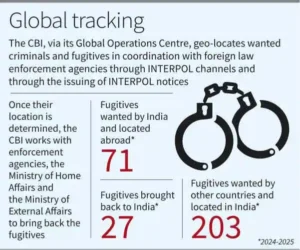
DoPT Annual Report 2024–25

Key Data (2024–25)

  • 71 fugitives located abroad – highest since 2013.
  • 27 fugitives returned to India during the year.
  • Extradition treaties: India has agreements with 48 countries and arrangements with 12 more.
  • Extradition requests (last 5 years): 137 sent; 134 accepted; 125 pending; 3 rejected.
  • Successful extraditions: 25 fugitives brought back in five years.
  • Letters Rogatory (judicial requests):
    • 74 sent in 2024–25.
    • 47 executed (42 by CBI, 5 by other agencies).
    • 533 pending globally as of March 2025.

Challenges

  • Slow extradition process: Many requests remain pending with foreign governments.
  • Legal hurdles: Differences in judicial systems and evidentiary standards.
  • Diplomatic sensitivities: Extradition often tied to bilateral relations.
  • Funding and resources: Tracking fugitives abroad requires strong coordination and technology.

International Framework

  • India is party to conventions like the UN Convention against Corruption, which provides a legal basis for cooperation.
  • Interpol notices and global law enforcement networks are used to geo-locate fugitives.

Significance

  • Rising numbers show India’s proactive approach in tracing fugitives.
  • Successful extraditions strengthen rule of law and accountability.
  • Highlights need for faster judicial cooperation and stronger diplomatic engagement.
  • Ensures that economic offenders and criminals cannot escape justice by moving abroad.

CBI

Origin:

    • Started as the Special Police Establishment (SPE) in 1941 to investigate corruption in wartime procurement.
    • Later formalized under the Delhi Special Police Establishment Act, 1946.

Formation of CBI:

    • In 1963, the Government of India set up the Central Bureau of Investigation (CBI) through a resolution of the Ministry of Home Affairs.
    • It was created to expand the scope of SPE beyond corruption cases to include serious crimes.

Legal Basis:

    • Though established by executive resolution, its powers come from the Delhi Special Police Establishment Act, 1946.
    • This Act allows the CBI to investigate cases across India with the consent of State governments.

Parent Agency:

    • Functions under the Department of Personnel and Training (DoPT), Ministry of Personnel, Public Grievances and Pensions.

Santhanam Committee Recommendation:

    • The Santhanam Committee on Prevention of Corruption (1962) recommended a central agency to tackle corruption and serious crimes, leading to the creation of CBI.

Headquarters: Located in New Delhi.

Conclusion

The record number of fugitives traced abroad in 2024–25 reflects India’s growing global coordination against crime. However, delays in extradition and pending judicial requests underline the need for legal reforms, and sustained diplomatic pressure to ensure fugitives face justice in India.

UNION GOVERNMENT ON DIVERSIFYING FISH BASKET

TOPIC: (GS3) ECONOMY: THE HINDU

The Union Fisheries Ministry has advised States to diversify fish species and explore new markets to reduce disease risks and strengthen seafood exports, especially amid tariff uncertainties and climate change challenges.

Background

  • India’s seafood exports face global tariff issues and climate-related disruptions.
  • Heavy dependence on a few species increases vulnerability to disease outbreaks.
  • Example: In 2006–07, the white spot virus wiped out black tiger shrimp farming.

Government Advisory

  • Diversification of Species: Promote scampi, tilapia, pangasius instead of only rohu and catla (limited global demand).
  • Reduce dependence on Litopenaeus vannamei (whiteleg shrimp).
  • Indigenous Varieties: Improve Penaeus indicus (Indian white prawn) and Penaeus monodon (giant tiger prawn) for disease-free farming. Both species already have strong export markets in over 100 countries.
  • Advanced Practices: Encourage integrated multi-trophic aquaculture (cultivating multiple species together).

Global Demand & Opportunities

  • High demand for seabass and Kerala’s karimeen (pearl spot) due to meat quality.
  • Expansion of brackish water farming in inland States (Punjab, Haryana, UP, Rajasthan) using saline groundwater.
  • Promotion of seaweed marine cage culture, already successful in China and Norway.
  • Meeting attended by envoys from 40+ countries (China, Russia, Iran, Vietnam, Saudi Arabia, etc.), exploring new export markets.

Significance

  • Enhances export competitiveness and reduces vulnerability to disease outbreaks.
  • Supports farmers’ income, rural employment, and sustainable aquaculture.
  • Aligns with India’s goal of becoming a global leader in seafood exports.

India Fisheries Sector

Overall Production

  • India ranks 2nd globally in fish production.
  • Contributes 8% of global fish output.
  • Fisheries sector is considered a “sunrise sector” due to rapid growth.

Marine Fisheries

  • India has a coastline of 7,500 km and 2.02 million sq. km Exclusive Economic Zone (EEZ).
  • Marine fish production is a major contributor to exports.
  • Popular marine species: seabass, pearl spot (karimeen), Indian white prawn, giant tiger prawn.
  • Marine exports face challenges like tariff barriers and climate change impacts.

Inland Fisheries & Aquaculture

  • Inland fisheries contribute over 65% of total fish production.
  • Major inland species: rohu, catla, tilapia, pangasius, scampi.
  • Integrated aquaculture practices are being promoted to increase productivity.
  • States with saline groundwater (Punjab, Haryana, UP, Rajasthan) are being encouraged to cultivate brackish water species.

Shrimp Market

  • Shrimp is India’s largest seafood export item.
  • Key species:
    • Litopenaeus vannamei (whiteleg shrimp) – dominant in exports.
    • Indigenous species being promoted: Penaeus indicus (Indian white prawn) and Penaeus monodon (giant tiger prawn).
  • India exports shrimp to 100+ countries, with major markets in the US, EU, Japan, and Southeast Asia.

Employment & Economy

  • Fisheries sector sustains ~9 million livelihoods.
  • Provides food and nutritional security.
  • Union Budget 2025–26 allocated ₹2,703.67 crore – highest ever support for fisheries.

Conclusion

Diversifying fish species and adopting modern aquaculture practices will make India’s fisheries sector more resilient, profitable, and globally competitive, while safeguarding farmers against risks of monoculture farming.

GRANTH KUTIR AT RASHTRAPATI BHAVAN

TOPIC: (GS1) INDIAN ART AND CULTURE: THE HINDU

President Droupadi Murmu inaugurated ‘Granth Kutir’, a new library and archival space at Rashtrapati Bhavan, showcasing India’s classical literary and cultural heritage.

About Granth Kutir

  • A dedicated library and archive within Rashtrapati Bhavan.
  • Houses 2,300 books and around 50 manuscripts.
  • Collection includes works in 11 classical languages: Tamil, Sanskrit, Kannada, Malayalam, Odia, Marathi, Pali, Prakrit, Assamese, Bengali, and others.
  • Aim: To highlight India’s philosophical, literary, and intellectual tradition
  • Serves as a repository of cultural knowledge for scholars and visitors.

Significance

  • Promotes awareness of India’s classical languages and manuscripts.
  • Strengthens preservation of ancient texts and cultural heritage.
  • Encourages research in literature, philosophy, and history.
  • Symbolizes Rashtrapati Bhavan as not just a political space but also a cultural institution.

What are Classical Languages?

  • Classical languages are those which have a rich heritage of ancient literature, long history of use, and cultural significance.
  • They are recognized by the Government of India based on specific criteria.

Criteria for Recognition (by Ministry of Culture)

  • High antiquity of early texts/recorded history (at least 1500–2000 years).
  • Rich and diverse ancient literature considered valuable heritage.
  • Original literary tradition, not borrowed from another language.
  • Distinct difference between ancient form and modern form.
  • Classical status is given to languages that have contributed significantly to Indian culture and knowledge systems.

Official Languages in the Constitution

  • Article 343: Hindi in Devanagari script is the official language of the Union. English continues as an associate official language for Union purposes.
  • 22 languages are recognized under the Eighth Schedule of the Constitution (includes Assamese, Bengali, Gujarati, Hindi, Kannada, Kashmiri, Konkani, Malayalam, Manipuri, Marathi, Nepali, Odia, Punjabi, Sanskrit, Sindhi, Tamil, Telugu, Urdu, Bodo, Santhali, Maithili, Dogri).
  • These languages are given importance in education, literature, and representation in commissions.
  • Classical languages (like Tamil, Sanskrit, Kannada, Telugu, Malayalam, Odia) enjoy special recognition for their rich heritage.

Conclusion

The inauguration of Granth Kutir reflects India’s commitment to preserving its linguistic and cultural diversity. Alongside constitutional recognition of official and scheduled languages, such initiatives strengthen India’s identity as a nation rooted in pluralism and heritage.

PLI SCHEME FOR WHITE GOODS

TOPIC: (GS3) ECONOMY: THE HINDU

Recently, five companies were selected under the Production Linked Incentive (PLI) Scheme for White Goods, marking a step towards strengthening domestic manufacturing in air conditioners and LED lights.

About the Scheme

  • Launched to build a strong local component ecosystem for ACs and LED lights.
  • Aims to integrate India into global supply chains.
  • Duration: 2021–22 to 2028–29.
  • Nodal Ministry: Department for Promotion of Industry and Internal Trade (DPIIT), Ministry of Commerce and Industry.

Objectives

  • Encourage large-scale investments in white goods manufacturing.
  • Remove sectoral disadvantages and promote economies of scale.
  • Boost exports and create a robust component ecosystem.
  • Generate employment opportunities in the manufacturing sector.

Incentives

  • Financial support of 4–6% on incremental turnover over the base year (2019–20).
  • Applicable for both domestic sales and exports.
  • Incentives available for a period of five years.

Eligibility

  • Companies must be incorporated under the Companies Act, 2013.
  • Must achieve thresholds of incremental sales and investments.
  • Firms already availing benefits under another PLI scheme for the same products are not eligible.

Significance

  • Strengthens India’s manufacturing capacity in consumer durables.
  • Reduces dependence on imports and supports Atmanirbhar Bharat.
  • Helps India emerge as a global hub for white goods production

ANNA CHAKRA

TOPIC: (GS3) ECONOMY: THE HINDU

The Department of Food and Public Distribution (DFPD) has been selected as a finalist for the 2026 Franz Edelman Award for its innovative Anna Chakra initiative, which optimises food grain logistics under the Public Distribution System (PDS).

About Anna Chakra

  • A decision support system based on operations research.
  • Designed to optimise food grain supply chains across States under the PDS.
  • Developed through a Government–UN–Academia partnership involving:
    • Department of Food and Public Distribution (DFPD).
    • United Nations World Food Programme (WFP) in India.
    • Indian Institute of Technology (IIT) Delhi.
  • Uses advanced algorithms to identify best transport routes and ensure smooth movement of grains.
  • Integrated with:
    • PM Gati Shakti platform.
    • FOIS (Freight Operations Information System) of Railways via Unified Logistics Interface Platform (ULIP).

Anna Chakra

Objectives

  • Improve efficiency and transparency in food grain distribution.
  • Reduce transportation costs and delays.
  • Ensure timely delivery of food grains to beneficiaries.
  • Strengthen India’s food security system.

Franz Edelman Award

  • Known as the “Nobel Prize of Operations Research and Analytics.”
  • Recognises impactful applications of advanced analytics and management science.
  • Award includes a $10,000 prize.

Significance

  • Enhances PDS efficiency and reduces wastage.
  • Demonstrates India’s ability to use technology-driven solutions for welfare delivery.
  • Strengthens India’s global reputation in operations research and analytics.

Write a Review

Your email address will not be published. Required fields are marked *