
COP30 – ROADMAP TO END DEFORESTATION AND NEW GLOBAL CLIMATE DIPLOMACY
TOPIC: (GS3) ENVIRONMENT: THE HINDU
The Global Mutirao Agreement gained significance as the major outcome of COP30 in Brazil, where countries agreed to prepare a roadmap to halt deforestation and move away from fossil fuels.
Mutirao Agreement.
- Focus on Forest Protection and Climate Justice: The agreement prioritises ending deforestation, protecting biodiversity, and supporting indigenous communities—especially in regions like the Amazon.
- Roadmap for Deforestation and Energy Transition; It asks countries to prepare two roadmaps: One to halt and reverse deforestation, Another to gradually transition away from fossil fuels (but without strict timelines).
- Greater Role for Developing Countries: The agreement reflects a shift in climate negotiations, giving more voice to Global South nations like Brazil, India, and other BRICS countries, focusing on fairness, finance, and sustainable development.
Deforestation Roadmap
- Brazil used its host leadership to prioritize forest protection, biodiversity, and indigenous communities, especially given the Amazon’s global importance.
- The roadmap aims to create:
- New funding mechanisms for forest conservation and restoration,
- Cross-border efforts to stop illegal logging and land conversion,
- Strategies to support indigenous and forest-based livelihoods.
- Strong symbolic significance as COP30 was hosted in the Amazon biome, one of the world’s largest carbon sinks.
- Fossil Fuels Phase-Out: Over 80 countries, including the EU and small island nations, demanded a clear fossil fuel phase-out timeline.
Opposition by Major Developing Nations:
- BRICS countries (India, China, Russia, South Africa) and Saudi Arabia pushed back, citing:
- Energy security and development needs, Limited climate finance, The principle of common but differentiated responsibilities (CBDR).
Outcome:
- Final text included a vague pledge to “transition away from fossil fuels”, without timelines or binding commitments.
- A separate voluntary roadmap was announced outside the formal text — showing intense political compromise.
Emerging Power Shift in Climate Negotiations
- For the first time, the United States did not attend COP30, reducing traditional Western dominance.
- BRICS nations gained influence, ensuring: Flexible pathways for developing countries, Focus on equity and economic justice,
- Attention to trade barriers like EU’s Carbon Border Adjustment Mechanism (CBAM).
Climate Finance
- A two-year finance work programme was adopted to assess global finance needs and improve transparency.
- Commitment to triple adaptation finance by 2035, prioritizing vulnerable economies.
- Article 9.1 reaffirmed: developed nations have a legal obligation to finance developing countries, not a voluntary role — a major win for the Global South.
Other Key Agreements
- Agreements adopted on: Technology transfer, Loss and Damage Fund, Just energy transition and livelihood security, Global Goal on Adaptation, Measurement and reporting transparency.
Conclusion
COP30 may not have delivered bold fossil fuel commitments, but it marked a political turning point, giving greater voice to developing nations. It emphasized realistic, equity-based climate action, highlighted forests’ role in global climate stability, and set the stage for deeper negotiations ahead — especially on finance and energy transitions.
2025 G20 JOHANNESBURG SUMMIT
TOPIC: (GS2) ECONOMY: THE HINDU
At the 2025 G-20 Leaders’ Summit in Johannesburg, the host South Africa achieved the adoption of the G-20 Leaders’ Declaration by consensus—despite the U.S. boycott and attempts to block the text

Adoption of the Declaration
- The Declaration was adopted at the beginning of the Summit — an unprecedented move.
- It was finalized earlier by Sherpas, showing strong coordination.
- South Africa declared it a victory for multilateralism, emphasizing that the G20 should not be stalled by any single country.
- The U.S. boycott reflected deteriorating ties with South Africa.
Major Themes of the Declaration
Multilateralism and Peace
- Reaffirmed commitment to UN Charter, international law, and peaceful resolution of disputes.
- Called for refraining from use of force for territorial gains.
- Minimal mention of Ukraine, Gaza, or Middle East conflicts.
- Condemned terrorism “in all forms.”
Focus on Global South
- Strong stress on development finance, debt relief, inequality, and African growth.
- Supported demands for major reforms in UN Security Council, with greater representation for Africa, Asia-Pacific, and Latin America.
- Ubuntu philosophy included: “I am because we are.”
Women-led Development
- Encouraged the role of women in governance, peacebuilding, and economic growth.
- Supported removal of socio-economic barriers and inclusive leadership.
India’s Contributions
- Called for redefining development models to ensure sustainability, equity, and ecological balance.
- Introduced Integral Humanism as a holistic development approach aligning material growth with ethical values.
- Proposed initiatives:
- G20–Africa Skills Multiplier: Training 1 million Africans.
- Global Traditional Knowledge Repository.
- Satellite Data Partnership for agriculture, disaster management.
- Healthcare Response Team and Counter Drug–Terror Network (focus on fentanyl, synthetic opioids).
- Critical Minerals Circularity Initiative for clean energy and recycling.
Broader Geopolitical Context
- Growing geopolitical fragmentation, trade tensions, and leadership shifts.
- The U.S. absence questioned its long-term G20 commitment.
- Increasing prominence of Global South voices in global governance.
Challenges Ahead
- Weak consensus on global conflicts.
- High debt burden on developing nations.
- Climate action remains slow despite high emissions from G20 countries.
- Structural inequality and trust deficits in global institutions.
Conclusion
The Johannesburg Summit marked a turning point for the Global South, showcasing Africa’s diplomatic rise, India’s thought leadership, and a renewed push for UN reform and inclusive global governance. However, lack of strong commitment on conflicts and climate remains a concern for future cooperation.
INDIA’S IPO BOOM & INVESTOR RISKS
TOPIC: (GS3) ECONOMY: THE HINDU
Chief Economic Advisor has cautioned that IPOs are increasingly being used by promoters and private investors. This raises concerns over inflated valuations, investor protection, and long-term market sustainability.
Shift in IPO Purpose
- Traditionally, IPOs are meant to raise funds for expansion, debt reduction, or capacity building.
- Recent IPOs are largely dominated by Offer for Sale (OFS), where promoters and early investors sell their existing shares to the public.
- Examples:
- LG IPO: Entire ₹11,000 crore went to foreign promoters.
- Tata Capital: ₹8,600 crore cashed out by Tata Sons and early investors.
- Lenskart & WeWork India: Completely OFS-driven issues.
- This indicates IPOs becoming monetisation events instead of tools for growth capital.
Concerns over Overpricing and Valuation Risks
- Companies with limited profits or unclear business models demand valuations higher than established listed firms.
- Hype, heavy marketing, and anchor investor participation create unrealistic expectations.
- Use of aggressive projections and accounting methods often hides weak fundamentals.
- This creates information asymmetry — insiders know the risks, but retail investors don’t.
Risks for Retail Investors
- Retail participants often enter IPOs expecting quick listing gains.
- After initial excitement, many shares decline as market corrects inflated valuations.
- Investors get stuck with overpriced stocks while promoters exit at peak valuations.
- Retail investors lack access to in-depth financial knowledge and rely on media narratives.
Regulatory and Market Implications
If IPOs continue to focus on promoter exits:
- Public trust in capital markets may weaken.
- Retail participation may reduce.
- Possible market correction due to inflated prices.
Suggested Reforms
- Strengthen transparency in pricing, profitability, and peer comparisons.
- Promote balanced mix of OFS and fresh issue components.
- Enhance investor education on valuation metrics and IPO risks.
- Regulators must tighten oversight while ensuring capital market growth.
Conclusion
India’s IPO boom shows vibrant capital market activity, but its increasing use as an exit route raises concerns about fairness, valuation integrity, and small investor protection. Sustainable market development requires a balance between capital raising, promoter exits, and investor confidence.
LATEST ON SHEIKH HASINA’S VERDICT AND BANGLADESH’S CRISIS
TOPIC: (GS2) INDUSTRIAL RELATIONS: THE HINDU
Former Prime Minister Sheikh Hasina was sentenced to death in absentia by Bangladesh’s International Crimes Tribunal (ICT) for crimes against humanity tied to a violent crackdown on student-led protests in 2024.
Background & Legal Framework
- The ICT in Bangladesh was originally established in 2009 to try war-crimes from the 1971 Liberation War.
- After mass student protests in July-August 2024 against quota issues in public service recruitment, a crackdown reportedly caused up to 1,400 deaths.
- Hasina fled to India in August 2024 as her government collapsed and later faced charges of ordering killings, authorising use of drones/helicopters and failing to prevent violence.
The Verdict & Immediate Outcomes
- On 17 November 2025, the ICT found Sheikh Hasina guilty of crimes against humanity and sentenced her to death.
- Bangladesh’s interim government issued an extradition request to India following the verdict.
- Hasina and her party (the Awami League) claim the trial was politically motivated and biased.
India’s Role & Regional Dimensions
- India’s Ministry of External Affairs (MEA) stated it “noted” the verdict and emphasised support for Bangladesh’s people (not explicitly the government) — a calibrated approach.
- India continues to provide refuge to Hasina and has not yielded to extradition requests, citing concerns about fairness and political nature of charges.
- The situation affects India-Bangladesh relations, stability in Bengal region, and democratic norms in South Asia.
Challenges & Risks Ahead
- The trial’s legitimacy is questioned by international rights groups over fairness, due process and use of death penalty in absentia.
- The ban on Awami League and exclusion of major parties may affect the credibility of the 2026 elections and Bangladesh’s democratic fabric.
- A leadership vacuum in major parties could lead to political instability, social unrest and governance void.
Conclusion
The sentencing of Sheikh Hasina marks a turning point in Bangladesh’s politics, signalling accountability but also triggering serious questions about rule-of-law, separation of powers and democratic legitimacy. For India and the region, the outcome underscores the importance of inclusive politics, transparent institutions and safeguarding democratic norms.
CENTRE NOTIFIES ALL FOUR LABOUR CODES
TOPIC: (GS2) POLITY: THE HINDU
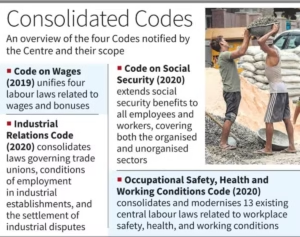
The Central Government has formally notified all four Labour Codes, marking one of the most comprehensive reforms in India’s labour governance framework since Independence.
Simplified Labour Reforms
- Labour Codes expand social protection to gig, platform, and informal workers, promote equal pay for men and women, and legally recognise fixed-term employment.
- They aim to improve worker welfare by strengthening workplace safety standards and widening access to social security benefits.
- A total of 29 old and fragmented labour laws have been merged into four modern Labour Codes to reduce complexity and make laws more relevant to today’s economy.
Government’s Vision of Inclusive Labour Reform
- The Prime Minister termed the notification as a landmark move, enabling a modern and equitable labour ecosystem that balances worker welfare with economic growth.
- Towards Worker Empowerment: The reforms aim to provide universal social security, timely and guaranteed wage payments, formalisation of employment, and safe working environments, especially in manufacturing and service sectors.
- Ease of Doing Business: The Labour Minister, Mansukh Mandaviya, emphasized that simplified compliance norms under the new Codes would attract domestic and global investment and facilitate employment creation.
- State Participation: Most States have framed draft rules, and the Centre is providing support to ensure smooth implementation of the Codes across federal jurisdictions.
Provisions in the Labour Codes
Worker Rights & Protection
- Women’s Employment: Permission for women to work night shifts with adequate safety measures.
- Health & Social Security: Mandatory annual health check-ups for workers above 40; expansion of ESIC coverage to all districts and hazardous sectors.
- National Floor Wage: Establishment of a national minimum wage to prevent exploitation.
Structural and Compliance Reforms
- Single Compliance Mechanism: One registration, one licence, and one return system for employers.
- National OSH Board: Standardised norms for workplace safety and occupational health.
Inclusive Labour Classifications
- Recognition of gig workers, platform workers, and aggregators for the first time under law.
- Plantation workers included under Occupational Safety, Health and Working Conditions (OSHWC) Code.
Employment Modernisation
- Fixed-Term Employment: Workers on fixed-term contracts eligible for all benefits similar to permanent employees.
- Universal Account Number (UAN): Aadhaar-linked UAN enables portability of benefits across regions and jobs.
Stakeholder Responses
Trade Unions’ Concerns
- Several central trade unions have rejected the Codes, calling them pro-employer and anti-worker.
- Concerns raised over job insecurity, weakening of worker safeguards, and the timing of implementation during high unemployment.
- Nationwide protests and strikes have been announced, demanding amendments to protect labour rights.
- Fear expressed of eroding labour protections and returning to a “master–servant” regime.
- BMS’s Stand: The Bharatiya Mazdoor Sangh supports the implementation but seeks amendments to modify provisions of the OSH and Industrial Relations Codes.
- Industry’s View: The Confederation of Indian Industry (CII) hailed the Codes as transformational, enabling a transparent, business-friendly, and globally aligned labour ecosystem.
Conclusion
The Labour Codes represent a critical structural reform for modernising India’s labour market, balancing social protection, ease of doing business, and employment growth. However, their successful implementation will depend on addressing stakeholder concerns, ensuring state readiness, and protecting worker rights through balanced regulation.
CISF TO LEAD NATIONAL MARITIME PROTECTION
TOPIC: (GS3) SECURITY: THE HINDU
Recently Government has designated the Central Industrial Security Force (CISF) as the sovereign security regulator for ports, including private ones, to ensure uniform and professional protection of maritime infrastructure.
New Security Framework
- CISF as Lead Security Agency: CISF to take charge of access control, cargo scanning, surveillance, and coastal patrolling at major ports.
- Phase-wise Implementation: Initially covers 80 major export-import ports. Remaining 170 minor ports to be gradually included.
- ISPS Alignment: CISF becomes the Recognised Security Organisation (RSO) under the International Ship and Port Facility Security (ISPS) Code, aligning ports with global maritime safety standards.
India’s Port Security Mechanism
- ISPS Code: Introduced post 9/11, mandates global norms for safeguarding ships and port facilities from terror threats. India is a compliant member.
- Central Leadership: CISF’s designation ensures unified, professional, and sovereign enforcement of security norms across commercial and private ports.
Major Challenges
- Fragmented Security: Private and small ports rely on local police or private security agencies lacking specialised maritime expertise.
- Transnational Threats: Increasing cases of drug trafficking, arms smuggling, illegal migration, maritime terrorism, and cyberattacks on port IT systems.
- Resource & Personnel Gaps: CISF needs nearly 10,000 extra personnel; each major port requires 800–1,000 officers.
- Coastal Vulnerability: India’s 7,500 km coastline remains porous with weak surveillance in non-major ports.
Committee Recommendations
- 2024 Joint Committee (CISF + Directorate General of Shipping) suggested:
- Hybrid Security Model: CISF to manage core security; state police/private agencies handle peripheral duties.
- Strengthening manpower, surveillance technology, and coastal coordination.
CISF

- Established: 1969, declared Armed Force of the Union in 1983.
- Mandate: Secures critical infrastructure including airports, seaports, nuclear plants, Delhi Metro, Parliament, heritage monuments, and major government buildings.
- Force Structure: Over 1.8 lakh personnel; seven operational sectors; specialized Fire Wing and Disaster Response Unit.
- Post-26/11 expansion: Extended to private sector and high-risk economic assets.
Conclusion
Unifying port security under CISF marks a major step in strengthening India’s maritime security architecture. It enhances global compliance, prevents illegal activities, and protects national economic lifelines. However, successful implementation will depend on manpower readiness, inter-agency coordination, and technological integration.
SULPHUR DIOXIDE AND FGD IN INDIA
TOPIC: (GS3) ENVIRONMENT: THE HINDU
Recent data from the Central Electricity Authority highlighted that several major power plants within 300 km of Delhi still operate without Flue Gas Desulphurisation (FGD) systems, which are essential for reducing Sulphur Dioxide (SO₂) emissions.
What is Sulphur Dioxide?
- Colourless gas with sharp, irritating odour (similar to a struck match).
- Highly soluble in water; forms sulphurous acid, contributing to acid rain.
- Widely used in chemical manufacturing, paper processing, metal treatment, and food preservation.
Sources of SO₂ Emissions
- Burning of fossil fuels, especially coal in power plants and industries.
- Copper, iron pyrite smelting and petroleum refining.
- Natural source: volcanic eruptions.
- Power plants are the largest contributors of SO₂ emissions in India.
Environmental and Health Impacts
- Causes asthma, bronchitis, and lung damage, especially in children and the elderly.
- Leads to acid rain, harming crops, soil fertility, and aquatic ecosystems.
- Reduces visibility and contributes to urban smog.
Flue Gas Desulphurisation (FGD)
- A pollution control method used to remove sulfur dioxide from exhaust gases of coal-based industries and power plants.
- Uses limestone, lime, or ammonia to neutralize SO₂.
- Essential for meeting National Clean Air Programme and emission standards of the Ministry of Environment.

Indian Initiatives
- FGD installation mandated for all thermal power plants by MoEFCC.
- National Clean Air Programme (NCAP) to reduce 40% SO₂ emissions by 2030.
- Perform, Achieve and Trade (PAT) scheme to improve energy efficiency in industries.
- Ujjwal DISCOM Assurance Yojana (UDAY) promotes sustainable power sector reforms.
Conclusion
The lack of FGD systems in major power plants reflects both regulatory delays and environmental negligence. Immediate action is essential to protect public health and meet India’s climate commitments.
STRAIT OF MALACCA
TOPIC: (GS1) GEOGRAPHY: THE HINDU
A new cyclonic circulation recently formed over the central region of the strait, reaching 5.8 km altitude, drawing attention to its strategic and climatic relevance.
Geographical Features
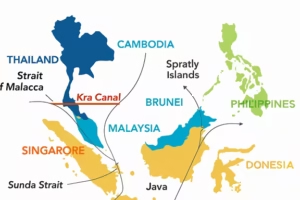
- Connects the Andaman Sea (Indian Ocean) to the South China Sea (Pacific Ocean).
- Lies between Sumatra (Indonesia) to the west, and Malaysia and southern Thailand to the east.
- Named after the historical Malacca Sultanate (1400–1511).
- Approximate length: 890 km; depth: around 25 meters; total area about 65,000 sq km.
- Hot, humid tropical climate influenced by the Northeast Monsoon (winter) and Southwest Monsoon (summer).
Economic and Strategic Significance
- Acts as a major global shipping corridor, connecting Europe, West Asia, and East Asia.
- One of the busiest maritime routes globally, handling over one-fourth of the world’s traded goods.
- Singapore, Malaysia, and Indonesia jointly patrol and manage maritime security in the strait.
Importance for India
- Nearly 60% of India’s maritime trade and almost all LNG imports pass through this strait.
- Crucial for India’s energy security, foreign trade, and Act East policy.
- The strait is a strategic choke point for China, heavily dependent on it for oil and trade routes — termed the “Malacca Dilemma.”
Conclusion
The Strait of Malacca is not just a commercial waterway but a strategic geopolitical asset, critical for global trade, regional security, and India’s maritime interests.