
RECLAIMING RESPECTFUL AND NEUTRAL PUBLIC DIALOGUE
TOPIC: (GS2) INDIAN POLITY: THE HINDU
Concerns have been raised over the declining quality of public dialogue in India, with increasing polarisation and loss of neutral, respectful communication affecting democratic functioning and social harmony.
Decline of Healthy Public Discourse
- India’s tradition of reasoned debate is weakening due to aggressive, sensational, and divisive communication.
- Spaces like TV debates, social media and public forums now encourage confrontation over understanding.
Crisis of Polarisation
- Binary Thinking: Society is pushed into extreme “either/or” positions — left vs right, pro vs anti. Nuanced or balanced positions are mocked as indecisive or weak.
- Attack on Neutrality: Individuals who choose impartiality face criticism and exclusion. The middle path is seen as irrelevant in an environment dominated by loud, polarised voices.
Impact on Institutions
- Decision-makers at Risk: Officials, mediators, and leaders struggle as compromise is portrayed as betrayal. Emotional fatigue grows among those trying to maintain balanced judgment.
- Legislature: Deep ideological divides cause legislative gridlock or blind approval of proposals without critical debate.
- Judiciary: Courts face suspicion of bias, weakening public confidence in impartial justice.
- Leadership: Political leaders are reduced to faction representatives, distancing them from people’s real concerns.
Social and Psychological Effects
- Mental Well-being: Constant political hostility increases stress, anxiety, and frustration.
- Community Fragmentation: People avoid interacting with those who differ politically, shrinking social networks. Workplace behaviour mirrors societal polarisation, leading to discrimination and conflict.
- Role of Technology: Social media algorithms amplify emotional and divisive content. Misinformation spreads quickly, shaping opinions without facts.
- Misuse of Neutrality: Some selectively use neutrality to judge others while ignoring their own faults. This inconsistent approach reduces trust and weakens genuine dialogue.
Way Forward:
- Protect Neutrality: Treat neutrality and balanced judgment as moral responsibilities, not weaknesses.
- Encourage Genuine Engagement: Listen with humility, accept multiple perspectives, and avoid rigid binaries. View opponents as fellow citizens, not enemies.
- Strengthen Democratic Culture: Promote respectful debates, fact-based discussions, and inclusive dialogue. Reject polarisation and choose reasoned conversation as the foundation of a mature democracy.
Conclusion
Strengthening respectful, fact-based public dialogue is essential for preserving democratic values. India needs collective commitment—from institutions, leaders, and citizens—to rebuild trust and reduce polarisation.
LABOUR AND HONOUR
TOPIC: (GS2) SOCIAL JUSTICE: THE HINDU
The Centre has indicated its intention to roll out the long-pending four Labour Codes, prompting renewed debate on their impact. Concerns from labour unions and the absence of tripartite consultations have revived demands for convening the 47th Indian Labour Conference (ILC).
What are Labour Codes?
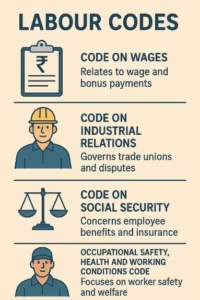
- Labour Codes are four consolidated laws that merge 29 existing central labour laws.
- They cover wages, social security, industrial relations, and occupational safety.
- Their purpose is to create a uniform, simplified, and modern framework for labour regulation in India.
Why were they codified?
- To reduce complexity by replacing multiple overlapping laws with clear, easy-to-understand codes.
- To improve compliance and make labour rules more transparent for both workers and employers.
- To support ease of doing business while ensuring better protection of workers’ rights.
Labour Code Reforms
- Parliament passed four major Labour Codes between 2019–2020:
- Wages Code
- Industrial Relations Code
- Social Security Code
- Occupational Safety, Health and Working Conditions (OSH) Code
- These Codes merge 29 earlier labour laws, reducing complexity and annual compliance burden for companies.
- Centre has said it will support States in framing Rules; most States have already published draft Rules.
Expected Benefits of the Labour Codes
- The Labour Codes are expected to simplify labour governance by reducing paperwork and merging multiple laws into a single, clear system.
- A cleaner regulatory framework can make it easier for companies to operate and attract both domestic and foreign investment.
- India’s rapidly growing workforce—about 12 million new entrants each year—needs more job opportunities, especially in productive sectors.
- As per the Economic Survey 2023–24, the economy must generate about 78.5 lakh non-farm jobs annually till 2030 to accommodate this expanding labour force.
Concerns Raised by Labour Unions
- Workers’ groups claim many pro-worker recommendations of the Second National Commission on Labour (2002) were overlooked.
- They argue the Codes favour employer flexibility over worker protection.
- Complaints persist despite the extended delay in implementation.
Changing Nature of Work
- New Work Models: Gig and platform work, digital labour, and AI-driven tasks are changing traditional ideas of “worker,” “wage,” and “job security.”
- This situation demands updated safeguards in social security and employer obligations.
- Global Uncertainties: War, supply-chain disruptions, and climate impacts demand stable and productive labour systems in both agriculture and industry.
Need for Tripartite Consultations
- Balanced Policy-Making: Bringing government, employers, and workers together ensures labour laws and decisions reflect all perspectives, not just one side’s interests.
- Reduced Industrial Conflicts: Joint consultations help resolve disputes early, preventing strikes, lockouts, and workplace unrest.
- Stronger Implementation: Policies framed with collective agreement gain greater acceptance, making compliance easier and more effective.
INDIAN LABOUR CONFERENCE (ILC):
- Platform for Dialogue: The ILC acts as India’s central forum where the government, employers, and workers jointly discuss labour policies and resolve issues.
- Advisory Body: Since its inception in 1942, it has given recommendations on wages, social security, working conditions, and labour reforms.
- Tripartite Working Method: It follows a tripartite model—decisions are made through consultation between government, industry representatives, and trade unions to ensure balanced and inclusive policy-making.
Way Forward
- Convene the 47th ILC to build consensus on the Codes.
- States, employers, and employees must be included to ensure smooth rollout and reduce conflict.
- A cooperative approach will strengthen trust and support the transition to a modern labour regime.
Conclusion:
The labour codes mark a major step toward modernising India’s labour system, but their success depends on inclusive dialogue and fair implementation. Strengthening tripartite consultations and reviving the ILC will be essential to ensure reforms protect workers while supporting economic growth.
BRIDGING INDIA’S NUMERACY GAP
TOPIC: (GS2) INDIAN POLITY: THE HINDU
The ASER 2024 report highlights a large gap between literacy and numeracy among primary students in India. Despite progress under the NIPUN Bharat Mission, numeracy outcomes remain significantly weaker
Importance of Foundational Learning
- NEP 2020 identifies Foundational Literacy and Numeracy (FLN) as the base of all future learning.
- NIPUN Bharat focuses on improving learning outcomes, not just school inputs.
- Surveys show improvements, but numeracy continues to lag far behind reading skills.
Scale of the Numeracy Challenge
- ASER 2024: 48.7% of Class 5 students can read fluently, but only 30.7% can do basic division.
- No State reports numeracy scores higher than literacy.
- Numeracy gaps worsen with higher classes — more than 50% of Class 8 students cannot perform division.
Why Numeracy Lags Behind Literacy
Cumulative Nature of Mathematics
- Math builds on earlier concepts; missing one idea (e.g., place value) makes later topics (decimals, fractions) difficult.
- Learning gaps widen each year if not corrected early.
Syllabus-driven Teaching
- Traditional teaching moves ahead with the syllabus even if students have not mastered earlier content.
- Teaching at the Right Level (TaRL) shows that learning must match a child’s actual level, not the class level.
Lack of Real-life Linkages
- Students who solve textbook math problems often fail to apply them in real-world settings.
- Children with real-life experience in shops struggle to translate that knowledge into classroom math.
- Shows a two-way disconnect between school math and practical use.
Consequences of Numeracy Gaps
- Poor performance in math and science in board exams.
- Many students drop out in middle school because classroom instruction becomes incomprehensible.
- Fear of mathematics blocks entry to higher education and limits career opportunities.
Need for a Multi-pronged Strategy
Extend FLN to Upper Primary
- Limiting FLN to Class 3 is insufficient when most Class 5–8 students still lack basic numeracy.
- Positive outcomes in Dadra & Nagar Haveli and Daman & Diu show benefits of extending interventions.
Introduce FLN+ Skills
- Skills like fractions, decimals, percentages, ratios, and integers are necessary for Class 10 and beyond.
- Low division skills imply extremely low mastery of these higher concepts.
Improve Pedagogy and Contextual Learning
- Activity-based learning used in FLN should also be applied to advanced topics.
- Teaching must align with the student’s actual level.
- Classroom learning should connect with real-life problem-solving.
Key Government Initiatives
- NIPUN Bharat Mission – Strengthens FLN for Classes 1–3 with outcome-focused learning.
- NEP 2020 – Prioritises FLN and competency-based education across levels.
- PARAKH (National Assessment Centre) – Standardises learning assessments, helping States track student progress.
Way Forward
- Extend FLN to Class 8 to prevent widening learning gaps and address post-pandemic loss.
- Introduce FLN+ modules, especially in fractions and decimals, for smoother transition to secondary school.
- Promote classroom–life integration, such as market-based math tasks, financial literacy, and hands-on activities.
ASER REPORT?
ASER (Annual Status of Education Report) is a nationwide, household-based survey that measures the schooling status and basic learning levels of children in rural India.
Who releases it?
It is released by the ASER Centre, the research unit of the Pratham Education Foundation.
What are its parameters?
- Tracks school enrollment of children aged 3–16 in rural areas.
- Assesses basic reading and arithmetic skills to gauge foundational learning.
- Collects information on household background, digital access, and basic school infrastructure.
Conclusion:
The latest ASER report shows that while school enrolment remains high, foundational learning levels continue to lag, demanding urgent attention. Strengthening early-grade teaching and consistent learning support is essential to close these gaps.
SC ADVISORY OPINION ON GOVERNOR’S POWERS (ARTICLE 143)
TOPIC: (GS2) INDIAN POLITY: THE HINDU
The Supreme Court recently gave an advisory opinion on a Presidential reference under Article 143 regarding the Governor’s powers over State Bills. This came after the April 2025 Tamil Nadu vs Governor judgment where a two-judge Bench fixed a 3-month deadline for Governors/President to act on Bills.
Background of the Issue
- The April 2025 judgment held that the Governor and President must decide on State Bills within three months.
- It also introduced the idea of ‘deemed assent’, treating pending Bills as approved.
- The Union government questioned the ruling and sought clarity through a 14-question Presidential reference, mainly on Articles 200 and 201, which deal with assent to Bills.
What Did the Presidential Reference Ask?
- Whether courts can set time limits for Governors/President when the Constitution does not specify them.
- Whether decisions of the Governor/President on pending Bills are open to judicial review before they become law.
- How far the Supreme Court’s Article 142 powers can go—can they override constitutional roles?
- Whether the Governor must act only on Cabinet advice while dealing with Bills.
Supreme Court’s Advisory Opinion
Three Choices under Article 200
- The Governor has only these options:
- Give assent,
- Return the Bill with comments,
- Reserve it for the President.
Discretion of the Governor
- The Court held that in using these three options, the Governor has discretion and is not bound by the State Cabinet’s advice.
Limited Judicial Review
- Courts cannot question the Governor’s decision-making process normally.
- Only extreme and unexplained delays may allow the court to order the Governor to act, but not to dictate what decision to take.
No Court-made Time Limits
- Since the Constitution does not set timelines, courts cannot create deadlines for Governors or the President.
- Thus, the 3-month timeline in the 2025 judgment is invalid.
No ‘Deemed Assent’
- The Supreme Court said its Article 142 powers cannot replace constitutional powers of the Governor/President.
- So, the idea of automatic assent is unconstitutional.
Concerns Raised
Federal Balance at Risk
- Earlier judgments (Shamsher Singh 1974; Nabam Rebia 2016) held that Governors act on aid and advice except in rare situations.
- The new opinion shifts more power to Governors, possibly allowing political interference in State laws.
Absence of Time Limits
- Commissions like Sarkaria and Punchhi recommended clear timelines (e.g., 6 months) to prevent delays.
- Without deadlines, State Bills can be held up indefinitely.
Way Forward
- Governors must act with constitutional responsibility and avoid unnecessary delays.
- Parliament or an All-India institutional mechanism may define clear timeframes for assent.
- Preserving cooperative federalism is essential so that Governors do not become hurdles to elected State governments.
Conclusion
The Supreme Court’s opinion reinforces constitutional procedure but leaves gaps that may allow prolonged delays in State legislation. Clear timelines and accountable gubernatorial conduct are essential to protect cooperative federalism and democratic functioning.
ROAD DUST POLLUTION AND INDIA’S CLEAN AIR EFFORTS
TOPIC: (GS3) ENVIRONMENT: THE HINDU
Recent studies and NCAP progress reports show that road dust remains a major contributor to PM10 pollution, even after heavy spending by cities.
Why Road Dust Matters
- Road dust consists mainly of PM10 and coarse particles, which form a large share of urban air pollution.
- NCAP targets a 40% reduction in PM10 by 2025-26, making road dust control essential.
- Scientific studies across 17 cities show road dust contributes 20–52% of PM10 and 8–25% of PM2.5.
Extent of the Problem
- High Silt Loads in Roads: IIT Delhi researchers found that silt levels differ widely, from 0.2 to 111 g/m²; Delhi alone has 14.47 g/m². North Indian cities carry heavier dust loads than southern cities.
- Growing Financial Investments: Between 2019–2025, ₹19,711 crore was allocated under NCAP. By 2023, 64% of spending went solely to road dust management—more than for biomass burning or vehicular pollution.
- Limited Results: Despite high spending, 29 cities showed increased PM10. In 68 cities where PM10 fell, 61 still exceeded national air quality standards.
Policy and Institutional Framework
Existing Measures
- 2018 Environment Ministry notification on construction-site dust control.
- 2021 CAQM directive to create Dust Control and Management Cells in NCR.
- Mechanised sweeping, roadside greening, anti-smog guns, and road repairs.
CAQM Studies (2025)
- 24% of assessed roads in poor shape; only 34% in good condition.
- Recommendations: Digital road mapping, Road-condition surveys, Standard guidelines for roadside dust control
Gaps in National Regulations
- Environment Protection Act and Air Act mention dust broadly but lack detailed rules.
- No SOPs for scientific disposal of collected dust.
- Construction & Demolition Waste Rules (2025) do not address road dust.
Challenges
- Fragmented Jurisdiction: Multiple agencies maintain roads (Delhi: 12; UP: 18; Haryana: 22). Overlapping roles dilute accountability and fund utilisation.
- Lack of Infrastructure: Delhi needs ~200 sweeping machines but has only 85. Other cities face even wider gaps.
- Ineffective Dust Disposal: Dust is dumped on roadsides or landfills, leading to resuspension.
- No Standard Guidelines: No norms on choosing cleaning equipment based on road width, surface, or traffic.
Government Initiatives
- NCAP (2019–2025): Financial support for air quality improvement.
- CAQM: Dust control cells, road surveys, mechanised sweeping plans.
- Green Delhi & Swachhata Apps: Digital grievance platforms for pollution complaints.
- Municipal-level dust control plans in several NCR cities.
Way Forward
- Create national SOPs for road dust collection, transport, and disposal.
- GIS-based monitoring platforms to link all road-owning agencies and track complaints.
- Standardise machinery use based on road category, surface, and traffic.
- Adopt science-based dust suppressants with proper safety evaluation.
- Mandate digital mapping and regular audits of road conditions.
- Shift to long-term urban planning that integrates air quality with road construction and maintenance.
Conclusion
India’s battle against road dust demands coordinated action, scientific disposal methods, and stronger accountability across agencies. Sustainable, well-planned road and urban management is essential to achieve cleaner air and healthier cities.
WHO DOCTOR–POPULATION RATIO
TOPIC: (GS2) HEALTH: THE HINDU
Recent investigations show that the widely quoted WHO norm of 1 doctor per 1,000 population is not an official WHO guideline. The Government of India has repeatedly used this ratio in Parliament to evaluate the country’s health workforce capacity, raising questions about accuracy and policy decisions.
Background
- For over a decade, the Indian government has compared the availability of doctors in India with the alleged WHO standard of 1:1,000.
- However, earlier Parliamentary answers (till 2010) stated that the WHO has not prescribed any fixed doctor-population ratio.
- Post-2015 replies began quoting the 1:1,000 figure, causing inconsistency.
How the Ratio Was Used in India
- Government included both allopathic and AYUSH doctors to show a more favourable ratio.
- For allopathic doctors, only 80% availability was considered, but this adjustment was not applied for AYUSH practitioners.
- This inflated India’s doctor-population ratio artificially.
WHO’s Clarification
- WHO officially stated that it does not recommend any country-level doctor-population standard.
- Workforce needs differ by a country’s health infrastructure, disease burden, and labour market strength.
- WHO only uses certain global monitoring benchmarks, but these are not prescriptive norms.
Actual Origins of the 1:1,000 Ratio
- Public health experts confirm that the ratio did not originate from WHO documents.
- The earliest formal use seems to be in Medical Council of India’s “Vision 2015” (2011), which set 1:1,000 as a target for India, not a WHO requirement.
- Academic papers incorrectly cited the ratio as a WHO norm, leading to repeated cross-citations.
What WHO Actually Tracks
- Composite Workforce Benchmark: WHO uses a composite threshold of 4.45 health workers (doctors + nurses + midwives) per 1,000 population for achieving 12 key SDG-linked health indicators. Earlier, the benchmark was 2.25 per 1,000, later revised to 4.45.
- Misinterpretation: Many assumed the composite figure implied a specific number of doctors, but WHO never suggested any such distribution.
- India’s Current Status (Global Data): India has 0.7 doctors per 1,000 people, ranking 118/181 countries. Composite indicator (doctors + nurses + midwives): 3.06 per 1,000, ranking 122/181. Both are below the 4.45 benchmark.
Key Issues
- Not a Shortage but a Distribution Problem: Experts argue India has adequate total doctors, but they are unevenly distributed. Rural–urban disparities remain severe; rural areas fall far below the composite standard.
- Political Use of Ratios: The 1:1,000 figure is often used to justify opening more medical colleges or equating AYUSH with allopathy. Health workforce planning becomes skewed when based on incorrect benchmarks.
Conclusion:
India’s long-standing use of a non-existent WHO doctor–population norm has led to flawed assessments of health workforce needs. A shift toward evidence-based planning—focused on actual distribution gaps rather than arbitrary ratios—is essential for strengthening healthcare delivery.
HUSSAIN SAGAR LAKE
TOPIC: (GS3) ENVIRONMENT: THE HINDU
Hussain Sagar in Hyderabad, a 16th-century artificial lake, has been facing severe pollution due to untreated sewage and industrial waste. To improve water quality, HMDA is planning to use advanced bioremediation methods such as enzyme solutions and biochar-based Bokashi balls.
What is Bioremediation?
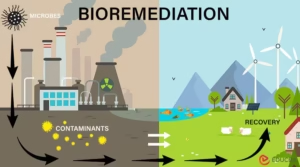
- Bioremediation is a natural cleaning process that uses microbes, enzymes, or biological materials to break down pollutants in water, soil, or air.
- Microorganisms convert harmful substances into harmless byproducts, such as water, carbon dioxide, or organic matter.
- It is eco-friendly, cost-effective, and suitable for lakes, where it helps reduce sludge, foul smell, algal blooms, and chemical contamination.
- Methods include enzyme treatments, biochar, Bokashi balls, microbial cultures, and natural aeration.
Main uses of bioremediation in simple points:
- Cleans polluted water bodies (lakes, rivers, ponds) by breaking down organic waste, sewage, and chemicals.
- Removes toxins from soil, especially at industrial sites, landfills, and oil-spill areas.
- Controls foul odour and sludge, improving overall environmental quality.
- Reduces algal blooms by lowering nutrient load (nitrogen, phosphorus) in water.
- Restores ecosystems naturally, without using harsh chemicals or heavy machinery.
Conclusion:
Bioremediation offers an eco-friendly and effective solution to restore polluted lakes like Hussain Sagar. Its use can improve water quality, reduce odour, and revive aquatic ecosystems sustainably.
EXERCISE AUSINDEX 2025
TOPIC: (GS3) SEQURITY: THE HINDU
The Indian Naval Ship INS Sahyadri recently took part in Exercise AUSINDEX 2025, a bilateral maritime exercise with Australia, held in the Northern Pacific, highlighting growing naval cooperation between the two nations.

Exercise AUSINDEX:
- Exercise AUSINDEX is a major biennial naval drill between India and Australia, first conducted in 2015.
- Its primary objective is to enhance interoperability, strengthen operational coordination, and deepen strategic ties between the two navies.
- The exercise provides a platform for both nations to collaborate on complex maritime operations and demonstrate mutual commitment to regional security.
Highlights of AUSINDEX 2025:
- The exercise involved intensive operations between the two navies’ warships and aircraft, focusing on anti-submarine warfare, gunnery drills, and advanced flying operations.
- INS Sahyadri of the Indian Navy participated alongside Australia’s HMAS Ballarat, showcasing bilateral maritime capabilities.
- The drills helped improve communication, tactical coordination, and operational readiness for both navies, reinforcing strategic maritime cooperation in the Indo-Pacific region.
Other India–Australia Military Exercises:
- Exercise AUSTRA HIND: Bilateral Army exercise focused on joint operations and tactical exercises.
- Exercise PITCH BLACK: Australia’s multilateral air combat training exercise, often involving international participants.
- Malabar Naval Exercise: A multilateral naval drill involving India, the U.S., Japan, and Australia.
- QUAD Exercises: Multilateral exercises emphasizing security collaboration among Quad nations, including India and Australia.
Significance:
- AUSINDEX strengthens India–Australia naval ties and contributes to maintaining a free, open, and secure Indo-Pacific.
- It enhances operational coordination, fosters mutual understanding, and demonstrates the strategic partnership between the two maritime powers.