

Table of Contents
ToggleVB–G RAM G ACT VS MGNREGA AND EMPLOYMENT GUARANTEE
TOPIC: (GS2) POLITY: THE HINDU
The recently introduced Viksit Bharat – Guarantee for Rozgar and Ajeevika Mission (Gramin) Act (VB–G RAM G Act) has triggered debate on the employment guarantee principle of MGNREGA, while the government claims it expands entitlements.
Background
- MGNREGA (2005): Provides 100 days of guaranteed wage employment per rural household.
- VB–G RAM G Act (2025): Introduced with a promise of 125 days of work per household.
- Critics highlight that the new Act allows the Centre to “switch off” the guarantee in selected areas, undermining universality.
Key Provisions & Issues
Work Guarantee Claim
- Government says VB–G RAM G offers 125 days of guaranteed work.
- Critics argue this could have been done under MGNREGA itself, without a new Act.
- The “switch-off clause” gives Centre discretion, weakening the guarantee.
Disentitlement Clause
- MGNREGA had a clause denying unemployment allowance if a worker refused work after applying.
- This clause was rarely used and practically irrelevant.
- VB–G RAM G removes it, but critics call this change symbolic, not substantive.
Normative Funding vs Demand-Driven Funding
- VB–G RAM G shifts to normative funding (budget caps) instead of demand-based funding.
- Critics say this undermines the essence of an employment guarantee.
- Government argues it ensures equitable distribution across States, but evidence shows MGNREGA already benefits both poor and better-off States.
Corruption & Technology
- Government claims VB–G RAM G will reduce corruption through digital systems.
- Critics note MGNREGA already uses digital tools, which often caused technical glitches and even facilitated corruption.
- Blind reliance on technology may hurt workers’ rights.
Copy-Paste Provisions
- Many VB–G RAM G clauses (like wage payment timelines, social audits) are identical to MGNREGA.
- Critics argue the new Act repackages existing provisions for political credit.
Significance
- Employment guarantee is a bold social protection idea, vital for rural livelihoods.
- Budget caps and discretionary powers risk weakening workers’ rights.
- Strengthening MGNREGA with higher wages and better implementation may be more effective than replacing it.
Conclusion
The VB–G RAM G Act is presented as an expansion of MGNREGA but critics see it as a repackaging exercise that dilutes the guarantee principle. The debate reflects larger concerns about federalism, workers’ rights, and the future of social protection in India.
NEED FOR PUBLIC-FUNDED GERIATRIC CARE
TOPIC: (GS2) SOCIAL JUSTICE: THE HINDU
A recent RBI report highlights India’s uneven demographic transition, warning that States like Kerala and Tamil Nadu will become “ageing States” by 2036, while northern States will continue to have a growing workforce. This raises concerns about pensions, healthcare, and elderly care.
Background
- India is often praised for its demographic dividend, but ageing is rising unevenly across States.
- Kerala & Tamil Nadu: Elderly population projected to exceed 20–22% by 2036.
- Bihar, UP, Jharkhand: Working-age population will keep growing beyond 2031.
- Karnataka & Maharashtra: In a middle stage, balancing ageing with workforce growth.
Key Issues
Fiscal Advice by RBI
- Ageing States asked to rationalise subsidies to meet pension costs.
- Youthful States advised to invest in human capital.
- Challenge: Advice ignores political undertones like lower tax devolution and upcoming delimitation reducing southern States’ representation.
Employment & Automation
- Youthful States face stagnation in education spending.
- Rising workforce enters job market amid automation and AI, risking “ageing before becoming rich.”
Impact on Women
- Women live longer but often lack financial assets.
- Majority of elderly women excluded from pensions as they were outside formal workforce.
- Family support is weakening due to migration and nuclear families.
Way Forward
- New Industrial Policy: Create jobs in green energy, care economy, and new sectors.
- Healthcare & Pension Systems: Youthful States must build these early to avoid future shocks.
- Expand Social Pensions: Essential to prevent elderly financial dependency, even if it challenges fiscal consolidation.
- Public Geriatric Care: Large-scale investment needed; otherwise, quality ageing will remain limited to the wealthy.
Conclusion
India’s demographic transition demands more than fiscal adjustments. Without public-funded geriatric care, stronger pensions, and inclusive policies for women, ageing will deepen inequality.
CYBERCRIME AND GLOBAL GOVERNANCE CRISIS
TOPIC: (GS3) SCIENCE AND TECHNOLOGY: THE HINDU
The United Nations adopted a new Convention against Cybercrime in December 2024, but India, along with the U.S., Japan, and Canada, chose not to sign it. This highlights divisions in global cyber governance and raises questions about India’s strategy in protecting its institutional autonomy.
Background
- The Convention was initiated by Russia in 2017 and finalized after multiple UN sessions.
- It is the first multilateral criminal justice treaty in over two decades.
- It aims to create a global framework for tackling cybercrime but has exposed fractures in international cooperation.
- India actively participated in negotiations but withheld its signature due to concerns over data sovereignty and institutional control.
Key Issues
Global Divisions
- Russia & China: Pushed the Convention to challenge Western dominance in cyber governance.
- Europe: Signed as it aligns with the Budapest Convention (2001), which already guides their cybercrime laws.
- U.S. & Allies: Opposed due to fears of misuse by authoritarian regimes against journalists and activists.
- India: Reluctant because its proposals on citizen data control were ignored.
Principles vs Practice Gap
- The Convention’s definition of cybercrime is broad and vague, risking misuse.
- Safeguards like judicial review depend on domestic laws, leading to uneven protection.
- Example: India’s draft rules on watermarking AI-generated content show how universal principles (user safety) can be implemented in overly prescriptive ways.
Polycentricism in Global Governance
- Multilateral institutions like the UN, WTO, and Security Council are weakening.
- Smaller plurilateral and bilateral groups are shaping rules, creating overlaps and confusion.
- Cybercrime governance now faces the same challenge as cross-border data flows — principles exist, but mechanisms are missing.
Implications for India
- India risks losing influence in global rulemaking if it stays outside major conventions.
- Must balance institutional autonomy with active participation in global frameworks.
- Needs to build technical capacity to engage at multiple levels simultaneously.
- Domestically, reforms in regulation, administration, and cyber law enforcement are urgent.
Conclusion
The UN Cybercrime Convention reflects the crisis in global governance, where principles are agreed upon but practices diverge. Without investment in technical expertise and domestic reforms, India may struggle to safeguard both its autonomy and its global standing.
VENEZUELA’S OIL COLLAPSE AND CUBA’S CRISIS
TOPIC: (GS2) INTERNATIONAL RELATIONS: THE HINDU
The U.S. invasion of Venezuela in late 2025 and subsequent seizure of Venezuela-linked oil tankers has cut off crude supplies to Cuba, leading to severe power cuts, fuel shortages, and food disruptions.
Background
- Cuba and Venezuela share close ties since the Bolivarian era under Hugo Chavez.
- Venezuela supplied subsidised crude to Cuba under the “oil-for-doctors” scheme in exchange for medical and technical support.
- This arrangement helped Cuba cope with the long-running U.S. embargo (since 1962).
Current Crisis
Oil Dependency
- Oil accounts for 83% of Cuba’s power generation.
- Energy from oil rose from 12,700 GWh (2000) to 16,500 GWh (2023).
- Oil products make up 56% of total energy consumption, powering industry, transport, agriculture, and households.
Food Supply Disruption
- Cuba imports 80% of its food.
- Blackouts interrupt refrigeration, worsening shortages of perishables.
Shrinking Imports
- 2022: Venezuela supplied 75% of Cuba’s crude, Russia 25%.
- 2023: Venezuela’s share fell to 58%, Mexico rose to 31%, Russia dropped to 11%.
- 2025: Venezuela supplied only 26,500 barrels/day (one-third of Cuba’s needs). Mexico added 5,000 bpd, Russia minimal.
- Mexico has refused to scale up supplies further.
Structural Challenges
- U.S. embargo: Began in 1962, tightened in the 1990s.
- Cuba excluded from global financial markets as dollar transactions clear through U.S. banks.
- 2021: Cuba redesignated as “State Sponsor of Terrorism,” deepening isolation.
- Over 1,000 instances of foreign banks refusing services (2021–24).
- Trade deficit: $4.4 billion in 2022 → $13.9 billion in 2023 (worst ever).
Implications
- Cuba cannot buy oil on commercial terms due to foreign exchange crisis and credit restrictions.
- Collapse of Venezuelan support has crippled Cuba’s economy, worsening energy insecurity and food shortages.
- Highlights vulnerability of small economies dependent on single suppliers and external aid.
Conclusion
Cuba’s crisis reflects the intersection of geopolitics, energy dependency, and economic isolation. Without diversified energy sources and relief from embargo restrictions, Cuba faces prolonged instability in power, food, and trade.
RBI PUSH FOR BRICS DIGITAL CURRENCY LINKAGE
TOPIC: (GS3) ECONOMY: THE HINDU
The Reserve Bank of India (RBI) has suggested that BRICS countries cooperate on using Central Bank Digital Currencies (CBDCs) for cross-border payments. The idea is to make international transactions faster, cheaper, and less dependent on the US dollar.
What is Being Proposed?
- RBI has informally advised the government to use India’s BRICS chairmanship (2026) to promote CBDC-based payment cooperation.
- The plan includes both original BRICS members (Brazil, Russia, India, China, South Africa) and new members like Egypt, UAE, Iran, Ethiopia, and Indonesia.
- Aim: Develop a common digital payment framework for smoother trade settlements.
What are CBDCs?
- Central Bank Digital Currencies (CBDCs) are digital versions of a country’s official currency issued by its central bank.
- Example: India’s e-rupee.
- Stored in digital wallets, not bank accounts.
- Unlike UPI, CBDCs transfer actual digital money, not just bank balances.
- Different from cryptocurrencies as they are regulated, stable, and government-backed.
Benefits of CBDC-Based Cross-Border Payments
- Faster and Cheaper Transactions: Reduces intermediaries in international transfers. Lowers transaction fees and settlement time.
- Greater Transparency: Blockchain-based records make transactions traceable. Helps control money laundering and illegal fund flows.
- Programmable Use: Digital money can be designed for specific uses (time-bound, sector-specific).
Strategic Advantage
- Reduces reliance on the dollar-dominated SWIFT system.
- Useful in trade with countries facing sanctions.
- Strengthens financial cooperation within BRICS.
Risks and Challenges
- Regulatory Coordination: Different legal and technical systems across countries make integration difficult.
- Financial Stability Risks: Sudden capital flows through digital systems may destabilize markets.
- Cybersecurity Concerns: Digital currency systems may face hacking or technical vulnerabilities.
- Geopolitical Risks: The U.S. may see this as an attempt to weaken the dollar’s global role. Could lead to trade pressures or tariff measures.
Way Forward
- Gradual pilot projects before full rollout.
- Strong cyber safeguards and legal coordination.
- Balance economic benefits with geopolitical sensitivities.
Digital Currency
- Money in electronic form – It exists only digitally, not as physical cash or coins.
- Used for online or electronic payments – You can send or receive it through phones, cards, or computers.
- Can be government-issued or private – Examples include Central Bank Digital Currency (like e-rupee) or cryptocurrencies like Bitcoin.
Conclusion:
A BRICS-based CBDC payment network offers faster and more independent global transactions, but India must adopt it cautiously to manage regulatory and geopolitical risks.
U.S. EXIT FROM THE INTERNATIONAL SOLAR ALLIANCE
TOPIC: (GS3) ECONOMY: THE HINDU
The United States has announced its withdrawal from the India-led International Solar Alliance (ISA) as part of exiting 66 global organisations deemed “not aligned with U.S. interests.”
What is the International Solar Alliance (ISA)?
- The ISA is a treaty-based intergovernmental organisation focused on promoting solar energy adoption worldwide.
- It was launched jointly by India and France in 2015 on the sidelines of the COP21 climate summit in Paris.
- Headquartered in Gurugram, India, it brings together sunshine-rich countries to scale solar deployment.
- The ISA aims to mobilise over USD 1 trillion of investments by 2030 and accelerate low-carbon energy transition in member nations.
- It supports policy advice, finance facilitation, capacity building, and risk mitigation for solar projects.
U.S. Role in ISA
- The United States joined ISA in 2021 as a member country and contributed about USD 2.1 million over three years.
- U.S. participation was seen as supportive of global solar growth and climate cooperation until the recent withdrawal.
Impact of U.S. Exit on ISA
- Financial Impact: The U.S. contribution was small—around 1% of ISA’s funds—so there is no direct budgetary shortfall. ISA programmes and operations are expected to continue uninterrupted.
- Operational Continuity: Indian officials have stated that ongoing initiatives will continue and capacity building efforts remain active. ISA still has over 125 member countries committed to solar scaling.
- Global Cooperation: U.S. exit could weaken global climate diplomacy and investor confidence in multilateral climate efforts.
Effect on India’s Solar Sector
- Domestic Solar Industry: India’s solar manufacturing and deployment are not dependent on U.S. membership in ISA.
- Investments: U.S. funding was not a major source of investment in India’s solar projects.
- Domestic finance, global funds, and development institutions continue to back solar expansion.
Impact on Developing Countries
- Many African nations and less wealthy countries rely on international support, financing, and collective risk mitigation for solar deployment.
- Reduced engagement by a major economy may slow project financing and decision-making in those regions.
- India’s leadership in ISA becomes even more important to support renewable goals in the Global South.
Conclusion
For India, solar adoption remains robust domestically, while the real challenge lies in maintaining multilateral momentum and global climate cooperation.
INDIA’S FIGHT AGAINST MALARIA ELIMINATION
TOPIC: (GS3) SCIENCE AND TECHNOLOGY: THE HINDU
India aims to eliminate malaria by 2030 under its national framework and has reported major gains, with 160 districts across 23 States/UTs achieving zero local cases by end-2025.
Malaria Elimination
- Malaria elimination means no local transmission of malaria for at least three consecutive years, backed by strong disease surveillance and response systems.
- The World Health Organization (WHO) uses this criterion to certify countries as malaria-free.
- By mid-2025, 47 countries/territories achieved malaria-free certification.
India’s Current Status
- India has significantly cut malaria cases over the past decade.
- Exited WHO’s “High Burden to High Impact” (HBHI) list in 2024, reflecting sustained improvements.
- Between 2015 and 2023, malaria cases fell by about 80%.
- By 2024, India achieved over 70% reduction in malaria incidence, nearly meeting the WHO target of 75% by 2025.
- However, in 2024, India still accounted for 73.3% of malaria cases in the WHO South-East Asia Region.
National Strategy for Elimination
- National Framework for Malaria Elimination (2016–2030): Sets long-term vision and staged targets toward zero malaria.
- National Strategic Plan (NSP) 2023–2027: Operational plan focusing on:
- Surveillance as a core intervention
- “Test, Treat, and Track” approach for early diagnosis and treatment
- Prevention and vector control (mosquito control measures)
- Universal access to malaria services
Key Challenges
- Migration and Transmission: Movement from high-burden areas raises the risk of reintroduction in low-transmission regions.
- Urban Malaria: Cities face unique problems due to density, mobility, and water storage practices creating mosquito breeding sites.
- Hard-to-Reach and Vulnerable Zones: Forest, tribal, border, and infrastructure project areas need special focus.
- Insecticide Resistance: India is strengthening resistance monitoring and ensuring strict treatment adherence, especially for Plasmodium vivax.
- Cross-Border Issues: Plasmodium vivax causes about two-thirds of cases in the South-East Asia Region. Transmission across India-Nepal borders highlights the need for joint regional coordination.
Road Ahead
- Robust surveillance and accurate data are essential, including mandatory reporting by private healthcare providers.
- Continued focus on high-burden districts and community engagement will help sustain gains.
- Urban malaria control needs participation at household and local levels to eliminate mosquito breeding grounds.
- Strengthening diagnostic capacity and stepping up control interventions remain priorities.
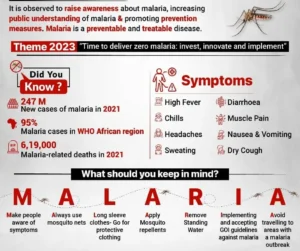
Malaria
Caused by Plasmodium parasites, transmitted through bites of infected Anopheles mosquitoes. Not spread person-to-person. Found mainly in tropical and subtropical regions.
Global Burden
- 2024: 282 million cases, 610,000 deaths worldwide.
- WHO African Region: Accounts for 95% of cases and deaths.
- Children under 5 years: Represent about 75% of malaria deaths in Africa.
Symptoms
- Mild: Fever, chills, headache.
- Severe: Fatigue, confusion, seizures, breathing difficulty.
- Untreated malaria can be life-threatening.
Conclusion
India has made major progress in reducing malaria and is on track for elimination, but focused strategies, strong surveillance, and collaborative efforts are key to achieving and sustaining zero indigenous malaria by 2030.
SONIC BOOM
TOPIC: (GS3) SCIENCE AND TECHNOLOGY: THE HINDU
Scientists recently used seismometers to record sonic booms caused by space debris re-entering Earth’s atmosphere. This shows how high-speed objects from space can create shock waves strong enough to be detected on the ground.
What is a Sonic Boom?
- A sonic boom is a loud, explosive sound produced when an object travels faster than the speed of sound (supersonic speed).
- Commonly associated with fighter jets, rockets, or falling space debris.

How is a Sonic Boom Formed?
- When an object moves at supersonic speed, it compresses air molecules in front of it.
- This creates shock waves that spread out in a cone shape.
- When these pressure waves reach the ground, they are heard as a sudden thunder-like noise.
- The sound is not continuous but occurs as the shock wave passes.
Factors Affecting Intensity
- Size and weight of the object: Larger objects create stronger shock waves.
- Altitude: Higher altitude weakens the boom before it reaches the ground.
- Shape of the object: Streamlined designs can reduce shock intensity.
- Weather conditions: Temperature, air pressure, and wind affect how the sound travels.
Visible Effects
- Sometimes a white vapor cloud appears around a supersonic aircraft.
- This happens when sudden pressure changes cause water vapor to condense, forming a temporary cloud.
Impact on Ground
- Sonic booms can rattle windows and occasionally break glass.
- However, they usually pose minimal danger to human life.