
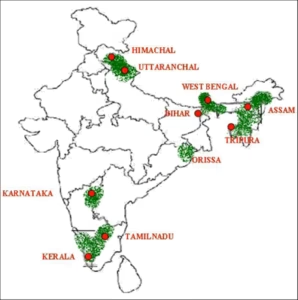
Assam’s tea sector is facing a dual crisis due to erratic climate patterns and little increase in real tea prices. These challenges are threatening the sustainability of one of India’s most important plantation industries.
Background
- Assam is the largest tea-producing region in India, supporting nearly 12 lakh workers, many of them women.
- Tea cultivation depends on stable temperature, steady rainfall, and moist soils, conditions that once prevailed in the Brahmaputra valley.
- Recent climate disturbances and slow price growth have created economic and ecological pressure on growers and estates.
Changing Climate Conditions in Assam
- Rising Temperatures: Mean and maximum temperatures have increased, pushing tea bushes beyond their comfort zone. Night-time temperatures are also rising, disturbing plant recovery.
- Altered Rainfall Patterns: Long dry spells, delayed monsoon, and sudden heavy showers are now common. Winter and pre-monsoon rainfall—critical for plant growth—are declining.
- Reduced Soil Moisture: Unpredictable rain distribution and heat reduce soil’s capacity to retain moisture. Leads to leaf wilting, weaker flush cycles, and lower productivity.
Scientific Findings on Future Risks
- A study by the Tea Research Association using IPCC climate pathways (RCP 2.6 and 4.5) predicts major shifts by 2050.
- Both minimum and maximum temperatures will rise, while rainfall will become more uneven.
- Present high-suitability zones like Upper Assam, South Bank, and Cachar may lose climate advantage.
- Tea cultivation may shift to higher altitudes like Karbi Anglong and Dima Hasao.
- Average minimum temperature has already risen 1°C in 90 years, with 200 mm annual rainfall loss.
Increased Pests and Plant Stress
- Heat beyond 35°C reduces nutrient uptake, making bushes vulnerable.
- New pests and diseases are spreading across plantations.
- Unlike other crop sectors, tea growers receive minimal disaster support.
Price Stagnation and Economic Pressure
- Tea auction prices have risen only 4.8% annually over 30 years, far below inflation and rising input costs.
- Farmers face shrinking margins and cannot easily replant with climate-tolerant varieties.
- Energy, labour, irrigation, and transport costs continue to rise.
Way Forward
- Climate-Resilient Farming: Promote seed-grown varieties, high-yield drought-tolerant clones. Use mulching, cover crops, organic matter to retain moisture.
- Water Management: Adopt micro-irrigation, rainwater harvesting, and better drainage systems.
- Sustainable Certification: Programmes like trustea (India Sustainable Tea Code) help small growers adopt efficient water use, integrated pest management, and climate-friendly practices.
- Economic Diversification: Promote allied activities such as fruits, spices, organic tea, fisheries, livestock, tourism, and direct selling.
- Policy Support: Treat tea at par with other crops for subsidies, insurance, and climate assistance. Increase investment in research, training, and climate-resilient technologies.
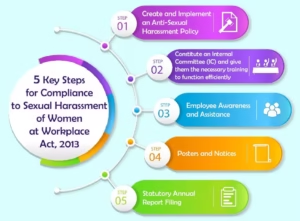
A recent case in Chandigarh, where a college professor was dismissed after an Internal Complaints Committee (ICC) inquiry under the POSH Act, highlighted both the law’s effectiveness and its persistent weaknesses.
Background
- The Sexual Harassment of Women at Workplace (Prevention, Prohibition and Redressal) Act, 2013, was introduced to create safe workplaces for women.
- While it has led to important decisions like the Chandigarh case, the overall conviction rate is very low, and many survivors face procedural hurdles.
- Power imbalance in educational institutions makes young students especially vulnerable.
Key Conceptual Gaps
No Recognition of “Informed Consent”
- The Act speaks of consent but does not distinguish consent given freely from consent obtained through manipulation or incomplete information.
- In academic and work settings, relationships may appear voluntary at first but later reveal hidden pressure or deceit.
- Such situations leave women feeling exploited, but the law does not cover this emotional and psychological manipulation.
Emotional and Psychological Abuse Overlooked
- Many perpetrators use subtle coercion, emotional pressure, or deception that does not leave visible evidence.
- The Act focuses mostly on explicit behaviour, ignoring mental harassment, which is common in modern workplaces.
Procedural Weaknesses
- Short Complaint Window: Survivors must file a complaint within three months, which is too restrictive.
- Soft Terminology: Calling the accused a “respondent” reduces the seriousness of the misconduct. Similar acts outside the workplace would be treated as criminal offences.
- Burden of Evidence: Vague definitions shift the responsibility onto the woman to “prove” harassment. Harassment usually occurs as a pattern, not a single act, yet ICCs often wait for direct evidence.
Structural Limitations
- Academic spaces involve visiting faculty, conferences, and collaborations.
- The POSH Act does not explain how to handle complaints that involve different institutions, allowing repeat offenders to escape scrutiny.
- The law allows action against complainants for “malicious” complaints.
- Though intended as a safeguard, this clause often discourages genuine survivors.
Challenges with Digital Evidence
- Harassment today occurs through disappearing messages, temporary images, and encrypted chats.
- ICC members usually lack the legal and technical skills to analyse such evidence.
- The Act does not include clear rules for handling digital forms of abuse.
Way Forward
- Update the law to include:
- Clearer definitions of consent, including informed and free consent.
- Recognition of psychological, emotional, and digital harassment.
- Longer time limits for filing complaints.
- Stronger investigation processes using behavioural evidence and digital protocols.
- Better training for ICC members and unified procedures for inter-institutional cases.
Conclusion:
The POSH Act was a milestone when enacted, but its gaps now weaken its ability to protect women effectively. Strengthening the law with clearer definitions, longer timelines, and better mechanisms is essential to ensure genuine and consistent justice.
A new AidData report (2024) revealed that China has provided over $2 trillion in global loans between 2000–2023, covering 80% of nations.
China’s Global Lending
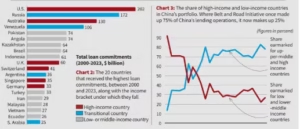
- Between 2000 and 2023, China extended loans and grants to 179 out of 217 countries/territories.
- Total global lending exceeded $2 trillion, making China one of the world’s most influential financial actors.
- In 2023 alone, China lent $140 billion, cementing its position as the largest bilateral creditor.
Major Beneficiaries
- United States:
- Received about $200 billion, the highest among all nations.
- Around 95% of loans came from Chinese state-owned banks and enterprises.
- Sharp rise from $320 million (2000) to $19 billion (2023), showing China’s commercial focus.
- Russia & Australia:
- Russia: $172 billion
- Australia: $130 billion
- European Union (27 countries):
- Received $161 billion for nearly 1,800 projects.
Shift Toward High-Income Economies
- Six high-income countries received over 20% of China’s total global lending.
- Overall, $943 billion went to high-income economies.
- Shows China’s transition from aid-driven engagement to profit-oriented commercial lending.
Decline in Developmental Lending
- China earlier focused on infrastructure in poorer countries, especially via the Belt and Road Initiative (BRI) from 2013.
- Initially, BRI accounted for 75% of China’s loans; now it is only 25%.
- China’s official development assistance fell to $1.9 billion in 2023 from the usual $5.7 billion.
Nature of Lending
- Increasing reliance on commercial loans, especially for developed nations.
- In the U.S., 75% of transactions were commercial, while only 7% were for development.
- China often uses offshore shell companies and international bank syndicates to navigate foreign screening systems.
- Has an 80% approval rate in overseas mergers and acquisitions.
India’s Borrowing from China
- India received $11.1 billion between 2000–2023.
- Major sectors: energy, banking, and financial services.
- Mix of developmental and commercial loans.
- Lending remains modest due to strategic distrust and border tensions.
Implications for Global Politics
- China’s financial presence deepens its geopolitical influence.
- Growing dominance may increase debt dependence of several nations.
- Shift toward high-income nations signals China’s aim for economic returns rather than soft-power through aid.
Conclusion
China’s global lending pattern shows a clear strategic shift from aid-based financing to commercially driven loans targeting richer economies. This changing trend will have long-term implications for global debt dynamics and India must stay cautious while navigating this evolving financial landscape.
Bharat Electronics Limited (BEL) and France’s Safran Electronics & Defence have recently signed an agreement to jointly manufacture the HAMMER Weapon System in India.
HAMMER Weapon System
- HAMMER stands for Highly Agile and Manoeuvrable Munition Extended Range.
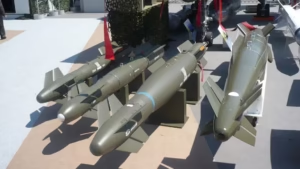
- It is an advanced air-to-surface precision strike weapon developed by the French defence firm Safran.
- Commonly referred to as a glide bomb, it allows aircraft to hit targets accurately from a safe distance.
Key Features
- Range and Deployment: Effective strike range of up to 70 km. Designed to be attached to standard bomb bodies of 250 kg, 500 kg, and 1,000 kg.
- High Accuracy and Survivability: Built with anti-jamming capability, allowing it to function even in hostile electronic warfare environments. Can be launched from low altitudes and used in difficult terrain.
- Modular and Platform-Friendly: Modular architecture allows easy integration with aircraft like Rafale and LCA Tejas. Components such as guidance kits and propulsion modules help achieve precise targeting.
What is a Precision-Guided Weapon?
- A weapon designed to hit a specific target while minimising collateral damage.
- Often called smart bombs due to their advanced guidance systems.
- Includes key parts like guidance sensors, warhead, and control fins for direction.
Conclusion
The HAMMER system strengthens India’s air strike accuracy and expands indigenous defence manufacturing. Its induction will enhance mission effectiveness while reducing reliance on foreign weapon systems.