Daily Current Affairs 28-November-2025

Share this Post

CONSCIENCE VS DISCIPLINE IN THE ARMED FORCES

TOPIC: (GS2) INDIAN POLITY: THE HINDU

Lieutenant Samuel Kamalesan was dismissed from the Indian Army for refusing to enter a place of worship during compulsory regimental rituals.

Background of the Case

  • Lt. Samuel Kamalesan, a Christian officer, was removed from service for not entering the sanctum during mandatory worship at his regiment.
  • He attended parades and stood with his unit but refused active religious participation.
  • The Delhi High Court supported the Army’s action.
  • The Supreme Court declined to interfere in the matter.

Legal Basis Used by the Court

  • The judgement mainly relied on Article 33 of the Constitution, which allows Parliament to restrict fundamental rights of armed forces personnel.
  • The Court viewed the issue as Disobedience of a lawful order, Not an exercise of personal faith rights
  • It gave priority to: Discipline, Unity, Military necessity

Stand of the Indian Army

  • The Army argued that Rituals promote bonding and morale
  • Officers must participate fully to gain trust of soldiers
  • It felt his refusal weakened cohesion.

Main Concerns Raised

Clash of Two Values

  • Freedom of conscience vs Organisational unity
  • The case shows conflict between Individual belief and Institutional discipline

Comparison with Past Judgments

  • Courts have previously Protected religious freedom (e.g., National Anthem case)
  • Intervened in military issues for Women officers Pension and promotion rules
  • Shows that courts can reform military practices when justice demands.

Broader Implications

  • Armed forces must: Protect unity, Also safeguard dignity of individuals
  • Excess rigidity can damage: Trust, Morale, Inclusiveness

Way Forward

  • Introduce clear guidelines for handling faith-related objections.
  • Promote reasonable accommodation without harming discipline.
  • Constitutional values must: Support diversity, Strengthen cohesion
  • Leadership should Resolve issues internally and Avoid harsh punishment when alternatives exist.

RELIGIOUS FREEDOM IN THE INDIAN CONSTITUTION

Article 25 – Freedom of Religion

  • Guarantees freedom of conscience and the right to profess, practise and propagate religion.

Article 26 – Freedom to Manage Religious Affairs

  • Every religious denomination has the right to: Establish religious institutions. Manage religious matters. Own and acquire property. Administer such property according to law.

Article 27 – Freedom from Taxes for Promotion of a Religion

  • The government cannot force citizens to pay taxes for promoting any particular religion.
  • Ensures State neutrality in religious funding.

Article 28 – Freedom from Religious Instruction

  • No religious teaching in: Government educational institutions.
  • Exceptions: Allowed in institutions run by trusts or religious bodies.
  • No person can be forced to attend religious worship in State institutions without consent.

Article 15 – No Discrimination on Religious Grounds

  • Prohibits discrimination based on: Religion, Race, Caste, Sex, Place of birth
  • Guarantees equal access to public places irrespective of religion.

Article 16 – Equality in Public Employment

  • No discrimination in government jobs based on religion.
  • Everyone has equal opportunity in public employment.

Conclusion

The case highlights that discipline and diversity can co-exist. True national strength comes not from forced uniformity, but from mutual respect within unity.

HIGHER EDUCATION COMMISSION OF INDIA (HECI) BILL, 2025

TOPIC: (GS2) INDIAN POLITY: THE HINDU

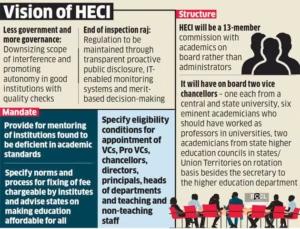
The Union Government is preparing to introduce the Higher Education Commission of India Bill, 2025 in Parliament. The Bill proposes a single regulator for higher education as recommended by the National Education Policy (NEP) 2020.

Present Regulatory System

At present, higher education in India is supervised by multiple bodies:

  • University Grants Commission (UGC) – regulates universities
  • All India Council for Technical Education (AICTE) – regulates technical education
  • National Council for Teacher Education (NCTE) – controls teacher education

What is HECI?

The Higher Education Commission of India (HECI) will replace all existing regulators with one central authority.

Objective:

  • Simplify governance
  • Increase accountability
  • Improve academic standards
  • Reduce interference
  • Promote institutional autonomy

HECI Bill,2025

Four Pillars of HECI (As per NEP 2020)

The commission will work through four specialised verticals:

  • NHERC (Regulation): Supervises all higher education (except medicine and law)
  • NAC (Accreditation): Grades institutions through performance-based evaluation
  • GEC (Academic Framework): Sets learning outcomes and curriculum benchmarks
  • HEGC (Funding Body): Decides grants and financial support (final power may rest with the Centre)

Benefits of the New System

  • One nation, one regulator model, Clear division of responsibilities
  • Faster decision-making  and Transparent accreditation process
  • More operational freedom to universities with Improved global competitiveness

2018 Attempt and Why It Failed

Earlier, the 2018 HECI Bill was withdrawn because:

  • It gave too much power to the Centre, UGC’s funding role was removed
  • States feared loss of control and Academicians opposed excessive regulation

Concerns with HECI Bill 2025

  • Centralisation of Power: Commission members are appointed by the Centre, Risk of political interference in education
  • Reduced State Role: Education is in the Concurrent List, States fear loss of autonomy
  • Funding Control: Direct funding through the Ministry may weaken university independence
  • Representation Issues: Critics highlight lack of: Women, SC/ST/OBC, Minorities, Persons with disabilities
  • Federal Structure at Risk: States may become implementers instead of partners

Conclusion

The HECI Bill promises reform through centralisation but raises serious concerns about autonomy and federal balance. Its success will depend on transparent functioning and cooperative federalism.

SPECIAL INTENSIVE REVISION (SIR) OF ELECTORAL ROLLS

TOPIC: (GS2) INDIAN POLITY: THE HINDU

The Election Commission of India (ECI) is conducting Special Intensive Revision (SIR) of electoral rolls in 12 States and UTs. The process is under judicial scrutiny for shifting the burden of voter verification from the State to citizens, risking large-scale disenfranchisement.

What is SIR of Electoral Rolls?

  • A special drive by the ECI to verify and update voter lists.
  • Voters must fill fresh forms and match details with old electoral rolls (2002–2005).
  • Introduced first in Bihar, now expanded to other States/UTs.

Features of the Current Process

  • Forms are distributed by Block Level Officers (BLOs).
  • Electors must submit documents to prove eligibility.
  • Draft rolls will be published after this exercise.
  • The process claims to remove duplicate and fake entries.

Major Concerns Raised

  • Burden Shifted to Citizens: Earlier, the State presumed residents as valid voters. Now, each person must prove their right to vote again.
  • Risk of Disenfranchisement: Married women, internal migrants, poor and elderly may lack documents. Bihar data showed fall in women voter ratio after revision.
  • Implementation Gaps: Door-to-door visits by BLOs are not happening uniformly. Many citizens report non-receipt of forms and confusion over documents.
  • Outdated Record Matching: Comparing current data with 20-year-old lists can create errors. Old addresses/names lead to wrongful deletions.

Legal Position

  • Under the Representation of the People Act, 1950, a voter is an “ordinary resident”.
  • Gauhati HC (1999) held residency depends on habitual living intent.
  • Traditionally, the State presumed residence unless proven otherwise.

Issue with Current Method

  • Presumption has been reversed: voters are treated as doubtful by default.
  • Supreme Court is hearing appeals on constitutionality of the process.
  • Focus so far is on fixing implementation, not on the validity of the method itself.

Impact on Democracy

  • May weaken universal adult franchise.
  • Can distort voter data and representation.
  • Undermines trust in the electoral system.

Suggested Way Forward

  • Restore State responsibility for correct enrolment.
  • Conduct genuine door-to-door verification.
  • Use technology for deduplication, not exclusions.
  • Ensure clarity in documents required.
  • Court must examine constitutional validity, not only procedures.

Conclusion

SIR must ensure clean rolls without denying genuine voters their rights. Purity of the register should not come at the cost of democracy itself.

ENABLING A MODERN AND FUTURE-READY LABOUR ECOSYSTEM

TOPIC: (GS2) SOCIAL JUSTICE: THE HINDU

The Government has brought into force the Four Labour Codes from November 21, 2025, marking the biggest reform in labour laws since Independence. The move aims to simplify regulations, expand social security and improve ease of doing business.

Why Labour Reforms Were Needed

  • India earlier had 29+ labour laws spread across decades.
  • Different definitions, overlapping rules and complex compliance burden.
  • Informal sector workers lacked social security.
  • The Second National Commission on Labour recommended consolidation into codes.

The Four Labour Codes – At a Glance

Code on Wages, 2019

  • Introduces national floor wage.
  • Ensures universal minimum wages to all workers.
  • Brings uniform definition of “wages”.
  • Mandates timely salary payment and appointment letters.

Industrial Relations Code, 2020

  • Simplifies rules for trade unions and industrial disputes.
  • Provides faster grievance redressal.
  • Enables flexibility to industries for hiring and retrenchment.

Code on Social Security, 2020

  • Universal social security coverage (formal + informal workers).
  • Covers gig and platform workers.
  • Establishes National Social Security Fund.
  • Expands EPF and ESIC coverage nationwide.

OSH Code, 2020

  • Focus on workplace safety and cleanliness.
  • Mandatory safety committees.
  • Free annual health check-ups.
  • Regulates working hours (48 per week).

Key Benefits for Workers

  • Equal wages and strong labour rights.
  • Improved social security (PF, insurance, pension).
  • Protection for informal and migrant labour.
  • Better healthcare and safety provisions.
  • Helps women with: Night shift work with consent. Maternity benefits. Equal pay rule.

Why Workers are Worried

  • Fear of Job Insecurity: Legal support for fixed-term employment may encourage “hire and fire” culture. Permanent jobs could decline.
  • Centralisation of Power: States lose control in labour matters, weakening federalism. Trade unions say democratic consultation was missing.
  • Weakening of Labour Rights: Right to strike and collective bargaining powers are reduced. Trade unions feel sidelined in drafting of laws.
  • Minimum Wage Concerns: A national floor wage may replace “living wage” concept. Coverage of minimum wage law may shrink due to higher factory thresholds.
  • Social Security Doubts: Only about 7% workers currently enjoy formal protection.: Unions argue informal workers will still be left out.

Conclusion

The Four Labour Codes mark a historic shift towards a simpler, gender-friendly, worker-centric and growth-oriented labour system. If implemented seriously by States and industry, they can support employment, productivity and inclusive development, paving the way for a developed India.

IMF, U.S. TARIFFS AND INDIA’S GROWTH DATA

TOPIC: (GS3) ECONOMY: THE HINDU

India has disagreed with the International Monetary Fund over its assumption that high U.S. tariffs will continue for long and over the size of their impact on India’s growth. The IMF has also graded India’s national income data (GDP/GVA) as ‘C’, citing methodological weaknesses.

IMF vs India on U.S. Tariffs Impact

  • IMF assumed that 50% U.S. tariffs would continue for a long time.
  • It estimated India’s GDP growth could fall by 0.4% in 2025–26 and 0.3% in 2026–27.
  • These views were shared in its Article IV Consultation report.

Government of India’s response

  • Disagreed with the “indefinite tariffs” assumption.
  • Said the growth impact estimated by IMF is overstated.
  • Argued that industries could shift exports to new markets and adjust through front-loading orders.
  • Accepted that some sectors may face pressure, but the overall impact is expected to be manageable.

Wider Context (Article IV Consultation)

  • IMF holds annual economic reviews of member countries.
  • The review includes discussions with the Ministry of Finance and the Reserve Bank of India to assess risks and policy health.

IMF’s ‘C’ Grade for India’s GDP Data

What does ‘C’ grade mean?

  • Data is available on time, but has limitations that affect accuracy and global comparison.
  • Across all datasets, India received a better overall grade of ‘B’.

Key problems pointed out

  • Old base year (2011–12) still being used for GDP calculations.
  • No proper Producer Price Index (PPI) → reliance on Wholesale Price Index for estimates.
  • Gap between production and expenditure estimates of GDP.
  • Under-coverage of informal sector, which is large in India.

Why does this matter?

  • Flawed data can mislead policy decisions.
  • Investors and global agencies may become cautious.
  • Accurate national accounts are vital for welfare spending, taxation and growth planning.

Way Forward

  • Update base year regularly.
  • Develop a full-fledged Producer Price Index.
  • Improve data coverage of the informal sector.
  • Align estimates between income, production and spending methods.
  • Strengthen statistical autonomy for credibility.

INTERNATIONAL MONETARY FUND (IMF)

The International Monetary Fund (IMF) is a global organisation that:

    • Promotes global financial stability
    • Supports countries facing economic crisis
    • Encourages international trade and cooperation
    • Helps maintain stable exchange rates

When and Why IMF was Created?

  • IMF was established in 1944 at the Bretton Woods Conference (USA)
  • It started functioning in 1945
  • Formed after World War II to:
    • Prevent another global economic disaster like the Great Depression
    • Rebuild war-affected economies
    • Promote stable currencies and trade between nations

Bretton Woods System

  • Countries agreed to:
    • Fix their currencies to the U.S. Dollar
    • The Dollar was linked to gold
  • IMF was created to supervise this system.

Conclusion

India has challenged IMF’s pessimism on tariffs but must seriously address concerns over data quality to sustain growth and global trust.

RARE EARTH MAGNET SCHEME TO BUILD DOMESTIC SUPPLY CHAIN

TOPIC: (GS3) ECONOMY: THE HINDU

The Union Cabinet has cleared a ₹7,280 crore scheme to create India’s first full-scale industry for sintered rare earth permanent magnets (REPMs).

Rare Earth Magnet Scheme

  • India uses about 900 tonnes of REPMs each year, nearly all imported, even though it has large reserves.
  • Demand is set to double by 2030 due to electric vehicles (EVs) and renewable energy.
  • Export controls by China in 2024–25 caused delays and risks for Indian manufacturers.
  • REPMs are vital for: EV motors and braking systems, Wind turbines, Consumer electronics, Defence and aerospace systems

Features of the Scheme

  • Total outlay: ₹7,280 crore for 7 years.
  • Two-part incentive system: ₹6,450 crore as sales-linked support (over 5 years), ₹750 crore as capital subsidy for factories
  • Capacity & selection: 5 firms selected through global bidding, Total target capacity: 6,000 MTPA (up to 1,200 MTPA per firm)
  • End-to-End Manufacturing Rule: Companies must produce the full chain: Oxides → Metals → Alloys → Finished magnets

Strategic Importance

  • For Electric Mobility & Green Energy: Neodymium magnets improve motor efficiency and battery usage. Helps keep EV costs stable and encourages domestic component supply.
  • For Defence & Aerospace: REPMs are used in radars, drones, avionics and precision weapons. Local production increases national security.
  • Economic Policy Alignment: Supports India’s Net Zero 2070 goal. Fits into the National Critical Minerals Mission.
  • Global Context: China controls over 80% of REPM processing. India’s scheme cuts risk from foreign policy shocks and boosts global credibility.

Challenges:

  • Need for advanced sintering technology: To improve material strength and efficiency.
  • High purity processing methods: To ensure defectfree and reliable outputs.
  • Environmentfriendly mining: To reduce ecological damage and promote sustainability.
  • Maintaining global quality standards: To stay competitive in international markets.

RARE EARTH MINERALS

Minerals containing rare earth elements (REEs) such as lanthanides, scandium, and yttrium.

  • Not truly rare: Found abundantly in the Earth’s crust but rarely concentrated enough for easy mining.
  • Unique properties: Essential for hightech applications due to their magnetic, luminescent, and catalytic traits.
  • Critical for technology: Used in smartphones, wind turbines, electric vehicles, defense systems, and renewable energy.
  • Global importance: Strategic resources influencing geopolitics, trade, and supply chains.
  • India’s role: Holds significant reserves, mainly in monazite sands along coastal regions.

Why They Matter

Rare earth minerals are vital for the clean energy transition, advanced electronics, and defense technologies, but their extraction poses environmental and geopolitical challenges.

Conclusion

The Rare Earth Magnet Scheme is a strategic push to make India self-reliant in a critical clean-energy technology. Success will depend on strong implementation, advanced technology and responsible mining practices.

MEKEDATU DAM PROJECT

TOPIC: (GS3) ECONOMY: THE HINDU

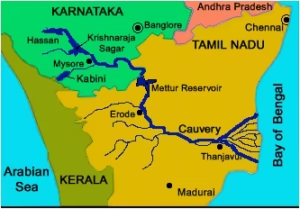
The Karnataka government has decided to submit a revised Detailed Project Report (DPR) to the Centre for the Mekedatu balancing reservoir project on the Cauvery river. The move has revived objections from Tamil Nadu, which fears impact on its water share.
Mejedatu Dam Project

Mekedatu Dam Project

  • Mekedatu is a multi-purpose project planned to provide drinking water and electricity.
  • It is proposed near Kanakapura in Ramanagara district of Karnataka.
  • The site is located:
    • Around 90 km from Bengaluru
    • About 4 km from the Tamil Nadu border
  • The dam is planned at the meeting point of the Cauvery river and Arkavathi river.

Features of the Project

  • Type: Concrete gravity dam
  • Height: About 99 metres
  • Length: Nearly 735 metres
  • Storage capacity: Around 66 TMC (Thousand Million Cubic Feet)
  • Hydropower generation: 400 MW
  • Purpose: Drinking water supply to Bengaluru (over 4 TMC annually), Power generation, Water regulation and storage

Importance for Karnataka

  • Bengaluru is facing increasing water scarcity due to population growth.
  • The project aims to ensure a stable water supply for the city.
  • Power generation will support the energy needs of the region.
  • The reservoir will also help manage seasonal water flow.

Objections Raised by Tamil Nadu

  • Tamil Nadu is a lower riparian state and depends heavily on Cauvery water.
  • It argues that:
    • Mekedatu is the last free-flowing point of Cauvery before entering Tamil Nadu.
    • The dam may reduce water availability downstream.
    • The project violates inter-state river agreements and tribunal orders.
  • Tamil Nadu fears: Loss of irrigation water, Impact on farming communities, Political misuse of stored water

Conclusion

The Mekedatu Dam Project highlights the complex nature of inter-State river disputes in India. While Karnataka views it as vital for urban water security, Tamil Nadu believes it threatens its legal water rights. A cooperative, legal and negotiated approach is essential for a sustainable solution.

INTERNATIONAL ASTRONOMICAL UNION (IAU)

TOPIC: (GS3) SCIENCE AND TECHNOLOGY: THE HINDU

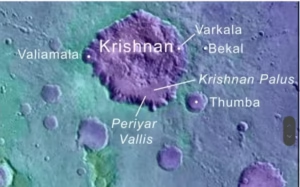
A very old crater on Mars (about 3.5 billion years) has been officially named after Indian geologist M.S. Krishnan. The names were approved by the global body for astronomy, the International Astronomical Union.
International Astronomical Union(IAU)

About the IAU

  • Set up in 1919 as the top international organisation for professional astronomy.
  • Works to advance astronomy through research, education, outreach, and global cooperation.
  • Headquarters: Paris, France.
  • It meets at a General Assembly every three years to decide long-term policies.

Key Functions

  • Standard-setting: Fixes astronomical constants and clear naming rules.
  • Official naming authority: Only body recognised worldwide to give formal names to planets, moons, craters and other space objects.
  • Information sharing: Helps spread new discoveries quickly.
  • Global observations: Supports and coordinates international observing campaigns.
  • Capacity building: Promotes astronomy education and discussions on future large scientific facilities.

Meetings & Activities

  • Organises many scientific gatherings.
  • Sponsors about 9 international symposia every year, besides other workshops and meetings.

Membership Structure

  • Members are professional astronomers grouped into Divisions, Commissions and Working Groups.
  • Also includes Junior Members to support young researchers.
  • Around 12,742 active members with voting rights and current affiliations.
  • Members come from 92 countries; 85 are National Members.

Significance of the News

  • Naming a Martian crater after M.S. Krishnan brings global recognition to Indian science.
  • Shows India’s growing contribution to planetary science and international research.
  • Highlights the IAU’s central role in ensuring neutral, scientific and standardised naming in space.


Write a Review

Your email address will not be published. Required fields are marked *