

Table of Contents
ToggleCAN THE ENFORCEMENT DIRECTORATE (ED) FILE WRIT PETITIONS?
TOPIC: (GS2) POLITY: THE HINDU
On January 20, 2026, the Supreme Court agreed to hear petitions filed by Kerala and Tamil Nadu challenging a Kerala High Court ruling that allowed the Enforcement Directorate (ED) to file writ petitions before constitutional courts.
Writs in India
- Writs: Writs are special orders issued by courts to protect rights or ensure justice when ordinary remedies are not enough.
- Types of Writs
- Habeas Corpus: Release a person from unlawful detention.
- Mandamus: Directs a public authority to perform its duty.
- Prohibition: Stops a lower court/tribunal from acting beyond its authority.
- Certiorari: Quashes illegal orders of lower courts/tribunals.
- Quo Warranto: Questions the legality of someone holding a public office.
- Nature of Writs
- Writs are discretionary remedies – courts may refuse if an alternative remedy exists.
- Cannot be issued against the President or Governor (Article 361).
- Generally not issued against private individuals, unless there is collusion with the State.
- Importance of Writs
- They act as a safeguard for citizens’ rights.
- Ensure that government authorities act within their powers.
- Strengthen the rule of law and judicial review in India.
Kerala high court’s ruling
- The dispute stems from the 2020 Kerala gold smuggling case (30 kg gold worth ₹14.82 crore). Kerala set up a Commission of Inquiry to probe alleged conspiracy against State leaders, which the ED challenged in the High Court through writ petitions.
- The State argued that the ED is only a Union department, not a juristic body, and therefore cannot file writs. It cited Article 131 (Centre–State disputes go directly to SC) and the 2003 SC ruling discouraging such writ petitions in High Courts.
- Kerala High Court held that the ED is a statutory authority under FEMA and PMLA, with officers exercising statutory powers. It dismissed objections to ED’s legal personality as a “trivial defect” and upheld its right to move High Courts under Article 226.
Possible Implications of the Case
- ED’s Status as a Juristic Entity: If the Supreme Court upholds ED’s writ jurisdiction, the agency may be treated like statutory bodies such as SEBI or RBI, which have independent legal personality and the capacity to sue or be sued.
- Criticism of ED’s Autonomy: Critics argue that the ED is merely an instrument of the Union government, functioning on its behalf, and therefore lacks the autonomy to act as an independent litigant.
- Centre–State Dispute Mechanism: Since States do not owe any public duty to the ED, disputes between the agency and State governments should be addressed under Article 131 of the Constitution, which gives the Supreme Court exclusive jurisdiction over Centre–State conflicts.
- Impact on Federal Balance: The Supreme Court’s ruling will be significant in shaping the balance of power between the Centre and States.
Writ Powers Supreme Court Vs High Courts
Supreme Court (Article 32)
- Scope of Power – Can issue writs only for enforcement of Fundamental Rights guaranteed under Part III of the Constitution.
- Nature of Right – Filing a writ petition under Article 32 is itself considered a Fundamental Right. Citizens can directly approach the Supreme Court if their rights are violated.
- Jurisdiction – Operates across the entire territory of India.
- Limitations – Cannot issue writs for ordinary legal rights or administrative matters; restricted to Fundamental Rights.
High Courts (Article 226)
- Scope of Power – Can issue writs not only for Fundamental Rights but also for any other legal rights.
- Nature of Right – Filing a writ under Article 226 is not a Fundamental Right, but a discretionary remedy provided by the Constitution.
- Jurisdiction – Operates within the territorial limits of the concerned State/Union Territory.
- Flexibility – Broader powers compared to the Supreme Court; can intervene in administrative actions, statutory violations, and matters beyond Fundamental Rights.
Conclusion
The Supreme Court’s verdict will decide whether ED can act as an independent litigant or must rely on the Union government to challenge State actions. The ruling is crucial for defining the limits of ED’s powers and the federal balance between Centre and States.
INDIA–EU FREE TRADE AGREEMENT
TOPIC: (GS3) ECONOMY: THE HINDU
India and the European Union (EU) have recently concluded a landmark Free Trade Agreement (FTA), significant for its scale and the maturity shown in negotiations. The deal is expected to reshape trade flows and strengthen India’s position in global commerce.
Importance of the Deal
- The EU accounts for nearly 12% of India’s trade, making this agreement far more impactful than the eight FTAs signed in the past four years with smaller economies.
- Under the pact, the EU will remove tariffs on 99.5% of Indian exports, most of them immediately.
- India has offered tariff concessions on 97.5% of EU exports, while safeguarding sensitive sectors.
Key Features
- Agriculture Protection: India excluded strategic agricultural and dairy sectors from tariff cuts. The EU also kept its sensitive farm products outside the agreement.
- Automobile Sector Resolution: Past talks collapsed in 2013 over auto tariffs. A quota-based system now protects India’s low-cost manufacturers while opening space for European luxury carmakers.
- Wine Tariffs: Quota-based tariffs allow French winemakers entry while protecting India’s growing domestic wine industry.
- Broader Cooperation: Separate agreements were signed on mobility, defence, and technology, showing a comprehensive partnership.
Significance for India
- Expanded Market Access: EU will remove tariffs on 99.5% of Indian exports, most to zero immediately. Benefiting sectors: Textiles, apparel, leather goods, gems & jewelry, pharmaceuticals.
- Boost for High-Value Industries: Quota-based concessions open opportunities for European luxury cars and wines, while protecting India’s domestic producers. Benefiting sectors: Automobiles, wine industry, domestic manufacturing.
- Strengthened Trade Balance & Investment: Greater access to Europe’s large consumer base encourages foreign investment in India’s manufacturing. Benefiting sectors: Electronics, machinery, IT services, renewable energy.
- Comprehensive Cooperation Beyond Trade: Separate agreements on mobility, defence, and technology enhance strategic ties. Benefiting sectors: Defence industry, skilled workforce mobility, technology and innovation.
Concerns
- Carbon Border Adjustment Mechanism (CBAM): India could not secure concessions under CBAM, which currently applies to six products but may expand to all industrial goods.
- Positive aspect: any concession given to another country will automatically extend to India.
- Need for Manufacturing Reforms: To attract foreign investors using India as a base for exports to Europe, India must scale up large-scale manufacturing quickly.
- Implementation Delay: The FTA must be translated into 27 EU languages and ratified by each member state and the European Parliament.
- India must push for speedy clearance to ensure benefits are not delayed, especially in light of U.S. tariff challenges.
Free Trade Agreement (FTA)?
An FTA is an arrangement under international law where countries agree to form a free-trade area by reducing or removing tariffs, quotas, and restrictions on imports and exports.
- Purpose:
- Promote smoother trade flows.
- Encourage investment and cooperation.
- Enhance competitiveness of domestic industries.
- Types:
- Bilateral FTAs: Between two countries.
- Multilateral FTAs: Between multiple countries or regional blocs.
Five of India’s major Free Trade Agreements (FTAs):
- India–Sri Lanka FTA (2000): Gave duty-free access to many goods, boosting textile and agriculture trade.
- SAFTA (2006): Regional trade pact among SAARC nations to reduce tariffs and promote South Asian trade.
- India–ASEAN FTA (2010): Lowered tariffs on goods, expanding trade in electronics, textiles, and agriculture.
- India–Japan CEPA (2011): Comprehensive pact covering goods, services, investment, and intellectual property.
- India–UAE CEPA (2022):
Conclusion
The India–EU FTA reflects a pragmatic and balanced approach to trade diplomacy. While challenges remain in CBAM and implementation timelines, the agreement positions India strongly in global trade and offers long-term economic opportunities.
VOTER BEHAVIOUR AND PARTICIPATION TRENDS IN INDIA
TOPIC: (GS2) POLITY: THE HINDU
Recent Lokniti-CSDS survey data reveal stable voter turnout, rising women’s participation, and growing independent decision-making among voters. India observed National Voters’ Day on January 25, 2026, highlighting the importance of electoral awareness.
Why higher voter turnout is important in a democracy:
- Stronger Legitimacy: When more citizens vote, the elected government reflects the true will of the people, making decisions more legitimate.
- Inclusive Representation: High turnout ensures that all groups, including women, youth, and marginalized communities, have their voices heard in policymaking.
- Accountability & Trust: Greater participation increases public trust in institutions and makes leaders more accountable to citizens.
Key factors behind this rise:
- Awareness campaigns encouraging women voters.
- Women-managed polling booths that enhance safety and inclusivity.
- Better access to polling stations through administrative reforms.
Voter Confidence in Impact
- In 2024, 56% of voters believed their vote influences governance, showing strong trust in electoral institutions.
- Only 20% felt voting makes no difference, highlighting growing expectations of accountability.
- Young voters increasingly link their choices to policy performance and delivery.
Women’s Political Engagement
- Women show higher interest in politics where governance is visible:
- Local politics – nearly 50% report moderate/high interest.
- State politics – 44% show interest.
- National politics – 38% engaged.
- This reflects a continuum of participation across levels of governance.
Independent Decision-Making
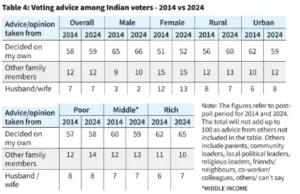
- Majority of voters decide independently: 2014 – 59%; 2024 – 59% (stable).
- Secret ballot (1951), EVMs (2004), and VVPAT (2013) strengthened privacy and autonomy.
- Gender patterns: Men – 65% (2014) → 66% (2024). Women – 51% (2014) → 52% (2024).
- Rural voters show similar independence to urban voters, challenging stereotypes.
How Voter Turnout is Calculated
- Identify Eligible Voters: Count the total number of people who are eligible to vote (registered voters in the electoral roll).
- Count Actual Votes Cast: Record the number of voters who actually voted (ballots cast, including valid and invalid votes).
- Formula
Voter Turnout (%) =Total Votes Cast Total Eligible Voters×100
Example
- Eligible voters: 1,00,000
- Votes cast: 65,000
- Voter turnout = 65,0001,00,000×100=65%
Conclusion
India’s electoral behaviour over the past decade shows continuity with gradual transformation. Stable turnout, rising women’s engagement, and independent voting highlight the resilience of democracy and the growing maturity of Indian voters.
INDIA’S TOURISM DEFICIT
TOPIC: (GS3) ECONOMY: THE HINDU
India, despite its rich cultural and natural diversity, has recorded low foreign tourist arrivals in 2025 (5.6 million till August) compared to smaller nations like Singapore (11.6 million). This highlights gaps in India’s tourism strategy and infrastructure.
India’s Tourism Industry (2025)
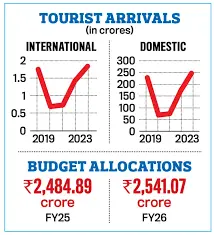
- GDP Contribution: Tourism contributed over ₹19 trillion to India’s GDP in 2023, about 10% higher than pre-pandemic levels.
- Employment: The sector supported 43 million jobs, marking an 8% increase compared to 2019.
- Domestic Tourism: Spending by Indian travelers reached ₹14.6 trillion, showing strong growth and driving recovery.
- Foreign Tourist Arrivals: India received 14.2 million international tourists in 2024–25, an 18% rise compared to the previous year.
Issues in Indian Tourism
Image Problem
- India’s global image is often shaped by negative headlines on safety, scams, sanitation, and bureaucracy.
- The ‘Incredible India’ campaign is attractive but insufficient to counter these perceptions.
- Tourists want safety, efficiency, and trust, which competitors like Singapore and Thailand consistently project.
- Need for segmented branding: Spiritual India, Adventure India, Luxury India, Buddhist circuit, Ramayana circuit, cricket tourism, etc.
Infrastructure Gaps
- First impressions at airports, immigration, taxis, and Wi-Fi remain weak.
- Poor last-mile connectivity to remote destinations.
- Lack of clean public toilets, reliable internet, and well-maintained heritage sites.
- Mid-range and luxury travel often costlier than Southeast Asian competitors.
India Itself – Experience Challenges
- Crowds, noise, scams, touts, and harassment erode trust.
- Hospitality sector faces 40% staff shortage; vocational training and multilingual guides are limited.
- Immigration processes remain complex; e-visas help but India lags behind peers.
- Need for friendlier immigration officers and openness to criticism.
Way Forward
- Rebranding Tourism: Promote targeted circuits (Golden Triangle, Himalayas, coastal belt). Use digital storytelling, influencer campaigns, and virtual tours.
- Infrastructure Development: Expand public-private partnerships for heritage site upkeep. Improve roads, rail, signage, and sustainable transport.
- Safety & Training: Strengthen tourist police, especially women officers. Crack down on scams and harassment. Skill development for homestays, eco-lodges, artisans.
- Visa Reforms: Simplify e-visas and offer multi-entry long-term visas. Explore Visa on Arrival for low-risk countries.
- Sustainability & Authenticity: Promote eco-tourism and community-based tourism. Regulate footfalls at fragile sites to prevent degradation.
Conclusion
India has unmatched history, natural beauty, and cultural depth, but weak fundamentals in image, infrastructure, and tourist experience limit its potential. Tourism must become a national priority to transform India into a top-tier global destination.
CAPITAL SUPPORT IN BATTERY CELL PRODUCTION
TOPIC: (GS3) ECONOMY: THE HINDU
Recently, concerns have emerged that India’s Production Linked Incentive (PLI) schemes are not delivering expected results in advanced green manufacturing, especially battery cell production.
Strategic Objectives of Non-Fossil PLI Schemes
- Aim to achieve 500 GW of non-fossil energy capacity by 2030 as part of India’s energy transition.
- Encourage domestic manufacturing of solar panels and advanced battery technologies.
- Reduce India’s dependence on imports of clean energy equipment and materials.
- Position India as a competitive player in global green energy supply chains.
Performance So Far
- Solar module assembly has achieved around 56% of its target by mid-2025, showing moderate progress.
- Polysilicon manufacturing has reached only 14% of planned capacity, highlighting a major gap in upstream production.
- Wafer manufacturing stands at just 10% of the target capacity, reflecting slow development in critical inputs.
- Battery cell production is far behind: out of a 50 GWh target, only 1.4 GWh (2.8%) has been commissioned by late 2025.
- Job creation has fallen short: against an expectation of 1.03 million jobs, only 1,118 jobs have been generated so far.
Why Upstream Manufacturing Is Struggling
- Very high capital costs and long project timelines.
- Dependence on imported machinery and technical know-how.
- Lack of domestic supply chains for raw materials and components.
- Technology barriers are higher than in simple assembly operations.
Issues in Battery Cell Manufacturing
- Gigafactory Requirements – Large-scale battery plants demand advanced engineering, reliable infrastructure, and sustained R&D ecosystems, which India is still developing.
- Domestic Value Addition Rules – Mandates of 25% value addition within two years and 60% within five years are difficult to achieve quickly.
- Delays in Imports and Expertise – Slow clearance of equipment imports and restrictions on foreign technical staff visas have delayed factory commissioning.
- Limits of Financial Support – Capital incentives alone cannot substitute for deep technological know-how and skilled manpower.
Policy Design Limitations
- Capital-Centric Approach – Current PLI design focuses mainly on output-linked subsidies, ignoring structural needs.
- Assumption of Finance as Solution – Policy assumes that money alone can bridge skill and technology gaps, which is unrealistic.
- Penalty Burden – Firms face steep penalties for delays, even when caused by structural or external challenges.
- Neglect of Ecosystem Needs – Insufficient emphasis on workforce training, R&D investment, and technology transfer mechanisms.
External Dependencies
- Raw Material Imports – Continued reliance on foreign sources for lithium, cobalt, and other critical inputs.
- Technical Expertise Dependence – Heavy dependence on foreign engineers and specialists for plant setup and operations.
- Supply Chain Vulnerability – Global disruptions in logistics and raw material supply frequently delay project timelines and raise costs.
Why Telecom PLI Performed Better
- Lower Technological Barriers – Telecom equipment manufacturing required fewer foundational innovations compared to complex sectors like solar or batteries, making entry easier for firms.
- Established Global Supply Chains – The telecom industry already had mature international supply chains, allowing Indian firms to integrate quickly without building upstream ecosystems from scratch.
- Faster Production Scaling – Since technology and inputs were readily available, production could be scaled up rapidly, unlike green technologies which demand long-term R&D and infrastructure.
Way Forward
- Extend Project Timelines – High-tech sectors such as solar and batteries need longer gestation periods; timelines must align with realistic technology development cycles.
- Strengthen R&D and Skill Development – Greater investment in research, workforce training, and collaboration between industry and academia is essential to build domestic expertise.
- Support Upstream Manufacturing – Policy focus should expand beyond final assembly to include critical upstream segments like polysilicon, wafers, and battery cells.
- Select Firms Based on Technical Capability – Eligibility should prioritize companies with proven technological expertise and innovation capacity, not just financial strength or net worth.
Conclusion
Building battery and solar manufacturing strength requires more than subsidies — it needs patient policy, skilled manpower, and strong research ecosystems to achieve true technological self-reliance.
POLAR VORTEX
TOPIC: (GS1) GEOGRAPHY: THE HINDU
A severe winter storm in the U.S. (Texas to New England) has been linked to the expansion of the polar vortex, drawing global attention to its role in extreme weather events.
What is Polar Vortex?
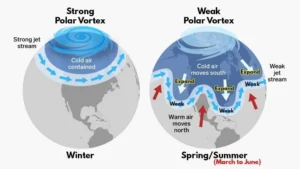
- A large zone of low pressure and cold air surrounding both poles.
- Extends from the tropopause (boundary between troposphere and stratosphere) up to the mesosphere (~50 km).
- The term “vortex” refers to the counter-clockwise circulation of winds that trap cold air near the poles.
- Contains some of the coldest air on Earth.
Seasonal Variation
- Strongest in winter, due to sharp temperature contrast between poles and equator.
- Weakens or may disappear in summer.
- Expansion in winter can push Arctic air southward with the jet stream.
Role of Jet Streams
- Jet streams are narrow bands of strong winds at ~9,000 meters altitude.
- They guide the movement of cold air masses.
- Expansion of the polar vortex often causes Arctic outbreaks in the U.S., Europe, and Asia.
Regional Differences
- Arctic vortex is irregular due to land–ocean mix, leading to frequent cold surges.
- Antarctic vortex is more stable, as Antarctica is surrounded by ocean; cold outbreaks are rarer and affect fewer populated regions.
Impact
- Main danger: extreme cold waves in regions not used to such low temperatures.
- Leads to disruptions in daily life, agriculture, energy demand, and health risks during winter.
DOOMSDAY CLOCK
TOPIC: (GS3) DISASTER MANAGEMENT: THE HINDU
In January 2026, the Bulletin of the Atomic Scientists (BAS) moved the Doomsday Clock to 85 seconds before midnight, the closest humanity has ever been to a potential global catastrophe.
What is the Doomsday Clock?
- Symbolic representation of humanity’s proximity to disaster.
- Midnight = global annihilation (“doomsday”).
- The minute hand moves closer or farther from midnight depending on global threats.
- Key risks considered:
- Nuclear weapons and arms races.
- Climate change and environmental collapse.
- Emerging technologies like artificial intelligence, biotechnology, and disinformation.
Historical Background
- Created in 1947 by the Bulletin of the Atomic Scientists (BAS), founded by Manhattan Project scientists including Albert Einstein and J. Robert Oppenheimer.
- Initially set at 7 minutes to midnight during early Cold War tensions.
- The clock has been reset 27 times since its creation, reflecting changing global risks.
- It is updated annually by the Science and Security Board of BAS, in consultation with Nobel laureates.
Latest Update (2026)
- In January 2026, the clock was moved to 85 seconds before midnight, the closest ever.
- Reasons cited:
- Escalating nuclear threats from Russia, China, and the U.S. amid conflicts in Ukraine and the Middle East.
- Breakdown of nuclear arms control treaties.
- Climate change failures and worsening global warming.
- Unregulated use of AI in military systems and risks from biotechnology.
Significance
- The clock is not a literal prediction but a symbolic warning system.
- It highlights the urgency of global cooperation to reduce existential risks.
- Serves as a powerful communication tool to remind policymakers and the public of humanity’s vulnerability.
JEEVAN RAKSHA PADAK AWARDS
TOPIC: (GS2) POLITY: THE HINDU
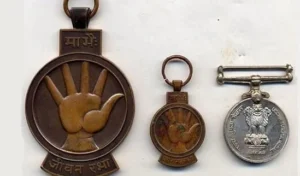
Recently, the President of India conferred the Jeevan Raksha Padak Awards (2025) to 30 individuals for acts of exceptional courage in saving lives.
About the Awards
- These awards recognize selfless acts of bravery in saving human lives.
- They are meant to honor ordinary citizens who show extraordinary courage in dangerous situations.
- Instituted to encourage the spirit of humanity and sacrifice.
Categories of Awards
- Sarvottam Jeevan Raksha Padak
- For exceptional courage in saving life under circumstances of extreme danger to the rescuer.
- Highest category.
- Uttam Jeevan Raksha Padak
- For bravery and quick action in saving life under great danger to the rescuer.
- Jeevan Raksha Padak
- For courage and promptitude in saving life where rescuer faces serious bodily injury.
Eligibility
- Open to all citizens, regardless of profession or background.
- Can be awarded posthumously.
- Presented by the respective Union Ministry/Organization/State Government connected to the awardee.
Significance
- Promotes the value of humanitarian service and courage.
- Encourages citizens to act with responsibility and bravery in emergencies.
- Strengthens the idea of selfless public service in Indian society.