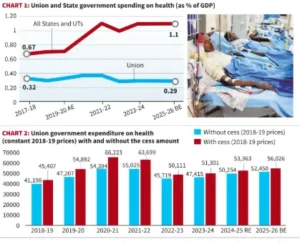
Recent data from the Reserve Bank of India (RBI) highlights that while States and Union Territories have steadily increased their allocations for health since 2017-18, the Union government’s spending has declined.
National Health Policy (2017) Commitments
- The NHP 2017 clearly stated that public health expenditure should rise from 1.15% to 2.5% of GDP by 2025.
- It also proposed that the Centre’s share should be 40% of total public spending on health, which means Union allocations should increase from 0.29% to at least 1% of GDP.
- This required a threefold increase in allocations, but the Union government has not scaled up its budget accordingly.
Current Spending Trends
- State Governments:
- Allocations for health rose from 0.67% of GDP in 2017-18 to 1.1% in 2025-26 (Budget Estimates).
- Share of health in overall state budgets increased from 5% to 5.6%, showing sustained commitment even after COVID.
- Union Government:
- Spending increased moderately during the pandemic but fell afterward.
- Allocation declined from 0.37% of GDP (2020-21 Actuals) to 0.29% (2025-26 BE).
- Share of health in Union Budget fell from 2.26% to 2.05%.
- In real terms, Union allocations in 2025-26 are 4.7% lower than 2020-21, meaning less care can be provided today compared to the pandemic period due to inflation.
International Comparison
- India’s public health spending is among the lowest globally.
- Bhutan: Per capita spending is 2.5 times higher than India.
- Sri Lanka: Spends 3 times more per person.
- BRICS nations: Spend 14–15 times more per capita than India.
- Thailand and Malaysia: Spend at least 10 times more per person.
- This shows India’s health expenditure is far below global standards, leaving its population vulnerable.
Health and Education Cess (HEC)
- Introduced in 2018-19 at 4% of taxable income to boost health and education funding.
- FY2023-24 collection: ₹71,180 crore, but only ₹17,795 crore (25%) went to health. The remaining amount was used to supplement general tax revenue.
- Without cess, Union health allocations fell 22.5% in real terms between 2020-21 and 2023-24, showing poor prioritisation.
Schemes and Transfers
- In 2014-15, nearly 76% of Union health spending was transferred to States for schemes like the National Health Mission (NHM).
- By 2024-25, this fell to 43%, leaving States underfunded despite being the main providers of healthcare.
- Other schemes like Pradhan Mantri Swasthya Suraksha Yojana, nutrition programs, and health research faced severe cuts.
- This reflects hyper-centralisation of resources by the Union government, even though health is primarily a State subject.
Conclusion
The National Health Policy (2017) targets remain unmet, and schemes vital for vulnerable populations are underfunded. Without significant increases in Union allocations and stronger support for programs like NHM, India risks falling further behind global standards in healthcare.
The Union government has notified the Solid Waste Management Rules, 2026, making waste processing at the source compulsory for bulk waste generators and urban local bodies.
Solid Waste Situation in India
- Urbanisation and lifestyle changes have led to a sharp rise in waste generation.
- India generates about 1.8–2 lakh tonnes of solid waste every day, with housing societies, offices, and institutions contributing a major share.
- Door-to-door collection has improved in many cities, but waste processing capacity remains insufficient.
- A large portion of waste still ends up in open dumps and landfills, causing pollution and health risks.
- Poor segregation at household and institutional levels increases costs and reduces recycling efficiency.
Earlier Regulatory Framework
- Waste management was governed under the Environment Protection Act, 1986.
- The Solid Waste Management (SWM) Rules, 2016 encouraged segregation, composting, recycling, and decentralised treatment.
- Urban Local Bodies (ULBs) were made primarily responsible for collection and disposal of waste.
- Bulk waste generators (like large housing complexes, institutions) were included in the framework, but enforcement was weak.
- Monitoring and accountability mechanisms were inadequate, limiting the effectiveness of the rules.
Features of SWM Rules, 2026
- Stricter Compliance Framework: New rules will be enforced from April 2026 with stronger monitoring and penalties.
- Urban Local Bodies (ULBs) and bulk waste generators must strictly follow segregation and disposal norms.
- Mandatory Processing at Source: Bulk waste generators (housing societies, institutions, offices, hotels) must treat and process waste at source.
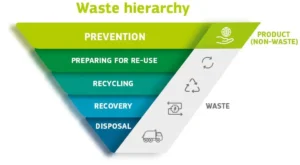
- Promotion of Circular Economy: Emphasis on resource recovery, recycling, and reuse to encourage industries and communities to adopt sustainable waste management practices.
- Higher User Fees for Non-Compliance: Dumping mixed or untreated waste will attract higher user charges.
Who Are Bulk Waste Generators?
- Entities that fall under this category include: Buildings with large floor areas
- Establishments using high volumes of water, Institutions producing over 100 kg of waste daily
This covers apartments, hotels, colleges, offices, and government complexes. - Mandatory Segregation Categories: Waste must now be separated into four streams:
- Wet waste (biodegradable)
- Dry waste (recyclables)
- Sanitary waste
- Domestic hazardous waste (batteries, e-waste, etc.)
- Extended Responsibility of Bulk Generators: Must treat wet waste on-site wherever possible. If not feasible, they must obtain a certified waste processing arrangement.
- Special Powers to Local Bodies: Hill and island regions can charge tourists for waste services. Authorities may limit visitor numbers based on waste-handling capacity.
Importance of Extended Producer Responsibility (EPR)
- Shared Responsibility: Under EPR rules (2022), major producers of plastics, electronics, and packaging must take responsibility for collection and recycling.
- Example: India generates 3.5 million tonnes of plastic waste annually (CPCB, 2023), and producers are now mandated to recycle a fixed percentage of it.
- Decentralised Treatment: Encourages local recycling and treatment facilities, reducing the need to transport waste long distances. Decentralisation lowers costs and improves efficiency in waste handling.
- Promotes Sustainability: Focus on resource recovery — turning waste into usable materials like recycled plastic, compost, or energy. Supports India’s target of reducing single-use plastics by 100% by 2030.
Conclusion
The SWM Rules, 2026 mark a decisive move towards accountable, source-based waste management, supporting India’s transition to a circular and environmentally responsible urban system.
The Economic Survey 2025-26 has cautioned that India’s ethanol-blending programme, while saving huge foreign exchange, may pose risks to food security as maize cultivation expands at the cost of pulses and oilseeds.
India’s ethanol-blending
- India’s ethanol-blending programme aims to reduce dependence on imported crude oil and promote cleaner energy.
- As of August 2025, ethanol blending saved India ₹1.44 lakh crore in foreign exchange and substituted about 245 lakh metric tonnes of crude oil.
- Farmers benefited through higher demand for crops like maize, which is increasingly used for ethanol production.
Emerging Concerns on Food Security
- Expansion of maize acreage is visible in Maharashtra and Karnataka, competing with pulses, oilseeds, soyabean, millets, and cotton.
- Pulses and oilseeds are vital for nutrition and consumption baskets, but are losing priority among cultivators.
- Reduction in paddy acreage, expected earlier, has not materialised. Highlights tension between self-reliance in energy (Aatmanirbharta in fuel) and self-reliance in food.
- Survey warns of imbalance: greater dependence on edible oil imports and higher domestic food price volatility during supply shocks.
Key Challenges
- Shift in Crop Patterns – Rising maize cultivation for ethanol risks reducing acreage of pulses and oilseeds, weakening India’s nutritional security.
- Dependence on Imports – Greater reliance on edible oil imports exposes India to global price fluctuations and supply chain shocks.
- Food vs Fuel Dilemma – Balancing energy security with food security creates policy tensions, as land, water, and labour are diverted from food crops to fuel crops.
Future Growth of Ethanol Production
- India has set a target of 20% ethanol blending in petrol by 2025-26, advancing from the earlier 2030 deadline.
- Recent expansion of ethanol distilleries and use of multiple feedstocks (sugarcane, maize, damaged grains) is boosting production capacity.
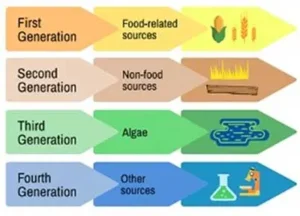
- Government is encouraging second-generation ethanol from agricultural waste to reduce pressure on food crops.
- With crude oil prices volatile and climate concerns rising, ethanol blending remains a critical part of India’s energy transition strategy.
- However, policies must ensure balanced crop diversification and adequate support for pulses and oilseeds to safeguard food security.
Conclusion
A balanced approach promoting non-food feedstocks, supporting pulses and oilseeds, and investing in advanced ethanol technologies is essential to achieve both energy self-reliance and food security.
India’s civil aviation sector will be showcased at Wings India 2026, Asia’s largest aviation event, scheduled from 28–31 January 2026 at Begumpet Airport, Hyderabad.
About Wings India 2026
- Recognised as Asia’s biggest civil aviation event.
- Serves as a global platform for connectivity, manufacturing, services, innovation, and sustainability.
- Inaugurated by Rammohan Naidu Kinjarapu, Union Minister of Civil Aviation.
- Theme: “Indian Aviation: Paving the Future from Design to Deployment, Manufacturing to Maintenance, Inclusivity to Innovation and Safety to Sustainability.”

India’s Aviation Growth Story
- India is among the fastest-growing aviation markets globally.
- Passenger traffic has multiplied several times in the last decade.
- Record aircraft orders place India among the largest future aircraft markets.
- Rapid expansion of airport infrastructure:
- New Greenfield airports.
- Modernised terminals.
- Regional connectivity under UDAN scheme.
Conclusion:
Wings India 2026 showcases India’s ambition to move from being a fast-growing aviation market to becoming a global aviation leader, integrating infrastructure growth, sustainability, and innovation.
Kerala has become the first State in India to officially notify a State Microbe, declaring Bacillus subtilis during the launch of the Centre of Excellence in Microbiome (CoEM).
About Bacillus subtilis
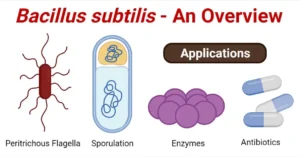
- A beneficial probiotic bacterium found in soil, water, human gut, and fermented foods.
- Plays a key role in controlling plant diseases, improving soil fertility, and enhancing crop productivity.
- Has strong potential for commercial microbial products in agriculture and biotechnology.
Centre of Excellence in Microbiome (CoEM)
- Established by the Kerala government to study microorganisms in health, environment, and sustainability.
- Focuses on translational research for direct societal benefits.
- Functions under the Kerala State Council for Science, Technology and Environment (KSCSTE) in collaboration with the Kerala Development and Innovation Strategic Council (K-DISC).
What are Betels?
- Betel leaves are widely used in India for chewing, cultural rituals, and traditional medicine.
- They are valued for their antimicrobial properties and socio-cultural significance in daily life and ceremonies.
Why Bacillus subtilis was Selected
- It supports sustainable agriculture by reducing dependence on chemical fertilizers and pesticides.
- Helps in biodiversity conservation and aligns with Kerala’s vision of promoting eco-friendly practices.
- Symbolises the integration of science, environment, and livelihood opportunities.