A DECADE AFTER PARIS ACCORD, AN UNSTOPPABLE TRANSITION
TOPIC: (GS3) ENVIRONMENT: THE HINDU
The Paris Agreement has completed 10 years, and the debate on global climate action has intensified ahead of COP30 at Belém (Brazil).
Paris Agreement:
- Adopted at COP-21 (Paris, 2015) as a legally binding global climate framework to fight climate change.
- Aims to limit global temperature rise to well below 2°C and pursue 1.5°C warming limit by cutting global emissions.
- Emphasises equity & common but differentiated responsibilities (CBDR-RC) with financial, technological, and capacity-building support for developing nations.
Achievements Since 2015
Slowing the Warming Path
- Before 2015 → world projected to heat 4–5°C by 2100.
- Today → trend lowered to ~2–3°C due to collective policies and climate cooperation.
Shift in Global Energy Economics
- Ten years ago fossil fuels were cheapest energy source.
- Now solar, wind, hydropower lead global growth.
- Clean energy brings jobs, energy independence, and security.
Rise of Electric Mobility
- Electric mobility once unrealistic; now mainstream.
- EVs ≈ 20% of new vehicles worldwide — rapid decline in transport-related fossil fuel use.
India–France Cooperation: ISA Success Story
- International Solar Alliance (ISA) launched at COP21 by India and France.
- Now 120+ members, supports capacity-building, funding, and technology.
- India targets:
- 50% non-fossil power capacity (achieved 5 years early),
- Low-carbon growth for Viksit Bharat 2047,
- Net-zero by 2070.
Key Priorities for COP30
- Raise Global Climate Ambition: Current pledges insufficient — faster emission cuts essential.
- Just & Inclusive Transition: Protect vulnerable populations. Support to Loss & Damage Fund, GCF, early-warning systems.
- Protect Natural Carbon Sinks: Forests, mangroves, oceans — crucial for climate stability. Protect ecosystems like Amazon & Sundarbans.
- Empower Non-State Actors Climate action must involve: Local governments, Businesses, Scientists, Civil society & youth
Uphold Climate Science
- Defend IPCC-led research against misinformation.
- Promote science-driven policies.
GOALS OF 2015 PARIS CLIMATE SUMMIT
- Limit global temperature rise to well below 2°C above pre-industrial levels and aim for 1.5°C.
- Reduce greenhouse gas (GHG) emissions rapidly to reach net-zero around mid-century.
- Strengthen climate resilience and reduce vulnerability to climate impacts.
- Ensure climate finance to developing countries, targeting $100 billion per year by developed nations.
- Nationally Determined Contributions (NDCs): countries must submit their own emission-reduction targets.
- Global stocktake every 5 years to review progress and strengthen commitments.
Conclusion
The Paris Agreement has not solved the crisis, but it changed the global direction — the transition to a greener planet is slow but unstoppable.
This article has been updated and published in detail on our new platform. Please visit the link below for the latest version:
CONSTITUTION (130TH AMENDMENT) BILL
TOPIC: (GS2) INDIAN POLITY: THE HINDU
The Union Government introduced the Constitution (130th Amendment) Bill to change provisions related to removal of Ministers if arrested and detained for 30 days. The bill has been referred to a Joint Parliamentary Committee, following strong objections from the Opposition.
Context
- The Bill proposes amendments to Articles 75, 164 and 239AA dealing with the Union/State Ministers and Delhi Government.
- Aim: Prevent continuation of Ministers facing serious criminal cases in public office.
Key Provisions of the Bill
Removal after 30 days of custody
- If a Union/State Minister or Delhi Minister is arrested and in custody for 30 continuous days, they must be removed.
- For PM/CM: Must resign by 31st day or automatically cease to hold office.
- Applicable where offence carries max punishment of 5 years or more.
Opposition Concerns
Arrest-based trigger
- Arrest power lies with police — may be used politically.
- Arrest is discretionary, not mandatory, even in serious offences (as upheld by courts).
- Fears of political misuse to unseat Opposition Ministers by engineered arrests.
Court-ordered detention
- Courts allowing custody can delay bail beyond 30 days.
- Bail may be denied for reasons other than flight-risk or evidence tampering.
Judicial References Mentioned
- Courts have held that arrest must be justified and is not automatic.
- SC cases emphasise bail as the norm, yet practice often differs.
Issues & Concerns
- Risk of Political Misuse: Police may act under political influence → arrest may become a tool to remove Ministers.
- Bail Challenges: Bail harder in special laws (PMLA, UAPA, NDPS) with reverse burden of proof. Example: Long pre-trial detention in high-profile cases (e.g., liquor policy case).
- Conflict with Default Bail Rules: Default bail possible only after 60–90 days, but Bill sets 30-day rule → irrational threshold.
- Dilemma for Ministers: Remaining in office may harm bail chances. Resigning to secure bail loss of ministerial functioning, hurting governance.
Judicial Subjectivity
- Bail decisions differ based on judicial approach to liberty → unpredictable outcomes.
Significance
- Intention: Cleaner politics, constitutional ethics, and prevent misuse of office.
- Challenge: Must balance anti-corruption goals with protection against political vendetta.
CONSTITUTION AMENDMENT BILL
How a Constitution Amendment Bill is introduced
- It can be introduced in either Lok Sabha or Rajya Sabha.
- It cannot be introduced in State Legislatures.
- Only a Minister or Member of Parliament can introduce it.
- The bill does not require prior approval of the President.
Voting process in Parliament
- The bill must be passed in each House separately.
- In both Houses, it requires a special majority:
- More than half of the total membership of the House
- and Two-thirds of members present and voting
- The two Houses vote independently, meaning joint sitting is not allowed if they disagree.
- For changes affecting federal provisions (like powers of Centre-State, judiciary, elections), at least half of State Legislatures must approve it.
How it becomes a Constitutional Amendment
- After both Houses pass it, and where required, States also approve it
- The bill is sent to the President of India
- The President must give assent, cannot return it
- After the President’s assent, it becomes a Constitution (Amendment) Act
Conclusion
The Bill aims to promote integrity in governance but raises serious concerns regarding potential authoritarian misuse, arrest powers, and unrealistic bail timelines. Strong safeguards, judicial oversight, and clearer safeguards against political bias are essential before implementation.
This article has been updated and published in detail on our new platform. Please visit the link below for the latest version:
CENTRE–STATE RELATIONS & EDUCATION FUNDING DEBATE
TOPIC: (GS2) INDIAN POLITY: THE HINDU
Kerala signed the PM SHRI school scheme MoU, linked to the National Education Policy (NEP) 2020, but later put it on hold after internal political disagreement. The issue reopened debate on federalism, autonomy in education policy, and conditional central funding.
Background
- Education is a Concurrent List subject (both Centre & States have powers).
- Kerala, Tamil Nadu, and West Bengal have opposed NEP 2020, citing attempts to centralise education and possible ideological influence.
- PM SHRI: Scheme to develop 14,500 model schools aligned to NEP 2020.
Recent Developments
Kerala’s Move
- Kerala unexpectedly agreed to join PM SHRI to access Centre’s education funds.
- Decision triggered political conflict inside the ruling LDF.
- CPI demanded withdrawal; CPI(M) said it was necessary to get withheld funds under Samagra Shiksha.
Temporary Suspension
- Scheme implementation paused.
- Cabinet sub-committee formed to study MoU.
- State to inform Centre about suspension.
Key Issues
Federalism & Fiscal Pressure
- States argue Centre uses funding as leverage to enforce policy alignment.
- Samagra Shiksha funds withheld for States rejecting NEP → pressure tactic.
State Autonomy in Education
- Kerala, TN, WB claim NEP undermines State curriculum authority.
- Fear of central ideological content and “Indian Knowledge Systems” leading to pseudoscience concerns.
Kerala’s High Education Standards
- Already strong indicators → high enrolment, retention, learning results.
- PM SHRI seen as branding exercise, not necessity.
- Joining forces Kerala to align with NEP norms unnecessarily.
Legal & Constitutional Concerns
- Tamil Nadu moved Supreme Court over fund freeze.
- Judiciary expected to safeguard cooperative federalism.
- Kerala may also explore legal route.
Significance
- Tests balance between Union authority & State rights.
- Highlights fiscal federalism gap—States depend on Centre for key schemes.
- Raises concern of policy centralisation in social sector governance.
Way Forward
- Strengthen cooperative federalism & transparent fund-sharing.
- Dialogue between Centre and States instead of compulsion.
- Judicial clarity on conditional central funding in Concurrent subjects.
Conclusion
The Kerala–PM SHRI episode reflects growing tension between State autonomy and centralised policy enforcement. Federalism must not be weakened by financial conditions — States deserve equitable access to funds without compromising their constitutional space.
This article has been updated and published in detail on our new platform. Please visit the link below for the latest version:
INDIA–NORWAY GREEN MARITIME PARTNERSHIP
TOPIC: (GS3) ENVIRONMENT: THE HINDU
Norway’s Minister of Fisheries & Ocean Policy visited Mumbai during India Maritime Week 2025. The visit highlighted growing maritime cooperation, especially green shipping and blue economy partnership between India and Norway.
Context
- India and Norway are major ocean-based economies.
- Both nations are aligning efforts to build sustainable, secure, and technology-driven maritime systems.
Key Bilateral Developments
Strategic Maritime Cooperation
- Oceans central to both economies → link trade, employment & shipping.
- India is rising as global shipbuilding, trade & digital maritime hub.
- Norway has advanced maritime clusters (ship design, finance, shipyards).
Trade Boost
- India–EFTA TEPA came into force (Oct 1) → boosts trade, investment, technology transfer.
Institutional Mechanisms
- India–Norway Ocean Dialogue (2019)
- Joint Working Group on Maritime Cooperation (10th meeting in 2025)
- India–Norway Task Force on Blue Economy → focus on marine protection, pollution control, decarbonization, ship recycling.
Industrial Collaboration
- India gaining prominence in global shipbuilding.
- ~10% of ships ordered by Norwegian shipowners are built in India.
- Cochin Shipyard signed 14-vessel deal with Norway’s Wilson ASA → trust in Indian shipyards.
- India playing key role in eco-friendly ship recycling.
Green Maritime Vision
- Norway’s Sustainability Goals: Cut 50% emissions from domestic shipping & fisheries by 2030 (vs 2005 levels).
- Innovation in Marine Tech: Exploring hydrogen, ammonia, autonomous ships.
- Human Resource & Gender Collaboration
- Seafarer Cooperation: Indian seafarers are 2nd largest group on Norwegian-controlled ships.
- Women in Maritime: Joint focus on gender equity in shipping. India’s active participation in Maritime SheEO Conference supported by Norway.
Future Vision
- India’s Maritime Vision 2030 & Amrit Kaal 2047 align with Norway’s ocean sustainability goals.
- Both nations work toward clean oceans, low-carbon shipping, digital maritime services & inclusive workforce.
Conclusion
The India–Norway maritime partnership is emerging as a global model for green shipping, ocean diplomacy, and blue economy cooperation. Both nations aim to build a cleaner, safer, and more equitable ocean future through technology, policy coordination, and people-to-people maritime training links.
This article has been updated and published in detail on our new platform. Please visit the link below for the latest version:
AI AWARENESS IN INDIA
TOPIC: (GS3) SCIENCE AND TECHNOLOGY: THE HINDU
A global survey by the Pew Research Center across 25 countries showed that India has the lowest awareness of Artificial Intelligence, yet the highest trust in the government to regulate AI.
Key Findings from the Survey
Low AI Awareness in India
- Only 14% Indians have deep knowledge about AI.
- Additional 32% have some knowledge → Total = 46% (lowest among 25 countries).
- Global median awareness = 81% → India significantly below average.
Youth Knowledge Gap
- Among youth (18-34 years), only 19% reported good understanding.
- Contrary to global trend, Indian young adults also show low awareness.
Low Public Concern about AI
- Only 19% Indians are more worried than excited about AI use in daily life.
- Indicates limited understanding of risks like job loss, privacy threats, bias, and misinformation.
High Trust in Government
- Around 90% Indians trust the government to regulate AI effectively — highest worldwide.
- Trust may stem from:
- Digital governance success stories (UPI, Aadhaar ecosystem)
- Low exposure to AI-related harms
- Public confidence in state-led technology initiatives
Link with Economic Development
- Wealthier nations like Japan, US, Germany, France → ~50% high awareness.
- Lower-income countries like India (14%) & Kenya (12%) → low awareness.
- Awareness aligns with GDP per capita, education quality, tech exposure.
Key Takeaways
- Digital usage ≠ AI understanding — India is digitally active but AI knowledge is shallow.
- High trust without awareness may limit public debate on AI ethics, safety, and rights.
- Building AI literacy is critical for future workforce, democratic accountability, and safe innovation.
Way Forward
- Introduce AI courses in schools and universities
- AI awareness campaigns through media & government programs
- Skilling programs for students, teachers, and professionals
- Strong regulatory framework to ensure ethical & safe AI
- Industry-government-academia collaboration for AI training
- Accessible AI learning tools in local languages
Conclusion
India is moving rapidly into the AI era, but public understanding must rise with technology growth. Strengthening AI literacy, ethical guidelines, and transparent governance will ensure that India harnesses AI responsibly and inclusively.
This article has been updated and published in detail on our new platform. Please visit the link below for the latest version:
INDIA–CHINA DISPUTE AT WTO OVER PLI SCHEME
TOPIC: (GS3) ECONOMY: THE HINDU
China has filed a case at the World Trade Organization (WTO) accusing India of offering trade-distorting subsidies under its Production-Linked Incentive (PLI) programme. China claims these incentives violate WTO subsidy rules by favouring domestic products over imports.
What is PLI Scheme?
- Launched in 2020 to promote manufacturing in India and strengthen supply chains.
- Offers financial incentives linked to incremental production/sales.
- Aims to:
- Build global-scale manufacturing hubs in India
- Promote domestic value-addition & technology development
- Integrate MSMEs through supply-chain linkages
PLI Schemes Challenged by China
China has objected to three specific PLIs:
PLI Scheme | Focus Area | DVA Requirement |
Advanced Chemistry Cell (ACC) | Battery manufacturing | ~25% |
Automobile & Components | Advanced automotive products | ~50% |
Electric Vehicles | EV manufacturing ecosystem | Linked to local production |
China alleges these PLIs encourage firms to source inputs domestically instead of importing.
China’s Complaint
- Claims India is giving Domestic Value Addition (DVA)-linked subsidies
- China argues these discriminate against imported goods, especially Chinese inputs
- Says India’s PLI support = Import Substitution subsidy, banned under WTO rules
Way Forward
- Strengthen legal defence citing global precedent (US, EU industrial subsidies)
- Highlight PLI’s tech development & scale-building goals
- Ensure subsidy design remains WTO-compliant
- Build alternate supply chains & reduce import dependence
Trade-Distorting Subsidies (WTO)
- Government financial support (money, tax rebate, incentives) that gives unfair advantage to domestic producers.
- Alters normal market competition by making local goods cheaper or more competitive than foreign imports.
- Encourages import substitution — i.e., firms are rewarded for using domestic materials instead of imported ones.
- Affects other countries’ trade interests, leading to loss of market access or reduced exports for foreign competitors.
- Covered under WTO SCM Agreement — such subsidies can be challenged at WTO and may require withdrawal or counter-measures.
Conclusion
The China-India WTO clash reflects growing competition in technology-intensive sectors like EVs and batteries. India must protect its industrial strategy while staying aligned with global trade rules to support long-term manufacturing growth.
This article has been updated and published in detail on our new platform. Please visit the link below for the latest version:
UNDP HUMAN DEVELOPMENT REPORT
TOPIC: (GS2) INDIAN POLITY: THE HINDU
The latest UNDP Human Development Report 2025 has been released. India’s HDI value has improved, but the country still falls in the Medium Human Development category.
Human Development Index (HDI)
- HDI is a global measure created by UNDP to assess development based on people’s well-being, not just economic growth.
- It evaluates quality of life through health, education, and income indicators.
- Introduced in 1990, inspired by Mahbub ul Haq and Amartya Sen’s work.
Components of HDI
- Health: Measured through life expectancy at birth, Shows access to medical care, nutrition, and living conditions
- Education: Mean years of schooling, Expected years of schooling, Reflects learning outcomes and skill development
- Standard of Living: GNI per capita (PPP), Captures income and economic opportunities available to citizens
How HDI is Calculated (Simple Steps)
- Indexes for health, education, and income are computed
- A geometric mean of the three gives HDI score (0 to 1 scale)
- Higher score = better human development
India’s HDI Performance
- Rank: ~130 out of 193 countries (2025 report)
- HDI Value: Increased to 0.685
- Long-term progress (1990–2023):
- Life expectancy: 58.6 → ~72 years
- Mean schooling: 3 → 6.2 years
- GNI per capita (PPP): $2,000 → ~$9,000
- Large variations across states:
- High HDI: Kerala, Goa, Himachal Pradesh
- Low HDI: Bihar, UP, Jharkhand
Government Initiatives Improving HDI
- Ayushman Bharat: free healthcare
- NEP 2020: education reforms
- Skill India Mission: employment skills
- PM-KISAN, PM Awas Yojana: rural support
- Beti Bachao Beti Padhao: girl empowerment
- Digital India: tech-driven governance
Inequality-Adjusted HDI (IHDI)
- Inequality reduces India’s HDI by ~31%
- Low female workforce participation, education, and representation reflected in Gender Inequality Index
Conclusion:
To achieve high human development status, India must continue investing in human capital, reduce inequality, and ensure inclusive growth across all regions and communities.
This article has been updated and published in detail on our new platform. Please visit the link below for the latest version:
KARAKORAM WILDLIFE SANCTUARY
TOPIC: (GS3) ENVIRONMENT: THE HINDU
The Central Government has recently received a proposal to revise and expand the boundaries of the Karakoram Wildlife Sanctuary in Ladakh to enhance wildlife protection and improve ecological conservation in the region.
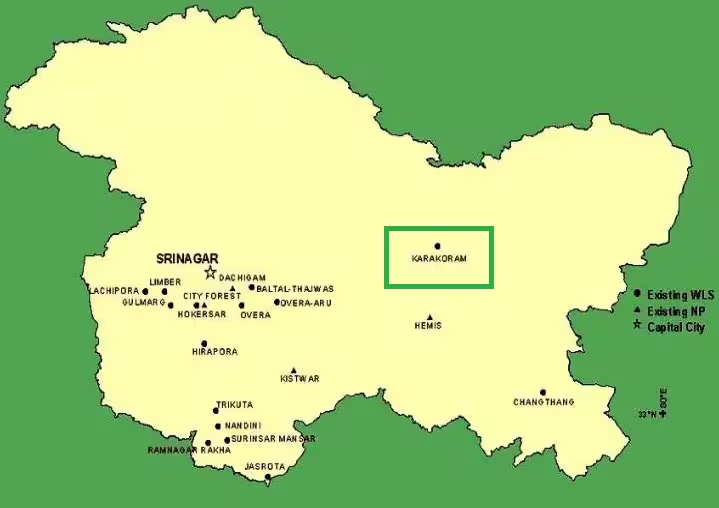
Location
- Situated in Ladakh, near the border with Jammu & Kashmir.
- Lies north of Hemis National Park and east of Deosai National Park (Pakistan).
- Part of the Karakoram mountain range, a high-altitude cold desert landscape.
Physical Features
- Terrain: Snow-clad mountains, vast alpine meadows, rocky slopes, and deep gorges.
- Climate: Extremely cold; even in summer, temperatures often stay below 0°C in higher areas and under 10°C elsewhere.
Water Systems
- Drained by the Shyok River and Nubra River, key tributaries in the Karakoram region.
Vegetation
- Dominated by alpine and cold desert flora.
- Notable plant groups include: Shrubs: Rosa webbiana, Ephedra, Caragana species Rich in medicinal herbs and glacial vegetation.
Wildlife
- Known for rare and high-altitude species, including: Snow Leopard, Siberian Ibex, Argali & Tibetan Gazelle
Conservation Importance
- Crucial for protecting fragile Himalayan ecosystems and trans-Himalayan biodiversity.
- Acts as a habitat corridor for endangered mountain species.
Conclusion
The sanctuary plays a vital role in preserving high-altitude wildlife and sensitive ecosystems. Strengthening its boundaries can significantly support conservation and ensure ecosystem stability in Ladakh’s cold desert region.
This article has been updated and published in detail on our new platform. Please visit the link below for the latest version: