
Table of Contents
ToggleMENSTRUAL HEALTH IN SCHOOLS AND RIGHT TO LIFE
TOPIC: (GS2) POLITY: THE HINDU
The Supreme Court of India has ruled that access to menstrual hygiene management (MHM) in schools is part of the fundamental right to life and dignity under Article 21.
Background of the Case
- The judgment It directed all States and Union Territories to ensure free sanitary napkins, functional toilets, and menstrual support facilities in schools.
- Based on a writ petition filed by Dr. Jaya Thakur, highlighting lack of menstrual hygiene facilities in schools.
- Court observed that absence of MHM measures leads to stigma, absenteeism, and unsafe practices among adolescent girls.
Observations of the Court
- Dignity is not abstract; it requires conditions that prevent humiliation and exclusion.
- Lack of menstrual facilities violates bodily autonomy, privacy, and decisional freedom of girl students.
- Menstrual poverty creates a gender-specific barrier to education, undermining the Right to Education Act (RTE).
- State cannot force girls to choose between education and dignity.
Directions Issued by the Court
- Sanitary Napkin Access – Free oxo-biodegradable sanitary napkins must be available in all schools, preferably through vending machines inside toilets.
- Functional Toilets – Schools must provide gender-segregated, hygienic toilets with water and disposal facilities.
- MHM Corners – Dedicated spaces with spare innerwear, uniforms, disposable bags, and other materials for emergencies.
- Accountability –
- Government schools must comply with Section 19 of RTE Act (separate toilets, barrier-free access).
- Private schools failing to comply will face de-recognition.
Role of Men in Menstruation
- Court stressed the need to educate male teachers and students about menstruation.
- Sensitisation will help reduce harassment, stigma, and invasive questioning of menstruating girls.
Significance
- Recognises menstrual health as a constitutional right under Article 21.
- Strengthens gender equality in education by removing barriers faced by girls.
- Promotes inclusive school environments and ensures dignity for adolescent students.
Writ Powers Supreme Court Vs High Courts
Supreme Court (Article 32)
- Scope of Power – Can issue writs only for enforcement of Fundamental Rights guaranteed under Part III of the Constitution.
- Nature of Right – Filing a writ petition under Article 32 is itself considered a Fundamental Right. Citizens can directly approach the Supreme Court if their rights are violated.
- Jurisdiction – Operates across the entire territory of India.
- Limitations – Cannot issue writs for ordinary legal rights or administrative matters; restricted to Fundamental Rights.
High Courts (Article 226)
- Scope of Power – Can issue writs not only for Fundamental Rights but also for any other legal rights.
- Nature of Right – Filing a writ under Article 226 is not a Fundamental Right, but a discretionary remedy provided by the Constitution.
- Jurisdiction – Operates within the territorial limits of the concerned State/Union Territory.
- Flexibility – Broader powers compared to the Supreme Court; can intervene in administrative actions, statutory violations, and matters beyond Fundamental Rights.
Conclusion:
The Supreme Court’s ruling affirms that menstrual health is a constitutional right under Article 21, essential for dignity and equality. Ensuring access to hygiene facilities in schools will remove barriers to education and empower girl students.
GREEN STEEL AND INDIA’S CLIMATE GOALS
TOPIC: (GS3) ENVIRONMENT: THE HINDU
India is exploring green steel production as part of its revised Nationally Determined Contributions (NDCs) under COP30 commitments. The steel sector, contributing nearly 12% of India’s carbon emissions, is seen as critical for achieving long-term climate targets.
Background
- India’s steel demand is expected to rise from 125 million tonnes per year to over 400 million tonnes by 2050.
- Steel is a key driver of infrastructure and industrial growth, making it vital for India’s development.
- Current production is heavily dependent on coal, contributing significantly to carbon emissions.
- Without a transition to cleaner technologies, India risks locking in carbon-intensive infrastructure, weakening both climate goals and global competitiveness.
Global Context
- China: Expanding scrap-based steel production and investing in green hydrogen to reduce coal dependence.
- European Union (EU): Implemented the Carbon Border Adjustment Mechanism (CBAM), which imposes penalties on high-carbon steel imports.
- Global Trend: Countries adopting low-carbon steel technologies gain access to premium export markets and avoid border taxes.
- Early movers in green steel secure a competitive advantage in international trade and sustainability leadership.
India’s Current Efforts
- Tata Steel: Hydrogen injection in blast furnaces, renewable power agreements, carbon capture pilots.
- JSW Steel & JSPL: Exploring green hydrogen integration.
- SAIL: Modernising furnaces and testing low-carbon routes.
- Policy Initiatives:
- Greening Steel Roadmap (2025).
- Green Steel Taxonomy (2024) – India became the first country to define green steel formally.
- National Green Hydrogen Mission and Carbon Credit Trading Scheme (CCTS) for 253 steel units.
Challenges in India’s Green Steel Transition
- High Cost & Limited Supply of Green Hydrogen: Green hydrogen is essential for low-carbon steelmaking but remains expensive and scarce.
- Insufficient Renewable Energy for Industry: Dedicated renewable energy for industrial use is inadequate, slowing decarbonisation.
- Weak Scrap Market & Informal Recycling: India’s scrap steel market is fragmented and informal. Limited availability of quality scrap reduces potential for secondary steel production.
- Natural Gas as Transition Fuel: Natural gas can serve as a bridge fuel before hydrogen-based steelmaking. However, consistent and affordable supply remains uncertain.
- Financing Barriers: Green steel projects require long-term, low-cost debt, which is currently lacking. High capital intensity (30–50% more than conventional steel) deters investment.
Way Forward
- Clear Carbon Targets: Government must set short-, medium-, and long-term emission reduction goals for steel.
- Carbon Pricing: Introduce a carbon price regime to make low-carbon technologies viable.
- Public Procurement Policy: Create demand for green steel through certification, labelling, and government purchases.
- Infrastructure Hubs: Shared facilities for hydrogen, renewable power, and CO₂ capture pipelines.
- Support for SMEs: Fiscal incentives and technology access to ensure equitable transition.
Conclusion
By combining corporate innovation with strong policy frameworks, India can decarbonise steel and set global standards in clean manufacturing.
UGC EQUITY RULES AND SUPREME COURT
TOPIC: (GS2) POLITY: THE HINDU
The Supreme Court of India has stayed the UGC’s Promotion of Equity in Higher Education Institutions Rules (2026), calling them “too sweeping.”
Background
- The Court had earlier directed UGC to frame rules to tackle discrimination in higher education institutions (HEIs).
- These rules were framed to address caste-based and other forms of discrimination in campuses after repeated incidents and rising complaints.
- The 2012 UGC framework on equity was largely ignored by universities and colleges.
- Rising cases of caste-based discrimination, including tragic incidents like Rohith Vemula’s suicide, highlighted the urgency.
- UGC data shows complaints of discrimination in HEIs have more than doubled in the last five years.
Features of the New Rules (2026)
- Establishment of Equal Opportunity Centres in all HEIs.
- Creation of Equity Committees, Helplines, and Squads for monitoring.
- Time-bound resolution of complaints with oversight and representation in inquiry committees.
- Provision for UGC action against non-compliant institutions, ensuring accountability.
Criticisms and Protests
- Definition Issue: Rules define caste discrimination only against SC/STs and OBCs, leaving out general category students.
- False Complaints: No clear provision to deal with false or malicious complaints.
- Dilution of 2012 Framework: Earlier framework had broader coverage, including reservation-related issues faced by SC/ST students.
- Campus Protests: Northern Indian universities witnessed opposition, citing unfairness and lack of safeguards.
Supreme Court’s Concerns
- The rules appear too broad and sweeping, requiring careful modifications.
- Suggested that the definition of caste discrimination should be left open-ended to avoid excluding certain groups.
- Provisions for false complaints must be designed cautiously — preventing misuse but not discouraging genuine grievances.
Significance of the Rules
- Directly addresses persistent caste-based discrimination in higher education institutions.
- Promotes equity, dignity, and inclusivity across campuses.
- Ensures institutional accountability through UGC monitoring and oversight.
- Strikes a balance between social justice and fairness, safeguarding both marginalised students and institutional integrity.
Way Forward
- Broaden Definition – Cover all forms of discrimination without restricting to specific categories.
- Safeguards Against Misuse – Introduce provisions for false complaints but limit them to proven malicious intent.
- Strengthen Monitoring – Ensure effective functioning of equity centres and committees with transparency.
Equity Vs Equality
Aspect Equality Equity
Definition Treating everyone the same Treating people fairly based on their needs
Focus Uniform distribution of resources Just distribution based on individual circumstances
Goal Uniform opportunity Equal outcomes through support
Example Same exam for all students Extra coaching for disadvantaged students
Constitutional Provisions
Article 14 – Right to Equality
- Guarantees equality before law and equal protection of laws.
- Allows reasonable classification to promote equity.
Article 15(3) & 15(4)
- Permits special provisions for women, children, SCs/STs to promote equity.
- Enables positive discrimination to uplift marginalised groups.
Article 16(4)
- Allows reservation in public employment for backward classes not adequately represented.
Directive Principles (Articles 38 & 39)
- Article 38: State to secure social, economic, and political justice.
- Article 39: Directs policies to ensure equal opportunity and reduce inequalities.
Conclusion:
The Supreme Court’s stay highlights the need to refine UGC’s equity rules so they remain effective yet balanced. A carefully revised framework can ensure dignity, inclusivity, and accountability in higher education while preventing misuse.
STRAY DOG ISSUE IN TELANGANA
TOPIC: (GS2) POLITY: THE HINDU
Mass killings of stray dogs have been reported in several Telangana villages after local elections, triggering legal, ethical and public safety debates. The issue has reached courts and exposed a growing conflict between animal welfare concerns and fear of dog attacks.
Background of the Issue
- Many villages in Telangana recently witnessed large-scale killing of stray dogs.
- Incidents came to light after new gram panchayat bodies took charge, with some elected leaders accused of supporting harsh measures.
- Animal activists claim hundreds of dogs have been killed across multiple districts.
- Locals, however, argue they are acting out of fear for children, elderly people and livestock.
Rising Dog Bite Cases
- Primary health centres are seeing high numbers of dog-bite victims every month.
- Severe injuries often require costly treatment and anti-rabies injections in city hospitals.
- Official data shows a sharp rise in dog-bite cases in Telangana over the past two years.
- Villagers report dogs moving in packs and attacking people and animals.
Causes Behind Stray Dog Population Growth
- Poor waste management in villages and towns provides easy food for stray dogs.
- Open dumping of food waste and animal remains supports their survival.
- Lack of sterilisation and vaccination programmes in rural areas.
- Rapid urbanisation and construction disturb habitats, pushing dogs into settlements.
Public Anger vs Animal Welfare
- Residents feel animal lovers do not face daily risks from aggressive dogs.
- Social media has increased polarisation between communities and activists.
- Some NGOs are accused of being inactive on ground, despite strong online presence.
- However, animal groups stress cruel killing methods are illegal and inhumane.
Legal and Policy Framework
- Prevention of Cruelty to Animals Act, 1960 promotes humane treatment.
- Animal Birth Control (ABC) Rules support sterilisation and anti-rabies vaccination, not mass killing.
- Laws allow euthanasia only under strict, humane and regulated conditions.
- Panchayats often lack clear authority, funds and infrastructure to manage strays legally.
Governance Challenges
- Urban vs Rural Gap: Rural panchayats lack dog-catching squads, shelters, and veterinary services, leaving stray populations unmanaged.
- Poor Waste Management: Unscientific disposal of garbage attracts more stray dogs by providing easy food sources.
- Weak Institutional Coordination: Limited cooperation between local bodies, health departments, and animal welfare groups.
Way Forward
- Expand Coverage: Extend sterilisation and vaccination drives beyond cities into rural and semi-urban areas.
- Strengthen Waste Management: Implement scientific solid waste management systems to cut down food sources for strays.
- Infrastructure Development: Establish district-level dog shelters and rapid response teams for humane handling of strays.
- Community Awareness: Conduct campaigns on safe behaviour around strays and responsible pet ownership. Encourage citizen participation in reporting stray-related issues.
Conclusion
The stray dog issue is not just about animals — it is a public health, governance and ethical challenge. A balanced solution needs humane control measures, better waste systems and strong local institutions, instead of violent and illegal responses.
GANDHI’S GRAM SWARAJ IDEAL AND LIMITS OF DECENTRALISATION
TOPIC: (GS2) POLITY: THE HINDU
The Union government renamed the MGNREGS as VB-G RAM G ahead of the Budget session. This move has triggered debate over its implications for rural development philosophy.
Background to MGNREGS
- Introduced in 2005, notified in 2006 to provide livelihood security in rural India amid farmer distress.
- “Mahatma Gandhi” prefix added in 2009 to link the scheme with Gandhi’s philosophy of rural empowerment.
- In December 2025, a Bill was introduced to repeal MGNREGA and replace it with VB-G RAM G.
- Opposition criticised this move as undermining Gandhi’s vision of self-sufficient villages.
Gandhi’s Vision of Gram Swaraj
- Village Self-Reliance: Gandhi saw villages as the foundation of India’s development.
- Critique of Urbanisation: He argued cities prospered by exploiting villages and wanted prosperity to flow back to rural India.
- Practical Experiments: Champaran Satyagraha (1917) and Sevagram Ashram embodied rural justice and self-sufficiency.
- Complete Republic: Each village should meet basic needs (food, clothing) while cooperating with others when necessary.
- Social Equality: Rejected caste hierarchies and untouchability; promoted non-violence and Satyagraha.
- Democratic Governance: Proposed Panchayats of five elected members, ensuring grassroots democracy.
Post-Independence Reality
- Urban-Centric Development: Industrialisation widened the rural–urban divide, leading to migration and slums.
- Limited Rural Reforms: Abolition of Zamindari and schemes like Jawahar Rojgar Yojana had limited impact.
- Infrastructure Gains: Roads and electricity improved, but education, healthcare, and social equality lagged.
- Migration Trends: Rural population declined from 82% (1960) to ~65% today, showing economic-driven migration.
- Weak Rural Entrepreneurship: Lack of policy support kept villages dependent on external job markets.
- Decentralisation Gap: Despite the 73rd Amendment, Panchayati Raj institutions lack real financial and administrative autonomy.
Challenges to Realising Gram Swaraj
- Limited Devolution of Power: Despite the 73rd Constitutional Amendment (1992) giving constitutional status to Panchayati Raj Institutions (PRIs), actual financial and administrative powers remain concentrated at state and central levels.
- Only about 4–5% of total government expenditure is routed directly through PRIs, showing weak fiscal autonomy.
- Persistent Rural–Urban Divide: India’s rural population has declined from 82% in 1960 to ~65% in 2025, reflecting migration due to lack of opportunities.
- Around 30% of rural youth (15–29 years) are either unemployed or underemployed, highlighting structural gaps.
- Weak Rural Entrepreneurship & Infrastructure: While over 98% of villages are electrified, reliable supply and productive use remain limited.
Decentralisation of Powers
Decentralisation of powers means transferring authority and responsibility from the central or state government to local levels of governance.
- It ensures that decision-making is closer to the people, making governance more participatory, efficient, and responsive.
- It is the opposite of centralisation, where all power is concentrated at the top.
Key Features
- Distribution of Authority: Powers are shared among different levels – Union, State, and Local bodies.
- Local Participation: Citizens directly engage in governance through Panchayats, Municipalities, and local councils.
- Efficiency: Local bodies can address issues faster since they understand local needs better.
- Democratic Deepening: Strengthens grassroots democracy by empowering people at the village and town level.
Examples
- India – Panchayati Raj System (73rd Amendment, 1992)
- Gave constitutional status to Gram Panchayats.
- Powers include planning local development, managing resources, and implementing schemes like MGNREGS.
- Example: A Gram Panchayat deciding on village roads, water supply, or sanitation projects.
- Municipal Governance (74th Amendment, 1992)
- Urban local bodies like Municipal Corporations manage city planning, waste disposal, and public health services.
- Example: Hyderabad’s GHMC running Animal Birth Control–Anti Rabies (ABC–AR) programme with NGO support.
Conclusion
Gandhi’s Gram Swaraj remains an unfinished project, requiring strong political will, grassroots empowerment, and sustained efforts to make India’s 6.74 lakh villages truly self-reliant.
NPS SWASTHYA PENSION SCHEME (NSPS)
TOPIC: (GS3) ECONOMY: THE HINDU
PFRDA has introduced the NPS Swasthya Pension Scheme (NSPS) on a pilot basis under its regulatory sandbox. The move aims to link retirement savings with medical expense support, addressing rising healthcare costs.
NPS Swasthya Pension Scheme (NSPS)
- NSPS is a pilot initiative launched by the Pension Fund Regulatory and Development Authority (PFRDA).
- It works as a Proof of Concept (PoC) under the Regulatory Sandbox framework.
- The scheme connects health-related financial needs with the National Pension System (NPS).
- It will run for a limited period with a restricted number of subscribers.
Objective
- To help individuals use part of their pension savings for medical treatment.
- To reduce the financial burden of hospitalisation and outpatient care.
- To test innovative pension products that combine retirement planning and health security.
Nature of the Scheme
- It is a voluntary, contributory scheme under the NPS Multiple Scheme Framework.
- Available to Indian citizens who already have an NPS Common Scheme Account.
- Pension Funds can offer it only after PFRDA approval.
- Collaboration with FinTech companies and health administrators is allowed.
Key Features
- Subscribers can invest as per regular NPS contribution rules.
- Those above 40 years (non-government subscribers) can shift up to 30% of their NPS savings into this health-linked scheme.
- Partial withdrawals allowed up to 25% of own contributions for medical needs.
- No limit on number of withdrawals, but minimum corpus of ₹50,000 must remain.
- In serious illness where treatment cost crosses 70% of savings, full withdrawal is permitted.
Claim Process and Safeguards
- Money is paid directly to hospitals, TPAs or health administrators, not to individuals.
- Any unused balance after medical payments goes back to the subscriber’s main NPS account.
- Some exit and withdrawal rules of NPS have been relaxed for the pilot phase.
Significance
NSPS reflects a shift toward integrating pension savings with social security needs, especially healthcare, which is a major expense for India’s ageing population.
PECHORA MISSILE SYSTEM
TOPIC: (GS3) SEQURITY: THE HINDU
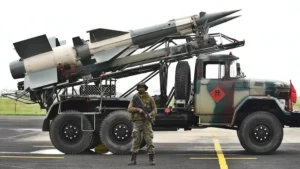
Bengaluru-based Alpha Design Technologies Ltd (ADTL) has successfully completed a major upgrade of the Indian Air Force’s (IAF) Pechora surface-to-air missile (SAM) system.
About the System
- The Pechora, officially called S-125 Neva/Pechora, is of Soviet origin.
- It is a medium-range SAM system designed to intercept low- to medium-altitude aerial threats.
- This aligns with the Centre’s focus on modernising ageing defence equipment through indigenous capability.
- In service with India since the 1970s, it has been a cornerstone of the nation’s air defence network.
Key Features
- Components: Radar-guided missile launcher. Fire control unit, typically using the V-600 missile.
- Radar: Employs the 4R90 Yatagan radar with five parabolic antennas. Capable of detecting, tracking, and locking onto targets.
- Operational Capability: Launches missiles to intercept and destroy threats mid-air. Effective against slow-moving or low-flying targets, including drones and cruise missiles.
- Can function independently or as part of an integrated air defence network. Resistant to heavy electronic jamming environments.
Performance Parameters
- Range: Operational firing range of 30–35.4 km (upgraded versions reach 35.4 km).
- Altitude: Engages targets from 20 meters up to 20–25 km.
- Detection: Radar can detect targets up to 100 km away, enabling early warning.
- Accuracy: High kill probability of around 92%. Can engage two targets simultaneously at speeds up to 900 m/s.
SOLAR CYCLES
TOPIC: (GS1) GEOGRAPHY: THE HINDU
A team from IIT-Kanpur has recently developed a new method to predict solar cycles, improving accuracy in forecasting solar activity.
About Solar Cycles
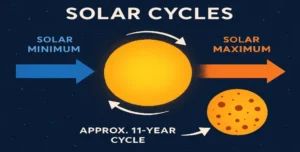
- The solar cycle refers to an 11-year periodic variation in the Sun’s activity, driven by changes in its magnetic field.
- It is tracked by observing sunspots, which are dark patches on the Sun’s surface caused by magnetic disturbances.
- Every 11 years, the Sun’s magnetic poles flip (north becomes south and vice versa). Another 11 years later, they flip back, completing a full cycle.
Stages of the Cycle
- Solar Minimum: Beginning of the cycle with fewest sunspots. Solar activity is at its lowest.
- Solar Maximum: Midpoint of the cycle with highest number of sunspots. Increased solar flares and coronal mass ejections.
- Cycle Renewal: Activity declines back to minimum, and a new cycle begins.
Impact on Earth
- Climate Influence: Variations in solar radiation affect Earth’s temperature and atmospheric circulation.
- Cosmic Rays: Stronger solar activity reduces cosmic ray intensity reaching Earth.
- Ozone Distribution: Changes in solar UV radiation impact ozone formation in the stratosphere.
- Space Weather: Solar storms can disrupt satellites, GPS, power grids, and communication systems.
Significance
- Accurate prediction of solar cycles helps in planning satellite launches, protecting power infrastructure, and studying climate change.
- India’s new predictive model strengthens its role in space science and atmospheric research.