Table of Contents
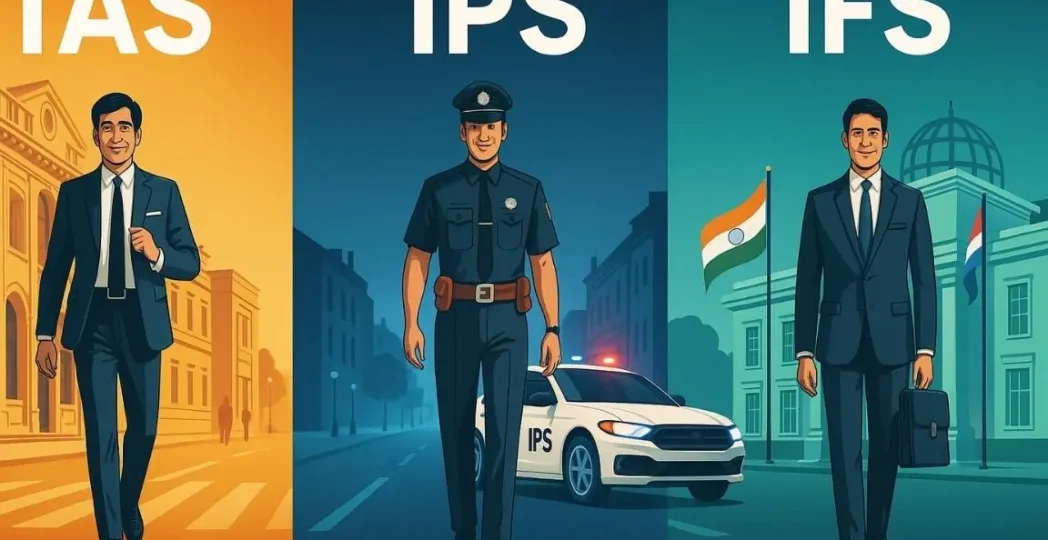
ToggleChoosing a service after clearing UPSC CSE shapes your day-to-day work, authority, and career growth. In simple terms, IAS runs civil administration, IPS safeguards law and order, and IFS handles foreign policy and diplomacy. Below is a crisp, exam-ready comparison across mandate, training, powers, postings, work culture, and career ladder—so you can map the service to your strengths and goals.
Quick primer on the difference between IAS IPS and IFS
- IAS (Indian Administrative Service): The Union–State generalist cadre that leads district administration, program delivery and policy design.
- IPS (Indian Police Service): India’s premier uniformed leadership for policing, crime investigation, internal security, and specialized wings like cybercrime, ATS, and traffic.
- IFS (Indian Foreign Service): India’s diplomatic corps—representing the nation abroad, negotiating treaties, promoting trade, and aiding Indian diaspora.
IAS — Administration & Development
As SDM/ADM/DM, an IAS officer coordinates all line departments, manages disaster response, implements flagship schemes, and later drafts policy as Secretary in a State or GoI. Keywords: district magistrate, public policy, governance.
IPS — Security & Justice
An IPS officer begins as ASP and rises to SP/SSP/IG/ADG/DGP. Core functions: law and order, crime control, intelligence, VIP security, counter-insurgency and community policing. Keywords: criminal justice, public safety, investigation.
IFS — Diplomacy & External Engagement
An IFS officer serves at MEA (HQ) and Indian Embassies/Consulates worldwide. Work includes bilateral/multilateral diplomacy, WTO/UN negotiations, economic diplomacy, consular services, and strategic communications. Keywords: foreign policy, trade promotion, diaspora.
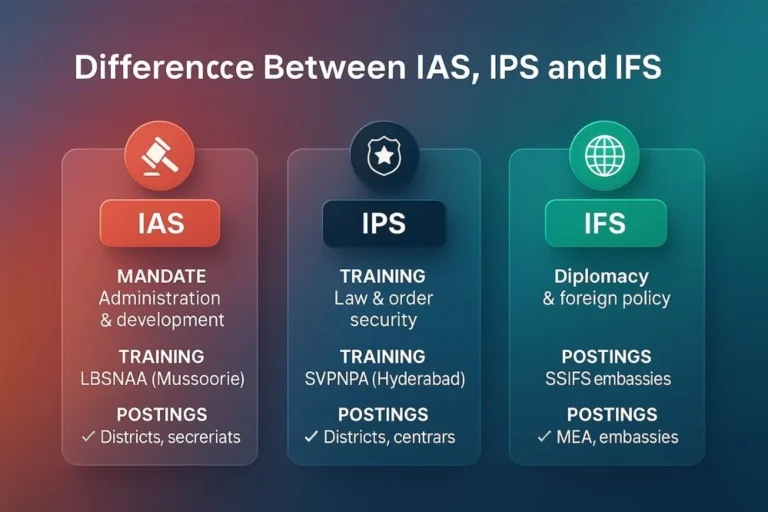
Training & Academies
- IAS: Foundation at LBSNAA (Mussoorie) with Bhararatiya governance, law, finance, e-governance; district attachments and Phase II mid-career courses.
- IPS: SVPNPA (Hyderabad) with intense physical, weapons, forensics, investigation, and field exercises; attachments with CAPFs.
- IFS: SSIFS (New Delhi) and Foreign Language training (often 1–2 years) plus attachments with Commerce, Home, Think-Tanks, and Missions abroad.
Powers, hierarchy, and postings
- IAS: Strong executive authority at district/state level; controls local police only in magisterial domains and coordination. Moves between field and secretariat; later becomes Chief Secretary/Secretary to GoI.
- IPS: Police Act/CrPC powers; operational command over district and state police units; deputation to IB, CBI, NIA, CAPFs.
- IFS: Extraterritorial postings; leads Political/Economic/Consular/Trade wings; can become Ambassador/High Commissioner and senior MEA leadership.
Lifestyle & skill fit
- IAS: High inter-departmental coordination, community interface, varied portfolios; suits generalists, problem-solvers, and public policy enthusiasts.
- IPS: Demanding field operations, 24×7 readiness, court procedures; suits those with leadership under stress, discipline, and investigative mindset.
- IFS: International mobility, languages, cross-cultural work; suits communicators, analysts, and those keen on global affairs.
Career growth & remuneration (broad strokes)
All three progress through Pay Levels under 7th CPC with perks (housing, transport, medical).
- IAS: Rapid exposure to development programs; apex roles in state/union policy.
- IPS: Command roles in specialized agencies; top posts like DGP.
- IFS: Head missions, lead divisions in MEA; global postings with foreign allowances.
How to choose smartly
Aptitude alignment: administration (IAS), policing/security (IPS), diplomacy (IFS).
Work environment: domestic field intensity (IAS/IPS) vs international exposure (IFS).
Family/lifestyle: frequent transfers vs long foreign postings.
Long-term vision: district statecraft, internal security, or global strategy.
UPSC-CSE Frequently Asked Questions (FAQs)
Which service is most versatile for governance?
IAS—from district administration to central policy—offers the widest generalist canvas.
Who controls police—IAS or IPS?
IPS officers command the police force; IAS has magisterial/coordination authority and district leadership.
Do IFS officers get domestic postings too?
Yes. IFS rotates between MEA HQ (Delhi) and missions abroad; tenure policies balance home and foreign postings.
Can I move from a central service to IAS/IPS/IFS later?
No inter-service transfer; you must re-attempt UPSC and secure a rank for the target service.
Which service suits a tech-policy or cybercrime interest?
Work profile, field intensity, family/lifestyle considerations, technical interest, career growth, and your purpose (governance, security, environment, finance, diplomacy).