Table of Contents
ToggleHIGH SEAS TREATY AND INDIA’S DOMESTIC FRAMEWORK
This topic is part of Daily Current Affairs – 21 January 2026
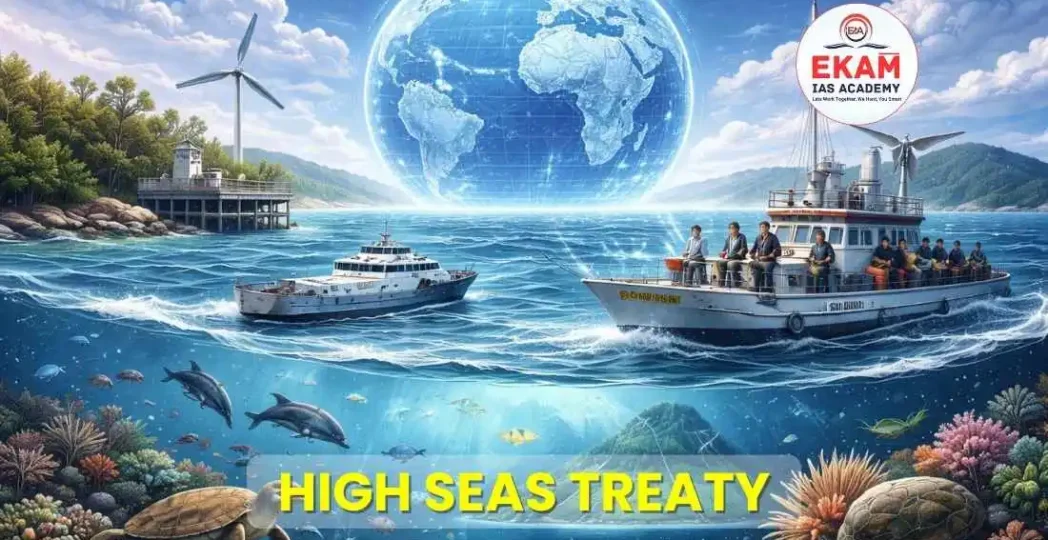
The High Seas Treaty (BBNJ Agreement) under UNCLOS will come into force on 17 January 2026, enabling the creation of marine protected areas in international waters for the first time. India has started preparing a domestic framework to implement the treaty, given its implications for fisheries, marine genetics, and ocean governance.
High Seas Treaty
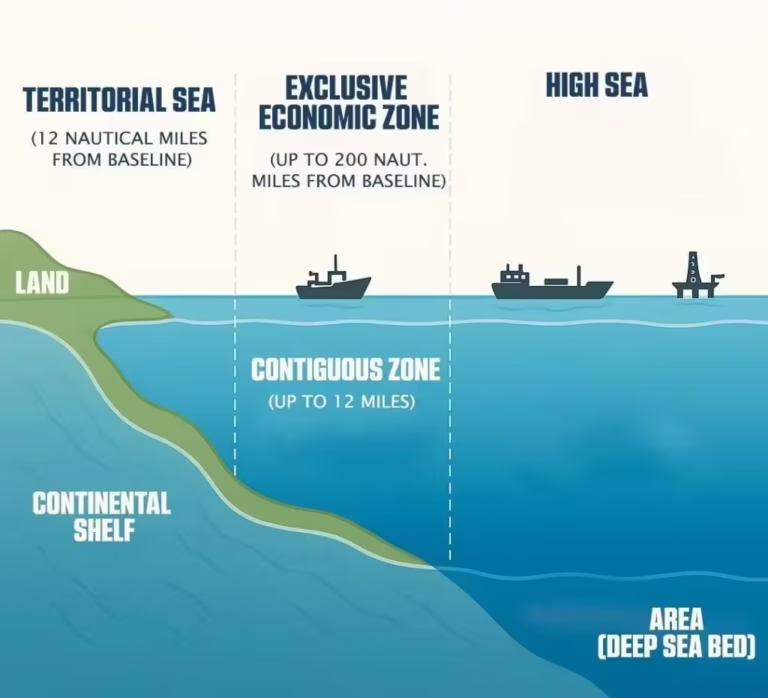
- A global accord to protect marine biodiversity in high seas and deep seabed beyond national jurisdiction.
- Covers two-thirds of the world’s oceans.
- Provides a legal framework to:
- Conserve marine ecosystems.
- Promote sustainable use of ocean resources.
- Ensure fair sharing of benefits from marine genetic materials.
Four Pillars of the Treaty
- Marine Genetic Resources & Benefit Sharing – equitable access to discoveries from deep-sea organisms.
- Area-Based Management Tools – creation of Marine Protected Areas (MPAs) in international waters.
- Environmental Impact Assessments – mandatory evaluation of activities affecting fragile ecosystems.
- Capacity Building & Technology Transfer – support for developing countries in ocean research and conservation.
Why is it a Landmark?
- First-time legal protection for biodiversity in international waters.
- Closes governance gaps on marine genetic resources and conservation.
- Applies at a global scale, covering nearly two-thirds of oceans.
Timing Significance
- Triggered by Morocco’s ratification in September 2025.
- Aligns with the UN 2022 biodiversity goal to protect 30% of land and oceans by 2030.
- Comes as deep-sea exploration and mining applications are under review.
India’s Preparations
- Institutional Coordination: Ministry of Earth Sciences held consultations with ICAR-CMFRI and CMLRE.
- Stakeholder Integration: Inputs from policymakers, scientists, legal experts, and fisheries industry.
- Roadmap Formation: Recommendations for India’s domestic framework ahead of the Conference of Parties (August 2026).
Governance Gaps Addressed
- Clarifies ownership and access to marine genetic resources.
- Establishes accountability through environmental impact assessments.
- Balances conservation with interests of coastal and developing nations.
Importance for India
- High seas activities affect fish stocks within India’s EEZ.
- Strengthens India’s role in ocean science, technology, and policy.
- Direct relevance for small-scale fisheries, sustainability, and food security.
Challenges
- Enforcement limited under international law; depends on cooperation.
- Some major powers (e.g., U.S.) have not ratified, affecting universality.
Conclusion
The High Seas Treaty transforms oceans from a regulatory vacuum to a governed commons. India’s proactive domestic alignment shows strategic intent to safeguard fisheries, integrate science with law, and contribute to global ocean governance.
HIGH SEAS TREATY AND INDIA’S DOMESTIC FRAMEWORK - FAQs
What is the High Seas Treaty (BBNJ Agreement)?
The High Seas Treaty is a global agreement under United Nations Convention on the Law of the Sea to protect marine biodiversity beyond national jurisdiction, covering nearly two-thirds of the world’s oceans.
Why is the High Seas Treaty considered a landmark agreement?
It is the first legal framework to enable Marine Protected Areas (MPAs) and biodiversity conservation in international waters, closing long-standing governance gaps.
What are the four pillars of the High Seas Treaty?
The treaty focuses on marine genetic resources & benefit sharing, area-based management tools, environmental impact assessments, and capacity building & technology transfer.
Why is the High Seas Treaty important for India?
High seas activities affect fish stocks within India’s EEZ, making the treaty crucial for fisheries sustainability, food security, and ocean governance leadership.
What challenges does the High Seas Treaty face?
Challenges include limited enforcement mechanisms, reliance on international cooperation, and non-ratification by major powers, which may weaken universal compliance.