
Table of Contents
TogglePAX SILICA AND INDIA’S STRATEGIC IMPORTANCE
This topic is part of Daily Current Affairs – 21 January 2026
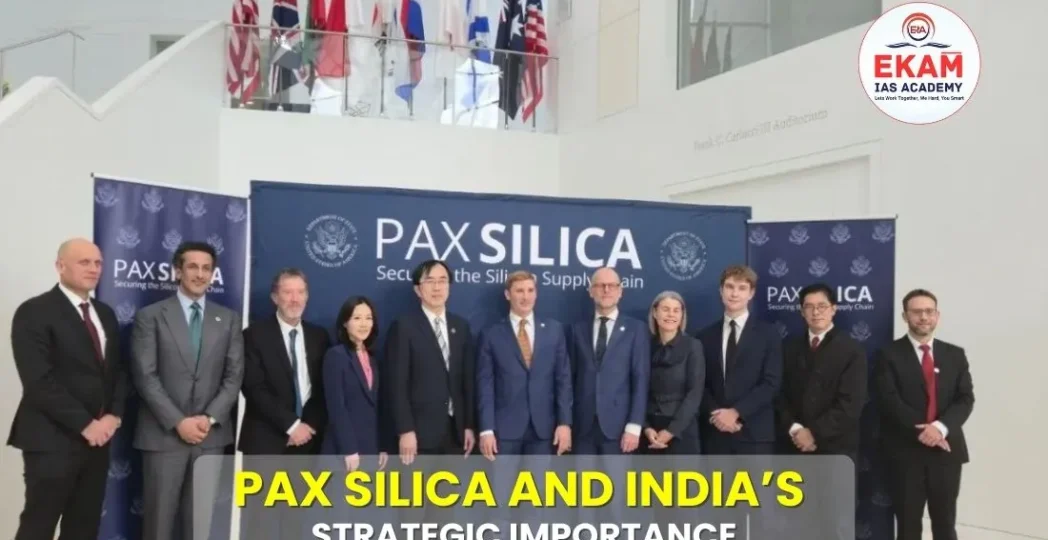
The U.S. convened the first Pax Silica Summit (December 2025) to secure supply chains for semiconductors, AI, and critical minerals. India, though not invited initially, is expected to join soon, as confirmed by the new U.S. Ambassador.
About Pax Silica
- Meaning: Pax Silica combines “Pax” (peace) with “Silica” (a key material in chip-making), symbolising secure and peaceful technology supply chains.
- Objective: The initiative aims to create trusted digital infrastructure, reduce dependency on single sources, and ensure resilience in global semiconductor and AI supply chains.
- Key Focus Areas: Strengthening access to Rare Earth Elements (REEs), advancing semiconductor manufacturing, and building robust AI ecosystems for future technologies.
- Additional Point: It also seeks to promote international cooperation among technology leaders and resource-rich nations to counter supply chain vulnerabilities.
Major Participants
- Technology leaders: U.S., Japan, South Korea, Netherlands, Singapore, Israel, U.K.
- Resource-rich nations: Australia (Lithium, REEs), Qatar & UAE (investment funds).
- Observers: Canada, EU, OECD, Taiwan.
- Membership evolving, with India likely to be included.
Countering China
- China dominates REE supply chains and has used export restrictions for political leverage.
- India faced disruption in rare-earth magnet imports, affecting automobile and electronics industries.
- Pax Silica aims to create an alternative supply chain to reduce dependence on China.
India’s Role and Opportunities
- Strengths:
- Strong digital infrastructure.
- Rapidly growing AI market.
- Launch of AI and Semiconductor Missions with major funding.
- Investments by Indian firms (Tata) and U.S. companies (Micron).
- Collaboration with Japan, Singapore, and Israel in semiconductor projects.
- Human Capital: Large pool of engineers trained in AI/semiconductors, many returning from U.S. universities.
- Potential Gains:
- Scale-up collaborations with Pax Silica members.
- Strengthen domestic semiconductor and AI ecosystems.
- Enhance resilience in supply chains.
Challenges for India
- India would be the first developing country and first non-U.S. ally to join Pax Silica → possible expectation gap.
- India’s semiconductor and AI sectors are still nascent compared to other members.
- India may prefer subsidies, procurement support, and import regulations to protect domestic firms, which may clash with Pax Silica’s free-market orientation.
- Must balance participation with strategic autonomy.
Way Forward
- Engage in detailed dialogue before joining to clarify expectations.
- Use Pax Silica membership to attract investment and technology transfer.
- Continue parallel initiatives like Quad Critical Minerals Initiative and Supply Chain Resilience Initiative.
- Position itself as a bridge between developed and developing countries in global tech governance.
Conclusion
Pax Silica represents a new geopolitical and technological framework to counter China’s dominance in REEs and secure AI/semiconductor supply chains. For India, joining offers opportunities to strengthen its tech ecosystem, but careful navigation is needed to protect strategic autonomy and domestic interests.
PAX SILICA AND INDIA’S STRATEGIC IMPORTANCE - FAQs
What is Pax Silica and why was it launched?
Pax Silica is a U.S.-led initiative to build secure semiconductor, AI, and critical mineral supply chains, reducing dependence on single-country dominance, especially China.
Why is India important to the Pax Silica framework?
India brings strong digital infrastructure, a growing AI market, semiconductor missions, and skilled human capital, making it a key partner for resilient global tech supply chains.
How does Pax Silica aim to counter China’s dominance?
Pax Silica seeks to diversify Rare Earth Elements (REEs) and chip supply chains to limit China’s export leverage and prevent geoeconomic coercion.
What benefits can India gain by joining Pax Silica?
Membership can attract investment, technology transfer, and strategic partnerships, strengthening India’s domestic semiconductor and AI ecosystem.
What challenges could India face within Pax Silica?
India must balance strategic autonomy, domestic industry protection, and free-market expectations, while bridging capability gaps with advanced economies.