Table of Contents
ToggleWhy is Indian Polity considered the highest-scoring GS subject in UPSC Prelims?
Indian Polity is consistently one of the highest-scoring subjects in UPSC Prelims, contributing approximately 10-15 questions. In Mains GS Paper 2, Polity, Governance, and International Relations form the backbone. Aspirants who master this subject early gain a significant advantage. At Ekam IAS Academy, Vijay Sir’s Polity classes are among the most attended and most celebrated sessions, with students regularly calling them the most impactful part of their UPSC preparation at Hyderabad’s best IAS coaching institute.
What are the essential topics in Indian Polity for UPSC Prelims and Mains?
The most important topics in Indian Polity for UPSC are: the Constitution — Preamble, Fundamental Rights (Part III), Directive Principles (Part IV), Fundamental Duties (Part IV-A), the Parliamentary system and Union Legislature, the Presidency and Vice Presidency, the Judiciary including the Supreme Court and High Courts, Federalism and Centre-State relations, Local Government (73rd and 74th Amendments), Emergency Provisions, Constitutional and Statutory Bodies, and Electoral System.
How should aspirants use M. Laxmikanth's Indian Polity for UPSC preparation?
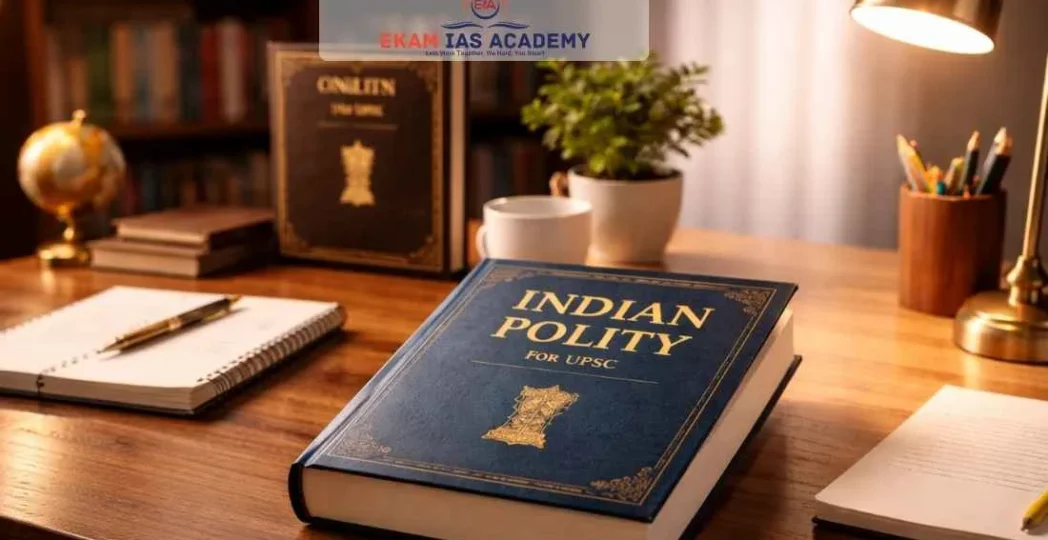
M. Laxmikanth’s Indian Polity is the essential reference for UPSC preparation. However, the mistake most aspirants make is reading Laxmikanth like a novel — cover to cover, in sequence. The better approach is to read NCERT Class 11 Indian Constitution at Work first to get the conceptual framework, then use Laxmikanth as a detailed reference, cross-referencing constitutional articles with real examples from current governance. Vijay Sir at Ekam IAS Academy adds a layer of real-world governance examples to every constitutional provision that makes the content come alive.
Which constitutional amendments are important for UPSC?
Constitutional Amendments are critical for UPSC. The most important ones include: 1st Amendment (restrictions on Fundamental Rights), 42nd Amendment (added Fundamental Duties, changed Preamble), 44th Amendment (reversed some changes of 42nd), 73rd and 74th Amendments (local governance), 86th Amendment (Right to Education), 97th Amendment (cooperative societies), 101st Amendment (GST), and 102nd, 103rd, 105th Amendments related to OBC commissions and reservations.
Why are important Supreme Court judgments relevant for UPSC preparation?
For Mains GS Paper 2, understanding judicial developments and landmark judgments helps aspirants connect constitutional provisions with real governance challenges.
How should aspirants integrate current affairs into Indian Polity preparation?
Current affairs in Indian Polity include developments such as ordinances, bills, constitutional changes, governance reforms, and judicial decisions, all of which must be connected with the constitutional framework.
How can aspirants write scoring answers in UPSC Mains GS Paper 2 Polity questions?
For Mains GS Paper 2, every Polity answer must connect constitutional provisions to real governance challenges. For example, answering a question on judicial accountability must reference the Constituent Assembly debates, existing constitutional provisions for removal, recent controversies involving the judiciary, and comparative global models.
How does Vijay Sir at Ekam IAS Academy Hyderabad teach Polity?
This multi-layered approach is what Vijay Sir’s sessions at Ekam — Hyderabad’s top UPSC coaching — instil in every student.