
Table of Contents
ToggleComplete Strategy to Prepare UPSC Ethics GS Paper IV
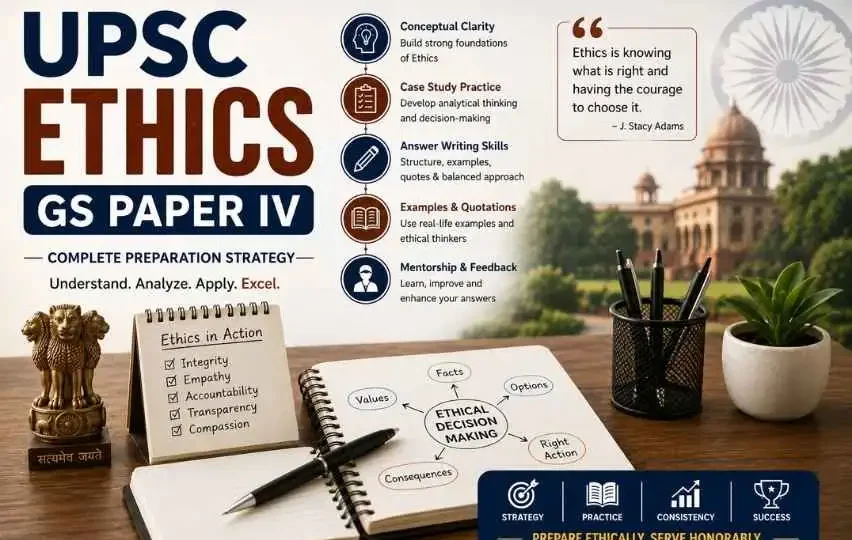
Preparing for the UPSC Ethics GS Paper requires a balanced approach that combines conceptual clarity, practical understanding, and answer writing skills. Since Ethics plays a crucial role in the UPSC Mains examination, aspirants must focus on both theory and application.
Moreover, many students in UPSC preparation Hyderabad initially underestimate this paper because it appears theoretical. However, with the right strategy, the UPSC Ethics GS Paper can become one of the highest-scoring sections in Mains.
Why UPSC Ethics GS Paper Is Important
Firstly, the UPSC Ethics GS Paper evaluates an aspirant’s integrity, attitude, emotional intelligence, and decision-making ability. Additionally, it tests how candidates apply ethical principles in real-life administrative situations.
Furthermore, aspirants preparing in a UPSC coaching institute in Hyderabad often perform better when they practice structured ethics answers regularly. Therefore, mastering the UPSC Ethics GS Paper is essential for improving overall Mains scores.
How to Start UPSC Ethics GS Paper Preparation
Understanding Concepts in UPSC Ethics GS Paper
The first step is understanding fundamental concepts such as ethics, integrity, aptitude, empathy, and emotional intelligence. Aspirants should focus on clarity instead of memorization.
Moreover, relating ethical concepts to real-life examples improves understanding and answer quality.
Importance of Case Study Practice
Case studies form a major portion of the Ethics paper. Therefore, aspirants should practice solving ethical dilemmas regularly.
Additionally, students in civil services coaching Hyderabad often improve through continuous case study discussions and evaluations. Consequently, regular practice strengthens analytical thinking and balanced decision-making.
Best Strategy for Ethics Answer Writing
Answer writing is extremely important in Ethics preparation. Aspirants should:
- Use simple and clear language
- Include real-life examples
- Add quotes and ethical thinkers
- Present balanced conclusions
Thus, structured presentation improves scores significantly.
Role of Examples and Quotations
Ethics answers become more impactful when supported with relevant examples and quotations. Therefore, aspirants should maintain a separate notebook for case studies, constitutional values, and ethical examples.
Furthermore, using examples from administrators, leaders, and daily life improves answer originality.
How Mentorship Helps in Ethics Preparation
Guidance and feedback play a major role in improving Ethics answers. Institutes like Ekam IAS Academy focus on mentorship-driven preparation and regular evaluation.
We Ekam IAS Academy guide aspirants in developing structured thinking and improving case study approaches through continuous practice.
Common Mistakes Aspirants Should Avoid
Many aspirants lose marks because they:
- Write overly theoretical answers
- Ignore case study practice
- Use complex language unnecessarily
- Lack practical examples
Therefore, avoiding these mistakes improves performance in the UPSC Ethics GS Paper.
Importance of Revision and Consistency
Consistency is essential for Ethics preparation. Aspirants should revise definitions, examples, and quotations regularly.
Additionally, aspirants studying in a best IAS academy in Hyderabad often benefit from answer writing sessions and regular discussions. Hence, consistent practice builds confidence and clarity.
Conclusion
In conclusion, the UPSC Ethics GS Paper is not just about theory but about practical understanding and balanced thinking. While the syllabus may appear simple, effective preparation requires answer writing practice, examples, and ethical clarity.
Therefore, aspirants should focus on conceptual understanding, case studies, and regular revision. With proper guidance and disciplined practice, scoring high marks in Ethics becomes achievable.



UPSC Ethics GS Paper 4: Complete Preparation Strategy-FAQs Answered
Is the UPSC Ethics GS Paper scoring?
Yes, with proper answer writing and case study practice, Ethics can become a high-scoring paper.
How should I prepare for Ethics case studies?
Practice real-life scenarios regularly and focus on balanced, practical solutions.
Are quotations important in Ethics answers?
Yes, relevant quotations improve answer quality and presentation.
How much time is needed for Ethics preparation?
Regular daily practice and revision over a few months are usually sufficient.
Can coaching help in Ethics preparation?
Yes, a UPSC coaching institute in Hyderabad can provide structured guidance and answer evaluation.