Table of Contents
ToggleThe GS-2 syllabus for UPSC Mains is one of the most analytical, dynamic, and current-affairs driven papers in the civil services examination. It tests an aspirant’s ability to interpret constitutional provisions, evaluate governance structures, understand social justice issues, and analyse India’s international relations. Among all parts of GS-2, Polity and Governance form the backbone because nearly 55–60% of the questions stem directly from these two segments.
To score 120+ in GS-2, aspirants must have strong command over the Constitution, Parliamentary processes, Judiciary, federalism, rights issues, government schemes, policy implementation, administrative reforms, and ethical governance mechanisms. A high-scoring GS-2 answer is always a blend of articles + landmark judgments + data + committee recommendations + governance case studies + current affairs. With structured learning from reputed UPSC coaching institutes, aspirants can streamline preparation and build precision in answer writing—an essential requirement for clearing Mains.
Complete GS-2 Syllabus for UPSC Mains (Polity + Governance Focus)
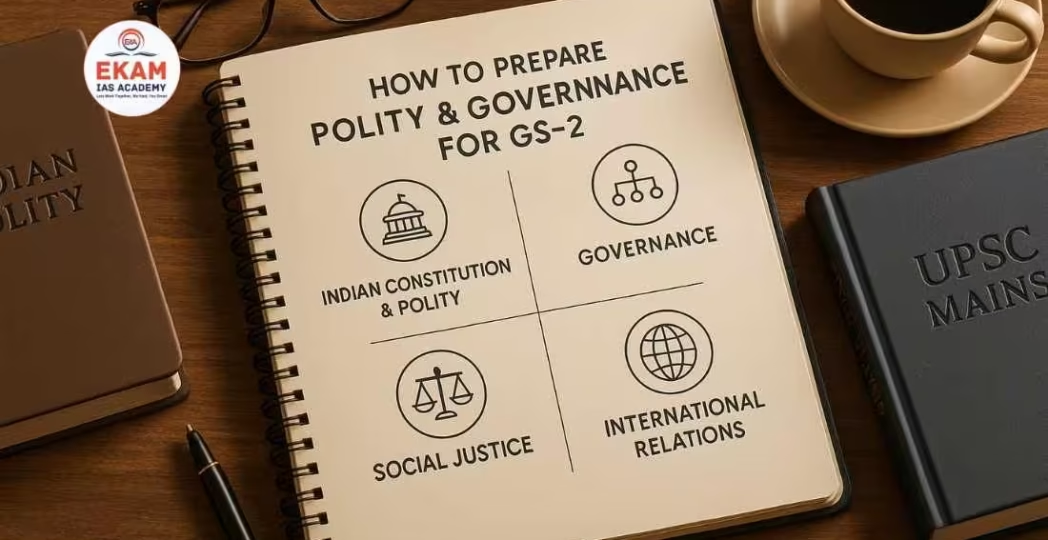
The GS-2 syllabus for UPSC Mains revolves around four major pillars, but Polity and Governance represent the core focus areas.
Key Areas
- Historical evolution, sources, philosophies
- Salient features of the Constitution
- Federal structure: cooperative & competitive federalism
- Union & State government structure
- Parliament & State Legislatures
- Executive (President, PM, Cabinet, Governor, CMs)
- Judiciary, judicial reforms, PIL, tribunals
- Separation of powers, checks and balances
- Constitutional amendments & Basic Structure Doctrine
- Independent offices like CAG, EC, UPSC, Finance Commission
Why This Section Is Important
The majority of GS-2 questions refer back to constitutional interpretation and contemporary issues. Mastering Polity helps candidates write analytical answers, backed by articles and Supreme Court judgments.
2. Governance (Dynamic & High Yield)
Key Areas
- Transparency, accountability
- e-Governance, Digital India, JAM trinity
- Role of civil services
- Citizen charter, RTI, grievance redressal
- Role of NGOs, SHGs, civil society
- Social service delivery mechanisms
- Government schemes: health, education, nutrition, poverty alleviation
Why Governance Is Scoring
Governance questions often ask about reforms, digital transformations, administrative bottlenecks, and service delivery—areas where practical examples, case studies, and recent schemes help score high.
3. Social Justice (Supporting Pillar for Governance)
Key Areas
- Welfare schemes
- Education & health reforms
- Vulnerable groups: SC/ST, women, minorities, elderly, PwDs
- Poverty, hunger, inequality
- Rights-based governance
- Constitutional and statutory bodies
4. International Relations (Complementary Section)
Though not core to Polity or Governance prep, IR carries approximately 80–100 marks.
Includes: India-US relations, India-China, neighbourhood policy, QUAD, UN reforms, etc.

How to Prepare Polity & Governance for GS-2 Effectively
Preparation for GS-2 Polity and Governance requires disciplined reading, current affairs integration, and exam-oriented answer writing. Below is a comprehensive approach.
Polity Preparation Strategy for GS-2
1. Build a Strong Constitutional Foundation
Aspirants must go deeper than Laxmikanth and understand:
- Constituent Assembly debates
- Doctrines (Basic Structure, Colourable legislation, Pith & Substance, etc.)
- Constitutional morality
- Judicial review & judicial activism
- Legislative processes & functioning
Best Books & Sources
- M. Laxmikanth (for structure)
- DD Basu (for conceptual clarity)
- Subhash Kashyap
- Ekam IAS Academy Polity Notes
- Supreme Court landmark judgments compilations
- PRS Legislative Research updates
What to Focus On
- Parliamentary committees, disruptions, reforms
- Anti-defection law (Tenth Schedule)
- Governor’s role debates
- Centre-state disputes, GST council judgments
- Electoral reforms (VVPAT, state funding, criminalization of politics)
- Judiciary reforms (NJAC, collegium, pendency reduction)
2. How to Integrate Current Affairs with Polity
Every polity topic must be linked with:
- Latest Bills
- Amendments
- Supreme Court verdicts
- Government schemes
- Constitutional debates
- Reports (NITI Aayog, ARC, Law Commission)
Examples That Boost Scores
- Right to Privacy → Puttaswamy judgment
- Federalism → S.R. Bommai, NCT Delhi case
- Constitutional morality → Navtej Johar case
- Parliamentary oversight → CAG audits
- Police reforms → Prakash Singh judgment
Answers with such references automatically stand out.
Governance Preparation Strategy for GS-2
1. Understanding Governance from Administrative Angle
Governance requires a fusion of:
- Public administration concepts
- Policy evaluation
- Administrative ethics
- Service delivery improvement
Key Themes to Study
- e-Governance (Umang, DigiLocker, CPGRAMS, Aadhaar)
- Citizen-centric governance
- DBT reforms & JAM trinity
- Role of civil services reforms (Mission Karmayogi)
- Decentralization (73rd & 74th amendments)
- Social audits
- Bureaucratic accountability (Lokpal, RTI, CVC)
2. Use Case Studies & Governance Models
To score 120+, you must quote real examples:
- Aspirational Districts Programme – model for outcome-based governance
- Kerala Kudumbashree – women-led SHG model
- Telangana Kaleshwaram Project – irrigation governance
- Odisha Disaster Management – internationally recognized
- Mohalla Clinics (Delhi) – health governance
How to Use Case Studies
- Insert them under:
- “Best Practices”
- “Way Forward”
- “Models of Good Governance”
- “Successful Implementation Cases”
Effective Answer Writing for GS-2 (Polity + Governance)
1. Structure Is Everything
A scoring answer must have:
- Intro: Article/definition/SC remark
- Body: Analysis + issues + examples + data
- Diagram: governance cycle, federal matrix
- Way forward: committees + reforms
- Conclusion: constitutional values
Use These In Every Answer
- Articles (Art 14, 21, 32, 370, etc.)
- SC judgments
- ARC reports
- NITI Aayog recommendations
- Facts from NFHS, NCRB, UNESCO, UNDP
Role of UPSC Coaching in GS-2 Preparation
Why Coaching Makes a Difference
GS-2 requires:
- Daily current affairs
- Expert interpretation of judgments
- Governance case studies
- Rigorous answer writing
- Test series evaluation
This is why good coaching accelerates clarity and performance.
How Ekam IAS Academy Helps in GS-2
Key Features
- Structured Polity + Governance classes
- Weekly tests for GS-2 syllabus
- Monthly Supreme Court judgment digest
- Updated governance case studies
- PYQ-based practice and model answers
- Personal mentoring for conceptual clarity
Why Students Prefer Ekam IAS
- Highest-quality notes + diagrams
- Integrated polity governance approach
- Daily editorials linked to GS-2 topics
- Strict answer evaluation to match UPSC standards
Final Tips to Score 120+ in GS-2 Polity & Governance
- Memorise 50–60 key articles
- Maintain 10–15 landmark judgments
- Prepare governance diagrams
- Solve PYQs from 2013–2024
- Use at least 2–3 contemporary examples in every answer
- Write 5 GS-2 answers every week
- Revise schemes & commissions frequently
GS-2 Syllabus for UPSC Mains - FAQs Answered
How to prepare Polity for GS-2 in UPSC Mains?
To prepare Polity for GS-2, focus on constitutional articles, landmark judgments, parliamentary processes, and integrate them with current affairs and real governance cases.
What are the most important topics in the GS-2 syllabus?
The GS-2 syllabus revolves around Constitution, Governance, Social Justice, and International Relations, with Polity + Governance forming nearly 60% of the paper.
How to write high-scoring answers in Polity & Governance?
Use articles, Supreme Court judgments, committees, and case studies, supported by diagrams and a structured intro–body–way forward format for better scoring.
Which sources are best for Polity and Governance preparation?
Standard books like Laxmikanth, DD Basu, PRS updates, ARC reports, and high-quality coaching notes enrich both conceptual clarity and GS-2 answer writing.
How to integrate current affairs with GS-2 Polity topics?
Link every topic with recent Bills, amendments, SC verdicts, governance reforms, and government schemes to create dynamic, exam-ready GS-2 answers.