Table of Contents
ToggleHistorical Background: Civilisational and Strategic Roots
The foundation of India–Afghanistan relations dates back to ancient times, when the region of Afghanistan was an integral part of the Indian cultural sphere, including areas under the Mauryan Empire and later influenced by Buddhist civilisation. The spread of Buddhism from India to Central Asia passed through Afghanistan, making it a cultural bridge between South Asia and Eurasia.
During the medieval period, Afghanistan became a gateway for invasions into India, including those led by Mahmud of Ghazni and Muhammad Ghori, shaping the political trajectory of the Indian subcontinent.
In the modern era, relations evolved during the British colonial period, when Afghanistan served as a buffer state in the Great Game between the British Empire and Russia. After India’s independence in 1947, Afghanistan was one of the first countries to recognize India and maintained a policy of strategic autonomy, even during the Cold War.
Post-Independence Relations: Strategic Partnership
India and Afghanistan signed the Treaty of Friendship (1950), marking the beginning of formal diplomatic ties. India consistently supported Afghanistan’s sovereignty and development, avoiding direct military involvement.
After the fall of the Taliban regime (2001) following the US intervention, India emerged as a major development partner. The relationship was institutionalized through the India–Afghanistan Strategic Partnership Agreement (2011) — India’s first such agreement with any country.
India’s Developmental Role in Afghanistan
India has been one of the largest regional donors to Afghanistan, contributing over $3 billion in development assistance. Key projects include:
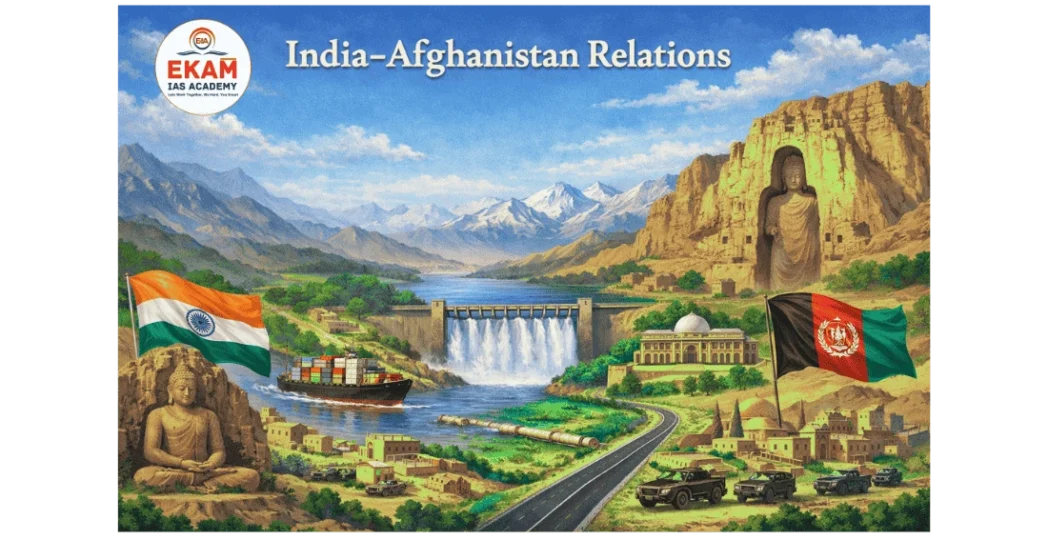
- Salma Dam (Afghan-India Friendship Dam) – Enhancing irrigation and power generation
- Afghan Parliament Building – Symbol of democratic support
- Zaranj–Delaram Highway – Connectivity to Iran’s Chabahar Port
- Humanitarian assistance – Food grains, medicines, and vaccines
India’s approach is often described as “soft power diplomacy”, focusing on capacity building, education, healthcare, and infrastructure development.
Strategic Importance of Afghanistan for India
Afghanistan holds immense importance for India’s foreign policy:
- Gateway to Central Asia: Afghanistan provides land connectivity to resource-rich Central Asia
- Counterbalance to Pakistan: A stable Afghanistan reduces Pakistan’s strategic depth doctrine
- Energy Security: Projects like TAPI Pipeline (Turkmenistan–Afghanistan–Pakistan–India)
- Regional Stability: Preventing Afghanistan from becoming a hub of terrorism and extremism
Challenges in India–Afghanistan Relations
Despite strong ties, several challenges persist:
- Pakistan factor: Pakistan’s influence over Afghan politics limits India’s strategic space
- Security concerns: Frequent attacks on Indian assets and personnel in Afghanistan
- Taliban resurgence (2021): The return of the Taliban regime created uncertainty
- Connectivity constraints: Lack of direct land access due to Pakistan
Recent Developments (2020–2026)
Recent years have marked a significant shift:
- Taliban takeover (2021): India evacuated its embassy but later re-established a technical mission in Kabul (2022)
- Humanitarian aid: India supplied wheat, medicines, COVID-19 vaccines, and earthquake relief
- Engagement without recognition: India has adopted a policy of “engagement without formal recognition” of the Taliban government
- Regional diplomacy: Participation in Moscow Format Talks and SCO discussions on Afghanistan
India’s approach is guided by its core concerns: terrorism, inclusivity, and humanitarian needs.
India’s Current Stand on Afghanistan
India’s policy towards Afghanistan is pragmatic and multi-dimensional:
- Support for an inclusive, representative government
- Strong opposition to terrorism and safe havens
- Emphasis on women’s rights and human rights
- Continued humanitarian assistance to Afghan people
- Strategic use of Chabahar Port to bypass Pakistan
India maintains that Afghan soil should not be used for anti-India activities, especially by groups like LeT and JeM.
Conclusion
India–Afghanistan relations exemplify a blend of civilisational depth, strategic necessity, and humanitarian commitment. While the Taliban-led political transition has altered the diplomatic landscape, India continues to balance strategic interests with ethical concerns. For UPSC aspirants, this relationship highlights how foreign policy adapts to geopolitical uncertainties while preserving long-term national interests.
UPSC Prelims: PYQs & Practice Questions
Previous Year Questions (Prelims)
Q1. [UPSC Prelims 2013]
Q: With reference to the Zaranj–Delaram Highway, consider the following statements:
1. It connects Afghanistan to Iran’s Chabahar Port.
2. It provides India direct access to Afghanistan bypassing Pakistan.
Which of the statements is/are correct?
(a) 1 only
(b) 2 only
(c) Both 1 and 2
(d) Neither 1 nor 2
Answer: (c) Both 1 and 2
Explanation:
The highway was built by India and links Zaranj in Afghanistan to Delaram, improving access towards Iran’s Chabahar connectivity route. It helps India bypass Pakistan for access to Afghanistan, making it strategically important for regional trade and connectivity.
Q2. [UPSC Prelims 2021]
Q: Consider the following:
1. India has provided humanitarian assistance to Afghanistan.
2. India has invested in infrastructure projects like the Afghan Parliament.
Which of the statements given above is/are correct?
(a) 1 only
(b) 2 only
(c) Both 1 and 2
(d) Neither 1 nor 2
Answer: (c) Both 1 and 2
Explanation:
India has consistently supported Afghanistan through humanitarian aid, capacity building, and infrastructure development. Major Indian projects include the Afghan Parliament building, roads, dams, and other public infrastructure, reflecting India’s soft power and development-oriented diplomacy.
Practice Questions
Q: Consider the following about India–Afghanistan relations:
1. India formally recognizes the Taliban government.
2. India operates a technical mission in Kabul.
3. India has invested more than $3 billion in Afghanistan.
Which of the above are correct?
(a) 2 and 3 only
(b) 1 and 2 only
(c) 1 and 3 only
(d) 1, 2 and 3
Answer: (a) 2 and 3 only
Explanation:
India follows a policy of engagement without formal recognition of the Taliban government, so Statement 1 is incorrect. India reopened its technical mission in Kabul in 2022, making Statement 2 correct. India has also invested more than $3 billion in Afghanistan through infrastructure, capacity-building, and development assistance, making Statement 3 correct.
Q: Which of the following projects is NOT associated with India in Afghanistan?
(a) Salma Dam
(b) Afghan Parliament Building
(c) China–Pakistan Economic Corridor
(d) Zaranj–Delaram Highway
Answer: (c) China–Pakistan Economic Corridor
Explanation:
CPEC is a China–Pakistan initiative and is not associated with India’s role in Afghanistan. In contrast, the Salma Dam, Afghan Parliament Building, and Zaranj–Delaram Highway are major Indian-supported projects in Afghanistan.



UPSC Mains – Previous Year & Practice Questions
Mains Previous Year Questions
Q1. [UPSC Mains 2016]
Question: “The emergence of Taliban in Afghanistan has created new challenges for India’s foreign policy.” Discuss.
Q2. [UPSC Mains 2020]
Question: What are the implications of the US withdrawal from Afghanistan for India?
Q3. [UPSC Mains 2021]
Question: Discuss India’s role in rebuilding Afghanistan. What challenges does it face?
Q4. [UPSC Mains 2022]
Question: How does instability in Afghanistan impact India’s internal security?
Q5. [UPSC Mains 2023]
Question: Evaluate India’s engagement strategy with Afghanistan after the Taliban takeover.
Mains Practice Questions
Question: “India’s Afghanistan policy reflects a balance between strategic interests and humanitarian concerns.” Critically examine.
Question: Analyse the role of Chabahar Port in strengthening India–Afghanistan relations in the context of regional geopolitics.
Question: Discuss how Afghanistan acts as a critical node in India’s Connect Central Asia Policy.