Table of Contents
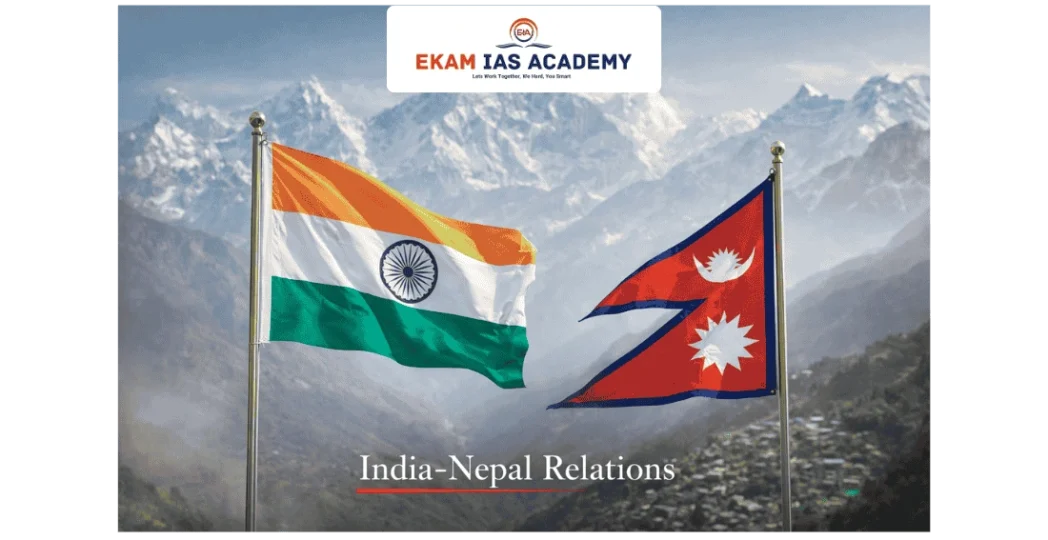
ToggleIndia and Nepal share one of the most unique, multidimensional, and civilisationally rooted bilateral relationships in the world. Bound by an open border, shared religious and cultural heritage, deep economic interdependence, and complex geopolitical dynamics, the India-Nepal bilateral relationship is simultaneously the most intimate and the most frequently troubled neighbourhood partnership in South Asia. For UPSC aspirants studying GS Paper 2 and PSIR Paper 2 Section B, India-Nepal relations offer a comprehensive case study of how geography, history, culture, and great power competition intersect in South Asian diplomacy.
Historical Background: Ancient Civilisational Bonds
The roots of India-Nepal civilisational connection stretch back thousands of years. Nepal is the birthplace of Lord Gautama Buddha at Lumbini — one of the most sacred sites for Buddhism, a faith that originated in India and spread globally through Indian civilisational influence. The Hindu religious tradition connects India and Nepal as the only two nations in the world that historically identified as Hindu kingdoms — with Nepal’s Pashupatinath Temple in Kathmandu being one of the most revered Shaivite shrines for Hindus across South Asia. The Himalayan mountain range — including Mount Everest — forms the natural northern boundary of this civilisational space, while the Terai plains in Nepal’s south are geographically, ethnically, and culturally continuous with India’s Gangetic plains.
During the British colonial period, Nepal maintained its sovereignty and independence — a unique distinction among South Asian nations — through the Sugauli Treaty of 1816, which ceded certain territories to British India while preserving Nepali sovereignty. The Gurkha soldiers of Nepal became legendary warriors in the British Indian Army — a military tradition that continues in the Indian Army, British Army, and Singapore Police Force to this day. This Gurkha connection represents one of the deepest people-to-people bilateral bonds between India and Nepal.
Post-Independence Framework: Treaty of Peace and Friendship 1950
The foundational legal framework governing India-Nepal bilateral relations is the Treaty of Peace and Friendship signed on July 31, 1950 — often called the ‘1950 Treaty’. This treaty established several extraordinary provisions: open border between India and Nepal allowing free movement of people and goods; equal treatment of each other’s citizens in employment, property ownership, and economic activities; and close defence and security consultation between the two governments. The 1950 Treaty also includes a security clause — Article 5 — under which Nepal would consult India on matters of security concern, effectively giving India a significant voice in Nepal’s defence and foreign policy decisions.
The 1950 Treaty has been simultaneously celebrated as the foundation of a unique bilateral friendship and criticised by Nepali nationalists as an unequal agreement reflecting India’s hegemonic approach to its smaller neighbour. Periodic Nepali demands for treaty revision reflect the core tension in India-Nepal bilateral relations — between intimate interdependence and Nepali desire for full sovereign equality.
Key Pillars of India-Nepal Bilateral Relations
INDIA-NEPAL BILATERAL FRAMEWORK
PILLAR KEY ELEMENTS
Open Border Free movement, shared communities
Economic Ties Trade, remittances, hydropower
Security Gurkhas, defence cooperation
Cultural Bonds Hindu-Buddhist heritage, language
Connectivity Roads, railways, pipelines
Energy Hydropower cooperation
Economic interdependence forms the first pillar. India is Nepal’s largest trade partner and primary source of imports — accounting for approximately 65% of Nepal’s total trade. The Indian Rupee and Nepali Rupee are linked through a fixed exchange rate mechanism — 1 Indian Rupee equals 1.6 Nepali Rupees — reflecting the monetary integration of the two economies. Nepal is almost entirely dependent on Indian territory for its access to sea ports — using Kolkata and Visakhapatnam ports for its international trade. This landlocked dependency is both a source of deep economic integration and a periodic political vulnerability for Nepal.
Hydropower cooperation forms the second critical pillar. Nepal possesses one of the world’s largest untapped hydropower potentials — estimated at 83,000 MW — fed by rivers originating in the Himalayas and Tibetan Plateau. India is the primary market and financier for Nepal’s hydropower projects. The Kosi Agreement (1954), Gandak Agreement (1959), and Mahakali Treaty (1996) govern water-sharing and hydropower cooperation. However, river water disputes — particularly Nepal’s dissatisfaction with water-sharing arrangements it considers exploitative — have been a persistent source of bilateral friction.
Security cooperation forms the third pillar. The open border — while facilitating people-to-people ties — also creates security vulnerabilities. India and Nepal share intelligence cooperation against common threats including ISI-backed terrorist networks, Maoist insurgent spillovers, and counterfeit currency circulation. The Gurkha recruitment — Nepal provides approximately 28,000 active soldiers to the Indian Army — represents the most tangible expression of bilateral security partnership.
Major Challenges and Friction Points
CHALLENGES IN INDIA-NEPAL RELATIONS
CHALLENGE DESCRIPTION
Border Disputes Kalapani, Lipulekh, Limpiyadhura
China Factor BRI, connectivity, Nepal tilt
2015 Blockade Memory Economic blockade perception
Water Treaties Unequal sharing perception
Political Interference India accused of meddling
Identity Issues Madhesi rights, Hindu identity
Border disputes represent the most acute contemporary challenge. The Kalapani-Lipulekh-Limpiyadhura territorial dispute escalated dramatically in May 2020 when India published a new political map showing the Lipulekh Pass — a point India, Nepal, and China trijunction — as Indian territory. Nepal retaliated by publishing its own new political map in June 2020 claiming Kalapani, Lipulekh, and Limpiyadhura as Nepali territory and amending its constitution to incorporate this claim. This dispute remains unresolved and represents the most serious bilateral territorial disagreement since the 1950 Treaty.
The 2015 economic blockade — while India officially denied imposing a blockade, Nepal experienced a devastating fuel and essential goods shortage lasting several months following Nepal’s adoption of its new constitution. Nepal perceived this as Indian coercion to influence its constitutional process, particularly regarding the rights of the Madhesi community in Nepal’s Terai region. The blockade memory profoundly damaged Indian credibility in Nepal and accelerated Nepal’s strategic tilt towards China.
The China factor has emerged as the most strategically significant challenge in India-Nepal bilateral management. China has systematically expanded its influence in Nepal through: BRI connectivity projects including road and rail links; economic assistance and investment; supporting Nepal’s alternative access to the sea through Chinese ports; and cultivating close relationships with Nepal’s communist political parties. Nepal joining China’s BRI in 2017 was a direct consequence of the bilateral trust deficit created by the 2015 blockade episode.
Current Events and Contemporary Developments
RECENT DEVELOPMENTS (2020-2024)
EVENT SIGNIFICANCE
Nepal’s New Map (2020) Kalapani territorial claim
Prachanda PM (2022-24) Pro-India signals
Power Export Agreement 10,000 MW by 2030 target
India-Nepal Railwa Raxaul-Kathmandu
UPI Launch in Nepal Digital payments integration
Pushpa Kamal Dahal Visit Bilateral reset attempt
Recent developments show cautious bilateral improvement. The Power Trade Agreement — India agreeing to import 10,000 MW of electricity from Nepal by 2030 — represents a transformative economic bilateral initiative that could make Nepal an electricity exporter rather than an energy-deficit nation. The Raxaul-Kathmandu Railway project, proposed as a cross-Himalayan connectivity initiative, would be India’s most ambitious infrastructure investment in Nepal. India’s launch of UPI payment system in Nepal reflects the digital integration of the two economies.
India's Current Stand and Strategic Approach
India’s current approach to Nepal is guided by the principle of “Neighbours First” — recognising that a stable, prosperous, and India-friendly Nepal is a strategic necessity, not merely a diplomatic preference. India’s strategic calculus on Nepal involves: preventing Nepal from becoming a Chinese strategic outpost on India’s northern border; maintaining open border as a symbol of unique bilateral friendship; deepening economic interdependence through hydropower, trade, and connectivity; and engaging Nepal’s political spectrum — including communist parties — rather than exclusively favouring pro-India governments.
As C. Raja Mohan observes, India must approach Nepal with “Kautilyan wisdom combined with civilisational generosity” — understanding that a smaller neighbour’s desire for sovereign dignity must be respected even within an asymmetric bilateral relationship. Harsh V. Pant argues that India’s biggest mistake in Nepal has been treating it as a subordinate rather than a sovereign equal — a mindset shift essential for bilateral reset.
Conclusion
India-Nepal relations represent the paradox of South Asian bilateralism — two nations bound by the world’s most intimate civilisational, geographic, and human connections, yet periodically estranged by asymmetric power perceptions, border disputes, and great power competition. The China factor has added urgent strategic imperative to what was historically managed as a cultural and economic partnership. For UPSC aspirants, India-Nepal relations offer the richest single case study of how geography, history, identity, water, borders, and great power competition simultaneously shape a bilateral relationship in the 21st century.
UPSC Prelims: PYQs & Practice Questions
Previous Year Questions (Prelims)
Q1. [UPSC CSE Prelims 2013]
Q: The Treaty of Peace and Friendship (1950) between India and Nepal is significant because:
1. It established an open border between India and Nepal allowing free movement of people and goods.
2. It gave citizens of both countries equal treatment in employment and property ownership.
3. It made Nepal a protectorate state of India with no independent foreign policy.
Which of the above statements is/are correct?
(a) 1 only
(b) 1 and 2 only
(c) 2 and 3 only
(d) 1, 2 and 3
Answer: (b) 1 and 2 only
Explanation: The Treaty of Peace and Friendship signed on July 31, 1950 established an open border between India and Nepal allowing free movement of people and goods. It also granted equal treatment to citizens of both countries in employment, property ownership, and economic activities. However, Nepal is not a protectorate of India; it remains a fully sovereign country with an independent foreign policy.
Q2. [UPSC CSE Prelims 2015]
Q: With reference to the Kalapani territorial dispute between India and Nepal, which of the following statements is correct?
(a) Kalapani is located at the trijunction of India, Nepal, and Bangladesh
(b) Kalapani is located at the trijunction of India, Nepal, and China and is claimed by both India and Nepal
(c) Kalapani was awarded to India by the United Nations in 1962
(d) Kalapani dispute was permanently resolved through the Mahakali Treaty of 1996
Answer: (b) Kalapani is located at the trijunction of India, Nepal, and China and is claimed by both India and Nepal
Explanation: Kalapani is strategically located at the trijunction of India, Nepal, and China in the high Himalayas. India has administered it since the 1962 Sino-Indian War and treats it as part of Uttarakhand, while Nepal claims Kalapani, Lipulekh, and Limpiyadhura based on its interpretation of the Sugauli Treaty of 1816. The dispute has neither been settled by the United Nations nor resolved through the Mahakali Treaty.
Practice Questions
Q1.
Q: The 'Kosi Agreement (1954)' between India and Nepal is primarily associated with which of the following?
(a) Border demarcation between India and Nepal
(b) Flood control, irrigation, and hydropower development on the Kosi River
(c) Gurkha soldier recruitment framework
(d) Establishment of the open border between India and Nepal
Answer: (b) Flood control, irrigation, and hydropower development on the Kosi River
Explanation: The Kosi Agreement (1954) is a bilateral framework between India and Nepal for flood control, irrigation, and hydropower development on the Kosi River. Under it, the Kosi Barrage was built in Nepal. The agreement has also been criticised in Nepal for being unequal, with claims that India gained operational control while Nepal bore much of the social and environmental burden.
Q2.
Q: Which of the following best explains Nepal's decision to join China's Belt and Road Initiative (BRI) in 2017?
(a) Nepal joined BRI because China offered Nepal nuclear technology
(b) Nepal joined BRI primarily as a consequence of the trust deficit created by the 2015 economic blockade and to diversify its connectivity away from exclusive Indian dependence
(c) Nepal joined BRI because India had terminated the 1950 Treaty
(d) Nepal joined BRI to establish a military alliance with China against India
Answer: (b) Nepal joined BRI primarily as a consequence of the trust deficit created by the 2015 economic blockade and to diversify its connectivity away from exclusive Indian dependence
Explanation: Nepal’s decision to join the BRI in 2017 is widely seen as a strategic diversification move after the 2015 bilateral crisis created a major trust deficit with India. It reflected Nepal’s desire to reduce overdependence on India by exploring alternative connectivity routes through China. It was not driven by nuclear cooperation, treaty termination, or a military alliance objective.



UPSC Mains – Previous Year & Practice Questions
Mains Previous Year Questions
Q1. [UPSC CSE Mains GS2 2015 | 12.5 Marks]
Question: "Nepal's political instability poses significant challenges for India's bilateral engagement." Examine the impact of Nepal's domestic political dynamics on India-Nepal bilateral relations.
Q2. [UPSC CSE Mains GS2 2017 | 15 Marks]
Question: Examine the growing Chinese influence in Nepal and its implications for India's security and strategic interests in the Himalayan region.
Q3. [UPSC CSE Mains GS2 2019 | 15 Marks]
Question: "Water has been both a bond and a source of tension in India-Nepal bilateral relations." Examine the river water disputes between India and Nepal and suggest a framework for equitable water sharing.
Q4. [UPSC CSE Mains GS2 2021 | 15 Marks]
Question: The Kalapani-Lipulekh-Limpiyadhura territorial dispute has emerged as the most serious India-Nepal bilateral challenge in recent years. Examine the historical basis of competing claims and suggest a diplomatic resolution framework.
Q5. [UPSC CSE Mains GS2 2023 | 20 Marks]
Question: "India's Neighbourhood First Policy has had mixed results in Nepal — achieving connectivity gains while failing to prevent strategic drift towards China." Critically evaluate India's Nepal policy since 2014.
Mains Practice Questions
Q1. [PSIR Paper 2 / GS2 | 20 Marks]
Question: "The open border between India and Nepal is simultaneously India's greatest bilateral asset and its most significant security vulnerability." Critically analyse this statement and suggest a comprehensive border management framework.
Q2. [GS Paper 2 | 15 Marks]
Question: Examine how hydropower cooperation can be transformed into the cornerstone of a new India-Nepal prosperity partnership. What are the key challenges and opportunities?
Q3. [PSIR Paper 2 | 20 Marks]
Question: "Nepal's foreign policy is increasingly characterised by 'equidistance' between India and China — a strategy that serves Nepal's sovereignty aspirations but creates strategic anxiety for India." Analyse this dynamic and suggest India's optimal response strategy.