Table of Contents
ToggleUnderstanding the Hierarchy of Time
The Geological Time Scale (GTS) is a system of chronological measurement that relates stratigraphy (the study of rock layers) to time. For UPSC, it is vital to remember the order of these divisions from largest to smallest:
- Eons: The largest division of time (e.g., Phanerozoic).
- Eras: Subdivisions of Eons (e.g., Mesozoic).
- Periods: Subdivisions of Eras (e.g., Jurassic).
- Epochs: Subdivisions of Periods (e.g., Holocene).
- Ages: The smallest formal unit of geological time.
The Pre-Cambrian Super-Eon (4.6 Billion – 541 Million Years Ago)
This period accounts for nearly 88% of Earth’s total history. It is divided into three distinct Eons:
Hadean Eon (4.6 – 4.0 Billion Years Ago)
- Earth’s Origin: The planet was a molten mass of fire.
- Moon Formation: The Giant Impact Hypothesis (or Big Splat) occurred, forming the Moon.
- Primordial Atmosphere: Dominated by hydrogen and helium, which were eventually stripped by solar winds.
Archean Eon (4.0 – 2.5 Billion Years Ago)
- Cooling of Earth: The crust began to solidify, and the hydrosphere formed as water vapor condensed into oceans.
- First Life: Unicellular prokaryotes (bacteria) emerged.
- Continental Cores: The first stable portions of continents, known as Cratons, were established.
Proterozoic Eon (2.5 Billion – 541 Million Years Ago)
- Great Oxidation Event: Cyanobacteria began producing oxygen through photosynthesis.
- Ozone Layer: Atmospheric oxygen led to the formation of the Ozone (O3) shield.
- Eukaryotes: Evolution of complex cells and the first multicellular organisms.
The Phanerozoic Eon (541 Million Years Ago – Present)
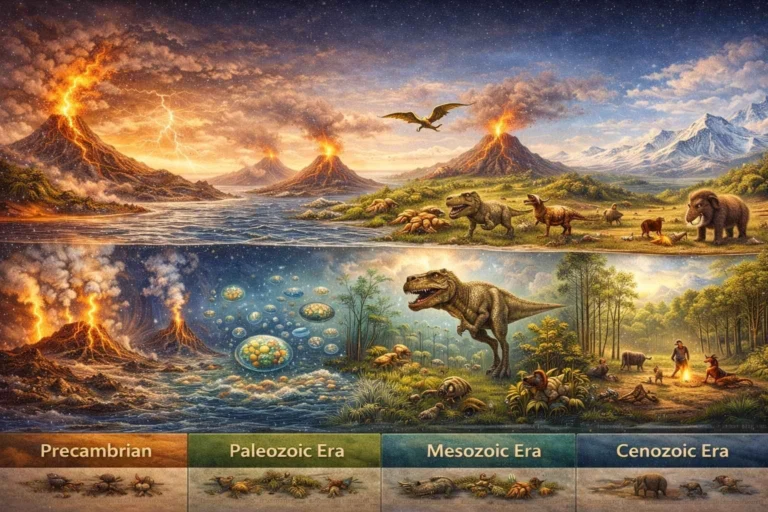
This Eon represents “visible life” and is divided into three major Eras.
The Paleozoic Era (Ancient Life)
- Cambrian Period: Characterized by the Cambrian Explosion, a rapid diversification of marine life.
- Carboniferous Period: High oxygen levels and massive swamp forests led to the formation of global Coal Deposits.
- Permian Period: The supercontinent Pangea was fully formed. It ended with the Permian-Triassic Extinction, the largest mass extinction in history.
The Mesozoic Era (Age of Reptiles)
- Triassic Period: Rise of the first dinosaurs and mammals.
- Jurassic Period: Pangea began to break into Laurasia and Gondwanaland.
- Cretaceous Period: Ended with the K-Pg Extinction (asteroid impact). In India, this period saw massive volcanic fissure eruptions forming the Deccan Traps.
The Cenozoic Era (Age of Mammals)
- Tertiary Period: The Indian Plate collided with the Eurasian Plate, initiating the Himalayan Orogeny.
- Quaternary Period:
- Pleistocene Epoch: Known as the Great Ice Age, marked by repeated glaciations.
- Holocene Epoch: The current “warm” period that allowed for the rise of human civilization.
Crucial Geological Concepts for UPSC
- Orogeny: The process of mountain building. Notable events include the Alpine-Himalayan orogeny in the Cenozoic.
- Differentiation: The process where Earth separated into layers (Crust, Mantle, Core) based on density.
- Degassing: The release of gases like water vapor and carbon dioxide from the interior via volcanism to form the early atmosphere.
Summary Table for Quick Revision
| Era | Period/Epoch | Major Event |
| Cenozoic | Holocene | Rise of Homo Sapiens and civilization. |
| Cenozoic | Tertiary | Formation of the Himalayas. |
| Mesozoic | Cretaceous | Extinction of dinosaurs; Deccan Traps formation. |
| Paleozoic | Carboniferous | Accumulation of Coal reserves. |
| Pre-Cambrian | Archean | Formation of Oceans and First Life. |
UPSC Prelims: PYQs & Practice Questions
Previous Year Questions (Prelims)
Question 1 (2014)
Q: Which of the following phenomena might have influenced the evolution of organisms?
1. Continental drift
2. Glacial cycles
Select the correct answer using the code given below:
(a) 1 only
(b) 2 only
(c) Both 1 and 2
(d) Neither 1 nor 2
Answer: (c)
Explanation: Both continental drift and glacial cycles altered climates, habitats, sea levels, and migration routes, forcing organisms to adapt, migrate, or undergo evolutionary change.
Question 2 (UPSC Standard Practice)
Q: The term “Anthropocene” is often discussed in environmental contexts. Which division of the Geological Time Scale does it most closely relate to?
(a) Mesozoic Era
(b) Paleozoic Era
(c) Holocene Epoch
(d) Archean Eon
Answer: (c)
Explanation: The Anthropocene is a proposed epoch highlighting significant human influence on Earth’s systems and is generally considered as succeeding the Holocene Epoch (which began about 11,700 years ago).
Practice Questions (Prelims)
Question 1
Q: Arrange the following Geological Eras in chronological order (Oldest to Newest):
1. Mesozoic
2. Paleozoic
3. Cenozoic
4. Pre-Cambrian
Select the correct sequence:
(a) 4-1-2-3
(b) 4-2-1-3
(c) 2-4-1-3
(d) 4-2-3-1
Answer: (b)
Explanation: The correct order is Pre-Cambrian (earliest), Paleozoic (ancient life), Mesozoic (age of reptiles), and Cenozoic (age of mammals).
Question 2
Q: During which Eon did the “Great Oxidation Event” occur, fundamentally changing the Earth’s atmosphere?
(a) Hadean
(b) Archean
(c) Proterozoic
(d) Phanerozoic
Answer: (c)
Explanation: The Great Oxidation Event occurred during the Proterozoic Eon when cyanobacteria released oxygen through photosynthesis. After oxygen sinks were saturated, oxygen accumulated in the atmosphere and later enabled ozone formation.
UPSC Mains – Previous Year & Practice Questions
Mains Standard Questions
Carboniferous Period and Energy Resources
Question: Explain the significance of the Carboniferous Period in the context of the world’s current energy resources. (150 words)
Cenozoic Era and Indian Physical Geography
Question: “The Cenozoic Era is the most significant for Indian Physical Geography.” Justify this statement with reference to the Himalayan Orogeny. (250 words)
Cambrian Explosion
Question: Describe the major biological and geological changes that occurred during the Cambrian Explosion. (150 words)
Big Splat Theory and Moon Formation
Question: Analyze the role of the ‘Big Splat’ theory in the formation of the Moon and its impact on the early Earth’s rotation. (150 words)
Archean vs Proterozoic Eons
Question: Differentiate between the geological conditions of the Archean and Proterozoic Eons. (250 words)
Mains Practice Questions
Geological Time Scale & Biological Revolutions
Question: “The Geological Time Scale is not just a measure of time, but a record of mass extinctions and biological revolutions.” Evaluate. (250 words)
Pleistocene Ice Age & Indian Biodiversity
Question: Discuss the impact of the Pleistocene Ice Age on the current distribution of flora and fauna in the Indian subcontinent. (250 words)
Differentiation & Earth’s Layered Structure
Question: Examine the process of ‘Differentiation’ and how it led to the formation of the Earth’s layered structure. (150 words)
The Geological Time Scale: A Comprehensive UPSC Guide - FAQs
Why are the Himalayas called 'Young Fold Mountains'?
They were formed during the Tertiary Period of the Cenozoic Era (roughly 50 million years ago) due to the collision of the Indian Plate with the Eurasian Plate.
What happened during the 'Permian-Triassic Extinction'?
Known as the “Great Dying,” it was the most severe mass extinction in Earth’s history, occurring roughly 252 million years ago and clearing the way for the rise of dinosaurs in the Mesozoic Era.
What are 'Cratons'?
Cratons are old and stable parts of the continental lithosphere (like the Indian Peninsular Block) that have remained relatively undisturbed since the Pre-Cambrian era.
How did the Oceans form?
As the Earth cooled during the Archean Eon, water vapor from volcanic degassing condensed and fell as rain, filling the massive depressions on the surface to create the Hydrosphere.
What is the 'Holocene'?
The Holocene is the current epoch of the Quaternary Period. It began approximately 11,700 years ago after the last major ice age and is characterized by a stable climate that allowed human civilization to flourish.