Table of Contents
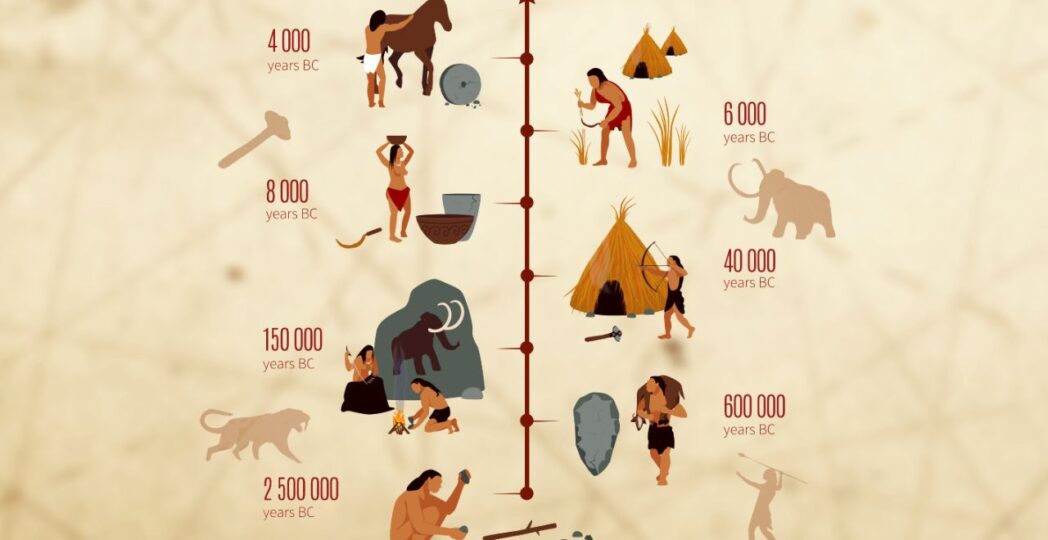
ToggleThe Prehistoric Period refers to the time before the invention of writing and script. Since no written records are available, our knowledge of this period comes mainly from archaeological excavations, tools, rock paintings, cave dwellings, pottery, bones, and other material remains.
In India, the prehistoric period is broadly classified into Stone Age, Chalcolithic Age, and Iron Age, based on the type of tools used and the subsistence pattern of humans.
Why is this topic important for UPSC?
- Prelims: Questions are often factual (sites, tools, paintings, agriculture, pottery).
- Mains: Questions are analytical (transition from food gathering → food production, significance of Neolithic revolution, social change in Chalcolithic age).
- Extra edge: Prehistoric art & archaeology also connects with Culture part of GS I and Anthropology optional.
Chronological Classification of Prehistoric India
- Paleolithic Period (Old Stone Age): 500,000 BCE – 10,000 BCE
- Mesolithic Period (Late Stone Age): 10,000 BCE – 6,000 BCE
- Neolithic Period (New Stone Age): 6,000 BCE – 1,000 BCE
- Chalcolithic Period (Stone–Copper Age): 3,000 BCE – 500 BCE
- Iron Age: 1,500 BCE – 200 BCE
Quick Chronology (Mnemonic: “People Make New Changes Instantly”)
Key Archaeologist: Robert Bruce Foote, known as the “Father of Indian Prehistory”, discovered the first Paleolithic tool in India (the Pallavaram Handaxe in Tamil Nadu, 1863).
Stone Age in India
The Stone Age is divided into three major phases:
- Palaeolithic Age (Old Stone Age)
- Mesolithic Age (Middle Stone Age)
- Neolithic Age (New Stone Age)
1. Palaeolithic Age (Old Stone Age)
Period: 500,000 BCE – 10,000 BCE
- Derived from the Greek words “palaeo” (old) + “lithic” (stone).
- Belongs to the Pleistocene (Ice Age).
- People were hunter-gatherers living in caves, open-air sites, and rock shelters.
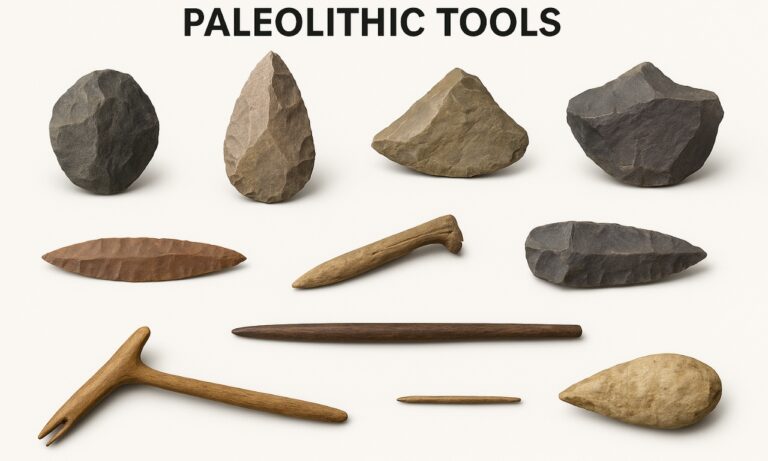
- Tools: Unpolished, crude stone tools like hand axes, cleavers, choppers, scrapers, burins.
- People are also called Quartzite Men, since tools were made from quartzite.
- No agriculture, pottery, or permanent housing.
- Fire was discovered in the later stages.
Rock art (paintings) begins in the Upper Palaeolithic phase.
Phases of the Palaeolithic Age
- Lower Palaeolithic (up to 100,000 BCE)
- Tools: Hand axes, cleavers, choppers.
- Sites: Bori (Maharashtra), Soan Valley (Pakistan), Belan Valley (U.P.), Bhimbetka (M.P.), Chotanagpur Plateau, Deccan Plateau.
- Tools: Hand axes, cleavers, choppers.
- Middle Palaeolithic (100,000 BCE – 40,000 BCE)
- Tools: Smaller and lighter – flakes, blades, scrapers, borers.
- Sites: Belan Valley, Luni Valley (Rajasthan), Son & Narmada Valleys, Bhimbetka, Tungabhadra Valley, Sanghao Cave (Pakistan).
- Tools: Smaller and lighter – flakes, blades, scrapers, borers.
- Upper Palaeolithic (40,000 BCE – 10,000 BCE)
- Climate became warmer.
- Emergence of Homo sapiens.
- Tools: Bone tools (needles, harpoons), blades, burins.
- Climate became warmer.
Sites: Bhimbetka (rock paintings), Kurnool caves (A.P.), Muchchatla Chintamani Gavi (A.P.), Orissa, Eastern Ghats.
PHASES OF PALAEOLITHIC AGE
| Phase | Timeline | Tools | Sites | Climate |
|---|---|---|---|---|
| Lower | Up to 100,000 BCE | Heavy tools (hand axe, cleaver, chopper) | Bori (MH), Soan Valley, Thar, Kashmir, Bhimbetka | Harsh Ice Age |
| Middle | 100,000 – 40,000 BCE | Flakes, scrapers, borers | Belan (UP), Luni (Raj), Son, Narmada, Bhimbetka | Slightly better |
| Upper | 40,000 – 10,000 BCE | Bone tools, blades, harpoons, needles | Bhimbetka (art), Kurnool, Muchchatla Chintamani Gavi (AP) | Warmer; emergence of Homo sapiens |
2. Mesolithic Age (Middle Stone Age)
Period: 10,000 BCE – 6,000 BCE
- Transition phase between Palaeolithic hunters and Neolithic farmers.
- Belongs to the Holocene Era (warmer climate, melting of ice).
- Tools: Microliths – small, sharp stone tools of geometric shapes, used as spearheads, arrowheads, sickles.
- Subsistence: Hunting, fishing, food gathering → gradual domestication of animals (dog first, then sheep & goat).
- First signs of agriculture and semi-permanent settlements.
- Burial practices suggest belief in life after death.
- Transition phase between Palaeolithic hunters and Neolithic farmers.
Important Mesolithic Sites
- Bagor (Rajasthan): Largest Mesolithic site; evidence of domesticated animals.
- Adamgarh (M.P.): Earliest evidence of animal domestication.
- Bhimbetka (M.P.): Rock art sites.
- Langhnaj (Gujarat): Skeletons + microliths.
- Kaimur (U.P.): Pottery evidence.
Sundargarh (Odisha), Ezhuthu Guha (Kerala): Rock paintings.
3. Neolithic Age (New Stone Age)
Period: 6,000 BCE – 1,000 BCE
- Derived from “neo” (new) + “lithic” (stone).
- Known as the Neolithic Revolution – transition from food-gathering → food-producing economy.
- Agriculture begins: Rice, ragi, horse gram.
- Domestication: Cattle, sheep, goats.
- Pottery: Handmade → later wheel-made. Black-burnished ware, grey ware.
- Settlements: Circular/rectangular mud houses, pit dwellings in Kashmir.
- Spinning & weaving: Cotton, wool.
Tools: Polished stone tools (celts), microliths, bone tools.
Important Neolithic Sites
- Mehrgarh (Pakistan): Earliest site, evidence of cotton cultivation.
- Koldihwa & Mahagara (U.P.): Oldest rice evidence.
- Burzahom (Kashmir): Pit dwellings, dog burial with humans.
- Gufkral (Kashmir): Pit houses + tools.
- Chirand (Bihar): Bone tools.
- Hallur, Maski, Piklihal (Karnataka): Cattle herding, ash mounds.
Belan Valley (U.P.): Sequential evidence of Palaeolithic → Mesolithic → Neolithic.
Chalcolithic Age (Copper Age)
Period: 3,000 BCE – 500 BCE
- First use of metal (copper) along with stone tools.
- Marked by the emergence of village economy.
- Agriculture: Wheat, rice, pulses, bajra, cotton.
- Domestication: Cow, buffalo, sheep, goat, pig.
- Pottery: Black & Red Ware (BRW), Ochre-Coloured Pottery (OCP).
- Settlements: Rural, mud houses, round and rectangular huts.
- Art & Craft: Spinning, weaving, bead-making, copper smelting.
- Religion: Worship of Mother Goddess, bull cult.
Social inequality begins (chiefs in big houses).
Important Chalcolithic Sites
- Ahar & Gilund (Rajasthan): Copper smelting, rice cultivation.
- Daimabad (Maharashtra): Bronze figurines (rhinoceros, elephant, chariot).
- Navdatoli (M.P.): Large settlement on Narmada.
- Kayatha (M.P.): Pre-Harappan pottery, copper tools.
- Malwa (M.P.): Rich ceramics, spindle whorls.
- Inamgaon (Maharashtra): Pit houses, large settlement.
Chirand (Bihar), Mahishdal (Bengal): Regional Chalcolithic cultures.
Iron Age in India
Period: 1,500 BCE – 200 BCE
- Iron tools & weapons revolutionized agriculture and warfare.
- Early use found in Ataranjikhera (U.P.), Hallur (Karnataka).
- Linked to the emergence of Megalithic culture in South India.
Iron technology paved the way for urbanization in the Ganga Valley, leading to the Mahajanapadas.
PYQs & Practice Questions
Prelims Questions
Prehistory PYQs & Practice
Which of the following characterizes the people of the Indus Civilization?
- They worshipped Mother Goddess.
- They domesticated the horse.
- They used polished stone tools.
- They domesticated cattle.
Show Answer
Correct: 1 & 4
Note: Horse domestication is doubtful; polished stone tools are a Neolithic trait.
Which of the following is/are sites of Mesolithic rock paintings?
- Bhimbetka
- Adamgarh
- Bagor
Show Answer
Correct: 1 & 2 (Bhimbetka & Adamgarh)
With reference to the history of India, the terms ‘Eripatti’, ‘Taniyurs’ and ‘Ghatikas’ are used in the context of:
- Administration of villages
- Land revenue system
- Education institutions
- Religious practices
Show Answer
Correct: (a) Administration of villages
Relevance: Reflects evolution of rural institutions from Chalcolithic/early historic foundations.
Which site provides the earliest evidence of rice cultivation in the world?
- Mehrgarh
- Koldihwa
- Daimabad
- Chirand
Show Answer
Correct: (b) Koldihwa
Microliths are associated with which prehistoric phase?
- Lower Palaeolithic
- Mesolithic
- Neolithic
- Chalcolithic
Show Answer
Correct: (b) Mesolithic
The Burzahom site in Kashmir is famous for:
- Rock paintings
- Pit dwellings and dog burials
- Bronze figurines
- Ochre pottery
Show Answer
Correct: (b) Pit dwellings and dog burials
Mains Questions
PYQs
Practice Questions
Frequently Asked Questions (FAQs)
What is the Prehistoric Period in India?
The Prehistoric Period in India refers to the time before the invention of writing. Knowledge of this era comes from archaeological remains, tools, pottery, rock art, and fossils. It is divided into the Stone Age, Chalcolithic Age, and Iron Age.
What are the three phases of the Stone Age in India?
The Stone Age is divided into:
- Palaeolithic Age – crude stone tools, hunting-gathering, no agriculture.
- Mesolithic Age – microliths, animal domestication, early agriculture.
- Neolithic Age – polished tools, pottery, settled agriculture.
Which sites are important for the Palaeolithic Age in India?
Key Palaeolithic sites include:
- Bori (Maharashtra), Soan Valley (Pakistan), Belan Valley (U.P.), Bhimbetka (M.P.), Chotanagpur Plateau, Tungabhadra Valley (Karnataka), Kurnool Caves (A.P.).
What is the significance of the Neolithic Revolution in India?
The Neolithic Revolution marked the shift from food-gathering to food-producing. It introduced agriculture, domestication of animals, permanent settlements, pottery, and weaving, laying the foundation for village life and later civilizations.
Who is called the “Father of Indian Prehistory”?
Robert Bruce Foote is known as the “Father of Indian Prehistory.” In 1863, he discovered the first Palaeolithic hand axe at Pallavaram, Tamil Nadu.