Table of Contents
ToggleIndia and Bhutan share one of the most stable, trust-based, and strategically significant bilateral relationships in South Asia — often described as the “model bilateral” of India’s Neighbourhood First Policy. Unlike most of India’s neighbourhood relationships which are marked by periodic tensions, boundary disputes, and great power competition, the India-Bhutan bilateral has demonstrated remarkable continuity, mutual respect, and civilisational warmth across decades. For UPSC aspirants studying GS Paper 2 and PSIR Paper 2 Section B, India-Bhutan relations offer a compelling case study of how small state diplomacy, hydropower economics, security partnerships, and civilisational bonds create a uniquely resilient bilateral framework in an increasingly competitive strategic environment.
Historical Background: Ancient Civilisational and Religious Bonds
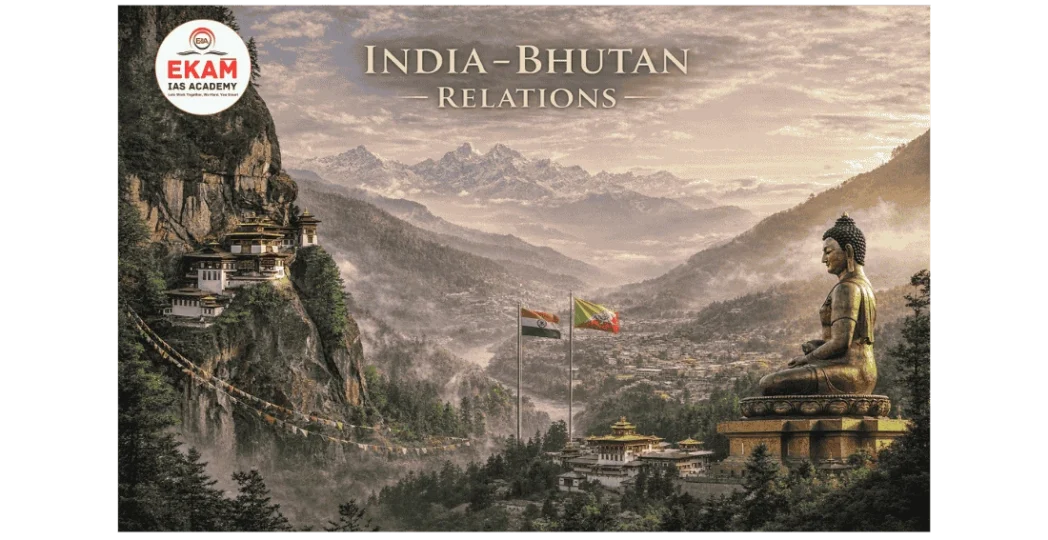
The foundation of India-Bhutan civilisational connection stretches back over a thousand years through shared Buddhist religious heritage. Bhutan’s Vajrayana Buddhist tradition — the dominant religion and cultural identity of the Drukpa people — has deep roots in Indian Buddhist traditions originating in the Nalanda and Vikramshila universities of ancient India. The legendary Guru Padmasambhava (Guru Rinpoche), credited with bringing Buddhism to Bhutan in the 8th century AD, travelled from northeastern India through the Himalayan passes — establishing the civilisational bridge between the two cultures that endures to this day. The sacred Taktsang Monastery (Tiger’s Nest) — perched dramatically on a Bhutanese cliff face — symbolises this ancient Indian-Bhutanese spiritual connection.
During the colonial period, Bhutan maintained its independence and sovereignty — a remarkable achievement in a region where British India systematically absorbed or subordinated its neighbours. The Treaty of Sinchula (1865) between Bhutan and British India defined their relationship after the Duar War, with Britain receiving certain Duars (lowland territories) in exchange for providing Bhutan an annual subsidy. This established the pattern of a special economic relationship underpinning Bhutan’s security arrangements with the dominant power in the subcontinent — a pattern that continued seamlessly into the post-independence era.
Post-Independence Framework: From 1949 Treaty to 2007 Modernisation
The Treaty of Friendship and Cooperation signed on August 8, 1949 established the post-independence bilateral framework. The treaty’s most debated provision was Article 2 — stating that Bhutan would be “guided by the advice of the Government of India” in its external relations. While India characterised this as a security partnership, international observers and Bhutanese nationalists viewed it as rendering Bhutan a semi-protectorate — limiting full sovereign independence in foreign policy.
This framework was fundamentally transformed by the revised India-Bhutan Friendship Treaty signed on February 8, 2007, during Prime Minister Manmohan Singh’s historic visit to Thimphu. The 2007 treaty explicitly recognised Bhutan as a fully sovereign and independent state with the right to conduct its own foreign policy. The critical provision established a mutual obligation — neither country would allow its territory to be used for activities “inimical to the national interests and security” of the other. This revision transformed the bilateral from an asymmetric patron-client arrangement to a modern partnership between sovereign equals — the most significant institutional evolution in the bilateral’s history.
Key Pillars of India-Bhutan Bilateral Relations
Hydropower cooperation stands as the most economically transformative pillar. Bhutan possesses approximately 24,000 MW of technically and economically feasible hydropower potential — fed by fast-flowing Himalayan rivers. India is the exclusive buyer of Bhutan’s surplus electricity, and hydropower revenues constitute approximately 25–30% of Bhutan’s GDP and over 40% of government revenue — funding Bhutan’s remarkable free healthcare, free education, and social welfare programmes. Key operational projects include the Tala Hydropower Project (1,020 MW), Chukha Project (336 MW), and Mangdechhu Project (720 MW) commissioned in 2019. However, the under-development Punatsangchhu I and II projects have faced massive cost overruns, creating significant Bhutanese debt to India — a growing source of bilateral tension that requires sensitive diplomatic management.
Security partnership forms the second critical pillar. India has provided Bhutan a comprehensive security umbrella since 1949 — training and equipping the Royal Bhutan Army (RBA) through the IMTRAT (Indian Military Training Team) stationed permanently in Bhutan since 1961. Bhutanese military officers are trained at IMA Dehradun and NDA Pune. The operational significance of this security partnership was dramatically demonstrated during the Doklam Standoff of June–August 2017 — when India physically intervened to stop Chinese People’s Liberation Army (PLA) road construction in the Doklam plateau — a territory claimed by Bhutan. India maintained a 73-day military standoff with China before a diplomatic resolution was achieved — demonstrating its strategic commitment to Bhutan’s territorial integrity.
The Doklam plateau’s strategic significance for India extends beyond bilateral obligation. Doklam overlooks the Siliguri Corridor (Chicken’s Neck) — a 20–22 km narrow strip connecting mainland India to its eight northeastern states. Chinese military infrastructure at Doklam would directly threaten this critical geographic artery — making Bhutan’s territorial sovereignty over Doklam a direct Indian national security interest, not merely a friendship obligation.
Development partnership constitutes the third pillar. India has financed Bhutan’s development across every Five Year Plan since 1961 — making it the single largest development partner in Bhutan’s history. Indian-funded projects include virtually all major road infrastructure, hospitals, schools, airports, and telecommunications across Bhutan. This partnership uniquely aligns with Bhutan’s GNH (Gross National Happiness) framework — the distinctive development philosophy introduced by the Fourth King Jigme Singye Wangchuck — prioritising environmental conservation, cultural preservation, good governance, and holistic wellbeing over pure GDP metrics. India’s development assistance respects this GNH philosophy, making the development partnership a model of South-South Cooperation rather than a donor-recipient relationship.
Trade and economic integration forms the fourth pillar. India accounts for approximately 90% of Bhutan’s total trade — making Bhutan one of the most economically dependent small states in the world. Phuentsholing — Bhutan’s primary border town facing India’s Jaigaon in West Bengal — functions as the trade gateway through which virtually all Bhutanese international commerce flows. The India-Bhutan Free Trade Agreement provides Bhutanese goods duty-free access to India’s vast market. The fixed exchange rate mechanism — with the Bhutanese Ngultrum pegged at par to the Indian Rupee — reflects the extraordinary monetary integration of the two economies.
The China Factor: Emerging Strategic Challenge
The most significant contemporary challenge in India-Bhutan relations is the China factor. China and Bhutan share a 470 km border but have no formal diplomatic relations — a unique geopolitical situation reflecting the unresolved China-Bhutan boundary dispute. China and Bhutan have conducted over 24 rounds of boundary negotiations since 1984 without final settlement. In October 2021, China and Bhutan signed a Memorandum of Understanding on the Three-Step Roadmap for boundary settlement — without prior consultation with India. This development created serious strategic concern in New Delhi.
China has reportedly offered Bhutan a “package deal” — conceding certain territories in eastern Bhutan in exchange for Bhutan conceding the Doklam plateau in the west. For India, any Bhutanese concession of Doklam to China — even through a legitimate sovereign boundary settlement — would place Chinese military forces directly overlooking the Siliguri Corridor, India’s most strategically vulnerable geography. India’s challenge is that under the 2007 Friendship Treaty, it cannot legally veto Bhutan’s sovereign boundary decisions — it can only offer security guarantees and economic incentives to influence Bhutan’s choices.
Current Events: Recent Developments (2020–2025)
Recent bilateral developments show deepening economic cooperation alongside strategic recalibration. PM Modi’s first foreign visit after his 2019 re-election was to Bhutan — a powerful symbolic statement of Bhutan’s priority in India’s foreign policy. The transformative Gelephu Mindfulness City project — Bhutan’s ambitious plan to develop a Special Administrative Region (SAR) on the India-Bhutan border in southern Bhutan adjoining Assam — represents the most exciting contemporary opportunity in the bilateral. India has enthusiastically supported this project as a joint economic development initiative that could transform the India-Bhutan border region into a South Asian economic hub. India has also committed to converting a greater proportion of development assistance from loans to grants — directly addressing Bhutan’s hydropower debt burden concern. The Agnipath Scheme controversy (2022) created a temporary bilateral friction — Nepal and Bhutan both expressed concerns about reduced Gurkha and bilateral military recruitment opportunities under the short-term service model.
India's Current Stand and Strategic Approach
India’s current approach to Bhutan reflects the Neighbourhood First Policy’s deepest strategic logic — recognising that a stable, prosperous, and India-aligned Bhutan is not merely a diplomatic preference but a strategic necessity for India’s Himalayan security architecture. India’s strategic goals in the bilateral include: preventing Bhutan from becoming a Chinese strategic outpost on India’s sensitive northern border; maintaining the security partnership through IMTRAT and military cooperation; deepening economic integration through hydropower, trade, and the Gelephu project; and engaging Bhutan’s sovereign aspirations — including its China boundary negotiations — with diplomatic sophistication rather than pressure.
As C. Raja Mohan observes, India must approach Bhutan with “calibrated generosity” — offering a bilateral relationship “more attractive than China’s” through genuine economic partnership. Harsh V. Pant argues that India’s Bhutan policy must evolve from patron-client dynamics to genuine strategic partnership — respecting Bhutan’s full sovereign aspirations while maintaining the security architecture protecting both nations’ interests. S. Jaishankar describes India-Bhutan relations as built on “trust, mutual respect, and shared destiny” — a foundation that must be consciously nurtured in an era of increasing great power competition in the Himalayan region.
Conclusion
India-Bhutan relations represent the most successful manifestation of India’s civilisational diplomacy — binding two nations through Buddhist heritage, hydropower economics, security partnership, and genuine mutual respect across seven decades of consistent bilateral engagement. The emergence of the China factor through boundary negotiations and the Three-Step Roadmap (2021) has added new strategic urgency to what was previously managed as a largely harmonious bilateral. The Gelephu Mindfulness City and the 10,000 MW hydropower commitment represent the most promising pathways for deepening the bilateral’s economic foundation. For UPSC aspirants, India-Bhutan relations offer the richest single case study of how small state sovereignty, Himalayan strategic geography, energy economics, civilisational bonds, and great power competition simultaneously shape a bilateral relationship in the 21st century multipolar world order.
UPSC Prelims: PYQs & Practice Questions
Previous Year Questions (Prelims)
Q1. [UPSC CSE Prelims 2013]
Q: With reference to the India-Bhutan Friendship Treaty, which of the following statements is/are correct?
1. The original Treaty of Friendship (1949) required Bhutan to be guided by India in its foreign policy.
2. The revised India-Bhutan Friendship Treaty (2007) replaced the 1949 treaty and recognised Bhutan's full sovereign equality.
3. Under the 2007 treaty, Bhutan is required to align its foreign policy with India's positions at all international forums.
Which of the above statements is/are correct?
(a) 1 only
(b) 1 and 2 only
(c) 2 and 3 only
(d) 1, 2 and 3
Answer: (b) 1 and 2 only
Explanation: The Treaty of Friendship (1949) contained Article 2 under which Bhutan was to be guided by India in its external relations. The revised India-Bhutan Friendship Treaty signed in 2007 replaced that framework and recognised Bhutan as a fully sovereign and equal state. Hence Statements 1 and 2 are correct. Statement 3 is incorrect because the 2007 revision removed the foreign policy guidance clause and did not require Bhutan to align its diplomacy with India.
Q2. [UPSC CSE Prelims 2015]
Q: The 'Doklam standoff (2017)' between India and China was triggered by which of the following events?
(a) China building a road in Indian territory near Sikkim
(b) China constructing a road in the Doklam plateau — a territory claimed by Bhutan — which India opposed on Bhutan's behalf under bilateral security commitments
(c) India constructing military infrastructure in Chinese-claimed territory
(d) Bhutan inviting Indian troops to occupy Chinese territory
Answer: (b) China constructing a road in the Doklam plateau — a territory claimed by Bhutan — which India opposed on Bhutan's behalf under bilateral security commitments
Explanation: The Doklam standoff of 2017 began when China attempted to extend a road in the Doklam plateau, a disputed area claimed by Bhutan at the India-Bhutan-China trijunction. India intervened to stop the construction, citing its security interests and its close treaty-based relationship with Bhutan. The standoff lasted 73 days and highlighted the strategic importance of Doklam, especially because of its proximity to the Siliguri Corridor.
Practice Questions
Q1.
Q: Which of the following best describes India's development assistance model with Bhutan under the Five Year Plans?
(a) India provides only military assistance to Bhutan with no development financing
(b) India finances Bhutan's development through grants and loans aligned with each of Bhutan's Five Year Plans covering infrastructure, education, health, and hydropower
(c) India and Bhutan have a joint development planning commission that manages both countries' budgets
(d) India's development assistance to Bhutan is exclusively channelled through World Bank programmes
Answer: (b) India finances Bhutan's development through grants and loans aligned with each of Bhutan's Five Year Plans covering infrastructure, education, health, and hydropower
Explanation:
India's development partnership with Bhutan is uniquely structured around Bhutan's own Five Year Plans — reflecting India's respect for Bhutan's developmental sovereignty. India provides grants and concessional loans for infrastructure development (roads, bridges, airports), education (schools, colleges, scholarships), health (hospitals, medical training), hydropower projects, and ICT infrastructure. India has been the single largest development partner across all of Bhutan's Five Year Plans since the First Five Year Plan (1961–66). This model is distinctive because it aligns with Bhutan's priorities rather than imposing Indian development conditionalities — reflecting the "elder brother" model of development partnership that characterises India-Bhutan bilateral relations at their best.
Q2.
Q: The 'Phuentsholing' town is significant in the context of India-Bhutan bilateral trade because:
(a) It is Bhutan's capital city where the Indian Embassy is located
(b) It is the primary land border crossing and trade gateway between India and Bhutan on the India-Bhutan border
(c) It is where the India-Bhutan hydropower control centre is located
(d) It is a disputed territory between India and Bhutan
Answer: (b) It is the primary land border crossing and trade gateway between India and Bhutan
Explanation:
Phuentsholing — located at the India-Bhutan border facing Jaigaon in West Bengal — is the most important trade gateway between India and Bhutan. Virtually all of Bhutan's international trade flows through Phuentsholing — goods enter and exit Bhutan primarily through this crossing before connecting to Indian road and rail networks. The town exemplifies the economic integration of border communities — Phuentsholing and Jaigaon function as a single economic zone with constant cross-border movement of people and goods. India's development of road connectivity to Phuentsholing is therefore directly linked to Bhutan's economic lifeline. The Indian Embassy is located in Thimphu (Bhutan's capital), not Phuentsholing — making option (a) wrong.



UPSC Mains – Previous Year & Practice Questions
Mains Previous Year Questions
Q1. [UPSC CSE Mains GS2 2015 | 12.5 Marks]
Question: "India-Bhutan bilateral relations are often described as a model for India's neighbourhood policy." Examine the key pillars of India-Bhutan relations and assess whether this characterisation is accurate.
Q2. [UPSC CSE Mains GS2 2017 | 15 Marks]
Question: The Doklam standoff (2017) revealed both the strength of India-Bhutan security partnership and the complexity of the India-China-Bhutan triangular relationship. Critically analyse.
Q3. [UPSC CSE Mains GS2 2019 | 15 Marks]
Question: Examine hydropower cooperation as the cornerstone of India-Bhutan bilateral relations. What are the opportunities and challenges in this partnership?
Q4. [UPSC CSE Mains GS2 2021 | 15 Marks]
Question: "China-Bhutan boundary negotiations present India with a strategic dilemma — support Bhutan's sovereignty aspirations while protecting India's own security interests in Doklam." Analyse India's options.
Q5. [UPSC CSE Mains GS2 2023 | 20 Marks]
Question: "India-Bhutan relations, despite being described as a model bilateral, face structural challenges that require urgent policy recalibration." Critically examine the challenges and suggest a comprehensive bilateral reset framework.
Mains Practice Questions
Q1. [PSIR Paper 2 / GS2 | 20 Marks]
Question: "The India-Bhutan security partnership is India's most strategically critical neighbourhood bilateral — yet it is increasingly tested by Bhutan's sovereign aspirations and China's diplomatic overtures." Critically evaluate.
Q2. [GS Paper 2 | 15 Marks]
Question: Examine how India's development partnership with Bhutan reflects the principles of South-South Cooperation and what lessons it offers for India's broader neighbourhood development diplomacy.
Q3. [PSIR Paper 2 | 20 Marks]
Question: "The China factor in India-Bhutan relations has transformed what was once a purely bilateral relationship into a complex trilateral strategic dynamic." Analyse this transformation and its implications for India's broader China strategy.