Table of Contents
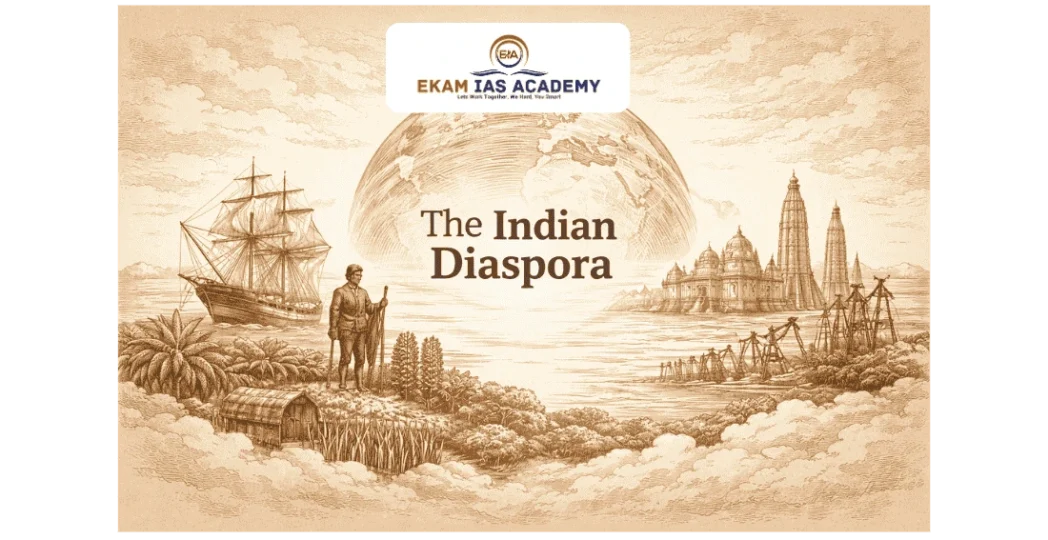
ToggleThe Indian Diaspora represents one of the most powerful and strategically significant transnational communities in the world. With over 32 million people of Indian origin spread across more than 190 countries, the Indian Diaspora is the largest diaspora globally — surpassing even the Chinese diaspora in terms of geographic spread and economic influence. For UPSC aspirants studying GS Paper 2 and PSIR Paper 2 Section B, understanding the Indian Diaspora is essential — it sits at the intersection of foreign policy, soft power, economic diplomacy, and cultural identity.
Historical Background: Waves of Indian Migration
The story of the Indian Diaspora unfolds across three distinct historical waves, each shaped by vastly different political and economic circumstances.
The First Wave — the Indentured Labour System (1830s–1917) — was born out of the brutal logic of British colonial economics. After the abolition of slavery in 1833, the British Empire needed cheap labour for its sugar, tea, and rubber plantations across the Caribbean, Africa, and Southeast Asia. Indians — predominantly from Bihar, Uttar Pradesh, and Tamil Nadu — were transported under the Girmit system (indenture system) to Fiji, Trinidad and Tobago, Mauritius, Guyana, South Africa, and Malaysia. These communities, known as the ‘Girmitiyas’, endured extreme exploitation and formed the foundation of what is today called the ‘Old Diaspora’. Despite their hardships, they built deeply rooted communities that preserved Indian culture, language, and religious traditions across generations. Mahatma Gandhi’s political awakening began precisely among this indentured Indian community in South Africa, making the diaspora’s struggle inseparable from India’s own independence movement.
The Second Wave — Post-Independence Professional Migration (1950s–1980s) — was driven by education and professional opportunity. Highly skilled Indians — doctors, engineers, scientists, and academics — migrated primarily to the United Kingdom, United States, and Canada, forming what is known as the ‘brain drain’ phenomenon. The United States Immigration Act of 1965, which removed national-origin quotas, opened the floodgates for Indian professional migration to America. This wave produced the foundation of today’s Indian-American community, which is widely recognised as the most educated and highest-earning ethnic group in the United States.
The Third Wave — Gulf Migration and IT Revolution (1970s–present) — had two distinct streams. The oil boom in the Gulf Cooperation Council (GCC) countries from the 1970s onwards drew millions of blue-collar Indian workers — particularly from Kerala, Andhra Pradesh, and Tamil Nadu — to the UAE, Saudi Arabia, Kuwait, Qatar, Bahrain, and Oman. These workers became the backbone of Gulf construction and service industries and simultaneously transformed the Indian economy through remittances. The Information Technology revolution of the 1990s then produced a new class of skilled Indian IT professionals migrating to the USA, UK, Australia, Canada, and Singapore — forming today’s globally influential Indian tech diaspora.
Economic Significance: Remittances and Investment
The economic contribution of the Indian Diaspora is staggering. India has consistently been the world’s largest recipient of remittances, receiving $125 billion in 2023 — surpassing countries like China, Mexico, and the Philippines. Remittances from the Gulf region alone constitute a critical share, with Kerala’s economy being heavily dependent on NRI remittances. Beyond remittances, the Indian Diaspora has emerged as a significant source of Foreign Direct Investment (FDI), particularly through Non-Resident Indian (NRI) investments in real estate, infrastructure, and technology sectors. The Indian-American community, with an average household income significantly above the US national average, represents enormous economic and political capital for India.
Political and Strategic Significance: Diaspora as Foreign Policy Tool
The strategic significance of the Indian Diaspora in India’s foreign policy cannot be overstated. Under Prime Minister Narendra Modi, diaspora engagement was elevated to a core instrument of foreign policy — what scholars call diaspora diplomacy. Modi’s Madison Square Garden event in New York (2014), the Wembley Stadium event in London (2015), and the Sydney cricket ground event in Australia (2014) demonstrated how the Indian Diaspora could be mobilised as a soft power asset and a diplomatic lobby simultaneously.
The Indian-American community has played a decisive role in shaping US policy towards India — from lobbying for the India-US Civil Nuclear Deal to supporting India’s NSG membership bid. The UK’s Indian-origin community has produced Prime Minister Rishi Sunak — the most visible manifestation of Indian diaspora’s political ascendancy in Western democracies. Similarly, Indian-origin leaders have held the positions of Vice President (Kamala Harris — of partial Indian origin), Prime Ministers, and senior cabinet positions across Canada, Portugal, Ireland, and Mauritius.
The Pravasi Bharatiya Divas (PBD) Convention, established in 2003 and held biennially, serves as the primary institutional platform for engagement between the Government of India and its diaspora. The Ministry of External Affairs manages diaspora relations through the Ministry of Overseas Indian Affairs (now merged with MEA), reflecting the mainstreaming of diaspora in India’s foreign policy architecture.
Soft Power and Cultural Diplomacy
The Indian Diaspora is India’s most powerful soft power asset. Bollywood films, classical Indian dance, yoga, Indian cuisine, and festivals like Diwali and Holi have transcended the diaspora community to become globally celebrated cultural phenomena. The global spread of yoga — championed by PM Modi through the establishment of the International Day of Yoga on June 21 by the United Nations in 2014 — is a direct product of diaspora-driven cultural diplomacy. The Indian Institutes of Technology (IIT) alumni networks across Silicon Valley represent a unique form of knowledge diaspora that continues to shape global technology, innovation, and entrepreneurship.
Challenges Facing the Indian Diaspora
Despite its successes, the Indian Diaspora faces significant challenges. Racism and discrimination — from the apartheid faced by Indians in South Africa to hate crimes against Indian-Americans post-9/11 — remain persistent concerns. The kafala system in Gulf countries creates exploitative conditions for Indian migrant workers, often denying them basic labour rights. Brain drain continues to concern Indian policymakers — the emigration of India’s most talented professionals represents a loss of human capital that India’s developmental needs require. The diaspora’s political vulnerability was evident when Indian students were attacked in Australia (2009–2010) and when Indian workers faced job losses in Gulf countries during the COVID-19 pandemic.

India's Current Stand: From Brain Drain to Brain Gain
India’s current policy framework seeks to transform the narrative from brain drain to brain gain — recognising that the diaspora, even while living abroad, contributes enormously through remittances, technology transfer, investment, and diplomatic influence. The Overseas Citizen of India (OCI) card, which provides lifelong visa-free travel and near-citizen rights to persons of Indian origin, is India’s most significant institutional mechanism for diaspora engagement. The Know India Programme (KIP) and Study in India initiatives seek to reconnect second and third-generation diaspora youth with their Indian heritage.
As C. Raja Mohan observes, India’s diaspora is not just an economic asset — it is a civilisational bridge connecting India to the world’s most powerful economies, democracies, and strategic centres. Harsh V. Pant argues that diaspora diplomacy under Modi has transformed the Indian community abroad from a passive cultural group into an active foreign policy constituency.
Conclusion
The Indian Diaspora has evolved from a community of colonial-era indentured labourers to a globally influential network of professionals, entrepreneurs, politicians, and cultural ambassadors. Its $125 billion remittance contribution, its political influence in Western democracies, its role as a soft power carrier, and its function as a diplomatic lobby make it an indispensable asset in India’s 21st century foreign policy. For UPSC aspirants, the Indian Diaspora is not just a topic — it is the living proof that India’s civilisational reach extends far beyond its geographical boundaries.
UPSC Prelims: PYQs & Practice Questions
Previous Year Questions (Prelims)
Q1. [UPSC CSE Prelims 2013]
Q: The Pravasi Bharatiya Divas (PBD) Convention is associated with which of the following?
(a) Celebration of Indian Independence Day abroad
(b) An annual convention for engagement between the Government of India and the Indian Diaspora
(c) A programme to encourage NRIs to return permanently to India
(d) A scheme providing financial assistance to Indian workers in Gulf countries
Answer: (b) An annual convention for engagement between the Government of India and the Indian Diaspora
Explanation: The Pravasi Bharatiya Divas (PBD) Convention was established in 2003 under Prime Minister Atal Bihari Vajpayee and is now held biennially. January 9 was chosen to mark Mahatma Gandhi’s return from South Africa to India in 1915. It serves as the principal institutional platform for engagement between the Government of India and the global Indian diaspora. It is not an Independence Day celebration, return scheme, or financial aid programme.
Q2. [UPSC CSE Prelims 2014]
Q: Which of the following statements about the Overseas Citizen of India (OCI) card is correct?
(a) OCI cardholders have full voting rights in Indian elections
(b) OCI cardholders can hold constitutional posts in India
(c) OCI card provides lifelong visa-free travel to India and near-citizen rights
(d) OCI cardholders can purchase agricultural land in India
Answer: (c) OCI card provides lifelong visa-free travel to India and near-citizen rights
Explanation: The OCI card, introduced under the Citizenship (Amendment) Act, 2005, grants lifelong multiple-entry visa-free travel to India and several near-citizen rights such as the right to work, study, and own non-agricultural property. However, OCI cardholders cannot vote, hold constitutional posts, or purchase agricultural land. It remains one of India’s key institutional mechanisms for diaspora engagement.
Practice Questions
Practice Q1
Q: Which of the following correctly explains the 'Brain Drain to Brain Gain' paradigm shift in India's diaspora policy?
(a) India stopping all emigration of skilled professionals
(b) Recognising that the diaspora contributes through remittances, technology transfer, investment, and diplomatic influence even while living abroad
(c) Requiring all Indian professionals abroad to return to India mandatorily
(d) India banning NRI investments in domestic sectors
Answer: (b) Recognising that the diaspora contributes through remittances, technology transfer, investment, and diplomatic influence even while living abroad
Explanation: The Brain Drain to Brain Gain shift reflects India’s move from seeing emigration as a loss to treating the diaspora as a strategic asset. Indians abroad contribute through remittances, technology transfer, investments, business networks, and diplomatic influence in host countries. Policies like OCI, Pravasi Bharatiya Divas, and active diaspora outreach reflect this new approach.
Practice Q2
Q: The 'Kafala System' in Gulf countries is frequently discussed in the context of the Indian Diaspora because:
(a) It provides special privileges to Indian workers in Gulf countries
(b) It is a sponsorship system that ties migrant workers to their employers, creating exploitative conditions
(c) It is a bilateral agreement between India and GCC for worker welfare
(d) It provides free housing and education to Indian workers in the Gulf
Answer: (b) It is a sponsorship system that ties migrant workers to their employers, creating exploitative conditions
Explanation: The Kafala system is a labour sponsorship framework in many Gulf countries under which a migrant worker’s legal status is tied to the employer (kafeel). This often creates exploitative conditions because workers may be unable to change jobs, leave the country, or seek protection without employer approval. It remains a major concern for Indian migrant workers in the Gulf.



UPSC Mains – Previous Year & Practice Questions
Mains Previous Year Questions
Q1. [UPSC CSE Mains GS2 2015 | 12.5 Marks]
Question: What is the significance of the Indian Diaspora in shaping India's foreign policy? Examine with suitable examples.
Q2. [UPSC CSE Mains GS2 2017 | 15 Marks]
Question: “The Indian Diaspora is both an asset and a liability for India's foreign policy.” Critically examine this statement.
Q3. [UPSC CSE Mains GS2 2019]
Question: Examine the welfare challenges faced by Indian workers in Gulf countries and evaluate India's policy response to protect their interests.
Q4. [UPSC CSE Mains GS2 2021 | 15 Marks]
Question: How has India's diaspora contributed to the country's soft power in international relations? Discuss with reference to culture, politics, and technology.
Q5. [UPSC CSE Mains GS2 2023 | 20 Marks]
Question: “From indentured labour to global leadership — the Indian Diaspora's journey mirrors India's own transformation as a rising power.” Substantiate this statement with historical and contemporary evidence.
Mains Practice Questions
Q1. [PSIR Paper 2 / GS2 | 20 Marks]
Question: “India's diaspora diplomacy under PM Modi has transformed the Indian community abroad from a passive cultural group into an active foreign policy constituency.” Critically evaluate this transformation and its implications for India's international standing.
Q2. [GS Paper 2 | 15 Marks]
Question: Examine the economic significance of Indian remittances and their role in India's development strategy. What policy measures can enhance the productive use of remittances?
Q3. [PSIR Paper 2 | 20 Marks]
Question: “The rise of Indian-origin political leaders in Western democracies represents both a triumph of the Indian Diaspora and a complex challenge for India's foreign policy.” Analyse.