Table of Contents
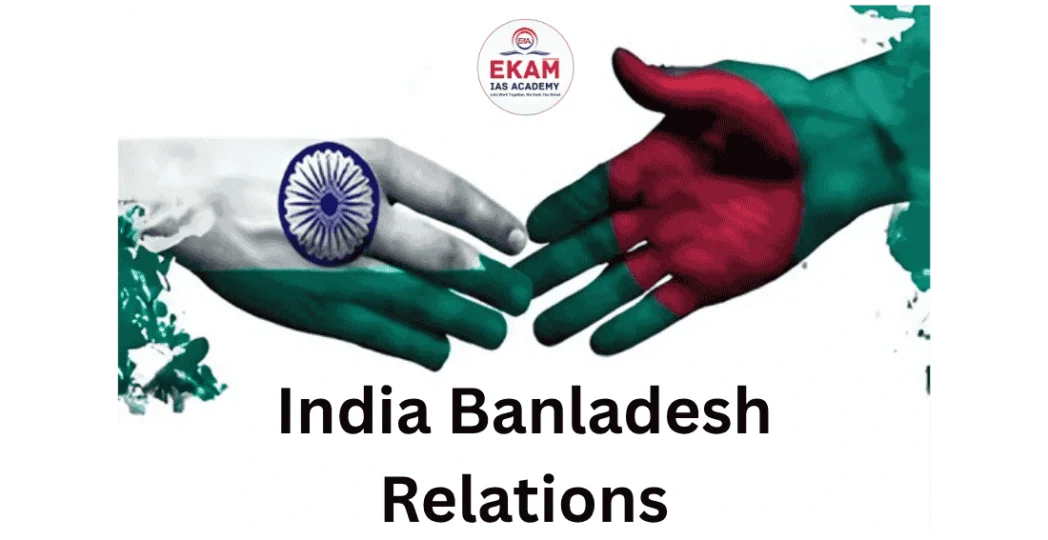
ToggleIndia and Bangladesh share one of the most historically rooted, emotionally connected, and strategically consequential bilateral relationships in South Asia. Born from the shared trauma and triumph of the 1971 Liberation War, the India-Bangladesh bilateral relationship encompasses civilisational bonds, river water interdependence, trade complementarity, security cooperation, and complex geopolitical dynamics involving China’s growing regional influence. For UPSC aspirants studying GS Paper 2 and PSIR Paper 2 Section B, India-Bangladesh relations represent a comprehensive case study of how historical solidarity, geographic interdependence, and great power competition simultaneously shape a neighbourhood bilateral in the 21st century.
Historical Background: Civilisational Roots and Colonial Legacy
The civilisational connection between India and Bangladesh predates the existence of Bangladesh as a nation by millennia. The territory of present-day Bangladesh — historically known as Bengal — shared a continuous cultural, linguistic, religious, and economic existence with the Indian subcontinent. The Bengali language and literature, Tagore’s cultural legacy, shared Sufi traditions, and the Ganges-Brahmaputra river civilisation created an organic unity between the peoples of eastern India and eastern Bengal that no political boundary has fully severed.
The British colonial partition of Bengal in 1905 — later reversed in 1911 — and the catastrophic Partition of 1947 that created East Pakistan as a geographically separated wing of Pakistan, divided communities, families, and civilisational spaces in ways that continue to shape Indo-Bangladesh bilateral dynamics to this day. The Partition of 1947 generated massive refugee flows — millions of Bengali Hindus fled East Pakistan to West Bengal and northeastern India in successive waves, creating demographic and political pressures that remain relevant in contemporary bilateral discussions on migration and citizenship.
1971 Liberation War: The Defining Bilateral Moment
No event defines the India-Bangladesh bilateral relationship more fundamentally than the 1971 Bangladesh Liberation War. When West Pakistan’s military launched Operation Searchlight on March 25, 1971 — beginning a genocidal campaign against Bengali nationalists — millions of Bengali refugees flooded into India. Approximately 10 million refugees entered West Bengal, Assam, Meghalaya, and Tripura, creating an unprecedented humanitarian and security crisis for India.
Prime Minister Indira Gandhi made the historic decision to militarily intervene on December 3, 1971 — transforming what began as a civil war into an India-Pakistan war that lasted only 13 days. India’s decisive military victory led to the surrender of 93,000 Pakistani soldiers on December 16, 1971 — the largest military surrender since World War II — and the creation of Bangladesh as an independent sovereign nation. India’s role in Bangladesh’s birth created a foundational bilateral bond of extraordinary emotional depth — making India’s relationship with Bangladesh inherently different from any other neighbourhood bilateral.
Sheikh Mujibur Rahman — the Father of the Bangladesh Nation (Bangabandhu) — acknowledged India’s role with profound gratitude, establishing the Awami League’s historically pro-India orientation that would shape bilateral relations across decades. The Treaty of Friendship, Cooperation, and Peace signed in March 1972 between India and Bangladesh cemented this foundational bilateral architecture.
Post-1971 Bilateral: Phases of Cooperation and Tension
The post-1971 bilateral history has moved through distinct phases reflecting Bangladesh’s domestic political cycles. The Awami League governments — under Sheikh Mujibur Rahman (1972–1975), Sheikh Hasina (1996–2001, 2009–2024) — consistently maintained warm, cooperative, and strategically aligned bilateral relationships with India. The Bangladesh Nationalist Party (BNP) and military governments — under Ziaur Rahman, Hussain Muhammad Ershad, Khaleda Zia — periodically cultivated Pakistan ties, Islamic identity politics, and distancing from India as domestic political tools, creating cycles of bilateral cooling.
The assassination of Sheikh Mujibur Rahman in August 1975 — just four years after independence — fundamentally altered Bangladesh’s political trajectory and bilateral orientation. The subsequent military governments pursued a more Pakistan-aligned and China-engaged foreign policy, challenging India’s assumption of a permanently grateful neighbour. This pattern established the structural vulnerability of India-Bangladesh relations — its warmth and depth being partly dependent on which political party governs in Dhaka.
Key Pillars of India-Bangladesh Bilateral Relations
Trade and economic cooperation forms the most tangible bilateral pillar. India is Bangladesh’s largest trading partner in Asia and the second largest globally after China. Bilateral trade has grown dramatically — reaching approximately $16 billion in recent years. Bangladesh is India’s largest export destination in South Asia, receiving Indian manufactured goods, cotton, vehicles, machinery, and petroleum products. India granted Bangladesh duty-free and quota-free access to Indian markets under the South Asian Free Trade Area (SAFTA) framework — a significant economic concession supporting Bangladesh’s garment and textile export industries. Indian investment in Bangladesh has grown substantially in power generation, telecommunications, and manufacturing sectors.
Connectivity cooperation represents the second transformative pillar. The India-Bangladesh connectivity revolution since 2010 has been dramatic. Key connectivity initiatives include: Maitree Express and Bandhan Express — passenger train services connecting Kolkata to Dhaka and Khulna; restoration of pre-1965 rail links across the border; Akhaura-Agartala rail link connecting northeastern India to Bangladesh; inland waterway protocols allowing goods movement through Bangladesh’s rivers; Petrapole-Benapole Integrated Check Post (ICP) — South Asia’s busiest land port; and the Tripura-Bangladesh power grid connection enabling India to transit electricity to its northeastern states through Bangladesh. These connectivity initiatives reflect India’s “connectivity as diplomacy” approach to neighbourhood relations.
Energy cooperation constitutes the third pillar. India exports electricity to Bangladesh — approximately 1,160 MW — through cross-border transmission lines, making India one of Bangladesh’s primary power suppliers. The Bangladesh-India Friendship Pipeline transporting diesel from India’s Numaligarh Refinery to Bangladesh represents another energy integration milestone. Plans for LNG cooperation and nuclear power assistance reflect the deepening energy security partnership between the two economies.
Security cooperation forms the fourth critical pillar. Bangladesh’s cooperation in counter-terrorism and insurgency management has been one of the most strategically valuable aspects of the bilateral under Sheikh Hasina’s governments. Bangladesh denied sanctuary to northeastern Indian insurgent groups — particularly ULFA (United Liberation Front of Asom), NSCN, and other separatist organisations — that had historically used Bangladesh territory. This cooperation addressed one of India’s most serious internal security challenges and represented a fundamental shift from earlier BNP government policies that had allowed insurgent transit.
Key Challenges in India-Bangladesh Relations
Teesta River water dispute remains the most persistent and politically sensitive bilateral challenge. The Teesta River — flowing from Sikkim through West Bengal into Bangladesh — is a critical water source for northern Bangladesh’s agriculture. Bangladesh has been seeking a permanent Teesta water-sharing agreement since 1983. India and Bangladesh negotiated a draft Teesta Water Sharing Agreement in 2011 during PM Manmohan Singh’s Bangladesh visit, proposing a 42.5% share for Bangladesh and 37.5% for India. However, the agreement was blocked by West Bengal Chief Minister Mamata Banerjee who objected to reduced water allocation for West Bengal — demonstrating how Indian federal politics can derail central foreign policy commitments. The Teesta dispute remains unresolved despite multiple subsequent attempts, creating persistent bilateral frustration in Dhaka.
Migration and illegal immigration represents the second major challenge. Illegal migration from Bangladesh to India — particularly into West Bengal, Assam, and Tripura — is one of the most politically explosive domestic-foreign policy intersections in India. The National Register of Citizens (NRC) process in Assam and the Citizenship Amendment Act (CAA) have created significant bilateral diplomatic sensitivity — Bangladesh has expressed concerns about the potential statelessness of persons excluded from NRC who might face pressure to return to Bangladesh. India’s domestic immigration politics therefore directly shape the bilateral diplomatic atmosphere.
China factor has emerged as the most strategically significant challenge. China has systematically deepened its engagement with Bangladesh — becoming Bangladesh’s largest arms supplier, primary infrastructure financier, and major development partner. China’s BRI projects in Bangladesh — including the Padma Rail Link financing, Karnaphuli Tunnel project, and other infrastructure investments — reflect Beijing’s strategic interest in Bangladesh as a connectivity hub in the Bay of Bengal region. The China-Bangladesh growing proximity creates a classic strategic encirclement concern for India — Bangladesh’s geographic position means Chinese strategic influence there directly affects India’s eastern flank security.
Rohingya refugee crisis adds a third contemporary challenge. Bangladesh hosts approximately 1.2 million Rohingya refugees from Myanmar — the world’s largest refugee crisis after Syria. India’s position on Rohingya repatriation and Myanmar policy creates occasional bilateral tension with Bangladesh, which bears an enormous humanitarian and economic burden that requires sustained international support.
2024 Political Transition: A New Bilateral Challenge
The most dramatic recent development in India-Bangladesh relations is the political transition of August 2024. Sheikh Hasina’s resignation and departure from Bangladesh following mass student-led protests against her government created the most significant bilateral uncertainty in decades. Hasina had been the most reliable pro-India political leader in Bangladesh’s post-independence history — her governments transformed the bilateral through connectivity, security cooperation, and strategic alignment. The interim government under Muhammad Yunus — and the potential return of BNP influence — creates genuine uncertainty about the bilateral’s future trajectory. India must navigate this political transition with diplomatic sophistication — engaging the new Bangladeshi political reality without being seen as trying to influence Bangladesh’s domestic political settlement.
India's Current Stand and Strategic Approach
India’s current approach to Bangladesh is guided by recognising that geographical, economic, and security interdependence makes a stable, cooperative Bangladesh a strategic necessity rather than merely a diplomatic preference. India’s strategic goals include: maintaining connectivity access through Bangladesh for northeastern India; preventing Bangladesh from becoming a Chinese strategic outpost on India’s eastern flank; resolving the Teesta dispute to remove a persistent bilateral irritant; and engaging Bangladesh’s new political reality post-2024 with patience and sophistication.
As C. Raja Mohan observes, India must approach Bangladesh with “civilisational patience” — recognising that the 1971 bond, while extraordinary, cannot be perpetually relied upon as a strategic asset without continuous economic and diplomatic investment. Harsh V. Pant argues that India’s Bangladesh policy must prioritise economic partnership and connectivity over security demands — making the bilateral relationship economically so beneficial that alignment with India becomes Bangladesh’s rational strategic choice regardless of which political party governs in Dhaka.
Conclusion
India-Bangladesh relations have traversed a remarkable journey — from the shared blood of 1971 to transformative connectivity partnerships, from BNP-era estrangement to Hasina-era strategic alignment, and now to the uncertainty of post-2024 political transition. The Teesta dispute, China factor, migration politics, and Bangladesh’s domestic political cycles remain the key challenges requiring sustained diplomatic attention. The connectivity revolution, energy partnership, and security cooperation of the past decade represent the bilateral’s greatest achievements — a foundation that must be consciously preserved and deepened regardless of political changes in Dhaka. For UPSC aspirants, India-Bangladesh relations offer an unparalleled case study of how historical solidarity, geographic interdependence, domestic politics, and great power competition simultaneously shape South Asian bilateralism in the 21st century.
UPSC Prelims: PYQs & Practice Questions
Previous Year Questions (Prelims)
Q1. [UPSC CSE Prelims 2013]
Q: With reference to the 1971 Bangladesh Liberation War, which of the following statements is/are correct?
1. Approximately 10 million refugees from East Pakistan entered India during the conflict.
2. India's military intervention began on December 3, 1971 and lasted 13 days.
3. The Pakistani military surrender involved approximately 93,000 soldiers — the largest since World War II.
(a) 1 only
(b) 1 and 2 only
(c) 2 and 3 only
(d) 1, 2 and 3
Answer: (d) 1, 2 and 3
Explanation:
All three statements are correct. Around 10 million refugees from East Pakistan entered India, creating a major humanitarian and security crisis. India’s formal military intervention began on December 3, 1971 and ended with Pakistan’s surrender on December 16, 1971, making it a 13-day war. The surrender of about 93,000 Pakistani soldiers in Dhaka was the largest military surrender since World War II.
Q2. [UPSC CSE Prelims 2014]
Q: The 'Teesta River Water Sharing Agreement' between India and Bangladesh has remained unresolved primarily because of which of the following reasons?
(a) Bangladesh refuses to share Teesta waters with India
(b) West Bengal Chief Minister Mamata Banerjee objected to the draft agreement, blocking its finalisation
(c) The United Nations has imposed a moratorium on bilateral river agreements in South Asia
(d) China has offered to mediate the Teesta dispute and India refused
Answer: (b) West Bengal Chief Minister Mamata Banerjee objected to the draft agreement, blocking its finalisation
Explanation:
A draft Teesta Water Sharing Agreement was negotiated in 2011, but it could not be finalised because of objections from the West Bengal government. Since Teesta waters are important for irrigation in the state, Mamata Banerjee opposed the proposed arrangement. This issue highlights how domestic federal politics can directly affect India’s foreign policy and bilateral agreements.
Practice Questions
Q: Which of the following correctly describes the 'Bandhan Express' in the context of India-Bangladesh connectivity?
(a) It is a freight train carrying Indian manufactured goods to Dhaka
(b) It is a passenger train service connecting Kolkata to Khulna in Bangladesh
(c) It is an inland waterway vessel connecting Kolkata to Chittagong
(d) It is a bus service connecting Delhi to Dhaka
Answer: (b) It is a passenger train service connecting Kolkata to Khulna in Bangladesh
Explanation:
The Bandhan Express — inaugurated in November 2017 by PM Modi and Bangladesh PM Sheikh Hasina — is a passenger train service connecting Kolkata in India to Khulna in Bangladesh, reviving the historic Kolkata-Khulna rail link suspended since 1965. Along with the Maitree Express and Mitali Express, it represents the restoration of pre-partition rail connectivity and reflects the role of connectivity as diplomacy in India-Bangladesh relations.
Q: Consider the following about China's growing influence in Bangladesh and its implications for India:
1. China has become Bangladesh's largest arms supplier and a major infrastructure financier.
2. China financed the Padma Rail Link — a key infrastructure project in Bangladesh.
3. Bangladesh has formally joined China's Belt and Road Initiative (BRI).
Which of the above statements is/are correct?
(a) 1 only
(b) 1 and 2 only
(c) 2 and 3 only
(d) 1, 2 and 3
Answer: (d) 1, 2 and 3
Explanation:
All three statements are correct. China is Bangladesh's largest arms supplier and a major infrastructure financier. It also financed the Padma Rail Link, an important connectivity project. Bangladesh formally joined the Belt and Road Initiative in 2016, reflecting the deepening of China-Bangladesh strategic and economic engagement, which carries important implications for India’s eastern security environment.



UPSC Mains – Previous Year & Practice Questions
Mains Previous Year Questions
Q1. [UPSC CSE Mains GS2 2015 | 12.5 Marks]
Question: "India-Bangladesh relations have been transformed from the shared trauma of 1971 into a comprehensive strategic partnership." Examine the key pillars of the contemporary India-Bangladesh bilateral relationship.
Q2. [UPSC CSE Mains GS2 2017 | 15 Marks]
Question: The Teesta River water dispute has been the most persistent unresolved bilateral challenge between India and Bangladesh. Examine the historical background, competing claims, and political obstacles to resolution.
Q3. [UPSC CSE Mains GS2 2019 | 15 Marks]
Question: Examine the growing Chinese influence in Bangladesh and its implications for India's eastern strategic posture and Bay of Bengal security.
Q4. [UPSC CSE Mains GS2 2021 | 15 Marks]
Question: "India-Bangladesh connectivity initiatives represent the most successful implementation of India's Neighbourhood First Policy." Critically examine this statement with specific examples.
Q5. [UPSC CSE Mains GS2 2023 | 20 Marks]
Question: "The 2024 political transition in Bangladesh presents India with its most significant neighbourhood policy challenge in a decade." Analyse the implications of Bangladesh's political transition for India's strategic interests and suggest India's optimal diplomatic response.
Mains Practice Questions
Q1. [PSIR Paper 2 / GS2 | 20 Marks]
Question: "India's northeastern states' development is inextricably linked to Bangladesh's bilateral cooperation — making Bangladesh India's most strategically consequential neighbour." Critically evaluate this claim and suggest a comprehensive connectivity framework.
Q2. [GS Paper 2 | 15 Marks]
Question: Examine how India's domestic policies — particularly NRC, CAA, and migration politics — create challenges for India-Bangladesh bilateral relations and suggest a framework for managing this intersection.
Q3. [PSIR Paper 2 | 20 Marks]
Question: "The 1971 Liberation War created a bilateral bond of extraordinary emotional depth — but India cannot perpetually rely on historical solidarity as a strategic asset without continuous economic and diplomatic investment." Analyse India-Bangladesh relations through this framework.