Table of Contents
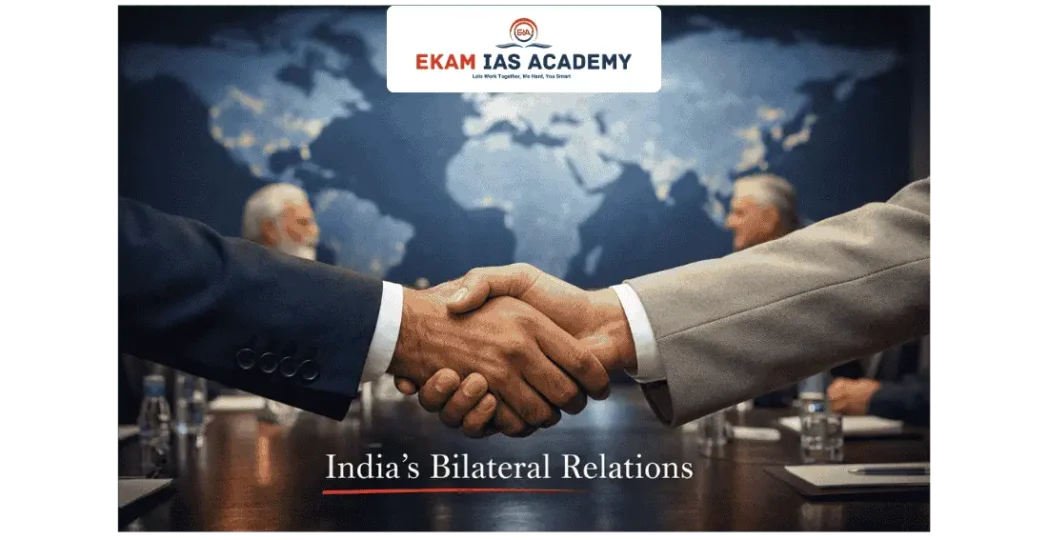
ToggleBilateral relations form the foundational architecture of India’s foreign policy and represent the most direct, structured, and consequential form of diplomatic engagement between two sovereign nations. In the context of UPSC GS Paper 2 and PSIR Paper 2 Section B, understanding India’s bilateral relationships — their historical evolution, strategic logic, current status, and future trajectory — is absolutely essential. India’s bilateral engagements span its immediate neighbourhood, major global powers, emerging economies, and strategic partners across every continent, making it one of the most complex and sophisticated diplomatic portfolios in the world.
Historical Background: Ancient Roots of Bilateral Engagement
India’s tradition of bilateral diplomatic engagement predates modern nation-states by millennia. Kautilya’s Arthashastra — written in the 4th century BC — laid down the world’s first systematic framework for state-to-state relations, articulating the Mandala theory of concentric circles of allies and adversaries, the Saptanga theory of state elements, and sophisticated principles of diplomacy, espionage, and statecraft. Ancient India maintained bilateral trade and cultural relations with Rome, Greece, China, Persia, and Southeast Asian kingdoms — evidenced by the Roman gold coins found in South Indian archaeological sites and the Silk Route commercial networks connecting India to Central Asia and China.
The Mauryan Empire under Ashoka pioneered a unique form of bilateral diplomacy — dharma diplomacy — sending Buddhist missionaries, goodwill ambassadors, and cultural emissaries to Sri Lanka, Myanmar, Central Asia, and the Hellenistic kingdoms of West Asia. This ancient tradition of civilisational diplomacy finds its modern echo in India’s contemporary soft power bilateralism.
The colonial period under British rule fundamentally disrupted India’s independent bilateral engagement with the world. Britain conducted all of India’s external relations from London, reducing India to a subordinate actor in the global diplomatic system. However, colonial India did develop unique bilateral experiences — including Indian communities in Africa, Fiji, and the Caribbean that would later inform post-independence diaspora diplomacy.
Post-Independence Era: Building Bilateral Architecture from Scratch
After independence in 1947, India faced the extraordinary challenge of building an entirely new bilateral diplomatic architecture virtually from scratch. Under Prime Minister Jawaharlal Nehru, India pursued a distinctive approach to bilateral relations guided by Panchsheel (1954) — the five principles of peaceful coexistence that Nehru co-authored with China’s Zhou Enlai. These principles — mutual respect for sovereignty, non-aggression, non-interference, equality, and peaceful coexistence — became the normative framework for India’s bilateral engagements across the world.
Nehru’s India prioritised bilateral relations with newly independent Afro-Asian nations, positioning India as the voice of the decolonised world through platforms like the Bandung Conference of 1955 and the Non-Aligned Movement (NAM) founded in Belgrade in 1961. India’s early bilateral relationships were characterised by strong ideological solidarity — particularly with Egypt under Nasser, Yugoslavia under Tito, Indonesia under Sukarno, and Ghana under Nkrumah — the founding architects of NAM.
The 1962 Sino-Indian War delivered a severe blow to India’s bilateral framework with China, shattering the “Hindi-Chini Bhai-Bhai” solidarity and establishing border disputes as the defining challenge of India-China bilateralism that persists to this day. The 1965 and 1971 wars with Pakistan cemented India-Pakistan bilateralism as the most complex, conflict-ridden, and strategically consequential bilateral relationship in South Asia. The 1971 Indo-Soviet Treaty of Peace, Friendship, and Cooperation demonstrated India’s capacity for strategic bilateral partnerships even within the framework of official Non-Alignment.
Post-Cold War Recalibration: Economic Diplomacy Transforms Bilateral Relationships
The collapse of the Soviet Union in 1991 and India’s concurrent economic liberalisation (LPG Reforms) fundamentally transformed the basis of India’s bilateral relationships. Economic interest replaced ideological solidarity as the primary driver of bilateral engagement. India’s Look East Policy (1991) opened transformative bilateral relationships with ASEAN nations, Japan, and South Korea. The establishment of full diplomatic relations with Israel in 1992 ended decades of ideological hesitancy. The India-US relationship, historically marked by Cold War distance and mutual suspicion, began its remarkable transformation into what would become the world’s most consequential democratic partnership.
The India-US Civil Nuclear Deal (2008) — signed between PM Manmohan Singh and President George W. Bush — became the single most transformative bilateral agreement in India’s post-independence history. By recognising India as a de facto nuclear power outside the NPT framework and granting India an NSG waiver for civilian nuclear commerce, the deal fundamentally altered India’s position in the global strategic hierarchy.
The Modi Era: Assertive Bilateralism and Strategic Diversification
The election of Prime Minister Narendra Modi in 2014 introduced the most significant transformation in India’s bilateral diplomacy since Nehru. The Modi Doctrine elevated bilateral relations to a personal diplomatic instrument — Modi became the most widely travelled Indian Prime Minister in history, conducting hundreds of bilateral summits across every continent. His approach is characterised by several distinctive features.
Neighbourhood First Policy placed India’s SAARC neighbours — Pakistan, Nepal, Bangladesh, Bhutan, Sri Lanka, Maldives, Afghanistan, and Myanmar — at the top of the bilateral priority hierarchy, reflecting Kautilyan wisdom that stable neighbourhood is prerequisite for global power projection. The invitation of SAARC leaders to Modi’s inauguration in May 2014 was a powerful symbolic gesture signalling this priority.
Strategic bilateral partnerships were simultaneously deepened with all major global powers. The India-USA bilateral evolved from a mere strategic partnership to a Comprehensive Global and Strategic Partnership, supported by foundational defence agreements — LEMOA (2016), COMCASA (2018), and BECA (2020) — and cutting-edge technology initiatives like iCET (Initiative on Critical and Emerging Technologies). The India-Japan bilateral was elevated to a Special Strategic and Global Partnership, with Japan becoming India’s largest Official Development Assistance (ODA) partner, funding transformative projects like the Mumbai-Ahmedabad High Speed Rail Corridor (Bullet Train).
The India-Russia bilateral — historically the most enduring and trust-based of India’s major power relationships — continued through the S-400 missile defence system acquisition despite intense US pressure through CAATSA sanctions threats, demonstrating India’s commitment to strategic autonomy in bilateral choices. The India-France bilateral produced the landmark Rafale fighter jet deal (2016) and a strategic partnership covering defence, space, nuclear energy, and Indo-Pacific security.
Key Bilateral Challenges in Contemporary India
India’s bilateral landscape today is defined by several structural tensions and opportunities. The India-China bilateral is the most complex — marked by LAC tensions, the 2020 Galwan Valley clash, economic interdependence, and competing visions of Asian order. India’s response — military modernisation, Quad membership, economic decoupling initiatives, and border infrastructure development — reflects a sophisticated competitive engagement strategy. As Rajiv Sikri noted, India faces China’s challenge at three levels: globally, regionally, and bilaterally as a neighbour.
The India-Pakistan bilateral remains the most conflict-prone — defined by terrorism, Kashmir dispute, nuclear deterrence, water conflicts (Indus Waters Treaty), and cross-border military tensions. India’s surgical strikes (2016) and Balakot airstrike (2019) represented a qualitative shift in India’s bilateral deterrence posture with Pakistan — demonstrating willingness to use limited military force as a diplomatic signalling tool.
India’s bilateral relationships with the Global South — Africa, Latin America, and Central Asia — have gained renewed strategic importance as India positions itself as the “Voice of the Global South”. The India-Africa Forum Summit (IAFS), India-Central Asia Dialogue, and India-CARICOM engagements reflect India’s systematic effort to build bilateral relationships across the developing world.
India's Current Stand: Multi-Alignment as Bilateral Strategy
India’s current bilateral strategy is best described as multi-alignment — simultaneously deepening partnerships with the USA (through Quad and iCET), Russia (through defence and energy), EU (through BTIA negotiations and strategic partnership), Gulf countries (through energy and diaspora diplomacy), Africa (through development partnership), and ASEAN (through Act East Policy). As EAM S. Jaishankar articulated: “India is not non-aligned, it is multi-aligned — it aligns with multiple partners on multiple issues based on national interest.”
C. Raja Mohan describes India’s contemporary bilateral approach as “issue-based partnership diplomacy” — India builds specific functional partnerships with each country rather than comprehensive alliances, maximising flexibility and strategic options in an increasingly multipolar world.
Conclusion
India’s bilateral relations have traversed a remarkable journey — from Kautilyan statecraft to Nehruvian idealism, from Cold War strategic tilts to post-1991 economic pragmatism, and from defensive bilateralism to assertive multi-alignment under the Modi Doctrine. The consistent thread across all these phases has been India’s commitment to sovereign decision-making, national interest, and civilisational responsibility as a rising global power. For UPSC aspirants, mastering India’s bilateral relationships is not merely an examination requirement — it is the key to understanding India’s role in the emerging multipolar world order.
UPSC Prelims: PYQs & Practice Questions
Previous Year Questions (Prelims)
Q1. [UPSC CSE Prelims 2014]
Q: With reference to the India-US Civil Nuclear Deal (2008), which of the following statements is/are correct?
1. It recognised India as a de facto nuclear weapons state outside the NPT framework.
2. It required India to sign the Nuclear Non-Proliferation Treaty (NPT) as a precondition.
3. It allowed India to engage in civilian nuclear commerce with NSG member countries.
Select the correct answer:
(a) 1 only
(b) 1 and 3 only
(c) 2 and 3 only
(d) 1, 2 and 3
Answer: (b) 1 and 3 only
Explanation: The India-US Civil Nuclear Deal recognised India as a responsible nuclear power outside the NPT framework and granted it access to civilian nuclear commerce with NSG countries through a waiver. Statement 2 is incorrect because India was not required to sign the NPT. The deal was significant because it gave India nuclear legitimacy without compromising its strategic autonomy.
Q2. [UPSC CSE Prelims 2015]
Q: The 'Panchsheel Agreement' signed between India and China in 1954 primarily laid down which of the following?
(a) A military defence pact between India and China
(b) Five principles of peaceful coexistence governing bilateral relations
(c) A framework for resolving the India-China border dispute
(d) An economic cooperation agreement between India and China
Answer: (b) Five principles of peaceful coexistence governing bilateral relations
Explanation: The Panchsheel Agreement of April 29, 1954 laid down five principles of peaceful coexistence: mutual respect for sovereignty and territorial integrity, mutual non-aggression, mutual non-interference in internal affairs, equality and mutual benefit, and peaceful coexistence. It was not a military pact, border settlement mechanism, or economic agreement. Panchsheel later became a foundational principle of India’s diplomatic outlook and the Non-Aligned Movement.
Practice Questions
Practice Q1
Q: The 'BECA (Basic Exchange and Cooperation Agreement)' signed between India and the USA in 2020 is significant because it provides India with:
(a) Access to US nuclear technology for civilian purposes
(b) Advanced geospatial intelligence and topographic data from US satellites
(c) Preferential tariff treatment in US markets
(d) US military personnel for joint border patrolling
Answer: (b) Advanced geospatial intelligence and topographic data from US satellites
Explanation: BECA (Basic Exchange and Cooperation Agreement for Geo-spatial Intelligence), signed in October 2020 during the 2+2 Ministerial Dialogue, allows India to access high-accuracy geospatial data, topographic maps, aeronautical charts, and satellite intelligence from the USA. This significantly improves India’s precision-strike capability and completes the set of foundational defence agreements supporting India-US defence interoperability.
Practice Q2
Q: Consider the following about India-Russia bilateral relations:
1. The Indo-Soviet Treaty of Peace, Friendship, and Cooperation (1971) provided diplomatic cover to India during the Bangladesh Liberation War.
2. India acquired the S-400 Triumf missile defence system from Russia despite US threats of CAATSA sanctions.
3. Russia is India's largest defence supplier at present.
Which of the above statements is/are correct?
(a) 1 and 2 only
(b) 2 and 3 only
(c) 1 only
(d) 1, 2 and 3
Answer: (a) 1 and 2 only
Explanation: The 1971 Indo-Soviet Treaty gave India vital diplomatic backing during the Bangladesh Liberation War. India also proceeded with the S-400 purchase from Russia despite possible CAATSA-related pressure from the United States. However, Statement 3 is outdated because although Russia remains a major defence partner, India has diversified defence procurement toward countries such as the USA, France, and Israel.



UPSC Mains – Previous Year & Practice Questions
Mains Previous Year Questions
Q1. [UPSC CSE Mains GS2 2015 | 12.5 Marks]
Question: "India-China relations are characterised by both cooperation and competition." Examine the key dimensions of India-China bilateral relations with reference to trade, border disputes, and strategic competition.
Q2. [UPSC CSE Mains GS2 2017 | 15 Marks]
Question: Examine the evolution of India-US bilateral relations from estrangement during the Cold War to the current Comprehensive Global and Strategic Partnership. What factors drove this transformation?
Q3. [UPSC CSE Mains GS2 2019 | 15 Marks]
Question: "The India-Pakistan bilateral relationship remains the most complex and conflict-prone in South Asia." Critically examine the key issues in India-Pakistan relations and evaluate India's policy options.
Q4. [UPSC CSE Mains GS2 2021 | 15 Marks]
Question: How has India's bilateral relationship with Russia been tested by the Russia-Ukraine War (2022)? Examine India's position and its implications for the India-US bilateral partnership.
Q5. [UPSC CSE Mains GS2 2023 | 20 Marks]
Question: "India's bilateral relations with its neighbours reflect the paradox of geographic proximity and strategic distance." Examine India's Neighbourhood First Policy and evaluate its successes and failures.
Mains Practice Questions
Q1. [PSIR Paper 2 / GS2 | 20 Marks]
Question: "India's bilateral relations in the 21st century are defined by multi-alignment rather than non-alignment." Critically evaluate this characterisation with reference to India's key bilateral partnerships.
Q2. [GS Paper 2 | 15 Marks]
Question: Examine the strategic significance of India-France bilateral relations and assess how the AUKUS controversy has impacted the India-France partnership in the Indo-Pacific.
Q3. [PSIR Paper 2 | 20 Marks]
Question: "India's bilateral relationships with Gulf countries represent the perfect convergence of energy security, diaspora diplomacy, and strategic partnership." Analyse with specific reference to India's relations with UAE and Saudi Arabia.