Table of Contents
ToggleIndia–China Relations UPSC: Challenges, Conflicts and Cooperation
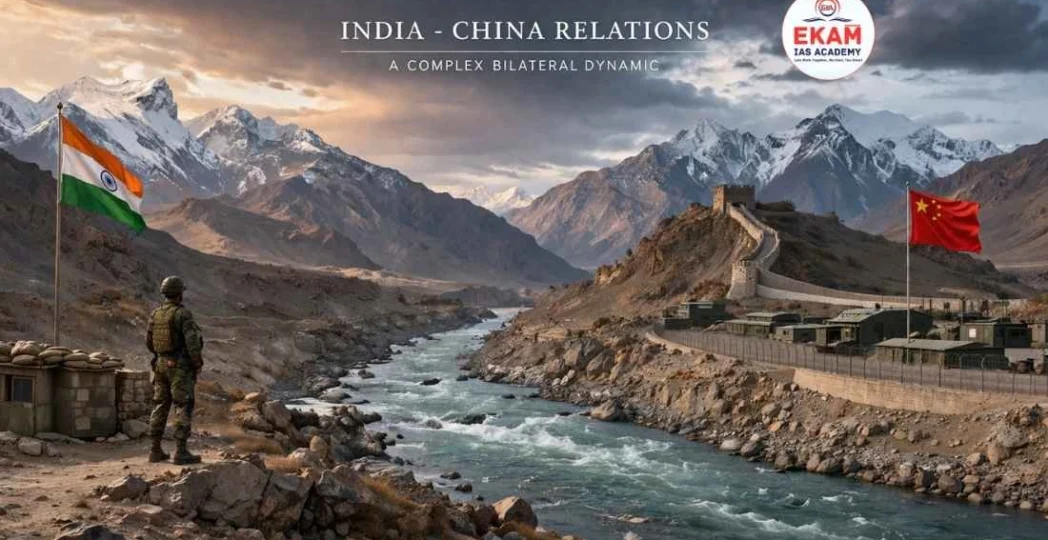
India and China share one of the most complex bilateral relationships in the world. As two major Asian powers with a disputed 3,488 km border, nuclear capabilities, and growing economies, their relationship significantly shapes 21st-century geopolitics. It is a classic case of cooperation, competition, and conflict coexisting simultaneously.
Historical Background
1. Ancient Civilisational Links
- Spread of Buddhism from India to China (1st century AD).
- Visits of Chinese scholars like Fa-Hien and Xuanzang to India.
- Trade via Silk Route and maritime networks (Chola–Chinese links).
2. Post-Independence Phase
- India recognized PRC in 1950.
- Panchsheel Agreement (1954) emphasized peaceful coexistence.
- Tibet issue and asylum to Dalai Lama (1959) created tensions
3. 1962 War
- Caused by border disputes and mistrust.
- China retained Aksai Chin, leading to long-term distrust.
Cold War to Re-engagement
- Rise of China–Pakistan axis (1963 boundary agreement).
- China’s nuclear test (1964) influenced India’s nuclear policy.
- Rajiv Gandhi’s 1988 visit normalized relations.
- Key agreements:
- 1993: Peace & Tranquillity Agreement
- 1996: Confidence Building Measures
Contemporary Phase: Cooperation vs Competition
1. Economic Interdependence
- Bilateral trade exceeds $135 billion.
- India faces a large trade deficit (~$85 billion).
- Dependence on Chinese imports (electronics, APIs, mac
2. Multilateral Engagement
- Cooperation in BRICS, SCO, RIC.
- Shared interest in multipolar world order.
This creates a model of “competitive engagement”.
Boundary Dispute: Core Issue
1. Western Sector (Ladakh – Aksai Chin)
- Controlled by China; vital for G219 highway.
2. Middle Sector
- Least disputed (Himachal–Uttarakhand).
3. Eastern Sector (Arunachal Pradesh)
- China claims it as “South Tibet”.
- Dispute over McMahon Line.
4. Line of Actual Control (LAC)
- Undefined and perception-based → frequent face-offs.
Galwan Valley Clash (2020)
- Most serious conflict since 1967.
- 20 Indian soldiers killed.
- Led to:
- Breakdown of trust
- Ban on Chinese apps
- Restrictions on Chinese investments
- Military build-up along LAC
- Stronger Quad alignment
China’s Strategic Challenges to India
Global Level
- Blocks India’s NSG and UNSC membership.
- Shields Pakistan-based terrorists at UN.
Regional Level
- China–Pakistan Economic Corridor (CPEC).
- String of Pearls strategy in Indian Ocean.
Bilateral Level
- Border incursions and territorial claims.
- Pressure in Arunachal Pradesh and Ladakh.
India’s Response Strategy
- Military Modernisation: Infrastructure (Atal Tunnel, roads, forward bases).
- Strategic Partnerships: Quad (USA, Japan, Australia).
- Economic Measures: App bans, FDI restrictions.
- Diplomatic Balancing: Engagement with ASEAN nations.
Strategy: “Decoupling without isolation
Recent Developments
1. Five-Point Consensus (2020)
- Focus on disengagement and dialogue.
2. Kazan Summit (2024)
- Agreement on disengagement in remaining friction points.
- Indicates possible diplomatic reset.
3. India’s Position
Based on:
- Mutual respect
- Mutual sensitivity
- Mutual interests
Conclusion
India–China relations represent a paradox of cooperation and rivalry. While economic and multilateral engagement continues, unresolved border disputes and strategic competition dominate the relationship.
For UPSC, it is a perfect case study of realism, interdependence, and power politics in a multipolar world.
UPSC Prelims: PYQs & Practice Questions
Previous Year Questions (Prelims)
Q1. [UPSC CSE Prelims 2013]
Q: With reference to the Panchsheel Agreement (1954), which of the following statements is/are correct?
1. It was signed between PM Jawaharlal Nehru and Chinese PM Zhou Enlai.
2. It contained five principles of peaceful coexistence including mutual respect for sovereignty and non-interference.
3. The 1962 Sino-Indian War demonstrated the complete success of Panchsheel principles in India-China relations.
(a) 1 only
(b) 1 and 2 only
(c) 2 and 3 only
(d) 1, 2 and 3
Answer: (b) 1 and 2 only
Explanation:
The Panchsheel Agreement, formally the Agreement on Trade and Intercourse between Tibet Region of China and India, was signed on April 29, 1954 between Prime Minister Jawaharlal Nehru and Chinese Premier Zhou Enlai. It laid down five principles of peaceful coexistence, including mutual respect for sovereignty, non-aggression, non-interference, equality and mutual benefit, and peaceful coexistence. However, the 1962 Sino-Indian War showed the failure rather than the success of Panchsheel in practice, making Statement 3 incorrect.
Q2. [UPSC CSE Prelims 2014]
Q: The 'Line of Actual Control (LAC)' between India and China differs from the 'Line of Control (LoC)' with Pakistan because:
(a) The LAC is a legally demarcated and internationally recognised boundary
(b) The LAC is a de facto boundary where the precise alignment is disputed by India and China in several sectors — unlike the LoC which was converted from a ceasefire line through the Simla Agreement
(c) The LAC was established by the United Nations after the 1962 war
(d) The LAC covers only the Ladakh sector while LoC covers all of J&K
Answer: (b) The LAC is a de facto boundary where the precise alignment is disputed by India and China in several sectors — unlike the LoC which was converted from a ceasefire line through the Simla Agreement
Explanation:
The Line of Actual Control is not a formally demarcated and mutually agreed international boundary. Its precise alignment remains disputed between India and China in multiple sectors, which leads to recurring patrol confrontations. By contrast, the Line of Control with Pakistan evolved from the ceasefire line and was formalised through the Simla Agreement. Therefore, option (b) is correct.
Previous Year Questions (Prelims)
Q: The 'Doklam Standoff (2017)' between India and China was primarily triggered by:
(a) India constructing a road in Chinese-claimed territory in Arunachal Pradesh
(b) China constructing a road in the Doklam plateau — a territory claimed by Bhutan — which India opposed citing security concerns for the Siliguri Corridor
(c) China occupying Indian territory in the Galwan Valley
(d) India closing the Nathu La pass to Chinese trade
Answer: (b) China constructing a road in the Doklam plateau — a territory claimed by Bhutan — which India opposed citing security concerns for the Siliguri Corridor
Explanation:
The Doklam Standoff of 2017 was triggered when China attempted to extend a road in the Doklam plateau, a disputed area claimed by Bhutan at the India-Bhutan-China trijunction. India opposed this move because of its security implications for the nearby Siliguri Corridor, the narrow stretch connecting mainland India to the northeastern states. The standoff lasted 73 days and was eventually resolved through diplomatic disengagement.
Q: Consider the following about India's border claims in the three sectors of the India-China boundary:
1. In the Western Sector, India claims the entire Aksai Chin based on the Johnson Line.
2. In the Eastern Sector, India's claimed boundary follows the McMahon Line drawn at the Simla Convention (1914).
3. In the Middle Sector (Himachal Pradesh-Uttarakhand), there is no boundary dispute between India and China.
Which of the above statements is/are correct?
(a) 1 and 2 only
(b) 2 and 3 only
(c) 1 and 3 only
(d) 1, 2 and 3
Answer: (a) 1 and 2 only
Explanation:
India claims Aksai Chin in the Western Sector based on the Johnson Line, so Statement 1 is correct. In the Eastern Sector, India’s claim follows the McMahon Line drawn at the 1914 Simla Convention, so Statement 2 is also correct. However, the Middle Sector is not entirely free of dispute; it has fewer and less intense disputes compared to the Western and Eastern sectors, making Statement 3 incorrect.



UPSC Mains – Previous Year & Practice Questions
Mains Previous Year Questions
Q1. [UPSC CSE Mains GS2 2015 | 12.5 Marks | 200 Words]
Question: "The 1962 Sino-Indian War remains the defining event in India-China bilateral relations — shaping strategic perceptions, military doctrines, and diplomatic approaches for over six decades." Examine this assertion.
Q2. [UPSC CSE Mains GS2 2017 | 15 Marks | 250 Words]
Question: Examine the India-China boundary dispute across the three sectors. Why has it remained unresolved despite decades of negotiations?
Q3. [UPSC CSE Mains GS2 2019 | 15 Marks | 250 Words]
Question: "India-China relations are characterised by the paradox of deepening economic interdependence and intensifying strategic competition." Examine this paradox and suggest India's optimal engagement strategy.
Q4. [UPSC CSE Mains GS2 2021 | 15 Marks | 250 Words]
Question: "The Galwan Valley clash (2020) represents a fundamental turning point in India-China relations — ending the era of competitive engagement and beginning the era of competitive deterrence." Critically examine.
Q5. [UPSC CSE Mains GS2 2023 | 20 Marks | 300 Words]
Question: "China's challenge to India operates simultaneously at global, regional, and bilateral levels — requiring India to develop a comprehensive multi-dimensional response strategy." Analyse with reference to Rajiv Sikri's framework and suggest India's optimal counter-strategy.
Mains Practice Questions
Q1. [PSIR Paper 2 / GS2 | 20 Marks | 300 Words]
Question: "India's trade dependence on China creates a structural vulnerability that undermines India's strategic autonomy in the bilateral relationship." Critically analyse and suggest a framework for India's economic de-risking strategy.
Q2. [GS Paper 2 | 15 Marks | 250 Words]
Question: Examine how the Quad (Quadrilateral Security Dialogue) serves India's strategic objectives in managing the China challenge and assess whether it represents India's departure from strategic autonomy.
Q3. [PSIR Paper 2 | 20 Marks | 300 Words]
Question: "The 2024 Kazan disengagement agreement between India and China signals a diplomatic reset — but structural strategic competition between Asia's two great powers makes genuine bilateral normalisation impossible in the foreseeable future." Critically evaluate.
India-China Relations-fAQs
What is the main issue in India–China relations?
The primary issue is the unresolved border dispute along the Line of Actual Control (LAC), leading to periodic tensions.
Why is Aksai Chin important in India–China relations?
Aksai Chin is strategically vital for China as it connects Xinjiang and Tibet through the G219 highway.
What was the impact of the Galwan Valley clash (2020)?
It led to severe trust deficit, military buildup, economic restrictions, and stronger Quad engagement.
How does China challenge India strategically?
China challenges India through border incursions, support to Pakistan, and influence in South Asia.
What is India’s strategy towards China?
India follows competitive engagement—balancing cooperation with strategic partnerships and military preparedness.