Table of Contents
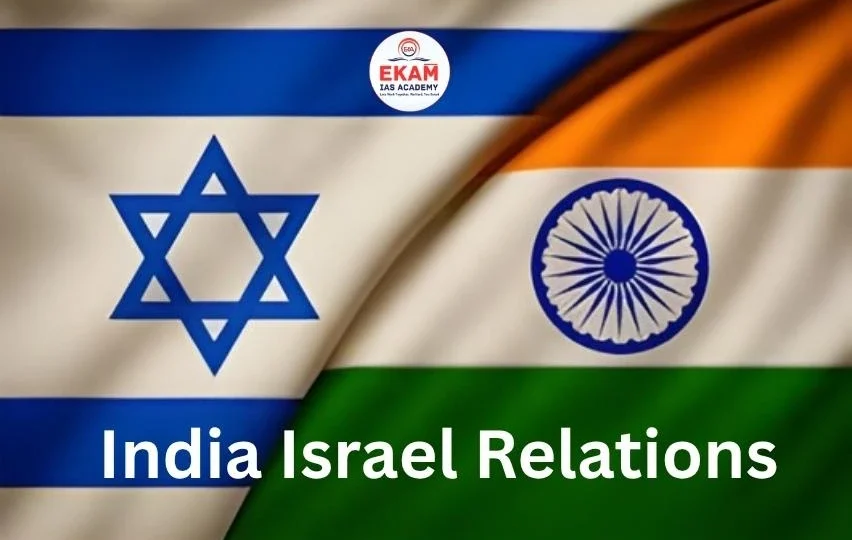
ToggleIndia and Israel share a multi-dimensional relationship that has evolved from limited engagement to a Special Strategic Partnership. Today, the partnership is defined by the slogan “Peace, Innovation & Prosperity.” For UPSC aspirants, understanding India-Israel relations UPSC is critical as the bond has moved beyond a “buyer-seller” defense dynamic to include deep cooperation in agriculture, water, and emerging technologies like AI.
Historical and Cultural Background
- Early Recognition: India officially recognized the State of Israel in 1950, but full diplomatic ties were only established in 1992 due to India’s Cold War alignments and commitment to the Palestinian cause.
- Clandestine Support: Even before 1992, Israel provided critical military assistance during the 1962, 1965, and 1971 wars, as well as during the 1999 Kargil Conflict.
- De-hyphenation Policy: In 2017, the Indian Prime Minister’s historic visit marked the official shift to a “De-hyphenation Policy,” allowing India to treat its ties with Israel independently of its relationship with Palestine.
Strategic Significance
Israel is a vital strategic partner in West Asia:
- Technological Edge: Israel is a global “Startup Nation,” providing India access to cutting-edge tech in Artificial Intelligence, Cybersecurity, and Space.
- Regional Connectivity: The I2U2 grouping (India, Israel, UAE, USA) and the India-Middle East-Europe Economic Corridor (IMEC) position Israel as a crucial hub for India’s trade connectivity.
- Counter-Terrorism: Both nations share intelligence and tactics to combat radicalization and cross-border terrorism.
Key Areas of Cooperation
- India-Israel Defense Cooperation: Israel is India’s third-largest arms supplier (behind Russia and France). Key equipment includes Phalcon AWACS, Heron drones, and the Barak-8 missile system (jointly developed).
- Agriculture and Water: Israel’s expertise in drip irrigation and desalination is helping India’s “Per Drop More Crop” mission. Over 35 Centres of Excellence are operational in India.
- Labor Mobility: In 2026, both nations signed protocols to facilitate the migration of thousands of Indian workers in the manufacturing and construction sectors.
Recent Developments (2024–2026)
- Special Strategic Partnership: In February 2026, ties were upgraded to a “Special Strategic Partnership for Peace, Innovation & Prosperity,” the highest tier of diplomatic engagement.
- Critical & Emerging Technology (CET): A new initiative led by the NSAs of both nations to collaborate on Quantum Computing, Semiconductors, and Biotechnology.
- UPI Integration: Efforts are underway to link India’s UPI with Israel’s fast payment systems to benefit the diaspora and trade.
Challenges
- The Balancing Act: India must balance its ties with Israel alongside its interests in Iran and the Arab world, which are vital for energy security and remittances.
- Geopolitical Volatility: Ongoing conflicts in Gaza or Lebanon put India in a difficult diplomatic spot regarding humanitarian concerns vs. strategic needs.
- Technology Transfer: While defense ties are strong, negotiations for the Transfer of Technology (ToT) and co-production under ‘Make in India’ remain complex.
Importance for India’s Foreign Policy
The India-Israel strategic partnership is a testament to India’s Strategic Autonomy.
- Atmanirbhar Bharat: Joint development projects (like missiles) help India move toward defense self-reliance.
- Link West Policy: Israel is the anchor for India’s engagement in the Western Indo-Pacific.
- Global Innovation: Collaborating with a “technology powerhouse” supports India’s vision of Viksit Bharat 2047.
Way Forward
- FTA Negotiations: Concluding the Free Trade Agreement to expand trade beyond diamonds and chemicals.
- Co-Production: Shifting from a buyer-seller model to joint R&D in niche areas like cyber-defense and green hydrogen.
- Multilateralism: Strengthening the I2U2 framework to finance regional food and energy corridors.
Conclusion
The relationship between India and Israel has reached a point of “no return,” characterized by deep mutual trust. For IR UPSC notes Israel, it is essential to highlight that while India remains committed to a Two-State Solution for Palestine, its partnership with Israel is indispensable for its national security, technological growth, and food security.
UPSC Prelims: PYQs & Practice Questions
Previous Year Questions (Prelims)
Q1. [UPSC Prelims 2018]
Q: The term ‘Two-State Solution’ is sometimes mentioned in the news in the context of the affairs of:
(a) China
(b) Israel
(c) Iraq
(d) Yemen
Answer: (b) Israel
Explanation:
The Two-State Solution refers to the proposed resolution of the Israel-Palestine conflict through the creation of an independent State of Palestine alongside the State of Israel. India has consistently supported this approach in its official position on the issue.
Q2. [Practice-based]
Q: Which of the following is/are the reasons for the ‘De-hyphenation’ policy of India in the context of Israel and Palestine?
1. It allows India to treat its relationship with Israel as a standalone entity.
2. It signifies that India has abandoned the Palestinian cause.
3. It helps India focus on its strategic interests in defense and agriculture with Israel.
Select the correct answer:
(a) 1 and 2 only
(b) 2 and 3 only
(c) 1 and 3 only
(d) 1, 2, and 3
Answer: (c) 1 and 3 only
Explanation:
De-hyphenation means India treats its ties with Israel independently from its ties with Palestine. It allows India to deepen cooperation with Israel in areas such as defence, agriculture, and technology, while continuing to support the Palestinian cause and the Two-State Solution. Therefore, Statement 2 is incorrect.
Practice Questions
Q: With reference to the ‘I2U2’ Grouping, consider the following statements:
1. It consists of India, Israel, the UAE, and the USA.
2. It is primarily a military alliance aimed at countering Iran.
Which of the statements given above is/are correct?
(a) 1 only
(b) 2 only
(c) Both 1 and 2
(d) Neither 1 nor 2
Answer: (a) 1 only
Explanation:
Statement 1 is correct because I2U2 consists of India, Israel, the United Arab Emirates, and the United States. Statement 2 is incorrect because I2U2 is not primarily a military alliance; it is mainly an economic and technological grouping focused on cooperation in areas such as water, energy, transportation, space, health, and food security.
UPSC Mains – Previous Year & Practice Questions
Mains Previous Year Questions
Q1. [UPSC CSE Mains 2018]
Question: India’s relations with Israel have, of late, acquired a depth and diversity, which cannot be rolled back. Discuss.
Q2. [2022/23 Context]
Question: The 'West Asian Quad' (I2U2) is a significant shift in India’s engagement with the Middle East. Analyze its impact on India’s strategic interests.
Q3. [Based on 2014/2017 trend]
Question: Evaluate the importance of Israel as a source of high-end defense technology for India.
Q4. [Analytical trend]
Question: How does the policy of 'De-hyphenation' help India navigate the complex geopolitics of West Asia?
Q5. [2016 / Geography-IR overlap]
Question: Discuss the role of Israeli technology in helping India achieve its 'Per Drop More Crop' objective under the Pradhan Mantri Krishi Sinchayee Yojana.
Mains Practice Questions
Q1. [15 Marks | 250 Words]
Question: "The India-Israel partnership has evolved from a 'Buyer-Seller' defense relationship to an 'Innovation-led' strategic alliance." Substantiate with examples.
Q2. [10 Marks | 150 Words]
Question: Examine the challenges India faces in balancing its ties with Israel and Iran, given the intense rivalry between the two nations.
Q3. [15 Marks | 250 Words]
Question: With the rise of the India-Middle East-Europe Economic Corridor (IMEC), analyze the strategic importance of the Haifa Port for India's trade connectivity.



India-Israel Partnership-fAQs
What does "De-hyphenation" mean in India-Israel ties?
It is a diplomatic strategy where India deals with Israel and Palestine on their own individual merits. India maintains a strong strategic and defense partnership with Israel while continuing to support the Palestinian cause for a sovereign state.
Which are the major defense systems India has acquired from Israel?
Key acquisitions include Phalcon AWACS (Airborne Warning and Control System), Heron & Searcher Drones, SPICE bombs, and the Barak-8 Surface-to-Air Missile system (jointly developed).
How is Israel helping India in the water sector?
Israel is a leader in Drip Irrigation and Desalination. Through several “Centres of Excellence,” Israel provides technical expertise to Indian farmers to maximize crop yield with minimum water usage.
What is the significance of the I2U2 grouping?
I2U2 (India-Israel-UAE-USA) allows India to engage with Israel and its Arab partners (UAE) simultaneously. It focuses on joint investments in infrastructure, food security, and green energy, effectively integrating India into the West Asian economic landscape.
Why did India wait until 1992 to establish full diplomatic ties with Israel?
Primarily due to Cold War dynamics, India’s dependence on Arab nations for oil, the large Indian diaspora in the Gulf, and a long-standing ideological commitment to the Palestinian struggle within the Non-Aligned Movement (NAM).