Table of Contents
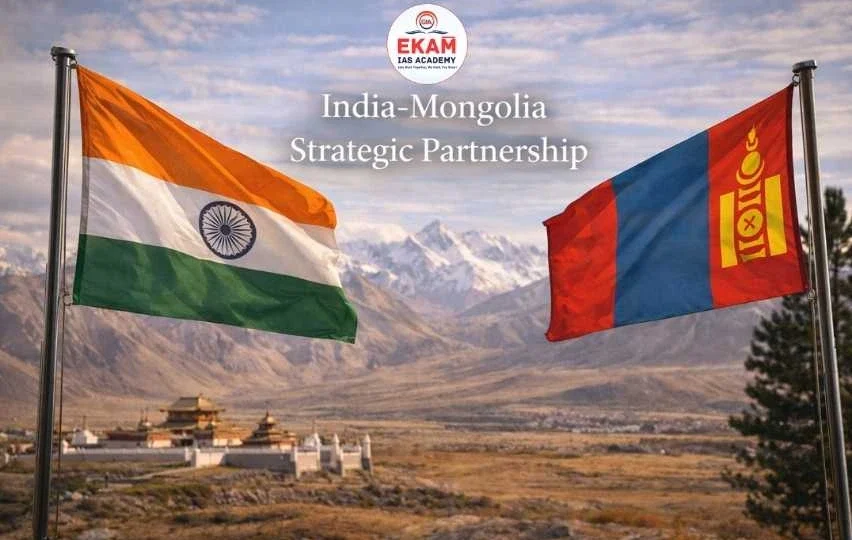
ToggleIndia and Mongolia share a relationship deeply rooted in history, spirituality, and shared democratic values. Often referred to as India’s “Spiritual Neighbor,” Mongolia occupies a distinct place in India-Mongolia relations UPSC. In 2015, the relationship was elevated to a Strategic Partnership, marking a new era of cooperation in the heart of East Asia.
Historical and Cultural Background
The bedrock of the relationship is Buddhism, which traveled from India to Mongolia via the Silk Road.
- Civilizational Links: Mongolians often refer to India as the “Land of Buddha” or the “Holy Land.”
- Diplomatic Milestone: India was the first country outside the Soviet bloc to establish diplomatic relations with Mongolia in 1955.
- Global Support: India played a decisive role in getting Mongolia membership in the United Nations (1961) and the Non-Aligned Movement (NAM).
Evolution of Relations
The tie has evolved from purely cultural to a multi-dimensional strategic partnership.
- 1955-1990: Focus on diplomatic support and cultural exchange.
- Post-Cold War: Transition to economic and democratic cooperation.
- 2015 Landmark Visit: Prime Minister Narendra Modi became the first Indian PM to visit Mongolia, transforming the tie into a Strategic Partnership.
Strategic Significance
Mongolia is a key pillar of India’s “Act East Policy”.
- Third Neighbor Policy: Mongolia views India as its “Third Neighbor” (neighboring countries other than Russia and China) to balance the influence of its two giant neighbors.
- Geopolitical Pivot: Mongolia’s location between Russia and China makes it a vital listening post for IR UPSC notes Mongol.
Key Areas of Cooperation
- Energy and Mining: India is building the Mongol Oil Refinery, the first of its kind in Mongolia, funded by an Indian Line of Credit (LoC) of over $1.2 billion.
- Defense: Regular joint military exercises titled “Nomadic Elephant” focus on counter-terrorism and high-altitude warfare.
- Digital Infrastructure: India is assisting in the establishment of the Atal Bihari Vajpayee Centre of Excellence in IT.
- Space: Cooperation in remote sensing and satellite communication.
Recent Developments
- Gagan Yatra: Discussions regarding training Mongolian astronauts as part of India’s space program.
- Coking Coal: India is exploring the import of coking coal from Mongolia via Russia to diversify its energy sources.
- Cultural Diplomacy: The printing of 108 volumes of Mongolian Kanjur (Buddhist canonical texts) by the Indian government
Importance for India’s Foreign Policy
- Countering Hegemony: A strong India-Mongolia strategic partnership prevents a unipolar Asian order.
- Multilateral Support: Mongolia consistently supports India’s candidacy for a permanent seat in the UN Security Council (UNSC).
- Act East Expansion: It expands the traditional “Act East” focus beyond ASEAN into North-East Asia.
Challenges
- Connectivity: Being landlocked between Russia and China, trade with Mongolia is logistically difficult and expensive for India.
- China Factor: China is Mongolia’s largest trading partner; any friction between India and China often complicates Mongolian maneuvering.
- Trade Volume: Despite the India-Mongolia cooperation, bilateral trade remains significantly below potential.
Way Forward
- Air Corridors: Establishing direct air connectivity to boost tourism and trade in high-value goods.
- INSTC Integration: Linking Mongolia to the International North-South Transport Corridor via Russia.
- Rare Earth Elements: Mongolia has vast deposits of critical minerals (like Uranium and rare earths) which are essential for India’s green energy transition.
Conclusion
The relationship with Mongolia is a testament to India’s “soft power” and strategic foresight. For UPSC aspirants, it is important to view this partnership not just through trade numbers, but as a symbolic and strategic alignment that strengthens India’s footprint in the Indo-Pacific and Eurasian landmass.
UPSC Prelims: PYQs & Practice Questions
Previous Year Questions (Prelims)
Q: With reference to the 'Nomadic Elephant', which of the following statements is correct?
(a) It is a conservation project for the protection of Asian Elephants in Northeast India.
(b) It is a bilateral military exercise between India and Mongolia.
(c) It is a cultural festival celebrating the nomadic tribes of Central Asia.
(d) It is a joint initiative by India and Thailand for maritime security.
Answer: (b) It is a bilateral military exercise between India and Mongolia
Explanation:
Nomadic Elephant is a bilateral joint military exercise conducted by India and Mongolia. It aims to strengthen defence cooperation, improve interoperability, and enhance coordination in areas such as counter-terrorism and high-altitude warfare.
Q: Which of the following is the first country outside the Soviet bloc to establish diplomatic relations with Mongolia in 1955?
(a) Japan
(b) United States
(c) India
(d) United Kingdom
Answer: (c) India
Explanation:
India became the first country outside the Socialist bloc to establish diplomatic relations with Mongolia on December 24, 1955. This reflects the deep historical, civilisational, and spiritual ties between the two countries, especially through the shared Buddhist connection.
Practice Questions
Q: The 'Mongol Oil Refinery', a major infrastructure project being built with an Indian Line of Credit (LoC), is located in which province? (Current Affairs Focus)
(a) Ulaanbaatar
(b) Dornogovi
(c) Darkhan
(d) Erdenet
Answer: (b) Dornogovi
Explanation:
The Mongol Oil Refinery is being constructed in Dornogovi Province of Mongolia. Supported by a $1.2 billion Line of Credit from India, it is Mongolia’s first oil refinery and is strategically important because it will reduce Mongolia’s dependence on imported Russian fuel.
UPSC Mains – Previous Year & Practice Questions
Mains Previous Year Questions
Question: Evaluate the significance of Mongolia in India's 'Act East' Policy. How does this partnership help India in the broader Indo-Pacific region?
Question: Discuss the role of cultural diplomacy, specifically Buddhism, in strengthening India’s ties with its extended neighborhood.
Question: Explain the 'Third Neighbor Policy' of Mongolia and analyze India’s position within this framework.
Question: To what extent does the landlocked geography of Mongolia act as a barrier to India’s economic interests in North-East Asia?
Question: Analyze the importance of critical minerals, particularly Uranium and Rare Earths, in the context of India-Mongolia cooperation.
Mains Practice Questions
Q1. [15 Marks | 250 Words]
Question: "India’s engagement with Mongolia is a classic example of 'Soft Power' being converted into 'Strategic Capital'." Comment.
Q2. [10 Marks | 150 Words]
Question: "Despite high political trust, bilateral trade between India and Mongolia remains negligible. Identify the structural bottlenecks and suggest solutions."
Q3. [15 Marks | 250 Words]
Question: "The Mongol Oil Refinery is not just an infrastructure project but a symbol of Mongolia's quest for strategic autonomy." Examine the role of India in supporting Mongolia's energy security.



India-Mongolia Relations-fAQs
What is the 'Kanjur Project'?
The Indian government has taken up the project of reprinting 108 volumes of the Mongolian Kanjur (Buddhist canonical texts). This is a significant cultural initiative under the Ministry of Culture to preserve the shared Buddhist heritage.
What are 'Critical Minerals' and why is Mongolia important for them?
Critical minerals include Uranium and Rare Earth Elements (REEs) used in green energy and high-tech defense. Mongolia is rich in these resources. India signed a civil nuclear cooperation agreement with Mongolia in 2009 to explore Uranium procurement.
How is India helping Mongolia in the IT sector?
India is establishing the Atal Bihari Vajpayee Centre of Excellence in IT, Communication, and Outsourcing in Ulaanbaatar. It is aimed at capacity building and skill development for Mongolian youth.
Does Mongolia support India’s claim for a permanent seat at the UNSC?
Yes, Mongolia has consistently and unequivocally supported India’s bid for a permanent seat in an expanded United Nations Security Council.
What is the main logistical challenge in India-Mongolia trade?
The “Geography of Transit.” Being landlocked between Russia and China, any physical trade must pass through either of these two countries. This makes transport costs high and subjects trade to the geopolitical whims of Mongolia’s immediate neighbors. India is exploring the Vladivostok-Chennai Maritime Corridor and then rail links through Russia to mitigate this.