Table of Contents
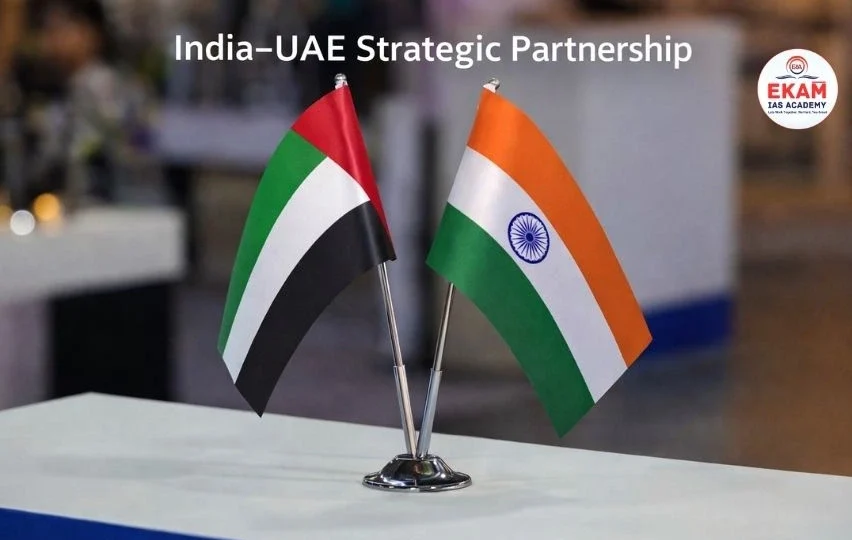
ToggleIndia and the United Arab Emirates (UAE) share a relationship that has transitioned from age-old maritime trade to a 21st-century Comprehensive Strategic Partnership. Today, the UAE is not just a major energy supplier but a top investor and a key pillar of India-UAE relations UPSC. The signing of the India-UAE CEPA agreement in 2022 marked a watershed moment, making the UAE India’s premier partner in the Arab world.
Historical Background
Trade links between the two regions date back to the Indus Valley Civilization and the Mesopotamian era. For centuries, the pearl industry and the spice trade formed the economic bedrock. After the formation of the UAE in 1971, diplomatic ties were formally established, further strengthened by the large-scale migration of the Indian diaspora to the Emirates during the oil boom.
Strategic Significance
The UAE occupies a vital geostrategic location at the entrance of the Persian Gulf.
- Energy Security: The UAE is one of India’s top sources of crude oil and is the first country to participate in India’s Strategic Petroleum Reserves (SPR) program.
- Geopolitical Bridge: The UAE serves as a gateway for India to the wider Gulf Cooperation Council (GCC) and African markets.
- Counter-Hegemony: Both nations collaborate to maintain stability in the Western Indian Ocean and the Strait of Hormuz.
Key Areas of Cooperation
- Trade and Investment: With the India-UAE CEPA agreement, bilateral trade is targeted to reach $100 billion. The UAE is the third-largest trading partner of India.
- Defense and Security: Cooperation includes joint naval exercises like ‘Zayed Talwar’ and intelligence sharing to counter maritime piracy and radicalization.
- Space Cooperation: Collaboration between ISRO and the UAE Space Agency, highlighted by the UAE’s ‘Hope’ Mars Mission and the launch of Emirati satellites by Indian rockets.
- Food Security: The India-UAE Food Corridor project aims to utilize UAE investment to develop high-tech agro-parks in India to ensure the UAE’s food security.
Recent Developments (2024-2026)
- I2U2 Grouping: Often called the ‘West Asian Quad,’ this partnership (India, Israel, UAE, USA) focuses on joint investments in water, energy, and transportation.
- IMEEC: The India-Middle East-Europe Economic Corridor, announced at the G20, positions the UAE as a critical transit hub connecting India to Europe.
- IIT Delhi – Abu Dhabi: The opening of the first overseas campus of IIT Delhi in Abu Dhabi symbolizes the deepening of “knowledge-based” ties.
- Local Currency Settlement (LCS): Both nations have started settling cross-border transactions in Rupee and Dirham to bypass the US Dollar and reduce transaction costs.
Importance for India’s Foreign Policy
- Link West Policy: The UAE is the linchpin of India’s engagement with the Middle East.
- Diaspora Diplomacy: Over 3.5 million Indians reside in the UAE, sending billions in remittances annually.
- Strategic Autonomy: Engaging with the UAE allows India to balance its relations with other regional powers like Iran and Saudi Arabia for IR UPSC notes UAE
Challenges
- Regional Volatility: Ongoing conflicts in West Asia (e.g., Israel-Palestine) can disrupt trade and the safety of the diaspora.
- China’s Footprint: Increasing Chinese investments in UAE infrastructure and 5G technology pose a strategic challenge to Indian interests.
- Labor Issues: Ensuring the welfare and legal protection of the blue-collar Indian workforce remains a persistent diplomatic task.
Way Forward
- Diversification: Moving beyond oil and gold to focus on FinTech, Green Hydrogen, and AI.
- Multilateralism: Leveraging the UAE’s recent entry into BRICS to coordinate on global south issues.
- Security Architecture: Evolving from buyer-seller defense ties to joint production of military hardware under ‘Make in India.’
Conclusion
The India-UAE strategic partnership has become “all-weather” and resilient. As India aims for a $5 trillion economy, the UAE’s capital and India’s human resources form a symbiotic bond. For UPSC aspirants, this relationship exemplifies how cultural affinity and economic pragmatism can create a robust framework for regional leadership and global stability.
UPSC Prelims: PYQs & Practice Questions
Previous Year Questions (Prelims)
Q1. [UPSC Prelims 2020]
Q: Consider the following pairs:
Town sometime mentioned in news — Country
1. Abu Dhabi — United Arab Emirates
2. Balkh — Afghanistan
3. Homs — Syria
Which of the pairs given above are correctly matched?
(a) 1 and 2 only
(b) 1 and 3 only
(c) 2 and 3 only
(d) 1, 2, and 3
Answer: (d) 1, 2, and 3
Explanation:
All three pairs are correctly matched. Abu Dhabi is in the United Arab Emirates, Balkh is in Afghanistan, and Homs is in Syria. Such questions reflect the UPSC trend of testing location-based current affairs through places frequently seen in international news.
Q: The 'I2U2' grouping, often referred to in the context of West Asian geopolitics, includes which of the following countries?
(a) India, Iran, UAE, USA
(b) India, Israel, UAE, UK
(c) India, Israel, UAE, USA
(d) India, Iraq, UAE, UK
Answer: (c) India, Israel, UAE, USA
Explanation:
I2U2 stands for India, Israel, the United Arab Emirates, and the United States. It is a minilateral grouping focused on practical cooperation and joint investments in sectors such as water, energy, transportation, space, health, and food security.
Practice Questions
Q: With reference to the 'Comprehensive Economic Partnership Agreement' (CEPA) signed between India and the UAE (2022), consider the following statements:
1. It is India’s first bilateral trade agreement with a major Gulf economy.
2. It aims to increase bilateral trade in goods to $100 billion within five years.
Which of the statements given above is/are correct?
(a) 1 only
(b) 2 only
(c) Both 1 and 2
(d) Neither 1 nor 2
Answer: (c) Both 1 and 2
Explanation:
Both statements are correct. The India-UAE CEPA, signed in February 2022, was India’s first bilateral trade agreement with a major Gulf economy. It aimed to raise bilateral trade in goods to $100 billion within five years and significantly expanded market access, including duty-free access for a large share of India’s exports to the UAE.
UPSC Mains – Previous Year & Practice Questions
Mains Previous Year Questions
Question: "The multi-faceted India-UAE relationship has been transformed from a traditional buyer-seller tie into a comprehensive strategic partnership." Discuss.
Question: "The 'West Asian Quad' (I2U2) is a significant shift in India’s engagement with the Middle East." Analyze its impact on India’s strategic interests.
Question: How does the large Indian diaspora in the UAE act as a bridge for India's foreign policy? Discuss the challenges associated with their welfare.
Question: Evaluate the significance of the India-Middle East-Europe Economic Corridor (IMEC) for India’s connectivity aspirations.
Question: "India’s 'Link West' policy has found its most successful manifestation in the UAE." Comment.
Mains Practice Questions
Q1. [15 Marks | 250 Words]
Question: "The India-UAE Food Corridor is a unique example of using investment to ensure the food security of one nation and the infrastructure development of another." Explain.
Q2. [10 Marks | 150 Words]
Question: Examine the strategic importance of the UAE's participation in India's Strategic Petroleum Reserves (SPR) program.
Q3. [15 Marks | 250 Words]
Question: "As India and the UAE move toward settling trade in local currencies (Rupee-Dirham), discuss the implications for the 'De-dollarization' of global trade."



India-UAE Relations-fAQs
What is the 'Zayed Talwar' exercise?
It is a bilateral naval exercise between the Indian Navy and the UAE Navy, aimed at enhancing interoperability and maritime security in the Persian Gulf region.
Why is the 'IIT Delhi-Abu Dhabi' campus significant?
It is the first time a premier Indian technical institute (IIT) has established an overseas campus. It symbolizes the shift in India-UAE relations from “labor and oil” to “knowledge and technology.”
What is 'Operation Sankalp'?
It is an Indian Navy operation launched in 2019 to ensure the safe passage of Indian vessels through the Strait of Hormuz and the Gulf of Oman following attacks on tankers in the region. The UAE is a key partner in providing maritime domain awareness for this.
How much remittance does India receive from the UAE?
The UAE is typically one of the top three sources of remittances for India. The 3.5 million-strong Indian diaspora contributes significantly to India’s foreign exchange reserves.
What is the 'I2U2' Food Security project?
Under the I2U2 framework, the UAE is investing $2 billion to develop a series of integrated food parks across India that will incorporate state-of-the-art climate-smart technologies to reduce food waste and conserve water.