Table of Contents
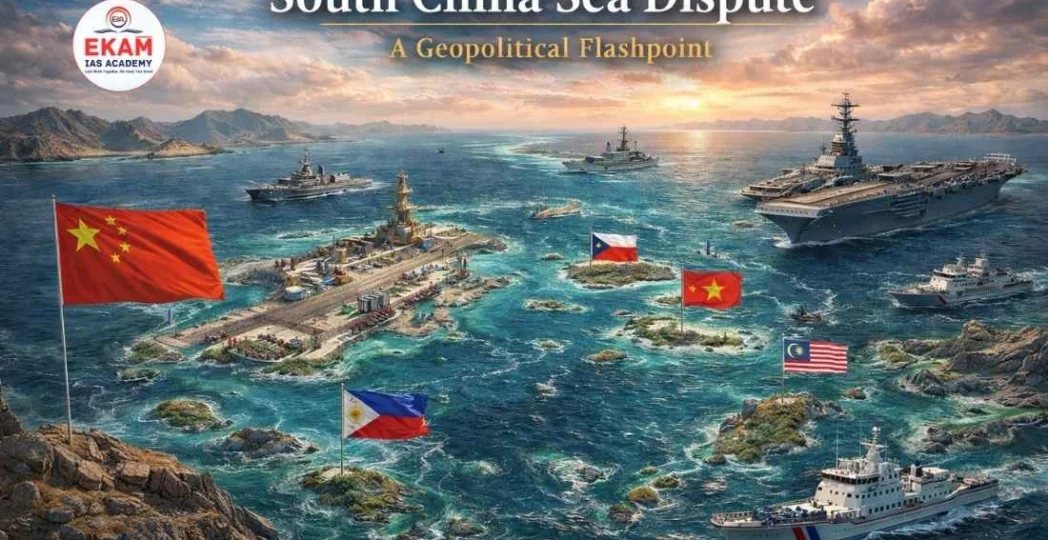
ToggleThe South China Sea (SCS) is a marginal sea of the Western Pacific Ocean, bordered by China, Taiwan, the Philippines, Vietnam, Malaysia, and Brunei. In recent years, it has transformed into a global flashpoint due to overlapping territorial claims and China’s aggressive maritime posturing. For UPSC aspirants, understanding the SCS is vital as it sits at the heart of the Indo-Pacific construct.
Background: The Roots of Conflict
The dispute is rooted in historical and legal claims. The most contentious is China’s Nine-Dash Line, a U-shaped boundary first proposed in 1947 that claims nearly 90% of the sea.
- Historical Claims: China cites “ancient maritime rights,” while Vietnam claims sovereignty over the Paracel and Spratly Islands based on 17th-century administration.
- Geographical Proximity: The Philippines and Malaysia base their claims on proximity and the legal framework of Exclusive Economic Zones (EEZ).
Key Stakeholders
- Claimants: China, Vietnam, Philippines, Malaysia, Brunei, and Taiwan.
- Non-Claimant Players: * United States: Focuses on Freedom of Navigation Operations (FONOPS).
- ASEAN: Seeks a legally binding Code of Conduct (CoC).
- India: Interested in a rules-based international order and trade security.
Strategic and Economic Importance
The SCS is one of thost vital waterways in the world:
- Trade Route: Over one-third of global shippe ming passes through this region.
- Natural Resources: Estimates suggest 11 billion barrels of oil and 190 trillion cubic feet of natural gas reserves.
- Fisheries: The sea accounts for roughly 10% of the global fisheries catch, essential for regional food security.
Recent Developments (2024-25)
- Aggressive Posturing: Frequent clashes between the Chinese Coast Guard and Filipino vessels near the Second Thomas Shoal and Scarborough Shoal.
- Militarization: China has converted reefs into artificial islands, equipping them with airstrips, radar, and missile systems.
- Mini-lateralism: Growth of the SQUAD (US-Japan-Australia-Philippines) to counter Chinese dominance.
Legal Aspects and UNCLOS
The United Nations Convention on the Law of the Sea (UNCLOS) defines the rights and responsibilities of nations regarding the use of oceans.
- 2016 PCA Ruling: The Permanent Court of Arbitration (The Hague) ruled in favor of the Philippines, stating China’s Nine-Dash Line has no legal basis.
- China’s Response: Beijing rejected the ruling as “null and void,” highlighting the lack of an enforcement mechanism in international law.
Impact on Global Stability
- Indo-Pacific Security: The dispute threatens the Free and Open Indo-Pacific (FOIP) concept.
- Arms Race: Increased military spending by ASEAN nations and frequent US-China naval face-offs raise the risk of unintended escalation.
India’s Interests and Role
India’s stance has evolved from “Look East” to “Act East”:
- Economic Stakes: Nearly 55% of India’s trade with the Indo-Pacific passes through the SCS.
- Energy Security: ONGC Videsh has oil exploration projects in Vietnam’s EEZ, which China frequently protests.
- Strategic Role: India supports UNCLOS and has increased naval cooperation with the Philippines (e.g., BrahMos missile deal) and Vietnam.
Challenges and Risks
- ASEAN Centrality: Internal divisions within ASEAN (e.g., Cambodia/Laos being pro-China) prevent a unified stance.
- Grey Zone Tactics: China uses fishing militias and “swarming” tactics that fall just below the threshold of open warfare.
Way Forward
- Binding Code of Conduct: Transitioning the 2002 Declaration into a legally binding Code of Conduct (CoC).
- Multilateralism: Strengthening forums like the Quad and ASEAN Outlook on the Indo-Pacific (AOIP).
- Legal Compliance: Encouraging all parties to respect the 2016 Arbitral Award.
Conclusion
The South China Sea Dispute is not merely a regional territorial row but a test for the global rules-based order. For India, a stable and open SCS is indispensable for its maritime security and economic aspirations.
UPSC Prelims: PYQs & Practice Questions
Previous Year Questions (Prelims)
Q1. [UPSC CSE Prelims 2022]
Q: Which of the following statements best reflects the issue with Senkaku Islands, sometimes mentioned in the news?
(a) It is generally believed that they are artificial islands made by a country around South China Sea.
(b) China and Japan engage in maritime disputes over these islands in East China Sea.
(c) A permanent American military base has been set up there to help Taiwan.
(d) Though International Court of Justice declared them as no man's land, some South-East Asian countries claim them.
Answer: (b) China and Japan engage in maritime disputes over these islands in East China Sea
Explanation:
The Senkaku Islands, known as Diaoyu in China, are located in the East China Sea and are a major point of maritime dispute between China and Japan. They are not artificial islands in the South China Sea, nor have they been declared no man’s land by the International Court of Justice. This issue reflects the wider pattern of strategic maritime competition involving China in East Asia.
Q: Which of the following countries are claimants in the South China Sea dispute?
1. China
2. Vietnam
3. Thailand
4. Philippines
5. Malaysia
(a) 1, 2, and 4 only
(b) 1, 2, 4, and 5 only
(c) 1, 3, 4, and 5 only
(d) All of the above
Answer: (b) 1, 2, 4, and 5 only
Explanation:
Thailand is not a direct territorial claimant in the South China Sea dispute. The principal claimants include China, Taiwan, Vietnam, the Philippines, Malaysia, and Brunei. Therefore, among the options listed, China, Vietnam, the Philippines, and Malaysia are correct.
Practice Questions
Q1.
Q: With reference to the 'Nine-Dash Line', consider the following statements:
1. It was originally an eleven-dash line proposed in 1947.
2. The 2016 Permanent Court of Arbitration (PCA) ruling upheld its legal validity under UNCLOS.
Which of the statements given above is/are correct?
(a) 1 only
(b) 2 only
(c) Both 1 and 2
(d) Neither 1 nor 2
Answer: (a) 1 only
Explanation:
Statement 1 is correct because the claim line was originally shown as an eleven-dash line by the Republic of China in 1947, before later being modified into the nine-dash line. Statement 2 is incorrect because the 2016 Permanent Court of Arbitration ruling clearly held that China’s historic rights claim under the Nine-Dash Line had no legal basis under UNCLOS.
UPSC Mains – Previous Year & Practice Questions
Mains Previous Year Questions
Question: What is the significance of the South China Sea for India’s energy security and freedom of navigation?
Question: The newly tri-nation partnership AUKUS is aimed at countering China’s ambitions in the Indo-Pacific region. Is it going to supersede the existing partnerships in the region? Discuss.
Question: China’s aggressive posturing in the South China Sea is a direct challenge to the rules-based international order. Comment.
Question: Evaluate the role of ASEAN in resolving the South China Sea dispute. Why has the Code of Conduct (CoC) been delayed for decades?
Question: Discuss the strategic importance of the Indo-Pacific region for India, particularly in the context of maritime security and the Act East Policy.
Mains Practice Questions
Q1. [15 Marks | 250 Words]
Question: "The South China Sea is not just a territorial dispute but a 'litmus test' for the effectiveness of UNCLOS in the 21st century." Analyze.
Q2. [10 Marks | 150 Words]
Question: Examine the impact of China's 'Grey Zone' tactics and land reclamation in the Spratly and Paracel Islands on regional stability.
Q3. [15 Marks | 250 Words]
Question: "With over 55% of its trade passing through the South China Sea, India can no longer remain a passive observer." Discuss India’s strategic options in the region.