Table of Contents
ToggleThe atmosphere is a deep blanket of gases that entirely envelops the earth. It is an integral part of the earth’s planetary system, held in place by gravitational attraction. Without it, life as we know it would not exist, as it provides the air we breathe and shields us from harmful solar radiation.
Composition of the Atmosphere
The atmosphere is a mixture of many gases, water vapour, and dust particles. While the proportion of gases changes in the higher layers, the composition in the lower layers is remarkably constant.
A. Permanent Gases of the Atmosphere
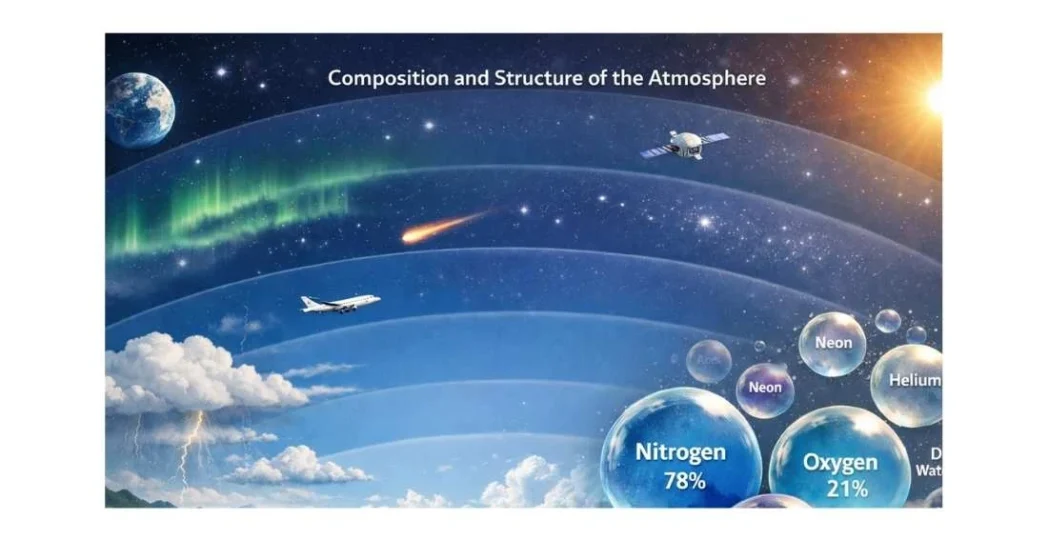
The atmosphere is composed almost entirely of Nitrogen and Oxygen. Together, they make up about 99% of the clean, dry air.
| Gas | Percentage (by Volume) | Significance for UPSC |
| Nitrogen (N2) | 78.08% | Essential for protein synthesis in plants; dilutes oxygen to prevent rapid burning. |
| Oxygen (O2) | 20.95% | The “life-giver”; essential for respiration and combustion. |
| Argon (Ar) | 0.93% | An inert gas; the third most abundant gas. |
| Carbon Dioxide (CO2) | 0.036% | A Greenhouse Gas (GHG); transparent to incoming solar radiation but opaque to outgoing terrestrial radiation. |
| Neon, Helium, Krypton, Xenon | Traces | Minor noble gases. |
B. Variable Components
- Carbon Dioxide (CO2): Though present in small amounts, it is meteorologically very important. It absorbs a part of terrestrial radiation and reflects it back toward the earth’s surface, creating the Greenhouse Effect. The increasing volume of CO2 due to fossil fuel burning is the primary driver of Global Warming.
- Water Vapour:
- It is a variable gas in the atmosphere, decreasing with altitude.
- In the warm and wet tropics, it may account for 4% of the air by volume, while in dry and cold areas (deserts/poles), it may be less than 1%.
- It acts as a blanket, allowing the earth neither to become too cold nor too hot.
3. Dust Particles (Aerosols):
- The atmosphere has a sufficient capacity to keep small solid particles, which may originate from sea salts, fine soil, smoke-soot, ash, pollen, and disintegrated particles of meteors.
- Hygroscopic Nuclei: Dust particles act as nuclei around which water vapour condenses to form clouds.
- They are responsible for the scattering of light, which gives the sky its blue color and creates beautiful sunrises and sunsets.
Structure of the Atmosphere
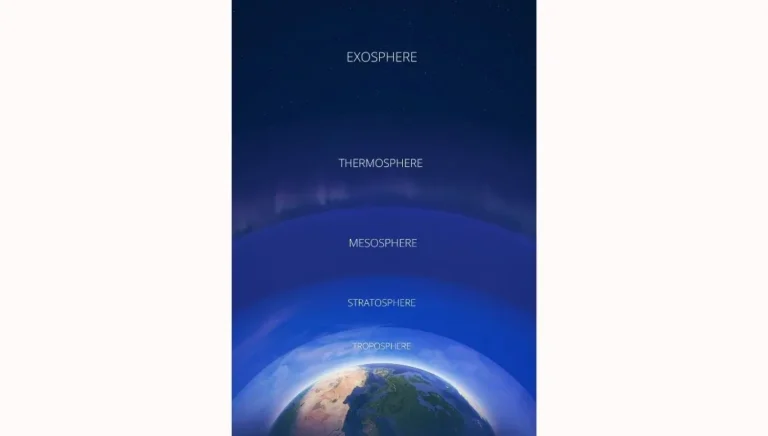
The atmosphere consists of different layers with varying density and temperature. Density is highest near the surface of the earth and decreases with increasing altitude.
I. Troposphere
- Altitude: It is the lowermost layer. Its average height is 13 km (roughly 8 km near the poles and 18 km at the equator).
- Thickness: The thickness is greatest at the equator because heat is transported to great heights by strong convectional currents.
- Normal Lapse Rate: Temperature decreases with height at a rate of 6.5°C per 1,000 m.
- Significance: This is the most important layer for all biological activity. All weather phenomena (rainfall, fog, hailstorms) occur here.
- Tropopause: The zone separating the troposphere from the stratosphere.
II. Stratosphere
- Altitude: Found above the tropopause and extends up to a height of 50 km.
- Temperature: The temperature remains constant for some distance and then increases due to the presence of Ozone.
- Ozonosphere: Contains the Ozone Layer, which absorbs Ultra-violet (UV) radiation from the sun, shielding life on earth from intense energy.
- Flight Conditions: This layer is free from clouds and associated weather phenomena, making it ideal for flying jet aircraft.
III. Mesosphere
- Altitude: Extends up to 80 km.
- Temperature: Temperature once again starts decreasing with increase in altitude, reaching minus 100°C at 80 km.
- Meteors: Most meteors burn up in this layer upon entering from space.
IV. Thermosphere (Ionosphere)
- Altitude: Extends between 80 and 400 km.
- Ionization: It contains electrically charged particles known as ions, hence it is known as the Ionosphere.
- Radio Communication: This layer reflects radio waves back to the earth, facilitating wireless communication.
- Auroras: The Aurora Borealis (Northern Lights) and Aurora Australis (Southern Lights) occur in this layer.
V. Exosphere
- Altitude: The uppermost layer of the atmosphere.
- Composition: Gases are very sparse here. Light gases like Helium and Hydrogen float into space from here. It gradually merges with outer space.
Key Concepts for UPSC Mains
The Greenhouse Effect and Global Warming
While the greenhouse effect is a natural process necessary for life, the anthropogenic increase in GHGs (CO2, Methane, Nitrous Oxide) is leading to Global Warming. Aspirants should link this to international agreements like the Paris Agreement and Kyoto Protocol.
Scattering of Light
Scattering occurs when light molecules or particles in the atmosphere intercept and redirect solar radiation.
- Rayleigh Scattering: Responsible for the blue sky.
- Mie Scattering: Occurs when particles are large (like water droplets), making clouds appear white.
UPSC Prelims: PYQs & Practice Questions
Previous Year Questions (PYQs)
Question 1 (2011)
Q: The jet aircraft fly very easily and smoothly in the lower stratosphere. What could be the appropriate explanation?
1. There are no clouds or water vapour in the lower stratosphere.
2. There are no vertical winds in the lower stratosphere.
Which of the statements given above is/are correct in this context?
(a) 1 only
(b) 2 only
(c) Both 1 and 2
(d) Neither 1 nor 2
Answer: (c) Both 1 and 2
Explanation: The Stratosphere is almost completely free from clouds and weather disturbances. Additionally, it lacks strong convectional currents (vertical winds) that are present in the troposphere. This provides a stable and smooth environment for high-speed jet aircraft travel.
Question 2 (Generic UPSC Pattern)
Q: Which one of the following is the correct sequence of the layers of the atmosphere as one moves upwards from the Earth's surface?
(a) Troposphere, Stratosphere, Mesosphere, Thermosphere
(b) Stratosphere, Troposphere, Mesosphere, Thermosphere
(c) Troposphere, Mesosphere, Stratosphere, Thermosphere
(d) None of the above
Answer: (a)
Explanation: Based on temperature trends and altitude variation, the correct order from the Earth's surface upward is: Troposphere (lowermost layer), Stratosphere, Mesosphere, and Thermosphere (which includes the Ionosphere). Each layer is distinguished by characteristic temperature changes and atmospheric composition.
Practice Questions (Prelims)
Question 1
Q: Consider the following statements regarding Carbon Dioxide (CO2) in the atmosphere:
1. It is transparent to incoming solar radiation but opaque to outgoing terrestrial radiation.
2. It is found only up to an altitude of 90 km from the earth's surface.
Which of the statements given above is/are correct?
(a) 1 only
(b) 2 only
(c) Both 1 and 2
(d) Neither 1 nor 2
Answer: (c) Both 1 and 2
Explanation: Carbon Dioxide (CO2) acts as a greenhouse gas by trapping outgoing terrestrial radiation while allowing incoming solar radiation to pass through. According to NCERT, CO2 and Water Vapour are largely confined to about 90 km above the Earth's surface, whereas Oxygen becomes negligible beyond about 120 km.
Question 2
Q: With reference to the 'Ionosphere', consider the following statements:
1. It contains electrically charged particles that reflect radio waves back to earth.
2. Temperature in this layer decreases with increasing height.
Which of the statements given above is/are correct?
(a) 1 only
(b) 2 only
(c) Both 1 and 2
(d) Neither 1 nor 2
Answer: (a) 1 only
Explanation: The Ionosphere (part of the Thermosphere) contains ionized particles that reflect radio waves, enabling long-distance wireless communication. However, temperature increases rapidly with height in this layer due to absorption of intense solar radiation. Hence, Statement 2 is incorrect.
UPSC Mains – Previous Year & Practice Questions
Previous Year Questions (Mains)
Arctic vs Antarctic Ice Melt (2021)
Question: How do the melting of the Arctic ice and glaciers of the Antarctic differently affect the weather patterns and human activities on the Earth? Explain. (2021)
Link to Topic: Discuss how increased Greenhouse Gases (GHGs) alter atmospheric composition, leading to global warming and impacting the Cryosphere.
Significance of the Troposphere
Question: Troposphere is a very significant atmospheric layer that determines weather processes. How?
Focus: Normal Lapse Rate, concentration of Water Vapour, cloud formation, and convectional currents responsible for weather phenomena.
Ozone Depletion in the Stratosphere
Question: Discuss the causes and consequences of ozone depletion in the Stratosphere.
Focus: Role of CFCs, thinning of the Ozonosphere, and increased exposure to harmful UV radiation.
Structure of the Atmosphere
Question: Explain the structure of the atmosphere and its stratification based on temperature.
Focus: Detailed explanation of Troposphere, Stratosphere, Mesosphere, Thermosphere (Ionosphere), and Exosphere with temperature trends.
Role of Aerosols in Climate
Question: In what way do dust particles (Aerosols) influence the Earth’s climate?
Focus: Hygroscopic nuclei formation, scattering of light (Rayleigh & Mie), cloud formation, and Albedo effect.
Mains Practice Questions
Atmospheric Thickness: Equator vs Poles
Question: Why is the atmosphere's thickness greater at the Equator than at the Poles? Explain the geomorphological and climatic implications. (250 words)
Inversion of Temperature
Question: Account for the 'Inversion of Temperature' and its significance in local weather phenomena. (250 words)
Role of Water Vapour in the Atmosphere
Question: Examine the role of water vapour as the most significant variable gas in the atmosphere. (250 words)
Composition and Structure of the Atmosphere - FAQs
What is the 'Normal Lapse Rate'?
It is the rate at which temperature decreases with increasing altitude in the Troposphere. The average rate is 6.5°C per 1,000 meters (or 1°C for every 165 meters).
Why does temperature increase in the Stratosphere?
Temperature increases due to the presence of Ozone. Ozone molecules absorb Ultra-violet (UV) radiation from the sun, and this energy is converted into heat.
What are 'Hygroscopic Nuclei'?
These are tiny particles (like dust, salt, or smoke) that have an affinity for water. They provide a surface for Water Vapour to condense upon, which is the first step in the formation of clouds and rain.
Is the composition of the atmosphere the same everywhere?
The proportion of major gases (Nitrogen, Oxygen) is fairly constant up to about 80 km. However, variable gases like Water Vapour decrease rapidly from the equator to the poles and with height.
What is the significance of the Mesopause?
The Mesopause is the boundary at the top of the Mesosphere. It is known as the coldest place on Earth, with temperatures dropping as low as -100°C.