Table of Contents
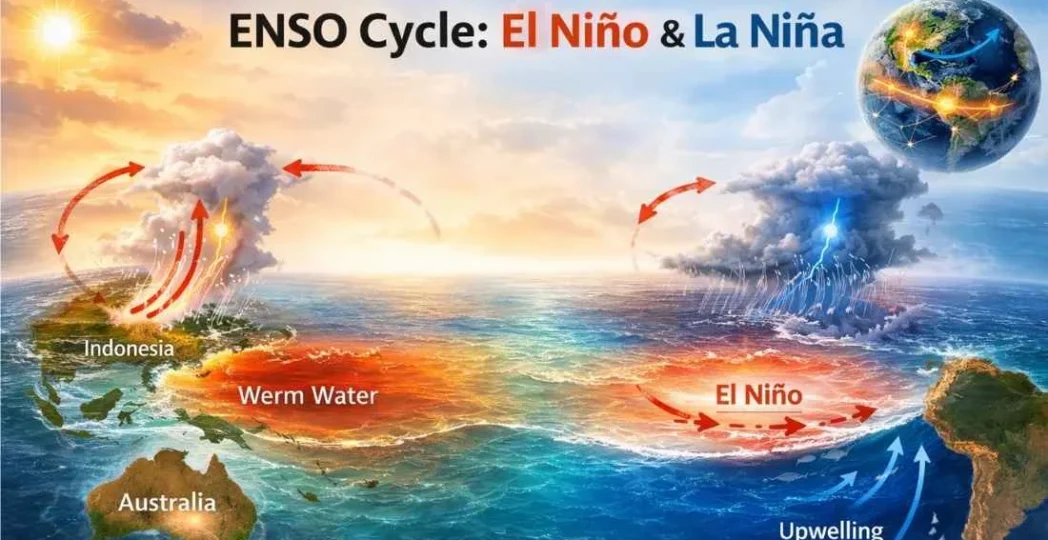
ToggleThe ENSO cycle is a periodic fluctuation in sea surface temperatures (SST) and the air pressure of the overlying atmosphere across the equatorial Pacific Ocean. It consists of two opposing phases—El Niño and La Niña—and a Neutral phase.
The Normal Conditions (Neutral Phase)
Under normal circumstances, the Pacific Ocean operates under the Walker Circulation:
- Trade Winds: Strong Tropical Easterly Trade Winds blow from East to West (from South America towards South-East Asia/Australia).
- Warm Pool: These winds push warm surface water toward the Western Pacific, creating a “warm pool” near Indonesia and Australia.
- Upwelling: In the Eastern Pacific (near Peru), cold, nutrient-rich water rises from the depths to replace the displaced surface water. This is known as Upwelling, which supports a rich fishing industry.
- Convection: The warm water in the West leads to low pressure and heavy convectional rainfall in Northern Australia and Indonesia.
El Niño: The Warm Phase
El Niño (Spanish for “The Boy Child”) refers to the unusual warming of surface waters in the eastern tropical Pacific Ocean.
Mechanism of El Niño
- Weakening of Trade Winds: For reasons still being studied, the Trade Winds weaken or even reverse direction.
- Eastward Shift of Warm Water: The warm water “pool” that was in the West slides back toward the central and eastern Pacific (towards the coast of Peru).
- Suppression of Upwelling: The arrival of warm water stops the upwelling of cold water near Peru. This results in a drastic decline in fish populations.
- Atmospheric Reversal: The area of low pressure and rainfall shifts from the Western Pacific to the Central/Eastern Pacific.
Global Impacts of El Niño
- South America: Heavy rains and flooding in Peru and Ecuador.
- Australia/Indonesia: Severe droughts and bushfires due to the suppression of rainfall.
- Indian Monsoon: Historically, El Niño is strongly correlated with poor monsoons and droughts in India.
La Niña: The Cold Phase
La Niña (Spanish for “The Girl Child”) is often described as the “anti-El Niño” or a transition back to normal conditions, but in an exaggerated way.
Mechanism of La Niña
- Intensification of Trade Winds: The Trade Winds become exceptionally strong.
- Accumulation of Warm Water: More warm water than usual is pushed toward the Western Pacific.
- Enhanced Upwelling: Cold water upwelling in the Eastern Pacific is intensified, leading to below-average sea surface temperatures.
Global Impacts of La Niña
- Australia/S.E. Asia: Catastrophic flooding and intense cyclonic activity.
- South America: Extreme drought in Peru and Chile.
- Indian Monsoon: Generally associated with above-normal rainfall and a “good” monsoon year in India.
The Southern Oscillation (SO)
While El Niño/La Niña refers to oceanic changes, the Southern Oscillation refers to atmospheric pressure changes. They are two sides of the same coin, hence the term ENSO.
- SOI (Southern Oscillation Index): Measured as the pressure difference between Tahiti (Central Pacific) and Darwin (Northern Australia).
- Negative SOI: Lower pressure at Tahiti, Higher at Darwin = El Niño.
- Positive SOI: Higher pressure at Tahiti, Lower at Darwin = La Niña.
Significance for the Indian Monsoon
For UPSC Mains, you must analyze the relationship between ENSO and India:
- The El Niño Effect: When El Niño occurs, the Walker Circulation shifts eastward. This interferes with the low-pressure system over the Tibetan Plateau, weakening the moisture-laden winds coming from the Indian Ocean, often leading to monsoon failure.
- The Indian Ocean Dipole (IOD): Sometimes, a “Positive IOD” (warmer Western Indian Ocean) can negate the drought-inducing effects of El Niño, leading to a normal monsoon despite the Pacific warming.
ENSO and Climate Change
Recent studies suggest that as the planet warms, the frequency and intensity of “Extreme El Niño” and “Extreme La Niña” events may increase. This leads to:
- Extreme Weather Events: Unpredictable cycles of floods and droughts.
- Coral Bleaching: Massive die-offs of coral reefs in the Pacific due to sustained high temperatures.
- Food Insecurity: Global agricultural yields are highly sensitive to ENSO-driven rain patterns.
UPSC Prelims: PYQs & Practice Questions
Previous Year Questions (PYQs)
1. With reference to ‘Indian Ocean Dipole (IOD)’, consider the following statements: (2017)
Q:
1. IOD phenomenon is characterized by a difference in sea surface temperature between tropical Western Indian Ocean and tropical Eastern Pacific Ocean.
2. An IOD phenomenon can influence an El Niño’s impact on the monsoon.
Which of the statements given above is/are correct?
(a) 1 only
(b) 2 only
(c) Both 1 and 2
(d) Neither 1 nor 2
Answer: (b) 2 only
Explanation: Statement 1 is incorrect because IOD is a temperature difference within the Indian Ocean (Western vs. Eastern), not the Pacific. Statement 2 is correct because a Positive IOD can often mitigate the drought-inducing effects of an El Niño, leading to a better monsoon for India.
2. Which of the following is the most likely cause of a 'Negative SOI' (Southern Oscillation Index)? (Conceptual Theme)
Q:
(a) La Niña
(b) El Niño
(c) Normal Walker Circulation
(d) Western Disturbances
Answer: (b) El Niño
Explanation: The SOI is the pressure difference between Tahiti and Darwin. During El Niño, pressure at Tahiti (Central Pacific) is low and pressure at Darwin (Australia) is high. This creates a Negative Index, signifying the weakening of the Trade Winds.
Practice Questions (Prelims)
Question 1
Q: During a La Niña event, which of the following is most likely to occur?
1. Stronger than average Trade Winds.
2. Increased upwelling of cold water off the coast of Peru.
3. Severe drought in Indonesia and Northern Australia.
(a) 1 and 2 only
(b) 2 and 3 only
(c) 1 and 3 only
(d) 1, 2, and 3
Answer: (a) 1 and 2 only
Explanation: Statements 1 and 2 are correct because La Niña strengthens trade winds and enhances cold upwelling near Peru. Statement 3 is incorrect because La Niña generally brings heavier rainfall and flooding to Indonesia and Northern Australia, not drought.
Question 2
Q: Consider the term “Modoki” often associated with El Niño. What does it signify?
(a) A cyclone forming during an El Niño year.
(b) Warming of the Central Pacific instead of the Eastern Pacific.
(c) The cooling phase of the Mediterranean Sea.
(d) The impact of El Niño on the Polar Vortex.
Answer: (b)
Explanation: El Niño Modoki is a variation of El Niño where the maximum sea-surface temperature warming is centered in the Central Equatorial Pacific, rather than the Eastern Pacific near the South American coast.
UPSC Mains – Previous Year & Practice Questions
Previous Year Questions (Mains)
El Niño & Unusual Climatic Events (2014)
Question: “Most of the unusual climatic happenings are explained as an outcome of the El-Niño effect. Do you agree?”
Focus: Discuss global teleconnections—floods in Peru, droughts in India and Australia, and the impact on Atlantic hurricanes.
Indian Ocean Dipole (IOD) vs El Niño (General Theme)
Question: “How does the Indian Ocean Dipole (IOD) differ from El Niño and what is its impact on the Indian Monsoon?”
Focus: Compare the Indian and Pacific Ocean basins, and explain how a Positive IOD can offset monsoon deficits and support Indian agriculture.
La Niña: Mechanism & Global Effects (Standard Geography)
Question: “Explain the mechanism and global climatic effects of La Niña.”
Focus: Highlight the strengthening of the Walker Circulation and its cooling influence on global average temperatures.
Southern Oscillation Index (SOI) & Trade Winds (General Theme)
Question: “Discuss the relationship between the Southern Oscillation Index (SOI) and the strength of the Trade Winds.”
Focus: Explain how pressure differences between Tahiti and Darwin influence Pacific surface wind systems.
ENSO & Global Food Security (General Theme)
Question: “Assess the impact of ENSO on global food security.”
Focus: Link El Niño cycles to crop failures in India (rice, sugarcane) and Australia (wheat), and discuss implications for global supply chains.
Mains Practice Questions
Triple-Dip La Niña & Extreme Weather (Climate Change Context)
Question: “In the context of climate change, examine the phenomenon of ‘Triple-Dip La Niña’ and its impact on the frequency of extreme weather events.” (250 words)
Peruvian Coast as ‘Ground Zero’ for El Niño & Marine Economy
Question: “Analyze why the Peruvian coast is the ‘ground zero’ for El Niño and how it affects the global marine economy.” (250 words)
Why Some El Niños Don’t Cause Monsoon Failure in India
Question: “While El Niño is usually associated with drought in India, not all El Niños lead to monsoon failure. Discuss the atmospheric factors that can override the ENSO signal.” (250 words)
El Niño and La Niña : ENSO,Climate Shockwaves Across Continents - FAQs
What is the 'Thermocline' and how does it change during El Niño?
The Thermocline is the transition layer between warm surface water and cold deep water. During El Niño, the thermocline in the Eastern Pacific deepens, preventing cold water from upwelling. In La Niña, it becomes very shallow.
What are 'Teleconnections'?
In climatology, teleconnections refer to weather disturbances in one part of the world that are linked to changes thousands of miles away. For example, warming in the Pacific (El Niño) leads to a poor monsoon in India.
How often do El Niño and La Niña occur?
They occur every 2 to 7 years on average. El Niño typically lasts 9–12 months, while La Niña can sometimes persist for 1–3 years (Triple-dip).
Does El Niño affect the Atlantic Hurricane season?
Yes. El Niño typically suppresses Atlantic hurricanes by increasing vertical wind shear, which “tears apart” developing storms. La Niña, conversely, often leads to a more active Atlantic hurricane season.
What is the 'Walker Circulation'?
It is an East-West atmospheric circulation over the tropical Pacific. Air rises over the warm Western Pacific (low pressure) and sinks over the cold Eastern Pacific (high pressure).