Table of Contents
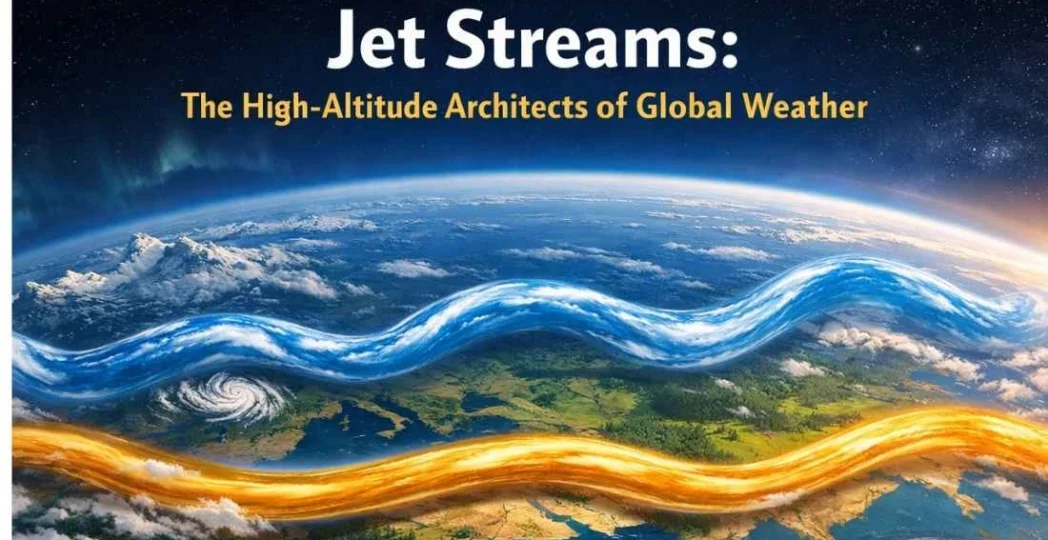
ToggleJet Streams are narrow bands of extremely strong winds in the upper troposphere (typically between 9 km and 15 km altitude). They follow a meandering path and travel at high speeds, usually from West to East.
Characteristics of Jet Streams
For the UPSC Prelims, it is essential to remember these specific physical traits:
- Velocity: Their speeds vary from 160 km/h in winter to about 110 km/h in summer. The velocity is highest in the core.
- Direction: They generally flow from West to East in both hemispheres due to the Coriolis Force.
- Path: They do not travel in a straight line; instead, they follow a “wavy” path known as Rossby Waves.
- Extent: They are typically a few hundred kilometers wide and only a few kilometers thick.
- Seasonality: They are stronger and move closer to the equator during the winter season because the temperature gradient between the poles and the equator is steepest then.
Why do Jet Streams Form?
The formation of a jet stream is driven by two primary factors:
The Temperature Gradient: The sharp contrast in temperature between cold polar air and warm tropical air.
Pressure Gradient Force (PGF): The temperature difference creates a steep pressure difference in the upper atmosphere.
Coriolis Force: As the air moves from high to low pressure, the Earth’s rotation deflects it, causing it to flow parallel to the isobars.
Types of Jet Streams
There are four permanent jet streams (two in each hemisphere), along with seasonal ones.
A. Polar Front Jet Stream
- Location: Found between 40° and 60° latitudes.
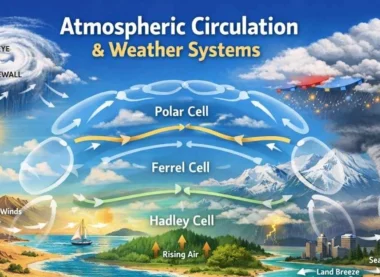
- Origin: Formed where the cold Polar Cell meets the warmer Ferrel Cell.
- Impact: It is responsible for the movement of Extra-tropical (Temperate) Cyclones and heavily influences the weather in Europe and North America.
B. Sub-tropical Westerly Jet Stream
- Location: Found between 25° and 35° latitudes.
- Origin: Formed at the boundary of the Hadley Cell and the Ferrel Cell.
- Indian Context: This jet stream plays a crucial role in bringing Western Disturbances to Northern India during the winter.
C. Tropical Easterly Jet Stream (Seasonal)
- Location: Typically forms over the Indian Peninsula and Africa during the Northern Hemisphere summer (June–August).
- Significance: It is unique because it flows from East to West. It is a major driver of the South-West Monsoon and helps in the formation of tropical depressions over the Bay of Bengal.
The Mechanism of Rossby Waves
Jet streams meander because of the Earth’s rotation and the distribution of landmasses.
- Meanders: These large-scale loops are called Rossby Waves.
- High and Low Pressure: The “crests” of these waves are associated with high-pressure ridges, while the “troughs” are associated with low-pressure systems.
- Cut-off Lows: Sometimes, a loop is pinched off from the main flow, leading to stagnant weather patterns (blocks), which can cause prolonged heatwaves or floods.
Significance of Jet Streams for India
This is the most critical section for UPSC Mains.
I. Winter Weather & Western Disturbances
During winter, the Sub-tropical Westerly Jet is bifurcated (split) by the Himalayan-Tibetan Highlands. The southern branch flows south of the Himalayas and brings Western Disturbances (shallow cyclonic depressions) from the Mediterranean. These are vital for Rabi crops, especially wheat.
II. The Burst of the Monsoon
In summer, as the sun moves north, the Sub-tropical Westerly Jet withdraws from the Indian plains and shifts north of the Himalayas. Its departure creates a vacuum that allows the South-West Monsoon to rush in. Simultaneously, the Tropical Easterly Jet develops, further strengthening the monsoon circulation.
Aviation and the Jet Stream
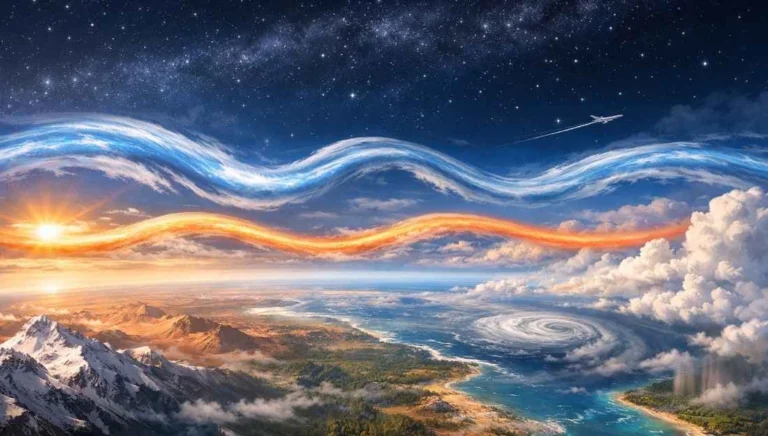
The discovery of jet streams occurred during World War II when pilots realized that flying with the wind significantly reduced travel time and fuel consumption, while flying against it was nearly impossible. Even today, airlines use the Jet Stream “Highways” to optimize flight paths.
Climate Change and Jet Streams
Recent research suggests that Arctic Amplification (the Arctic warming faster than the rest of the world) is reducing the temperature gradient between the poles and the tropics.
- Consequence: The jet stream is becoming “wavier” and slower.
- Result: This leads to “stuck” weather patterns, causing extreme weather events like the Polar Vortex in the US or record-breaking heatwaves in Siberia.
UPSC Prelims: PYQs & Practice Questions
Previous Year Questions (PYQs)
1. Consider the following statements: (2020)
Q:
1. Jet streams occur in the Northern Hemisphere only.
2. Only some cyclones develop an eye.
3. The temperature inside the eye of a cyclone is nearly 10°C lesser than that of the surroundings.
Which of the statements given above is/are correct?
(a) 1 only
(b) 2 and 3 only
(c) 2 only
(d) 1 and 3 only
Answer: (c) 2 only
Explanation: Jet streams exist in both hemispheres (Polar and Sub-tropical). The eye of a cyclone is actually warmer than the surroundings due to adiabatic warming of subsiding air. Only intense tropical cyclones develop a clear eye.
2. With reference to the Indian Ocean Dipole (IOD), which of the following statements is/are correct? (2017)
Q:
1. IOD phenomenon is characterised by a difference in sea surface temperature between tropical Western Indian Ocean and tropical Eastern Pacific Ocean.
2. An IOD phenomenon can influence an El Nino’s impact on the monsoon.
Select the correct answer:
(a) 1 only
(b) 2 only
(c) Both 1 and 2
(d) Neither 1 nor 2
Answer: (b) 2 only
Explanation: Statement 1 is wrong because IOD is the temperature difference between the Western and Eastern Indian Ocean (not Pacific). Statement 2 is correct; a positive IOD can reduce/offset the ill effects of El Nino on the Indian Monsoon, often linked to broader circulation changes including the Tropical Easterly Jet.
Practice Questions (Prelims)
Question 1
Q: Which of the following statements best describes “Rossby Waves”?
(a) High-frequency radio waves used in weather forecasting.
(b) Giant meanders in high-altitude winds like jet streams.
(c) Ocean currents found in the Arctic circle.
(d) Waves produced by underwater volcanic eruptions.
Answer: (b)
Explanation: Rossby Waves are large-scale horizontal meanders in the jet stream caused by the rotation of the Earth and the presence of mountain ranges/landmasses.
Question 2
Q: The “Bifurcation of the Jet Stream” over the Tibetan Plateau is primarily responsible for:
(a) The onset of the South-West Monsoon.
(b) The occurrence of Western Disturbances in North India.
(c) The formation of the “Loo” wind in summer.
(d) The development of Tropical Cyclones in the Arabian Sea.
Answer: (b)
Explanation: In winter, the Sub-tropical Westerly Jet is split by the Himalayas. The southern branch flows over North India, steering Western Disturbances into the region.
UPSC Mains – Previous Year & Practice Questions
Previous Year Questions (Mains)
Jet Stream & Indian Monsoon (General Theme)
Question: “How does the jet stream influence the Indian Monsoon? Explain.”
Focus: Discuss the shift of the Sub-tropical Westerly Jet to the north of the Himalayas and the birth of the Tropical Easterly Jet.
Polar Vortex & Jet Stream Fluctuations (Theme from 2014–15)
Question: “What is the ‘Polar Vortex’ and how is it related to the fluctuations of the Jet Stream?”
Focus: Discuss how a weak jet stream allows cold polar air to spill into mid-latitudes.
Western Disturbances & North Indian Climate (Theme from 2013)
Question: “Explain the role of Western Disturbances in the climate of Northern India.”
Focus: Link them to the Sub-tropical Westerly Jet and their importance for Rabi crops.
Jet Stream Formation & Global Heat Balance (Standard Geography)
Question: “Discuss the mechanism of Jet Stream formation and its role in global heat balance.”
Focus: Thermal gradient, Coriolis force, and heat transfer from tropics to poles.
Arctic Amplification & Jet Stream Stability (Current Affairs Link)
Question: “Critically examine the impact of Arctic Amplification on the stability of the Northern Hemisphere Jet Streams.”
Focus: How melting ice makes the jet stream “wavier” and slower.
Mains Practice Questions
Sub-tropical Westerly Jet as Monsoon Gatekeeper
Question: “The Sub-tropical Westerly Jet Stream acts as a 'gatekeeper' for the Indian Monsoon. Elaborate.” (250 words)
Polar Front Jet vs Sub-tropical Jet
Question: “Compare the characteristics of the Polar Front Jet and the Sub-tropical Jet. How do they differ in their seasonal migration?” (250 words)
Omega Block & Extreme Weather
Question: “Explain the ‘Omega Block’ phenomenon in atmospheric circulation and its consequences for extreme weather.” (250 words)
Jet Streams: The High-Altitude Architects of Global Weather - FAQs
Do jet streams blow at the surface of the Earth?
No. They are high-altitude winds found near the Tropopause (9–15 km high). However, they strongly influence the movement of surface weather systems like cyclones and fronts.
Why do jet streams move from West to East?
This is due to the Coriolis Force. Air moving from the warm equator toward the cold poles is deflected to the right in the Northern Hemisphere, resulting in a Westerly flow.
What is the 'Tropical Easterly Jet' (TEJ)?
Unlike the permanent westerly jets, the TEJ is a seasonal jet that forms over the Indian Peninsula in summer. It flows from East to West and is vital for directing monsoon depressions into India.
How does the Jet Stream affect flight times?
Pilots use the jet stream as a “tailwind” when flying from West to East (e.g., USA to Europe) to save fuel and time. Conversely, flying against it (East to West) takes longer and consumes more fuel.
What is 'Clear Air Turbulence' (CAT)?
CAT is sudden, severe turbulence occurring in cloudless regions at high altitudes, often caused by the high wind shear near the edges of a Jet Stream. It is invisible to radar and a major concern for aviation.