Table of Contents
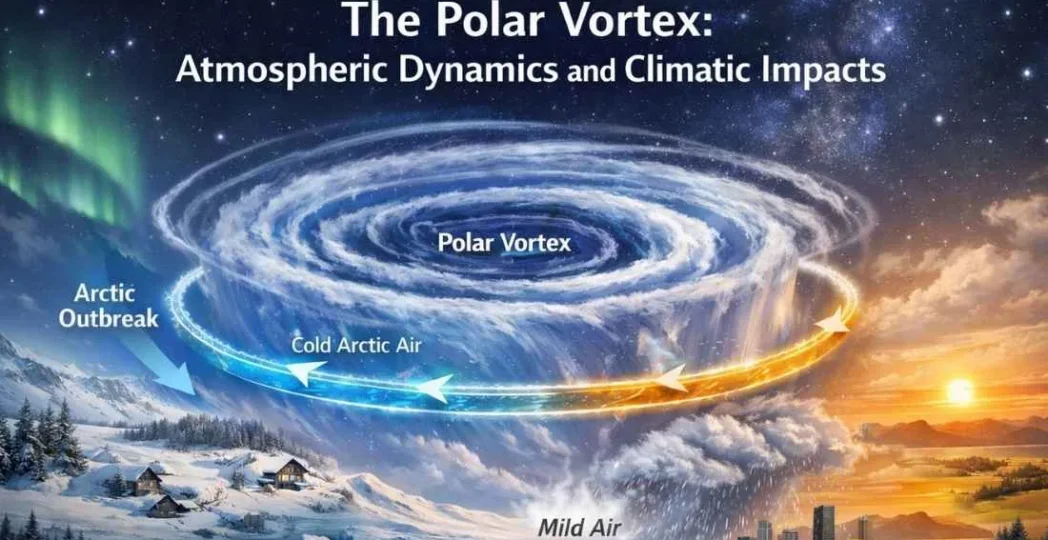
ToggleThe Polar Vortex is a large area of low pressure and extremely cold air surrounding both of the Earth’s poles. While it is a permanent atmospheric feature, its “wobbling” or weakening has profound impacts on mid-latitude weather, leading to the severe “Arctic outbreaks” seen in recent years.
Defining the Polar Vortex
Contrary to popular belief, the polar vortex is not a single storm. It is a persistent, large-scale cyclonic circulation in the middle and upper troposphere and the stratosphere.
- Structure: It is a wide expanse of swirling cold air that is strongest during the winter season.
- Direction: In the Northern Hemisphere, it rotates counter-clockwise (cyclonic).
- Components: It is held in place by the Polar Front Jet Stream, which acts as a boundary between the cold polar air and the warmer air of the mid-latitudes.
The Mechanism: How it Stays Stable
The stability of the vortex depends on the temperature gradient between the Arctic/Antarctic and the Tropics.
Strong Vortex (Stable): When the temperature difference is high, the Jet Stream is strong and travels in a relatively straight path. This keeps the cold air “locked” at the poles.
Weak Vortex (Unstable): When the Arctic warms, the temperature gradient decreases. The Jet Stream weakens and begins to meander in large loops known as Rossby Waves.
Sudden Stratospheric Warming (SSW)
This is a critical concept for UPSC Mains. Sudden Stratospheric Warming is a phenomenon where the polar stratosphere experiences a rapid increase in temperature (up to 50°C in a few days).
- The Process: Large-scale weather patterns in the lower atmosphere (troposphere) push energy upward into the stratosphere.
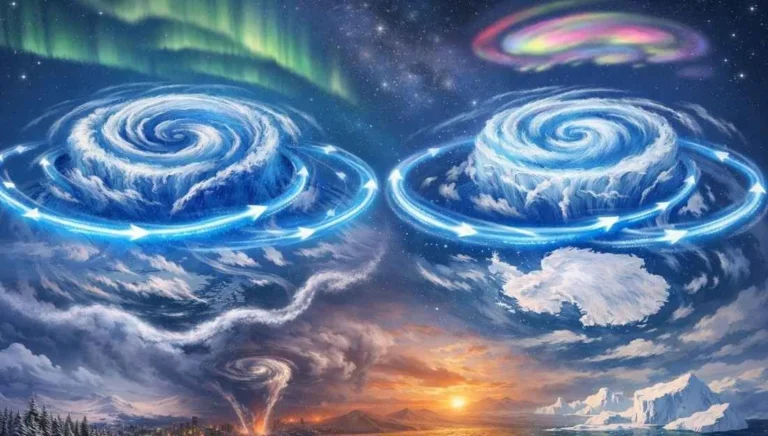
- The Result: This energy disrupts the vortex, causing it to shift off the pole or split into two or more “sister” vortices.
- Weather Impact: These smaller vortices migrate south, bringing record-breaking cold to the USA, Europe, and Asia.
Arctic Amplification and Climate Change
UPSC often asks about the “why” behind increasing extreme weather. Arctic Amplification is the phenomenon where the Arctic is warming at more than twice the global average rate.
- Albedo Effect: As sea ice melts, the dark ocean absorbs more heat, accelerating warming.
- Weakening the Barrier: This warming reduces the pressure difference between the pole and the mid-latitudes, making the Jet Stream “wavy” and prone to blocking patterns.
- Extreme Weather: This instability explains why we see “stuck” weather patterns—prolonged heatwaves in summer and extreme cold snaps in winter.
Difference Between Polar Vortex and a Cold Front
Aspirants must maintain technical accuracy in their answers:
- Polar Vortex: A high-altitude, planet-scale atmospheric feature located in the stratosphere and upper troposphere.
- Cold Front: A surface-level weather boundary where a cold air mass replaces a warm air mass. The southward dip of the polar vortex often drives the movement of these intense cold fronts.
Impact on the Southern Hemisphere (Antarctica)
The Southern Polar Vortex is generally stronger and more stable than its northern counterpart.
- Reason: Antarctica is a landmass surrounded by a vast, uninterrupted ocean. This lack of geographical “obstacles” allows the vortex to spin more consistently.
- Ozone Hole: The cold, isolated air within the southern vortex facilitates the formation of Polar Stratospheric Clouds (PSCs), which are the site of chemical reactions that lead to Ozone Depletion.
Significance for India
While India is a tropical country, the Polar Vortex indirectly affects our weather:
- Western Disturbances: A weak or wavy Northern Polar Vortex can push the Sub-tropical Westerly Jet Stream further south, increasing the frequency or intensity of Western Disturbances that bring rain to North India.
- Cold Waves: Intense intrusions of polar air into Central Asia can occasionally spill over as “cold waves” into the Indo-Gangetic plains.
UPSC Prelims: PYQs & Practice Questions
Previous Year Questions (PYQs)
1. Consider the following statements: (Conceptual Link to 2014–2015)
Q:
1. The Polar Vortex is a persistent, large-scale cyclone located near the Earth's poles.
2. It is strongest during the summer when the temperature contrast between the pole and the equator is highest.
Which of the statements given above is/are correct?
(a) 1 only
(b) 2 only
(c) Both 1 and 2
(d) Neither 1 nor 2
Answer: (a) 1 only
Explanation: Statement 1 is correct; the polar vortex is a large area of low pressure and cold air surrounding both of Earth’s poles. Statement 2 is incorrect because the polar vortex is strongest during winter, when the temperature gradient between the cold pole and warmer mid-latitudes is highest, strengthening the jet stream and the vortex.
2. Which of the following phenomena is most closely associated with the “waviness” of the Jet Stream and the southward intrusion of the Polar Vortex? (Generic UPSC Theme)
Q:
(a) El Niño Modoki
(b) Rossby Waves
(c) Walker Circulation
(d) Hadley Cell
Answer: (b) Rossby Waves
Explanation: Rossby Waves are large meanders in high-altitude westerlies. When these waves become highly amplified, they make the jet stream “wavier” and allow cold air linked to the polar vortex to plunge southward into mid-latitudes (e.g., North America, Europe, Northern Asia).
Practice Questions (Prelims)
Question 1
Q: With reference to the “Polar Vortex”, consider the following statements:
1. It is located in the upper troposphere and stratosphere.
2. A “Polar Vortex Breakdown” can lead to a phenomenon known as Sudden Stratospheric Warming (SSW).
3. It rotates clockwise in the Northern Hemisphere.
Which of the statements given above is/are correct?
(a) 1 and 2 only
(b) 2 and 3 only
(c) 1 and 3 only
(d) 1, 2, and 3
Answer: (a) 1 and 2 only
Explanation:
Statements 1 and 2 are correct. Statement 3 is incorrect: the Polar Vortex is a low-pressure cyclonic system,
so it rotates counter-clockwise in the Northern Hemisphere (and clockwise in the Southern Hemisphere).
UPSC Mains – Previous Year & Practice Questions
Previous Year Questions (Mains)
Polar Vortex & Jet Stream Fluctuations (General Theme)
Question: “What is the ‘Polar Vortex’ and how is it related to the fluctuations of the Jet Stream? Discuss its impact on the weather of mid-latitudes.”
Focus: Define the vortex, explain the role of Rossby Waves, and describe extreme cold waves in the US and Europe.
Arctic Amplification & Polar Vortex Stability (Current Affairs Link)
Question: “How does ‘Arctic Amplification’ influence the stability of the Polar Vortex?”
Focus: Discuss how rapid warming of the Arctic reduces the temperature gradient, making the vortex “wobbly.”
Sudden Stratospheric Warming (SSW) & Climate Impacts (General Theme)
Question: “Explain the phenomenon of ‘Sudden Stratospheric Warming’ (SSW) and its climatic consequences.”
Focus: Describe the upward movement of energy from the troposphere that disrupts the vortex.
Polar Vortex vs Blizzard vs Cold Front (Standard Practice)
Question: “The Polar Vortex is often confused with a ‘blizzard’ or a ‘cold front’. Clarify the differences.”
Focus: Distinguish between a high-altitude atmospheric circulation system and surface weather events.
Ozone Hole & Southern Polar Vortex Strength (General Theme)
Question: “Discuss the link between the ozone hole over Antarctica and the strength of the Southern Polar Vortex.”
Focus: Explain how a colder, stronger vortex traps air and facilitates chemical reactions that destroy ozone.
Mains Practice Questions
Polar Vortex “Wobbling” & Anthropogenic Climate Change
Question: “Analyze how the ‘wobbling’ of the Polar Vortex serves as evidence for Anthropogenic Climate Change.” (250 words)
Northern vs Southern Polar Vortex: Stability & Regional Impacts
Question: “Compare the Northern Polar Vortex with the Southern Polar Vortex in terms of stability and impact on regional climates.” (250 words)
Polar Vortex Intrusions: Energy Security & Agriculture
Question: “Examine the socio-economic implications of Polar Vortex intrusions on energy security and agriculture in the Northern Hemisphere.” (250 words)
The Polar Vortex: Atmospheric Dynamics & Global Climatic Impacts - FAQs
Is the Polar Vortex a new phenomenon?
No. The Polar Vortex has always existed. It is a permanent feature of Earth’s atmospheric circulation. It only makes “news” when it weakens and spills cold air into populated mid-latitude regions.
What is the difference between the Polar Vortex and the Jet Stream?
The Polar Vortex is the mass of cold air itself, spinning at the poles. The Jet Stream is the “ribbon” of high-speed wind that acts as a boundary, keeping the cold air trapped within the vortex.
Does the Polar Vortex affect India?
Directly, no. The Himalayas act as a massive physical barrier. However, a disrupted Polar Vortex can influence the Sub-tropical Westerly Jet, which may alter the frequency or intensity of Western Disturbances in North India.
What causes the Polar Vortex to "break"?
It is usually caused by Sudden Stratospheric Warming (SSW). When large-scale weather systems from the lower atmosphere (troposphere) push energy upward, they can warm the stratosphere rapidly, causing the vortex to split or shift.
Why is the Antarctic Polar Vortex stronger than the Arctic one?
The Southern Hemisphere has very little landmass at high latitudes. In the North, the presence of mountains (like the Rockies and Himalayas) and the contrast between land and sea create more “waves” that disturb the Arctic vortex, making it more prone to breaking.