
Table of Contents
ToggleWhy do many Indian graduates compare UPSC and MBA as career choices?
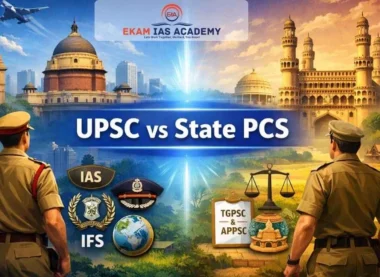
Among India’s most ambitious graduates, the debate between pursuing UPSC and an MBA from a top institute is a recurring and deeply personal one. Both paths lead to prestigious, rewarding careers but through very different journeys. At Ekam IAS Academy, the best IAS coaching in Hyderabad, we counsel hundreds of graduates — including many engineering and MBA pass-outs — every year who are making this exact decision.
What does a UPSC IAS career offer in terms of salary, power, and lifestyle?
The UPSC IAS career offers: unparalleled administrative power at district, state, and national levels; complete job security with a government pension; a salary of ₹56,100 at entry level rising to ₹2.25 lakh as Cabinet Secretary; significant perks including government accommodation, vehicles, staff, and healthcare; and most importantly, the unique ability to directly impact the lives of millions of citizens. An IAS District Collector administers a district of 1-5 million people — a responsibility no private sector job comes close to.
What does an MBA career offer in terms of pay and growth?
An MBA from IIM-A, B, or C leads to average starting salaries of ₹25-35 lakh per annum in consulting, finance, or management roles. The private sector offers faster early career growth in financial terms, more global exposure, and significant professional freedom. However, job security is lower, work hours are longer (especially in consulting and investment banking), and the societal impact is less direct.
How do UPSC and MBA careers compare in terms of job security and work-life balance?
The private sector offers faster financial growth but typically involves longer working hours and less job security compared to government service. In contrast, UPSC careers provide stability, authority, and long-term security.
What is the intangible value of becoming an IAS officer?
The most important consideration often overlooked: purpose and personality fit. People who are driven by public service, who want to make a difference to India’s development, and who value stability alongside authority are typically better suited to IAS.
Can someone pursue an MBA first and then attempt UPSC?
Many MBA graduates — particularly those who went to IIM or ISB for financial security but feel unfulfilled — return to UPSC preparation at Ekam IAS Academy in Hyderabad. Their analytical training from MBA actually makes them better UPSC candidates, especially for essay writing and GS Paper 3 Economy answers.
What are the UPSC age limit and attempt criteria?
The UPSC age limit for General category is 32 years (6 attempts), leaving plenty of time after an MBA.
Why do many MBA graduates join Ekam IAS Academy Hyderabad for UPSC preparation?
Ekam’s Weekend Coaching and Mentorship Program are ideal for working professionals and MBA graduates making this transition.