Table of Contents
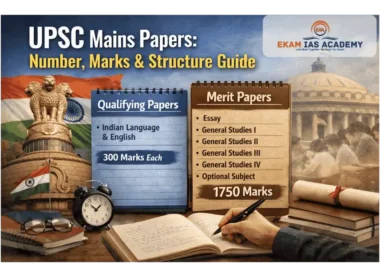
ToggleThe UPSC Civil Services Examination evaluates candidates not only on general awareness but also on intellectual depth and subject mastery. In this framework, the optional subject in UPSC Mains plays a decisive role by allowing aspirants to demonstrate specialised knowledge, analytical ability, and academic discipline. With 500 marks at stake, the optional subject can significantly influence a candidate’s final rank.
Understanding the role of optional subjects becomes particularly important for aspirants preparing through structured guidance such as IAS coaching in Hyderabad, where strategic decision-making is emphasised from the early stages of preparation.
Understanding Optional Subjects in UPSC Mains
What Is an Optional Subject?
In the Mains stage of the examination, candidates are required to choose one optional subject from a list prescribed by UPSC. The subject consists of two papers, each carrying 250 marks. Unlike General Studies, optional subjects allow aspirants to focus deeply on a single discipline, enabling greater conceptual clarity and answer sophistication.
Why Optional Subjects Carry Strategic Importance
High Weightage in Final Merit
Optional subjects together account for nearly one-third of the total Mains marks, making them one of the most influential components of the examination. Performance in the optional papers often becomes the differentiating factor between candidates clustered in similar General Studies score ranges.
This is why aspirants associated with the Best IAS Academy in Hyderabad are guided to treat optional selection as a long-term strategic decision rather than a short-term convenience.
Role of Optional Subjects in Rank Determination
Optional as a Performance Multiplier
A well-prepared optional subject can:
- Offset moderate performance in General Studies
- Enhance overall score consistency
- Improve chances of securing a higher service preference
Conversely, weak performance in the optional papers can negate otherwise strong GS scores.
Optional Subjects vs General Studies: A Conceptual Difference
Depth Versus Breadth
General Studies papers test a candidate’s ability to deal with diverse issues across governance, society, economy, and ethics. Optional subjects, on the other hand, assess:
- Depth of understanding
- Conceptual coherence
- Subject-specific analytical ability
This contrast is often highlighted during mentoring sessions conducted by Top UPSC Coaching in Hyderabad, where aspirants are trained to leverage the strengths of their chosen discipline.
Optional Subjects and Answer Writing Quality
Scope for Structured Excellence
Optional subjects offer a defined syllabus, allowing candidates to:
- Practice similar question themes repeatedly
- Develop standard frameworks and conceptual models
- Use diagrams, thinkers, and subject-specific terminology
Such predictability enhances scoring potential and reduces uncertainty compared to dynamic GS papers.
Choosing the Right Optional Subject
Key Considerations
An effective optional subject should align with:
- The candidate’s academic background or genuine interest
- Availability of quality resources and guidance
- Manageability alongside GS preparation
- Relevance to analytical writing skills
Most aspirants seek expert counselling at a UPSC Coaching Centre in Hyderabad before finalising their optional to avoid costly mistakes.
Role of Coaching in Optional Subject Preparation
Why Expert Guidance Matters
Optional subjects demand:
- Subject-specific expertise
- Regular answer evaluation
- Trend analysis of previous years’ questions
Institutions offering Best IAS Coaching Institute Hyderabad distinguish themselves by providing specialised faculty and structured optional programmes rather than generic coverage.
Role of Coaching in Optional Subject Preparation
Why Expert Guidance Matters
Optional subjects demand:
- Subject-specific expertise
- Regular answer evaluation
- Trend analysis of previous years’ questions
Institutions offering Best IAS Coaching Institute Hyderabad distinguish themselves by providing specialised faculty and structured optional programmes rather than generic coverage.
Optional Subjects and Preparation Stability
Reduced Syllabus Volatility
Unlike General Studies, optional subjects have:
- A relatively stable syllabus
- Recurrent conceptual themes
- Minimal dependence on daily current affairs
This stability allows aspirants to build confidence and consistency, especially when supported through UPSC online coaching Hyderabad with recorded lectures and structured revision plans.
Common Misconceptions About Optional Subjects
Clarifying Popular Myths
- No optional subject is inherently scoring or non-scoring
- Technical background does not guarantee higher marks
- Optional preparation cannot be postponed until after Prelims
These misconceptions are often addressed early in comprehensive UPSC prelims and mains foundation course programmes.
Optional Subjects and Interview Readiness
Optional subjects indirectly contribute to interview performance by:
- Improving conceptual articulation
- Enhancing confidence in academic discussions
- Helping candidates handle subject-related questions
Thus, the value of optional subjects extends beyond written marks.
Conclusion
The role of optional subjects in UPSC Mains is central to merit formation and rank differentiation. By testing depth, discipline, and analytical maturity, optional papers allow aspirants to stand out in a highly competitive examination.
A carefully chosen optional subject, supported by disciplined preparation and expert guidance from a reputed UPSC academy in Hyderabad, can become a decisive strength in the Civil Services Examination journey.
What Is the Role of Optional Subjects in UPSC Mains? - FAQs Answered
What is the role of optional subjects in UPSC Mains?
Optional subjects in UPSC Mains carry 500 marks and play a decisive role in rank determination by testing depth, analysis, and subject mastery.
How important is the optional subject for UPSC rank?
The optional subject can significantly improve overall rank as it contributes nearly one-third of the total Mains score.
Is the optional subject compulsory in UPSC Mains?
Yes, choosing an optional subject in UPSC Mains is mandatory for all candidates appearing in the written examination.
Are optional subjects more scoring than General Studies?
Optional subjects offer higher scoring potential due to a defined syllabus and greater scope for conceptual depth and answer quality.
When should optional subject preparation be started?
Optional subject preparation should ideally begin early and continue alongside General Studies for effective revision and mastery.